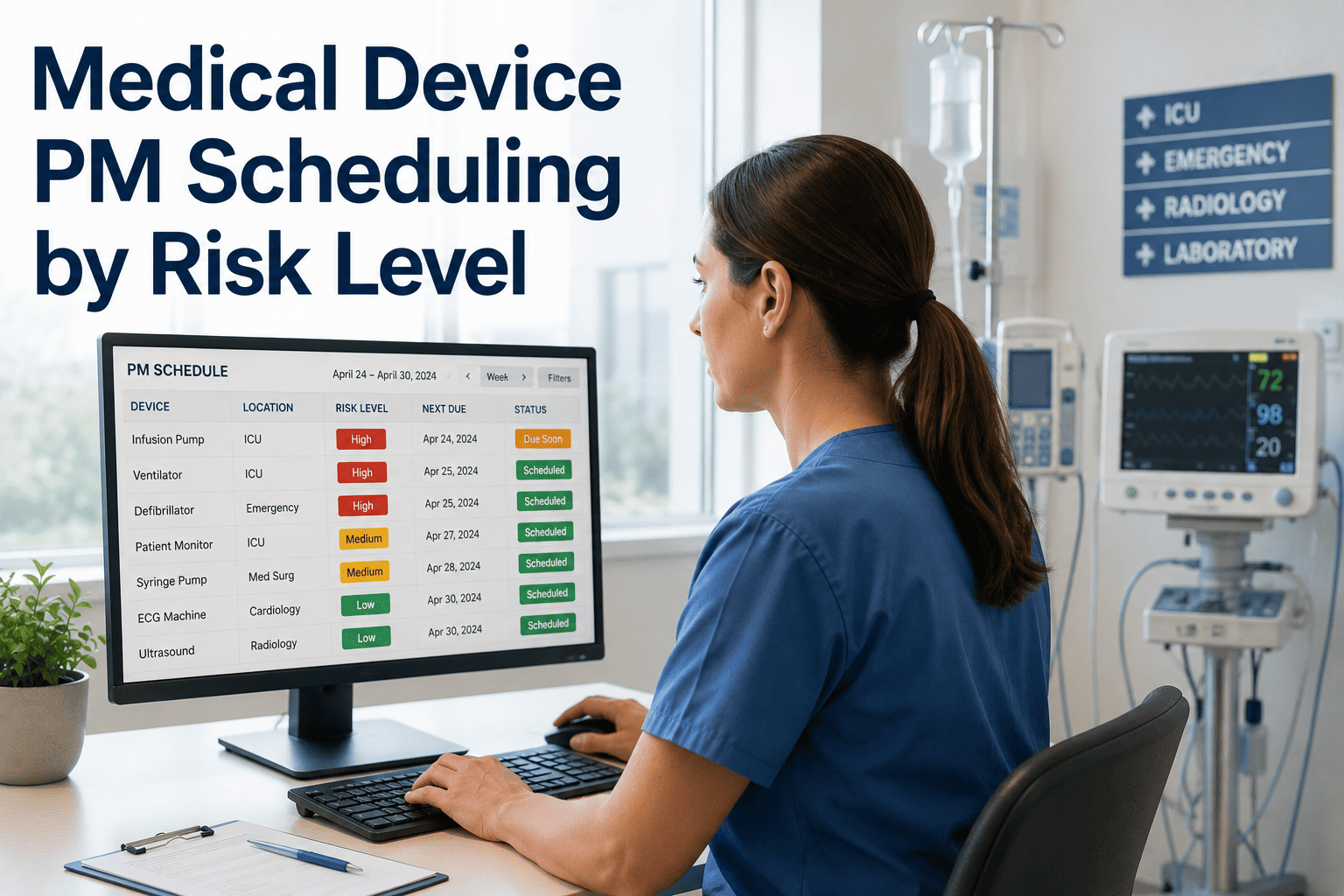
A ventilator running twenty-four hours a day in the ICU and an identical unit used twice a month in a clinic do not wear at the same rate — but a calendar-only schedule treats them as if they do. The heavily used device blows past its real service point weeks before the date on the spreadsheet comes due, while the idle one gets pulled for maintenance it has not yet earned. That is how hospitals miss PM windows: not from neglect, but from scheduling everything by a single fixed date instead of by how the device is actually used, how risky it is, what its manufacturer requires, and what the regulator demands. Risk-level PM scheduling reads all four signals and fires the work order on whichever comes due first. See how OxMaint Preventive Maintenance schedules by risk, usage, manufacturer guidance, and compliance. Book a demo to configure triggers for your device fleet.
Medical Device PM Scheduling by Risk Level
Stop scheduling every device by the same fixed date. Trigger PM by risk level, usage hours, manufacturer guidance, and compliance interval — whichever comes due first — so high-use, high-risk equipment is never serviced late.
Calendar-Only Misses the Devices That Matter Most
A fixed date is a useful baseline, but it is blind to how an individual device is actually being used and how much its failure would cost. That blind spot is where PM windows slip — and it slips worst on exactly the high-use, high-risk equipment you can least afford to lose.
Four Triggers, Whichever Fires First
Every device carries up to four independent triggers on its profile. The scheduler watches them all at once and generates the work order the instant any one of them comes due.
Built So a PM Window Can't Quietly Slip
Multi-trigger scheduling only helps if a miss can't hide. Three safeguards make sure the schedule fails loudly, never silently.
Compliance You Can Show the Surveyor
Joint Commission Environment of Care and Life Safety standards require documented evidence of scheduled maintenance, and facilities still on paper logs face a steep audit-failure risk. Multi-trigger PM both raises completion and produces the record automatically.
What Biomed Leaders Say
A ventilator that runs around the clock and one that sits in a closet cannot share a service date — and for years ours did, because the spreadsheet only knew months. The day the scheduler started counting run-hours, the heavy-use pumps finally got serviced on their real interval instead of a calendar guess. The early failures between dates stopped almost immediately.
Biomedical Equipment Manager · 17 Years Clinical EngineeringA surveyor wants documented proof the PM happened on schedule, and calendar-only looks perfect on paper right up until a high-use device fails early between its dates. Triggering on usage and risk — and auto-escalating any miss — is what makes the documentation actually true instead of just tidy. That difference is the whole audit.
Director of Clinical Engineering & Compliance · 20 Years Hospital HTMFrequently Asked Questions
How is this different from calendar-based PM?
Calendar PM fires on a fixed date and nothing else. Multi-trigger scheduling watches up to four signals on each device — risk level, usage hours, manufacturer interval, and compliance deadline — and generates the work order on whichever comes due first. The calendar is still there as a baseline; it is simply no longer the only thing that can trigger service. See the PM scheduler to compare the two side by side.
What signals can actually fire a PM?
Calendar intervals, runtime or usage hours, procedure and cycle counts, condition-score thresholds, the manufacturer's recommended interval, and a regulatory compliance deadline — configured per device and watched simultaneously. A single asset can hold several of these at once, which is what lets a heavily used pump and an idle backup of the same model follow completely different real-world schedules. Start free to set triggers per device.
Why does calendar-only miss high-use devices?
Because wear tracks usage, not the date. A ventilator running continuously reaches its real service point well before its annual date, so a date-only schedule lets it run past due — exactly the kind of gap that turns into an early failure. A usage trigger catches it at the run-hour threshold instead, which matters most on the highest-use biomedical equipment. See the PM scheduler to watch usage triggers fire.
What if a usage meter fails or the data is missing?
The calendar interval is the safety net. In a whichever-comes-first model, a missing or faulty meter reading simply means the date trigger fires on schedule, so the device still gets serviced. Usage data can pull a PM earlier, but it can never remove the underlying calendar floor — you get the benefit of usage tracking without the risk of relying on it alone. Start free to configure the fallback.
How does this keep us survey-ready?
Every completed PM auto-generates a timestamped, technician-signed record tied to the device, which is exactly the documented evidence of scheduled maintenance that Environment of Care and Life Safety surveys require. Facilities still on paper logs carry a high audit-failure risk precisely because that proof is hard to assemble on demand; here it is exportable instantly. See the PM scheduler to view the audit exports.
Does it respect our AEM program and manufacturer intervals?
Yes — high-risk equipment defaults to manufacturer-recommended intervals unless a formal alternative-equipment-maintenance program documents a different one, and the platform stores the PM completion and failure-rate evidence that program needs. You can run risk-based intervals where they are justified and stay on manufacturer guidance everywhere else, all on one schedule. Start free to align intervals to your program.
Schedule Every Device by What Actually Wears It Out
OxMaint triggers preventive maintenance on risk level, usage hours, manufacturer guidance, and compliance deadlines at once — firing on whichever comes first and escalating anything that slips — so your fleet stays serviced on time and your records stay survey-ready.