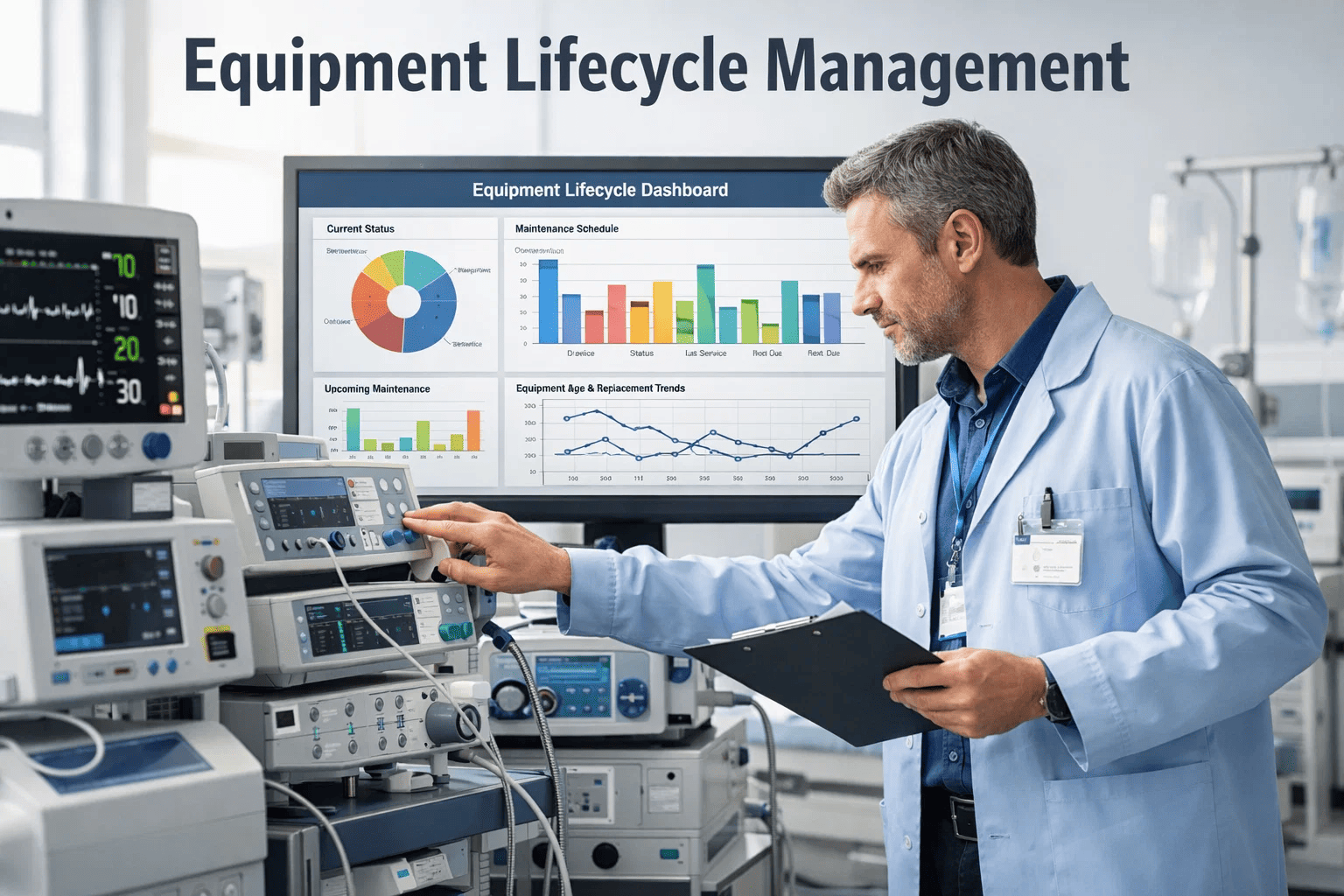
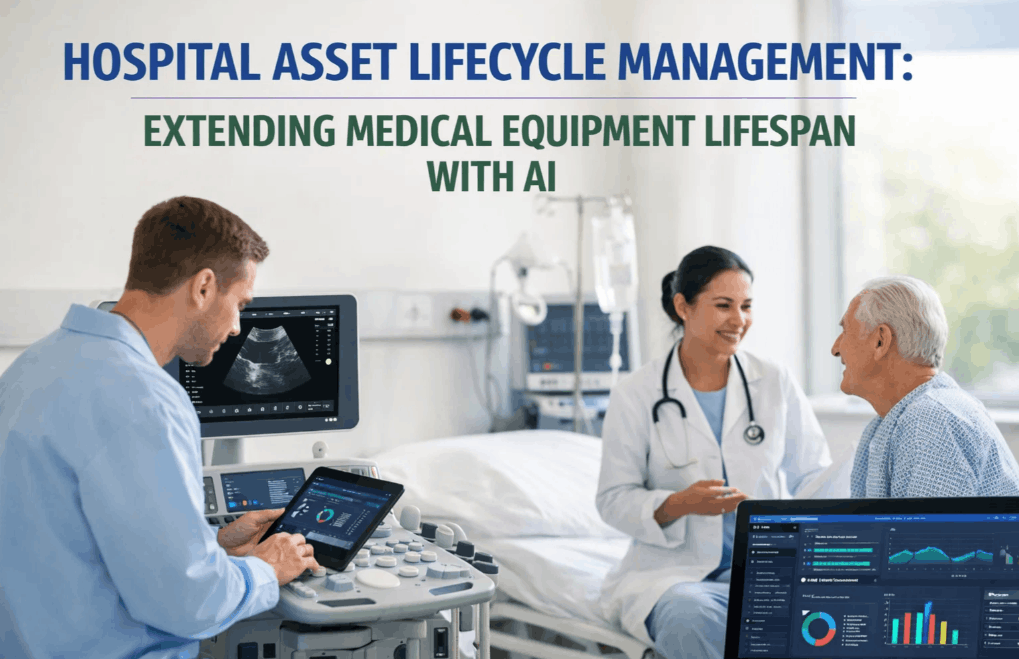
Medical Equipment Lifecycle Management: From Procurement to Disposal

By Jack Edwards on March 31, 2026

medical-equipment-lifecycle-management-procurement-disposal

Most hospitals don't discover their equipment lifecycle gaps during a routine review — they find them during a budget crisis, when a $280,000 MRI scanner fails unexpectedly because nobody tracked its service history or planned its replacement. A single unplanned equipment failure in a critical care unit costs 4.8x more than a scheduled replacement. This page is built for biomedical engineers, facility directors, and capital planning teams who want to move from reactive fire-fighting to data-driven lifecycle control. Want to see what structured lifecycle management looks like in practice? Start a free trial or book a demo to walk through a live capital forecasting workflow with our healthcare team.

Medical Equipment Lifecycle Management · 2026 Capital Planning Framework

From Procurement to Disposal:
The Complete Medical Equipment Lifecycle

A data-driven framework for biomedical engineers, facility directors, and CFOs to control total cost of ownership, predict replacement cycles, and eliminate surprise capital failures across every device in your portfolio.

4.8x
Higher cost of emergency equipment replacement vs. planned capital replacement
Healthcare facility management benchmark, 2024
68%
Of hospital CFOs report inaccurate equipment inventories impacting CapEx decisions
ASHE capital planning survey, 2025
$2.1M
Average annual equipment-related budget overspend in a 300-bed hospital
Healthcare operations analysis, 2025
35%
CapEx waste reduction achieved with structured 5-year lifecycle forecasting
Oxmaint healthcare client outcomes, 2025
The Core Framework

What Is Medical Equipment Lifecycle Management?

Medical equipment lifecycle management is the structured discipline of tracking, maintaining, and planning every device in a healthcare facility from the day it is purchased through the day it is decommissioned. It answers three questions that every biomedical engineer and finance director needs answered before budget season: what do we own, what condition is it in, and when does it need to be replaced?

Without a formal lifecycle framework, hospitals manage capital equipment reactively — replacing devices after they fail, not before. The result is unbudgeted emergency spend, clinical disruption, and compliance exposure when aging equipment fails during a survey or an active patient episode. If your team is making replacement decisions from memory rather than data, start a free trial to see what a structured lifecycle record looks like, or book a demo with our capital planning team.

Three Questions Lifecycle Management Answers
01
What do we own?
Complete asset registry with acquisition date, cost, location, and criticality tier
02
What condition is it in?
Real-time condition scoring tied to maintenance history and inspection outcomes
03
When does it need replacing?
5–10 year CapEx forecast model based on age, utilization, and failure patterns
The Lifecycle Phases

6 Phases Every Medical Device Goes Through

Each phase generates data that should feed your capital planning model. Most hospitals capture Phase 1 (procurement) and nothing else. Oxmaint captures all six — automatically.

01
Procurement & Commissioning
Purchase order, vendor, acquisition cost, warranty terms, and installation details enter the asset record. The clock on useful life and depreciation starts here. Most facilities capture this — and stop.
Data captured: Purchase price, warranty expiry, install date, location
02
Acceptance Testing & Baseline
Initial performance benchmarking and safety testing establish the baseline against which all future condition assessments are measured. Missing this creates a 100% gap in condition trending.
Data captured: Baseline performance metrics, safety certification, initial condition score
03
Active Use & Preventive Maintenance
The longest phase — and the richest data source. Every PM completion, work order, repair event, and parts replacement builds the history that drives replacement timing. 78% of lifecycle cost occurs here.
Data captured: PM records, repair frequency, downtime hours, parts spend, technician logs
04
Condition Monitoring & Trending
Ongoing inspection results and failure frequency are compared against the acceptance baseline. Condition scores trending downward beyond a threshold trigger replacement planning — before a failure occurs.
Data captured: Condition score trend, MTBF, failure mode frequency, inspection findings
05
End-of-Life Planning & CapEx Forecasting
Assets approaching end-of-useful-life enter the 5-year CapEx forecast. Replacement is budgeted 2–3 years ahead, eliminating emergency procurement premiums that average 22% above standard acquisition cost.
Data captured: Replacement cost estimate, procurement lead time, budget year, peer replacement trigger
06
Decommission, Disposal & Transfer
Formal retirement with documented disposal method, regulatory compliance for regulated devices (WEEE, biohazard), residual value recovery where applicable, and asset register update. The record closes — but the lifecycle data informs the next procurement decision.
Data captured: Disposal date, method, residual value, regulatory compliance record
TCO Framework

Total Cost of Ownership: What Most Hospitals Are Miscalculating

Purchase price is typically 30–40% of a device's true lifetime cost. The remainder — maintenance, downtime, parts, clinical disruption, compliance — is rarely tracked in the same system. Here is the full TCO model by device category.

Equipment Category Avg. Purchase Price Typical Useful Life Maint. as % of TCO Downtime Cost / Hour End-of-Life Signal
Imaging (MRI / CT) $500K–$3M 10–15 years 38–45% $3,000–$8,000 Repair cost >40% of replacement
Surgical Robotics $1M–$2.5M 8–12 years 42–50% $5,000–$12,000 OEM support withdrawal
Ventilators / ICU $20K–$80K 7–10 years 28–36% $800–$2,400 PM frequency >4x baseline
Infusion Pumps $2K–$8K 6–8 years 24–32% $200–$600 Alarm failure rate >5%
Patient Monitoring $5K–$40K 7–10 years 22–30% $400–$1,200 Connectivity / integration failure
Sterilization / CSSD $30K–$200K 12–18 years 35–42% $1,500–$4,000 Compliance cycle failure rate
Laboratory Analyzers $50K–$500K 8–12 years 30–38% $600–$3,000 Reagent discontinuation
Anesthesia Machines $40K–$150K 10–15 years 32–40% $2,000–$6,000 Parts availability <50% stocked

Tracking these figures in isolation provides limited value. The insight comes when purchase price, maintenance spend, downtime cost, and replacement timing are unified in a single asset record — which is what Oxmaint's lifecycle module delivers. Ready to build your TCO model? Start a free trial or book a demo and walk through a live TCO dashboard with our team.

Pain Points

8 Lifecycle Management Failures That Drive Budget Overruns

These are the recurring patterns found across hospitals that manage equipment reactively. Each one is a preventable cost — not an inevitable one.

01
No Condition Scoring System
Equipment condition assessed subjectively by individual technicians. No standardized scoring means no trend data, no early warning, and no defensible replacement rationale for the CFO.
02
Procurement Decisions Without Lifetime Cost Data
Capital decisions made on purchase price alone. Devices with lower acquisition cost but 3x higher maintenance burden are routinely selected because the lifetime cost model doesn't exist.
03
Warranty Expiry Not Tracked
Warranty periods lapse unnoticed. Teams pay for service calls that should be covered under manufacturer warranty — a recoverable cost that averages $45K annually in a 200-bed hospital.
04
Reactive Replacement Triggered by Failure
Equipment is replaced after failure — not before it. Emergency procurement adds an average 22% premium over planned acquisition, plus clinical disruption costs and patient safety exposure during the failure window.
05
No Spare Parts Correlation to Asset Age
Inventory managed by historical consumption, not by asset age profile. As equipment ages, spare parts demand increases — but without lifecycle data linked to inventory, stockouts coincide with peak failure periods.
06
Multi-Site Asset Data in Silos
Health systems with multiple campuses manage equipment data in disconnected systems. Portfolio-level replacement planning — and bulk procurement leverage — is impossible without consolidated lifecycle data.
07
Decommissioned Assets Still on Inventory
Retired devices remain in the asset register, inflating PM schedules, skewing cost data, and creating discrepancies that flag during TJC Environment of Care surveys. 12% of average hospital inventories contain phantom assets.
08
CapEx Requests Without Supporting Data
Biomedical engineers submit replacement requests based on professional judgment. Finance teams reject them without data. The cycle repeats until an expensive failure forces the decision — at 4.8x planned cost.
Before vs. After

Reactive Equipment Management vs. Oxmaint Lifecycle Control

The operational difference between these two states is not incremental — it's structural. One is managed by crisis; the other is managed by data.

Without Lifecycle Management
Replacement Trigger
Device failure or clinician complaint
CapEx Planning Horizon
12 months — annually updated guesswork
Condition Visibility
Technician memory — no standardized scoring
Procurement Premium
+22% emergency acquisition markup
Warranty Management
Manual tracking — average $45K/year missed
Multi-Site Visibility
Zero — each site managed independently
With Oxmaint Lifecycle Management
Replacement Trigger
Condition score threshold + cost-per-use model
CapEx Planning Horizon
Rolling 5–10 year forecast, asset-by-asset
Condition Visibility
Real-time score per device, trended over time
Procurement Premium
Standard pricing — planned 2–3 years ahead
Warranty Management
Automated alerts — zero missed coverage
Multi-Site Visibility
Portfolio dashboard — one view, all sites

The data advantage compounds over time. A 300-bed hospital running Oxmaint lifecycle management for 3 years has richer replacement data than a 1,000-bed system running spreadsheets for 20 years. Ready to make the shift? Start a free trial or book a demo with our capital planning team.

How Oxmaint Solves It

How Oxmaint Manages the Full Medical Equipment Lifecycle

Every feature in Oxmaint's asset management module is built around one goal: giving biomedical engineers and finance teams the data they need to make proactive, defensible equipment decisions — before failure forces their hand.

01
Full Asset Registry With Condition Scoring
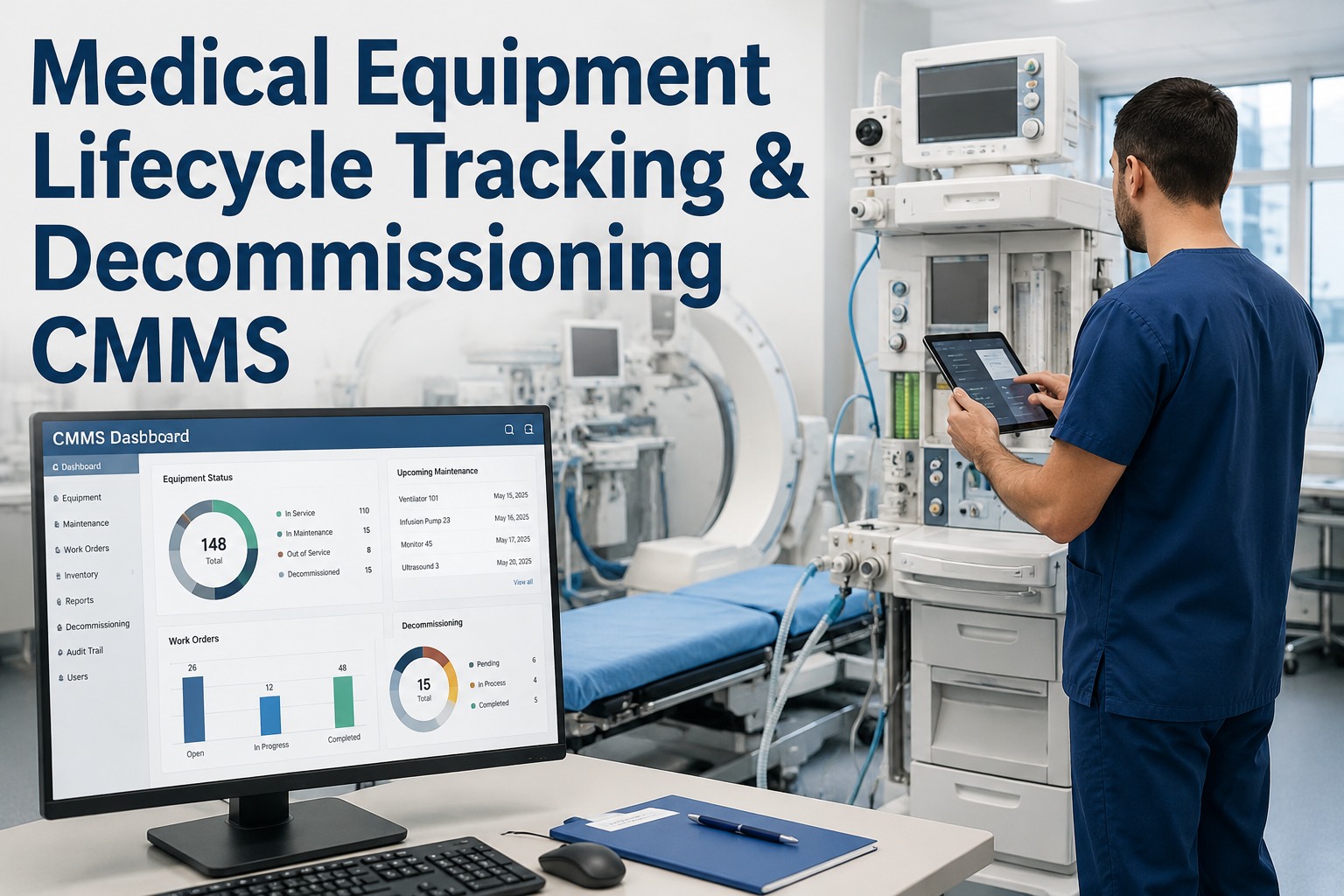
Every device in your portfolio lives in a structured record: acquisition date, purchase price, warranty terms, location, criticality tier, and a rolling condition score updated by every PM and inspection. Replace spreadsheet guesswork with a live, searchable source of truth.
02
Preventive Maintenance Tied to Asset Records
PM schedules are built into the asset record — not maintained separately. Every completed PM updates the device's condition score and maintenance cost total. When PM frequency starts climbing, the system flags it as a replacement signal before you ask.
03
Rolling 5–10 Year CapEx Forecasting
Generate a rolling capital replacement forecast by device category, building, or portfolio. Filter by replacement year, cost threshold, or condition tier. Walk into every budget cycle with a data model — not a wish list. Finance teams can trust the numbers because they see the asset data behind them.
04
Cost-Per-Use and Repair-vs-Replace Analysis
Track actual maintenance spend against acquisition cost over time. When cumulative repair cost on a device exceeds the replacement threshold you set — typically 40–60% of current acquisition cost — the system surfaces it for review. No more gut-feel repair-or-replace debates.
05
Warranty and Service Contract Tracking
Warranty expiry dates and service contract terms are stored on the asset record with automated alert windows. Stop paying for service calls covered by the manufacturer. Stop missing contract renewal windows that default to unfavorable pricing.
06
Mobile Inspections With Digital Condition Records
Biomedical technicians complete device inspections on mobile — with structured checklists, photo capture, pass/fail scoring, and digital signatures. Every inspection result is timestamped, linked to the asset record, and updates the condition score in real time.
07
Multi-Site Portfolio Visibility
Health systems operating across multiple campuses see a consolidated lifecycle dashboard — condition scores, CapEx forecasts, maintenance spend, and overdue PM counts — across every site in one view. Standardize lifecycle standards and leverage bulk procurement across the portfolio.
08
Decommission Workflow With Full Audit Record
Retirement isn't just removing a device from a spreadsheet. Oxmaint's decommission workflow captures disposal method, regulatory compliance documentation, residual value recovery, and formal record closure — satisfying TJC EC.02.04.01 and providing data for the next procurement decision.
ROI and Results

What Structured Lifecycle Management Delivers: Measured Outcomes

These outcomes reflect healthcare facilities that transitioned from reactive equipment management to Oxmaint's lifecycle framework. The gains are financial, operational, and clinical.

35%
CapEx Waste Reduction
Facilities using 5-year rolling lifecycle forecasts eliminate emergency procurement premiums and budget-year end spending pressure that drives suboptimal decisions.
22%
Procurement Cost Savings
Average acquisition premium eliminated by planning replacements 2–3 years ahead of end-of-life versus emergency sourcing after an unexpected failure.
40%
Reduction in Unplanned Downtime
Condition-score-triggered replacement planning catches deteriorating devices before they fail during active clinical use — the highest-risk failure mode in critical care environments.
$45K
Annual Warranty Recovery
Average value of service calls recovered from manufacturer warranty coverage when warranty tracking is automated. Most facilities paying this out of maintenance budgets unnecessarily.
FAQ

Frequently Asked Questions: Medical Equipment Lifecycle Management

Tap any question to expand the full answer.

01
How do we determine when a medical device has reached end of useful life?
End-of-Life Criteria

End of useful life is determined by a combination of factors, not a single threshold. The most defensible framework uses four signals evaluated together: cumulative repair cost exceeding 40–60% of current replacement value; PM frequency trending more than 2x above the baseline established at commissioning; OEM parts availability dropping below 70% of standard stocked items; and condition score declining below a facility-defined threshold on two consecutive quarterly assessments.

Age alone is a poor predictor. A well-maintained MRI scanner at 14 years may outperform a poorly maintained unit at 8 years. The combination of condition score trending and repair cost accumulation is the most reliable replacement signal available — and it's exactly the data Oxmaint's lifecycle module tracks continuously against every asset in your register.

Repair cost > 40–60% of replacement PM frequency 2x baseline Condition score decline
02
What data should be captured at the time of procurement to support lifecycle management?
Procurement Data

Procurement is the single highest-leverage moment in the lifecycle — the data captured here either enables or prevents every downstream decision. At minimum, every asset record should be created at procurement with: purchase price and funding source, manufacturer and model number, serial number and asset tag, installation date and location, warranty start and expiry date, service contract terms and vendor contact, manufacturer-recommended PM schedule, and expected useful life per OEM specification.

Facilities that capture all of these at commissioning can generate a preliminary 10-year CapEx forecast on day one. Facilities that capture only the purchase order number spend years trying to reconstruct this data when replacement decisions become urgent.

Purchase price + funding source Warranty terms OEM useful life
03
How does Oxmaint handle equipment with IoT sensors and real-time condition data?
IoT Integration

Oxmaint integrates with IoT and SCADA systems to pull real-time performance data directly into the asset record — eliminating the manual inspection lag that allows condition deterioration to go undetected between scheduled assessments. When a sensor reading exceeds a defined threshold, Oxmaint can automatically generate a work order, update the condition score, and — if the reading indicates significant degradation — flag the device for accelerated replacement review.

For medical imaging equipment, building management systems, and HVAC tied to clinical environments, this real-time integration means condition monitoring moves from quarterly snapshots to continuous surveillance. The lifecycle data becomes richer and more predictive with every hour of operation.

IoT + SCADA integration Auto work order creation Real-time condition scoring
04
How long does it take to build a usable CapEx forecast in Oxmaint?
Implementation Timeline

A preliminary 5-year CapEx forecast can be generated within the first 30 days, based on asset register data imported at onboarding. For facilities with an existing asset list — even an imperfect spreadsheet — the initial forecast is available in the first week. The model improves continuously as PM records, repair costs, and inspection outcomes populate the system and refine the condition scores that drive replacement timing.

Most Oxmaint healthcare clients present a first investor-grade CapEx report to their CFO within 60 days of go-live. That report is defensible because every replacement line item links back to specific asset-level data — condition score history, repair cost accumulation, and OEM end-of-life guidance — not a judgment call.

Day 1: Asset import Week 1: Preliminary forecast Day 60: Investor-grade report
Stop Managing by Crisis

Your Next Equipment Failure Is Already Predictable. Start Treating It That Way.

Oxmaint gives biomedical engineers and facility directors the complete lifecycle toolkit — condition scoring, PM history, repair cost accumulation, rolling CapEx forecasts, and one-click investor-grade reports — to replace reactive crisis management with data-driven capital control. No heavy implementation. No long onboarding. A defensible 5-year forecast in your hands within 30 days, across every device, every site, every asset class in your portfolio.
Share This Story, Choose Your Platform!