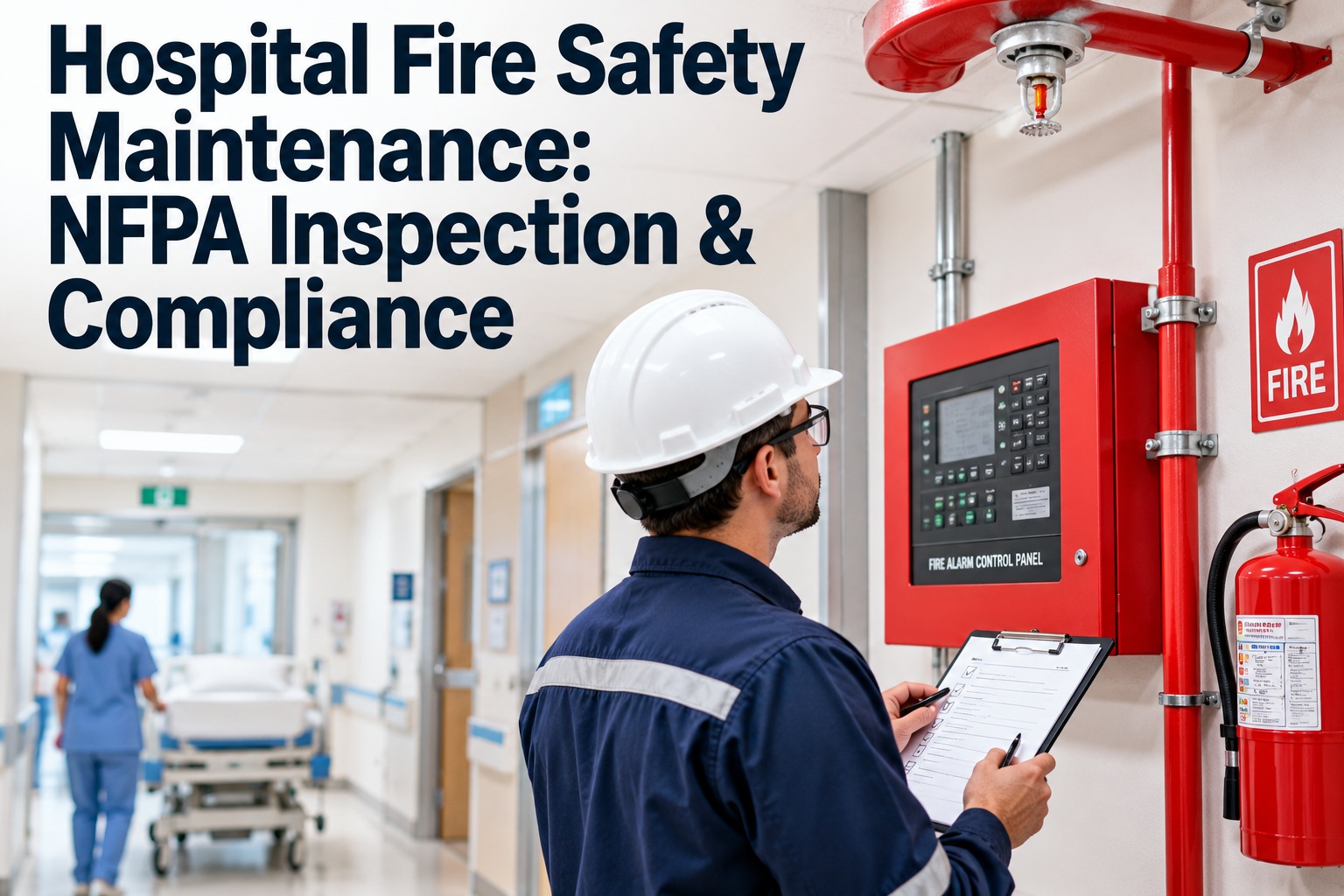
Medical gas systems are the invisible lifeline of every hospital, surgical center, and long-term care facility across North America. From oxygen delivery in ICUs to nitrous oxide in operating rooms and medical air in ventilators, these systems directly impact patient outcomes every single day. Yet despite their critical importance, medical gas compliance remains one of the most overlooked and misunderstood areas of healthcare facility management. With the FDA's landmark new regulations under 21 CFR Part 213 taking effect in December 2025 and ever-evolving NFPA 99 requirements, facility managers can no longer afford a reactive approach. This guide breaks down everything you need to know about staying compliant, audit-ready, and — most importantly — safe.
Why Medical Gas Compliance Is Non-Negotiable
Medical gases including oxygen, nitrogen, nitrous oxide, carbon dioxide, helium, and medical air are classified as drugs under the Federal Food, Drug, and Cosmetic Act. This means they are subject to the same level of regulatory scrutiny as pharmaceutical products. A compliance failure does not just mean a citation during an audit — it can mean patient harm, facility shutdowns, or loss of accreditation. In 2024 alone, the FDA cited numerous facilities for improper storage conditions, inadequate maintenance documentation, and failure to follow current Good Manufacturing Practice (cGMP) requirements. The Joint Commission's unannounced inspections have also flagged medical gas systems as a top area of non-compliance during accreditation surveys.
Keeping up with constantly evolving compliance requirements manually is nearly impossible. That is exactly why leading healthcare facilities are turning to digital maintenance platforms. Sign up for OxMaint to automate your medical gas compliance tracking and never miss a critical inspection deadline again.
The Regulatory Landscape: Who Governs Medical Gas Compliance?
Understanding medical gas compliance in North America requires knowing the key regulatory bodies and how their standards interact. There is no single authority — instead, multiple agencies and organizations create a layered compliance framework that every facility must navigate.
The FDA classifies medical gases as drugs and oversees their manufacturing, labeling, and distribution. The new 21 CFR Part 213, effective December 18, 2025, establishes cGMP requirements specifically tailored to medical gas production, replacing the previous Parts 210 and 211. This includes requirements for cleaning and maintenance of equipment, supplier reliability verification, and container integrity standards.
NFPA 99 is the backbone of medical gas system safety in North American healthcare facilities. It establishes requirements for design, installation, testing, inspection, and maintenance of medical gas and vacuum systems. The code uses a risk-based approach, categorizing systems into three risk levels (Category 1, 2, and 3) based on the potential impact of system failure on patient safety.
TJC accreditation surveys evaluate medical gas systems for compliance with NFPA standards, proper documentation, staff training, and emergency procedures. Accreditation is renewed every three years, with unannounced inspections at any time. Non-compliance can result in conditional accreditation or loss of Medicare/Medicaid reimbursement eligibility.
CMS has adopted the 2012 edition of NFPA 99 as its minimum standard. Facilities receiving Medicare or Medicaid payments must demonstrate compliance with these codes. CMS surveyors verify that medical gas systems meet all applicable requirements during Conditions of Participation surveys.
Stop Managing Medical Gas Compliance on Spreadsheets
OxMaint gives you automated inspection scheduling, digital checklists, and audit-ready maintenance logs — all in one platform built for healthcare compliance.
NFPA 99 Risk Categories: Know Where Your Facility Stands
One of the most important aspects of NFPA 99 compliance is understanding the risk categorization system. The category assigned to your medical gas systems determines the level of inspection, testing, and maintenance required. Getting this wrong means either over-investing in unnecessary procedures or — far worse — under-maintaining critical systems.
Conducting an accurate risk assessment is the foundation of your compliance program. Every medical gas outlet, pipeline, and storage system in your facility should be classified. Without a centralized system to track these classifications and schedule appropriate maintenance, gaps are inevitable. Book a demo with OxMaint to see how our platform maps your entire medical gas infrastructure and assigns inspection schedules automatically based on risk category.
Essential Maintenance & Inspection Requirements
NFPA 99 Chapter 14 consolidates inspection, testing, and maintenance (ITM) requirements into a single reference point for facility managers. Understanding these requirements is critical for building a maintenance program that survives scrutiny during audits.
Daily & Weekly Checks
Quarterly & Annual Tasks
Every single one of these tasks must be documented with dates, technician names, findings, and corrective actions taken. Paper-based logs are not only inefficient but also risky — a single missing entry during a Joint Commission survey can trigger a finding. Sign up for OxMaint and generate complete, timestamped digital records that satisfy every auditor.
FDA's New 21 CFR Part 213: What Changed in 2025
The FDA's final rule published in June 2024 and effective December 18, 2025, represents the most significant regulatory shift for the medical gas industry in decades. For the first time, medical gas manufacturers have their own dedicated cGMP framework instead of being forced to comply with pharmaceutical manufacturing rules that never quite fit their operations.
FDASIA defines "designated medical gas" and directs FDA to create tailored regulations for the industry
FDA publishes final rule establishing 21 CFR Part 213 with new cGMP, labeling, and reporting requirements
New regulations take effect — Part 213 replaces Parts 210 and 211 for medical gas manufacturers
Comment period closes on FDA draft guidance for medical gas cGMP compliance
Key changes include updated cleaning requirements reflecting sealed closed-system manufacturing, elimination of arbitrary expiration dates for gases that do not chemically degrade, new gauge requirements for portable containers used by patients, and consolidated standards for both bulk and cylinder operations. Healthcare facilities that receive medical gases must ensure their suppliers are compliant with these new rules and maintain documentation proving supply chain integrity.
Qualified Personnel: Who Can Touch Your Medical Gas Systems?
One of the most common compliance failures is having unqualified personnel perform maintenance on medical gas systems. NFPA 99 is very specific about who is authorized to work on these critical systems, and The Joint Commission actively checks for this during surveys.
Your CMMS should track technician certifications, expiration dates, and automatically flag when recertification is needed. It should also restrict work order assignments to only qualified personnel for medical gas tasks. Book a demo with OxMaint to see how role-based access control and certification tracking keep your facility compliant with NFPA 99 personnel requirements.
Building Audit-Ready Maintenance Logs
When a Joint Commission surveyor or CMS inspector walks through your door, the first thing they will ask for is documentation. Not just any documentation — they want complete, organized, easily retrievable records that prove your maintenance program is functioning as designed. Here is what audit-ready documentation looks like for medical gas systems.
The difference between a clean audit and a conditional finding often comes down to one missing record. Paper-based systems create gaps. Spreadsheets get lost or overwritten. A purpose-built CMMS like OxMaint creates an unbreakable chain of documentation that auditors trust. Every inspection, every work order, every alarm event is timestamped, geo-tagged, and linked to the specific asset and technician involved. Sign up for OxMaint today and transform your audit preparedness.
Ready to Make Your Medical Gas Compliance Effortless?
Join hundreds of healthcare facilities that use OxMaint to automate inspections, track certifications, and maintain audit-ready records for every medical gas system in their facility.
Canadian Compliance: CSA Standards for Medical Gas Systems
While much of the conversation around North American medical gas compliance focuses on U.S. regulations, Canadian healthcare facilities face their own set of requirements under the Canadian Standards Association (CSA). CSA Z7396.1 covers the design, installation, and testing of medical gas pipeline systems, closely paralleling NFPA 99 but with distinct Canadian requirements for provincial compliance and Health Canada oversight.
Canadian facilities must also comply with provincial health regulations, which can vary significantly. For example, Ontario's hospitals are surveyed by Accreditation Canada, which evaluates medical gas system maintenance as part of its Required Organizational Practices (ROPs). Whether your facility operates under U.S. or Canadian standards — or manages cross-border operations — having a unified compliance platform is essential. Sign up for OxMaint to manage both U.S. and Canadian compliance requirements from a single dashboard.
Common Compliance Pitfalls to Avoid
After reviewing thousands of inspection reports and audit findings across North American healthcare facilities, these are the most frequently cited compliance failures for medical gas systems — and all of them are preventable with the right maintenance management system in place.
Performing maintenance but failing to record it properly. If it is not documented, it did not happen — at least in the eyes of an auditor.
Allowing in-house staff without proper ASSE credentials to perform repairs or inspections on medical gas systems.
Skipping quarterly or annual inspections due to scheduling conflicts or lack of automated reminders.
Failing to classify medical gas systems by NFPA 99 risk category, leading to inappropriate maintenance schedules.
Performing maintenance without documented authorization, shutdown procedures, and post-work testing verification.
Failing to periodically test and calibrate medical gas alarm panels, master alarms, and area alarm systems.
Frequently Asked Questions
What is NFPA 99 and why does it matter for medical gas compliance
NFPA 99 is the Health Care Facilities Code published by the National Fire Protection Association. It establishes requirements for the design, installation, inspection, testing, and maintenance of medical gas and vacuum systems in healthcare facilities. CMS has adopted the 2012 edition as the minimum standard for facilities receiving Medicare or Medicaid payments, making compliance mandatory for most hospitals and healthcare organizations across North America.
How often should medical gas systems be inspected
NFPA 99 requires a multi-layered inspection approach. Daily or weekly checks should be performed on alarm systems, manifold supply levels, and compressor performance. Central supply systems must be fully inspected annually, including all major components. Quarterly maintenance is required according to manufacturer recommendations. Station outlets and inlets must be periodically tested for flow, labeling accuracy, latching function, and leaks.
What qualifications are needed to maintain medical gas systems
NFPA 99 Section 5.1.14.2.2.5 specifies that maintenance personnel must have one of the following: ASSE 6040 certification for maintenance personnel, ASSE 6030 certification for verifiers, or completion of a documented training program acceptable to the healthcare facility. The individual must also be technically competent on the specific equipment installed at the facility. This applies to both employed and contracted staff.
What changed with the FDA's new 21 CFR Part 213
Effective December 18, 2025, the FDA replaced Parts 210 and 211 with Part 213, creating cGMP regulations specifically designed for medical gas manufacturing. Key changes include updated cleaning requirements for sealed closed-system production, removal of arbitrary expiration dates for gases that do not degrade, new gauge requirements for portable patient containers, and a consolidated standard covering both bulk and cylinder operations.
What happens if our facility fails a medical gas compliance audit
Consequences vary by the auditing body. The Joint Commission can issue conditional accreditation, require a corrective action plan, or in severe cases revoke accreditation. CMS can issue deficiency citations that require immediate correction or risk loss of Medicare and Medicaid reimbursement eligibility. State health departments can issue fines or restrict facility operations. Beyond regulatory consequences, non-compliance puts patients at direct risk.
How can a CMMS help with medical gas compliance
A CMMS like OxMaint automates the entire compliance workflow — from scheduling inspections based on NFPA 99 risk categories to generating audit-ready documentation. It tracks technician certifications and flags expirations, creates digital permit-to-work workflows, logs alarm events with response times, and provides instant access to complete maintenance histories during audits. This eliminates the documentation gaps that cause most compliance failures.
Does Canada have different medical gas compliance requirements
Yes. Canadian facilities follow CSA Z7396.1 for medical gas pipeline system design and installation, along with provincial health regulations that vary by province. Accreditation Canada evaluates medical gas maintenance as part of its Required Organizational Practices. While many requirements parallel NFPA 99, there are distinct Canadian standards and provincial variations that facilities must navigate.
What is the Responsible Facility Authority under NFPA 99
The Responsible Facility Authority (RFA) is a designated person or persons responsible for implementing NFPA 99 medical gas requirements within a facility. The RFA advises on risk assessments, oversees the permit-to-work system, and ensures code compliance for Category 1, 2, and 3 facilities. The RFA must demonstrate competency through ASSE credentials or an equivalent educational program.