Most hospital fire and life safety citations are not caused by broken systems — they are caused by missing, misfiled, or unproducible inspection records. The Joint Commission's most frequently cited Environment of Care standard, EC.02.03.01, has one consistent finding: facilities that performed the work but cannot prove it. OxMaint replaces paper binders with a searchable, mobile-first inspection system that keeps every NFPA 99 record audit-ready at all times.
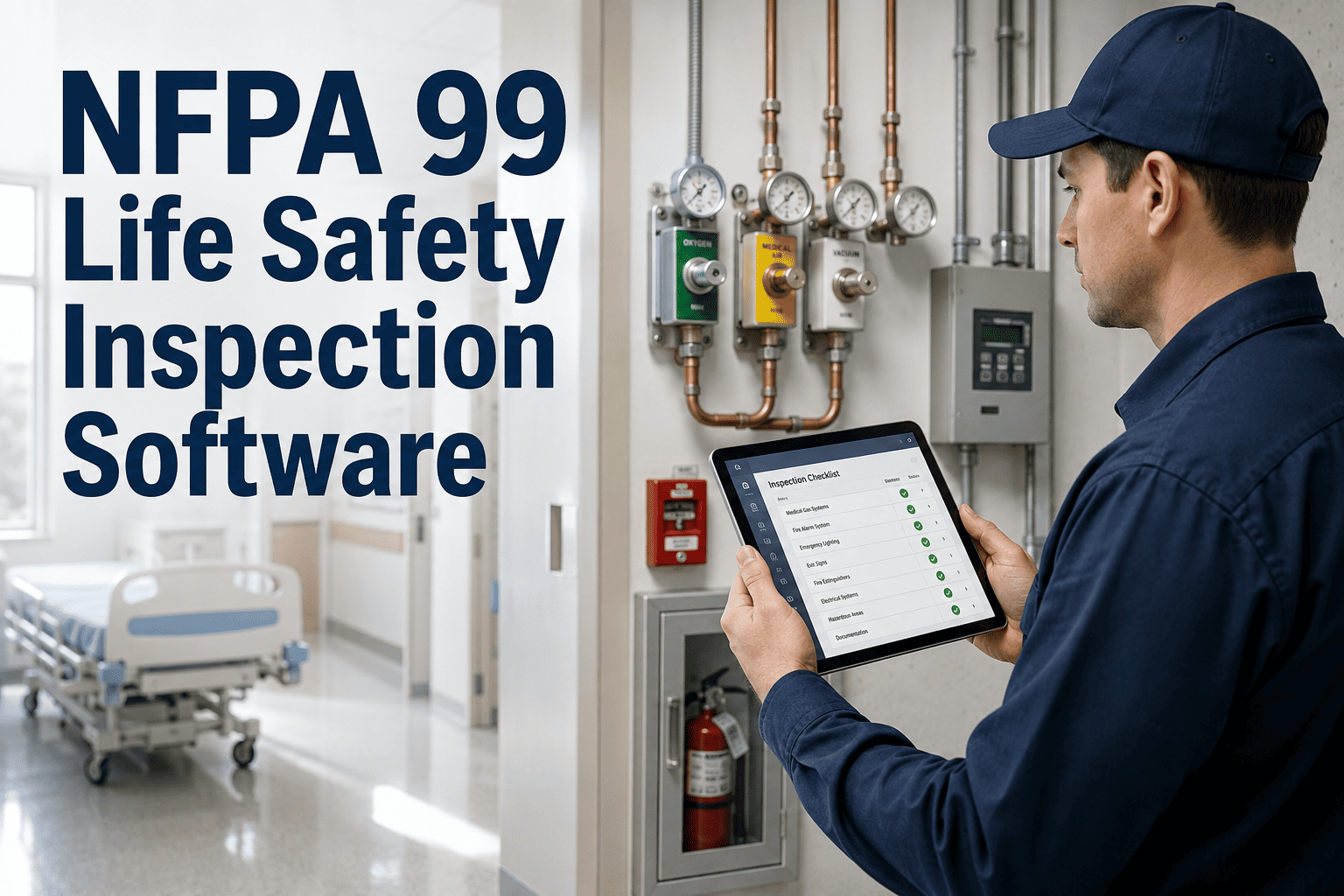
NFPA 99 Life Safety Inspection Software
Medical gas, emergency power, fire systems, and utilities — all inspection cycles managed in one platform with mobile checklists, corrective action routing, and Joint Commission-ready audit trails.
Why Healthcare Facilities Fail NFPA 99 Audits
NFPA 99 governs electrical systems, medical gas, vacuum systems, emergency power, fire suppression, and HVAC across every licensed healthcare facility in the United States. CMS enforces it as a Condition of Participation. The Joint Commission audits to it on every triennial survey. Yet the most common reason facilities receive a Requirement for Improvement is not a malfunctioning system — it is a record that cannot be produced within the survey window.
Paper binders in different departments cannot be searched during a 4-hour Joint Commission visit. Records for fire doors, generator tests, and medical gas inspections are scattered across facilities teams, biomedical, and engineering.
NFPA 99 requires different frequencies for different systems — monthly, quarterly, semi-annual, and annual. Spreadsheet-based scheduling misses the handoffs. When one team finishes and another should start, the gap goes undetected until an audit.
Finding a deficiency is only half the requirement. NFPA 99 and TJC both require documented corrective actions with completion dates. Many facilities complete the repair but never close the loop in writing — creating a finding from work that was actually done.
Annual sprinkler, generator, and gas system tests are frequently outsourced. When contractor test reports arrive late, are stored in email, or are never linked to the asset record, they are invisible to the surveyor — and to the facility's own compliance team.
Stop Managing NFPA 99 on Paper Binders
OxMaint digitizes every inspection cycle, corrective action, and audit trail required under NFPA 99 — from medical gas to emergency power to fire systems — in one searchable platform.
What NFPA 99 Requires You to Inspect
NFPA 99 covers six core system categories. Each has its own inspection frequency, documentation standard, and corrective action requirement. Every category below is supported natively in OxMaint with pre-built checklists aligned to the 2024 edition of the code.
NFPA 99 Inspection Schedule at a Glance
| System | Monthly | Quarterly | Semi-Annual | Annual | Code Reference |
|---|---|---|---|---|---|
| Medical Gas Alarm Panels | Required | — | — | Full Test | NFPA 99 §5.1 |
| Emergency Generator | 30-min Run | — | — | Full Load Test | NFPA 99 §7 / NFPA 110 |
| Transfer Switch | Visual | Functional | — | Full Test | NFPA 99 §7.6 |
| OR/ICU HVAC Pressure | — | Required | — | Full Validation | NFPA 99 §8 / ASHRAE 170 |
| Isolated Power Panels | Alarm Check | — | — | Performance Test | NFPA 99 §6.3 |
| Hot Water Temperature | Temperature Log | — | — | — | CMS / NFPA 99 §9 |
| Zone Valve Shutoffs | — | — | — | Operation Test | NFPA 99 §5.1.11 |
From Scheduled Inspection to Closed Corrective Action
OxMaint pre-loads NFPA 99 inspection frequencies for every system type. Monthly generator runs, quarterly HVAC validations, and annual zone valve tests are auto-generated — no manual calendar management required.
Technicians complete inspections on a phone or tablet. Each checklist item is linked to the NFPA 99 requirement it satisfies. Photos, readings, and signatures are captured at the asset — not back-filled at a desk.
When a checklist item is failed, OxMaint automatically opens a corrective action work order, assigns it to the responsible team, and tracks it through closure. The finding and the fix live in the same record.
When a surveyor arrives, the compliance manager pulls a date-filtered report for any system, any asset, any date range. Every inspection, every corrective action, and every technician signature is exportable as a single PDF — ready before the surveyor reaches the first department.
What Compliance Officers Say About Digital Inspection Management
NFPA 99 Inspection Software — FAQ
What systems does NFPA 99 require to be inspected in a hospital?
NFPA 99 covers medical gas and vacuum systems, electrical systems including isolated power panels, emergency power supply systems (generators and transfer switches), HVAC and environmental systems, plumbing systems, and hyperbaric facilities where applicable. Each system has its own inspection frequency — ranging from monthly alarm checks to annual full-load tests — and all must be documented with corrective action records to satisfy CMS Conditions of Participation and Joint Commission accreditation surveys. OxMaint supports all six categories with pre-built checklists.
How does CMS enforcement of NFPA 99 differ from Joint Commission surveys?
CMS enforces the 2012 edition of NFPA 99 as a Condition of Participation, meaning non-compliance can jeopardize Medicare and Medicaid reimbursement. The Joint Commission conducts triennial accreditation surveys and uses Environment of Care standards that mirror NFPA 99 requirements. In practice, both bodies require the same documentation — completed inspection records, corrective action logs, and evidence of timely follow-through — and both can trigger citations when records are missing rather than when systems are actually malfunctioning. A digital system like OxMaint ensures the same records satisfy both requirements simultaneously.
Can OxMaint track corrective actions tied to specific NFPA 99 deficiencies?
Yes. When a technician marks a checklist item as failed during an inspection, OxMaint automatically opens a linked corrective action work order with the deficiency description, the asset location, and the NFPA 99 code reference pre-populated. The work order is assigned to the responsible team, tracked through completion, and stored alongside the original inspection record. Surveyors can see the finding and the fix in a single view — which is what the Joint Commission looks for when reviewing corrective action documentation. Book a demo to see this workflow live.
What does NFPA 99 2024 edition change compared to earlier editions?
The 2024 edition introduces a new consolidated Chapter 14 for hyperbaric facilities, a new Chapter 15 for dental gas and vacuum piping systems, and new requirements for supplementary supply connections on medical gas systems following COVID-19 supply disruptions. It also includes new fire extinguisher selection requirements for spaces unique to healthcare facilities. While CMS currently enforces the 2012 edition, facilities that implement the 2024 requirements now are positioning themselves ahead of the next regulatory update cycle. OxMaint checklists are aligned to the 2024 edition.
Replace Paper Binders With a Searchable NFPA 99 Compliance System
Every inspection cycle, every corrective action, every audit trail — across medical gas, emergency power, fire systems, and utilities — in one platform. Built for the way healthcare facilities actually run.