In a hospital, a maintenance backlog isn't just an operations headache — it's a patient-safety and accreditation risk that compounds quietly until a surveyor asks for the records. US hospitals collectively carry over $100 billion in deferred maintenance that grows 8 to 12% a year when ignored, and the queue almost always swells for the same reason: requests, approvals, and technician assignments are still handled by email, phone, and spreadsheet. Every manual handoff adds days, and a deferred PM on a regulated system becomes a documentation gap a Joint Commission or CMS survey will cite. This guide shows how to pull that backlog back into control by centralizing visibility, automating assignment, and tracking completion aging in OxMaint's work order management — or book a demo to see it on your own queue.
Hospital Operations / Work Order Management
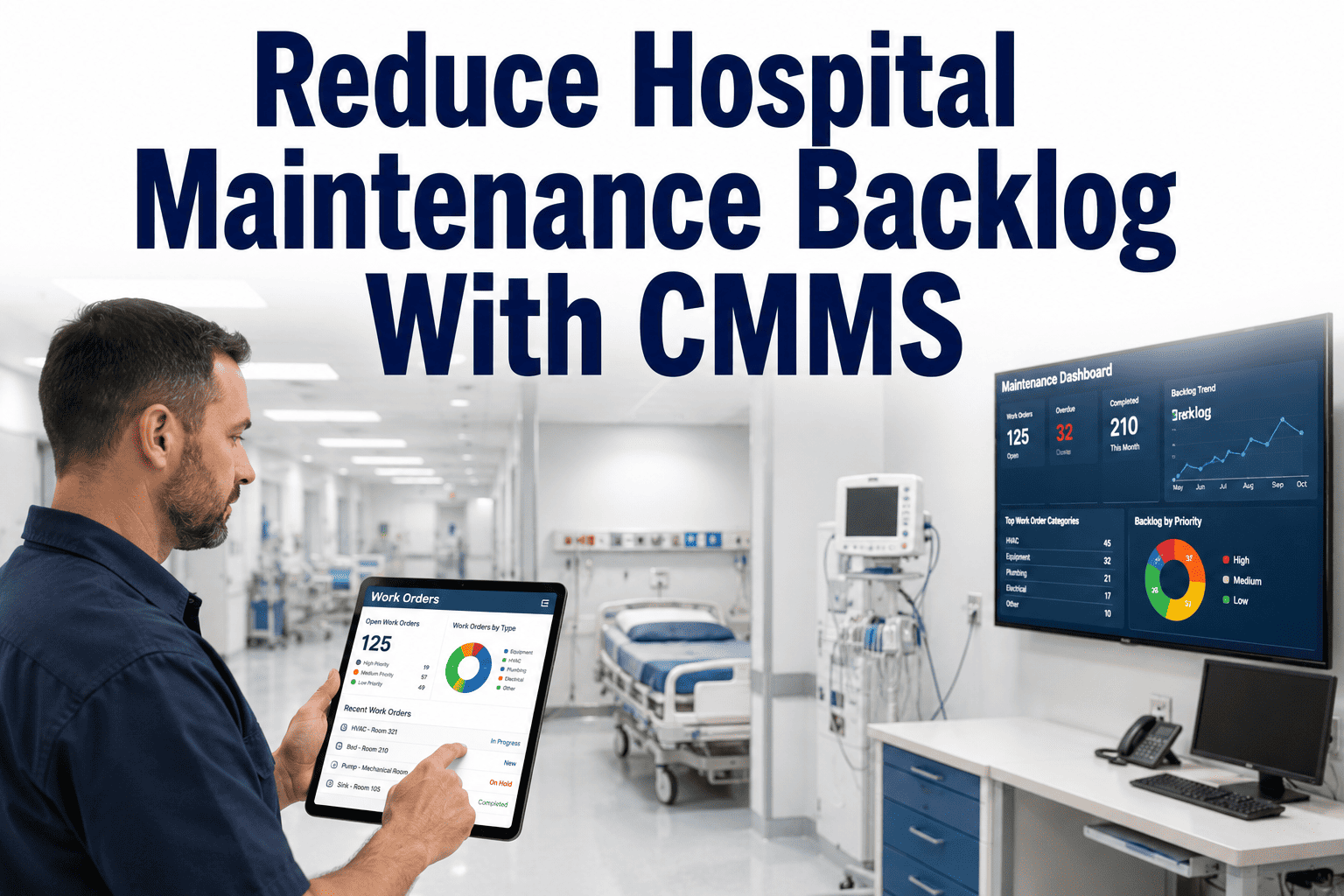
Reduce Hospital Maintenance Backlog With CMMS
Centralize backlog visibility, automate technician assignment, and track completion aging — so deferred work stops becoming a patient-safety and survey exposure.
$100B+
Deferred maintenance carried across US hospital systems
45%
Average backlog reduction within 90 days of CMMS rollout
68%
Of CMS facility citations tied to the physical environment
$93K
Possible CMS penalty per day for condition-level deficiencies
Where the backlog is born
Backlogs rarely start with too much work — they start with too many manual handoffs. Each step below leaks days when it runs on email and memory instead of one system.
Request
A nurse emails or calls; the issue sits unlogged in an inbox.
→
Approval
It waits for a supervisor to notice and sign off.
→
Assignment
A tech is matched by memory — gaps and double-booking follow.
→
Execution
Finally worked — but already aged before it began.
Close those gaps and the same crew clears far more work, because the time lost between steps often dwarfs the time spent on the wrench itself.
Prioritize by patient impact, not arrival order
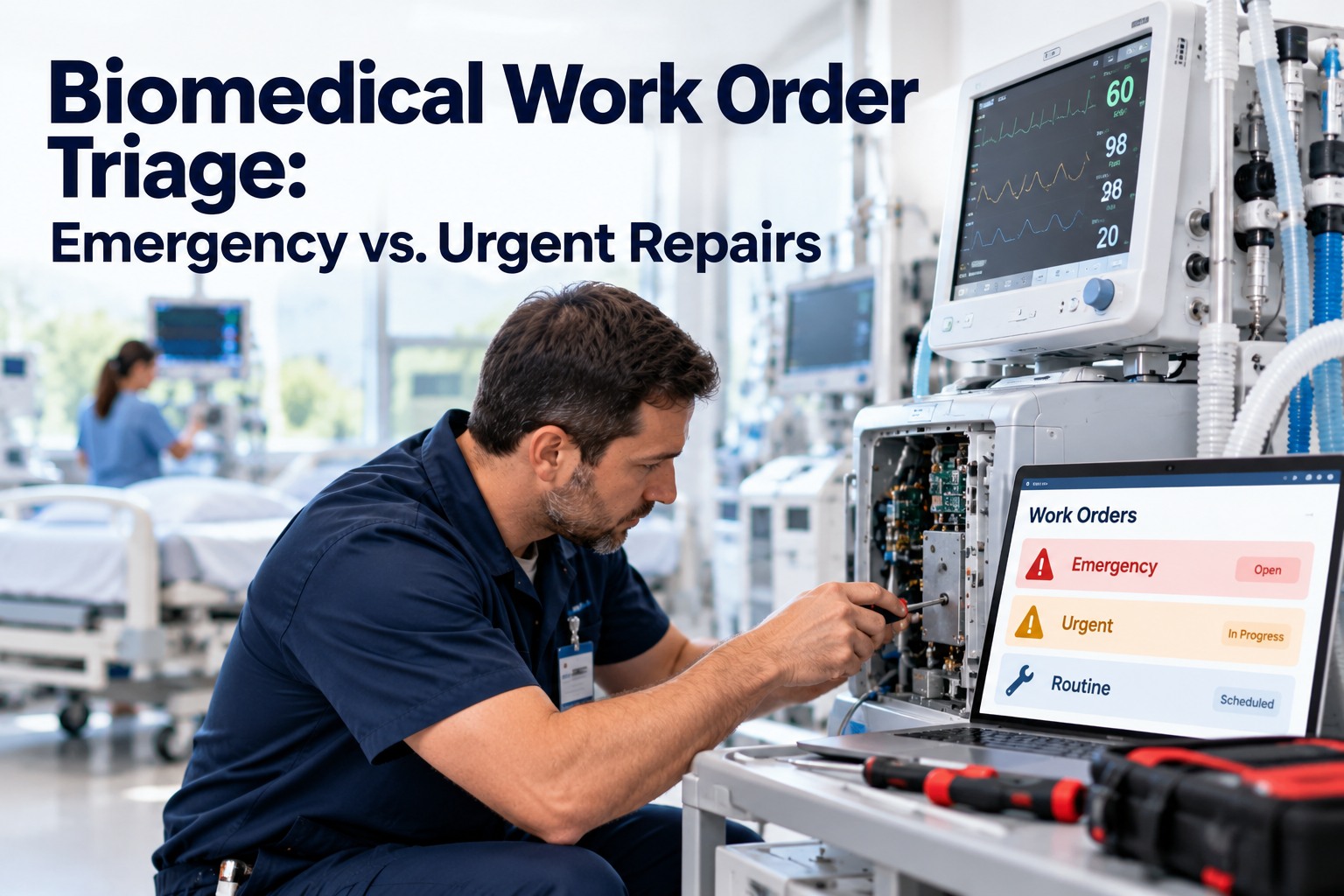
In a hospital, a ventilator fault and a storeroom light cannot share a first-come queue. A four-tier model routes each request by clinical and regulatory stakes, with the SLA clock starting at submission — not assignment.
| Tier | Example | Response target |
|---|
| P1 Critical | Ventilator, medical gas, fire or life-safety system | Immediate, ~15 min |
| P2 Urgent | OR or imaging HVAC, clinical equipment impact | Same shift |
| P3 Compliance | Generator load test, sprinkler, regulated inspection | Within mandated interval |
| P4 Routine | Non-urgent repair, planned maintenance | Planned backlog |
Starting the clock at submission closes the hidden gap between a request being created and assigned — in a hospital, that gap is where a P1 becomes a patient-safety event.
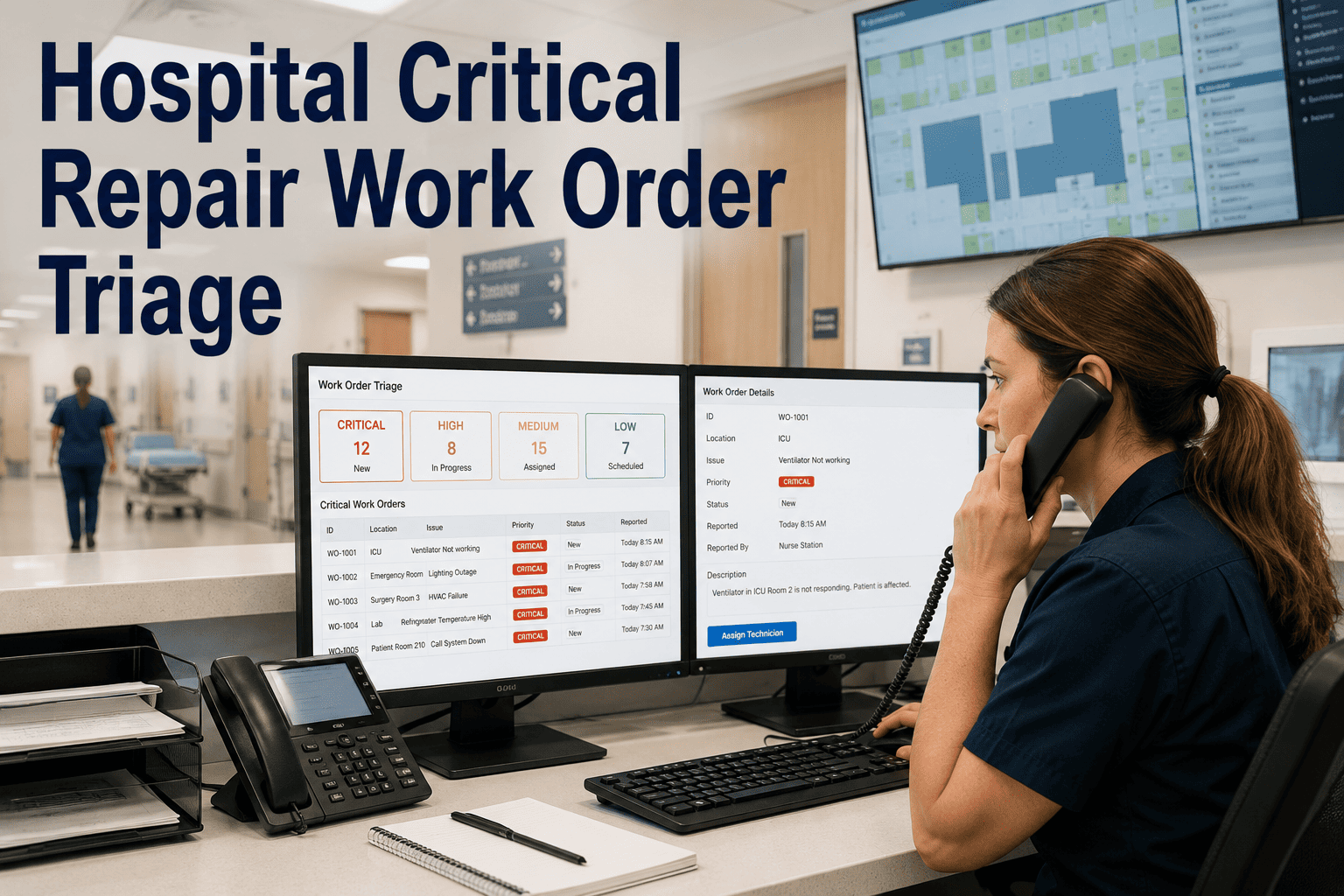
See your whole backlog on one screen
OxMaint pulls every request — nurse, biomed, or facilities — into a single prioritized queue, so nothing hides in an inbox.
Track completion aging, not just a count
A backlog number hides the danger — ten fresh requests are nothing like ten work orders that have aged on regulated equipment. Aging buckets show where the queue is rotting and which jobs threaten a survey.
31-90 days
Aging, compliance risk
90+ days
Critical, survey exposure
Backlog age responds fastest to automation — it improves the moment manual handoffs disappear, which is why it's the first metric to move after a CMMS goes live.
The three-move fix
Reducing a hospital backlog comes down to three moves, each closing one of the manual gaps that let work pile up in the first place.
1
Centralize visibilityEvery request from every channel lands in one backlog dashboard — nothing lives in an inbox or on paper.
2
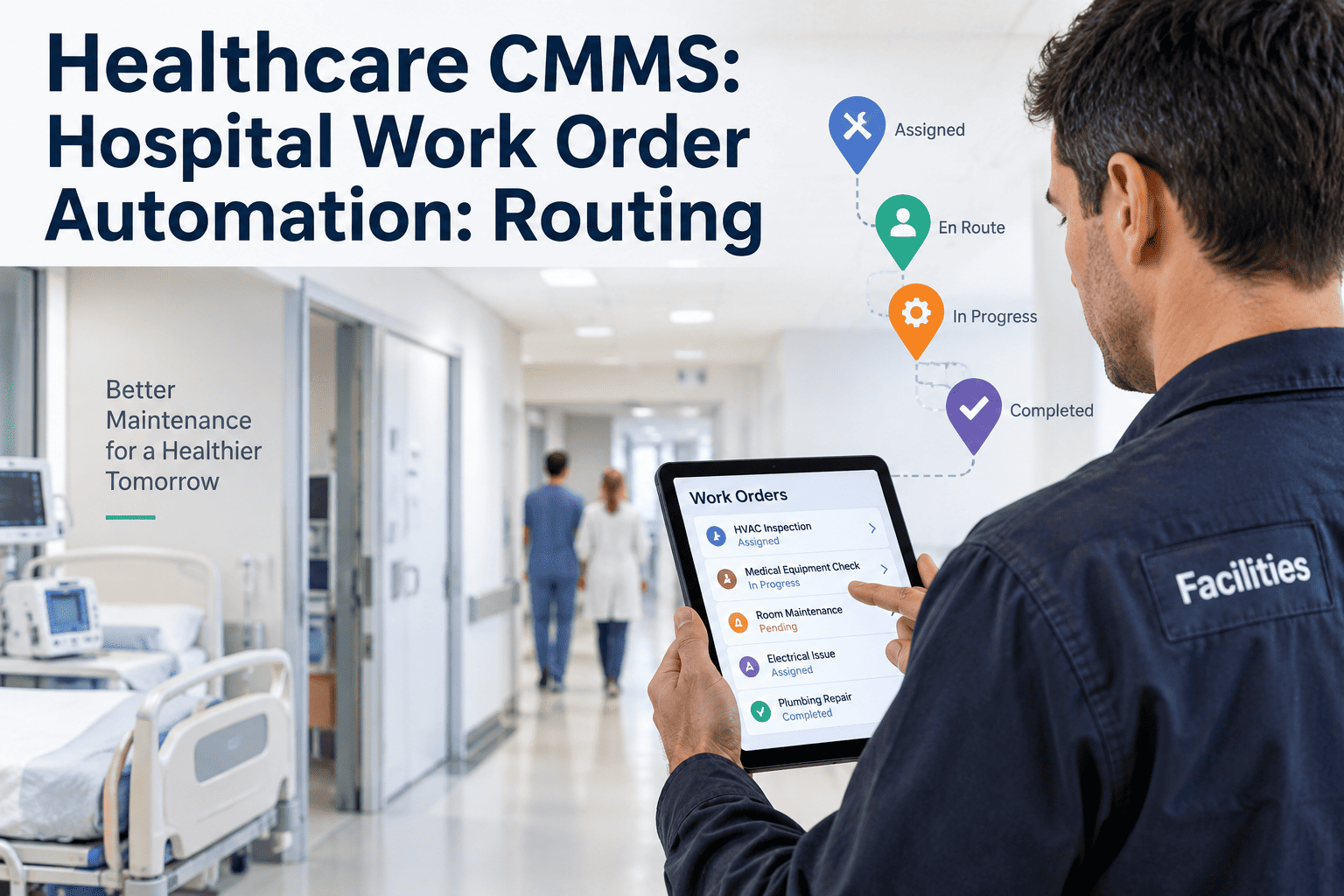
Automate assignmentSkill-based routing sends biomed work to biomed and facilities work to facilities, with no manual matching delay.
3
Track completion agingAging buckets and overdue escalation keep regulated work from quietly crossing into survey risk.
Expert Review
"The mistake I see most often is treating the backlog as a labor problem when it's a flow problem. The crew isn't the bottleneck — the inbox is. A request waits a day to be seen, another for approval, another to be assigned, and by the time a technician touches it, a P3 compliance task has aged into a survey finding. Centralize intake, let the system route by skill, and watch the aging buckets, and a hospital backlog that looked like a hiring crisis turns out to be a workflow fix. The overdue queue is usually the first thing to fall, often within the first couple of months."
Reviewed by a Certified Healthcare Facility Manager and ASHE member, 15+ years in multi-campus Joint Commission survey readiness.
Turn the backlog into a controlled queue
Walk through a live hospital backlog in OxMaint — centralized intake, automated assignment, and aging tracked across every department.
Frequently asked questions
What causes hospital maintenance backlogs to grow?
Backlogs balloon when requests, approvals, and technician assignments are tracked by hand — a nurse's email sits in an inbox, an approval waits for a supervisor, and a job is matched to a tech from memory. Each manual handoff adds days, so the queue compounds faster than the team can clear it. Centralizing the flow removes those gaps. OxMaint puts every request in one dashboard —
book a demo.
What's a healthy work order backlog for a hospital?
A common benchmark flags trouble when more than roughly 10% of open work orders are past their due date, signaling capacity, scheduling, or parts constraints. Backlog age matters as much as count — the longer a regulated task sits, the higher the survey risk it carries. The goal is a small, current backlog you can clear within each task's window. Track yours live in
OxMaint.
How does backlog become a Joint Commission or CMS risk?
Deferred PM on regulated systems is a documentation gap waiting to be cited — physical-environment requirements account for the largest share of CMS facility deficiencies, and most Joint Commission Environment of Care findings stem from missing records, not broken equipment. CMS can impose penalties up to $93,000 a day for ongoing condition-level deficiencies. A current, documented backlog closes that exposure.
Book a demo for audit-ready records.
How should hospital work orders be prioritized?
Most hospitals use four tiers: P1 for patient or life-safety impact with an immediate response target, P2 for clinical impact handled the same shift, P3 for regulated compliance tasks due within their mandated interval, and P4 for routine planned work. The SLA clock should start at submission, not assignment, so nothing hides in the gap between the two. Configure these tiers in
OxMaint.
Why measure completion aging, not just backlog count?
A raw backlog number hides the risk; ten new requests are very different from ten work orders that have aged past ninety days on regulated equipment. Aging buckets show where the queue is rotting and which jobs threaten patient safety or a survey, turning a flat count into a ranked priority list. That ranking is what lets a director act before a deadline. See aging buckets in
a quick demo.
How fast can a CMMS reduce our backlog?
Hospital teams commonly see meaningful movement within the first 60 to 90 days, with the overdue portion often dropping sharply in the first two months as intake and assignment automate. Backlog age is one of the fastest-responding metrics because it improves the moment manual handoffs disappear from the workflow. Full reliability gains follow over the next few maintenance cycles.
Book a demo to model your timeline.
Can biomed and facilities share one backlog system?
Yes — a healthcare CMMS routes a ventilator calibration to a biomedical technician and a storeroom light to facilities from the same queue, classifying and assigning each correctly without manual triage. One backlog feeds two workflows, with the technician's credential captured on every closure record for the audit trail. That shared visibility is what prevents work from falling between teams. Run both in
OxMaint.
How does OxMaint reduce our backlog?
OxMaint centralizes every request into one backlog dashboard, automates skill-based assignment so nothing waits for manual matching, and tracks completion aging with overdue escalation before tasks cross into compliance risk. The result is a backlog you can see, clear, and prove — survey-ready by default rather than assembled under pressure. Try it on your own facility with a
free trial.
Stop letting the inbox set your priorities
Centralize intake, automate assignment, and track aging on every work order — and turn a compounding hospital backlog into a controlled, survey-ready queue.
.jpg)