Tablet Press Maintenance & Compression Force Monitoring: AI-Driven Quality Control for Pharmaceutical Production
A complete framework for pharma manufacturing engineers, quality managers, and maintenance teams to implement predictive compression monitoring, automated punch-die lifecycle tracking, and real-time tablet quality assurance — with measurable defect reduction benchmarks.
What Is Tablet Press Compression Force Monitoring?
Compression force monitoring in tablet presses is the continuous, real-time measurement and analysis of the mechanical force applied during tablet compaction — tracked per punch station, per tablet cycle, and across every production batch. Unlike periodic manual sampling, modern compression monitoring systems capture force profiles at millisecond resolution, detecting micro-deviations that correlate directly with tablet hardness variation, weight inconsistency, and dissolution profile drift.
For pharmaceutical manufacturers operating under FDA 21 CFR Part 11 and EU GMP Annex 11 compliance requirements, compression force monitoring is evolving from a nice-to-have quality tool into a regulatory expectation. The 2023 FDA guidance on continuous manufacturing explicitly references real-time process monitoring as a critical control point — and tablet presses, as the final formation step before coating, represent the last intervention point where force-related defects can be corrected before batch release. Want to see real-time force analytics running on your press data? Start a free trial or book a demo to walk through a live compression monitoring deployment with our pharma engineering team.
Effective compression monitoring integrates three data streams: main compression force per station, pre-compression force where applicable, and ejection force during tablet discharge. AI-based systems compare these force signatures against historical batch data, API-specific compression profiles, and punch-die wear patterns to flag anomalies before they manifest as out-of-spec tablets in quality control testing.
The 6 Core Compression Metrics Pharma Manufacturers Must Track
Every tablet press generates dozens of sensor signals — but only six metrics directly predict quality deviation events with statistical reliability. Here is what production-grade monitoring systems prioritize.
Why Tablet Press Quality Control Fails in Traditional Maintenance Programs
Most pharma manufacturers have some form of tablet press monitoring. The gap between installed sensors and actionable quality control is where batch rejections, regulatory findings, and unplanned downtime accumulate.
The 4-Layer Tablet Press Predictive Maintenance Stack
Effective tablet press PdM requires integration across four monitoring layers — from individual component wear to batch-level quality correlation. This is the architecture pharma manufacturers use to achieve sub-1% tablet rejection rates.
How Oxmaint Automates Tablet Press Quality & Maintenance
Oxmaint connects to tablet press control systems via OPC-UA, Modbus, or direct PLC integration — capturing compression force, vibration, temperature, and production count data in real time. The platform applies pharma-specific AI models trained on validated batch data to predict quality deviations, punch wear, and bearing failures before they impact production. Curious how this works with your specific press models? Start a free trial or book a demo to see live integration with Fette, IMA, Korsch, and Manesty press systems.
Tablet Press Quality Control: Manual Monitoring vs AI-Driven PdM
The operational difference between periodic manual checks and continuous AI-based monitoring is measured in defect rates, downtime hours, and regulatory audit outcomes. Here is what the same 500-million-tablet annual production facility looks like before and after predictive compression monitoring.
Data based on Oxmaint pharma client transitions from manual press monitoring to AI-driven PdM. Results vary by facility size, press models, and product portfolio complexity. Ready to model your facility's improvement potential? Start a free trial or book a demo with our pharmaceutical solutions team today.
ROI Metrics: What AI-Driven Tablet Press Monitoring Delivers
These outcomes are measured across pharmaceutical manufacturers that implemented Oxmaint compression monitoring and predictive punch maintenance — ranging from single-line contract manufacturers to multi-site branded pharma operations.
6-Phase Tablet Press PdM Deployment Framework
Rolling out AI-driven compression monitoring across a pharma production facility requires coordination between engineering, quality, IT, and regulatory affairs. This is the proven implementation sequence that minimizes production disruption and accelerates time to validated monitoring.
Frequently Asked Questions: Tablet Press Compression Monitoring
How does real-time compression monitoring integrate with existing tablet press control systems without disrupting validated processes?
Oxmaint connects to tablet press PLCs through standard industrial protocols like OPC-UA, Modbus TCP, or Profinet — reading sensor data without writing any control commands back to the press. This means the monitoring system operates as a read-only observer with zero ability to alter press parameters or interrupt production. From a regulatory validation standpoint, Oxmaint sits outside the validated control loop — monitoring and analyzing data streams that already exist but adding no new control logic to the press itself. This architecture allows deployment on validated production lines without triggering full revalidation, though a change control and risk assessment process is still required per ICH Q9 guidelines. The system captures compression force, temperature, vibration, and production count data at the PLC polling rate — typically 100-1000 milliseconds depending on press speed — then streams it to cloud or on-premise analytics servers for processing.
What is the difference between compression force monitoring and traditional in-process tablet testing?
Traditional in-process testing involves pulling tablet samples at defined intervals — every 15-30 minutes for most pharma operations — and measuring hardness, weight, thickness, and sometimes friability in a quality control lab or at-line station. This approach creates 15-30 minute blind spots where quality deviations can occur undetected, producing thousands of potentially defective tablets before the next sample is pulled. Compression force monitoring operates continuously on every single tablet produced, capturing the mechanical process parameter that directly controls tablet density and hardness. When compression force drifts out of specification, the monitoring system alerts operators within seconds — before defective tablets accumulate. The two approaches are complementary: compression monitoring provides real-time process control while periodic tablet testing validates final product quality. The ideal state is using compression force data to reduce sampling frequency for stable processes while maintaining full testing for new products or formulation changes.
Can AI-based punch wear prediction reduce spare parts inventory costs without increasing stockout risk?
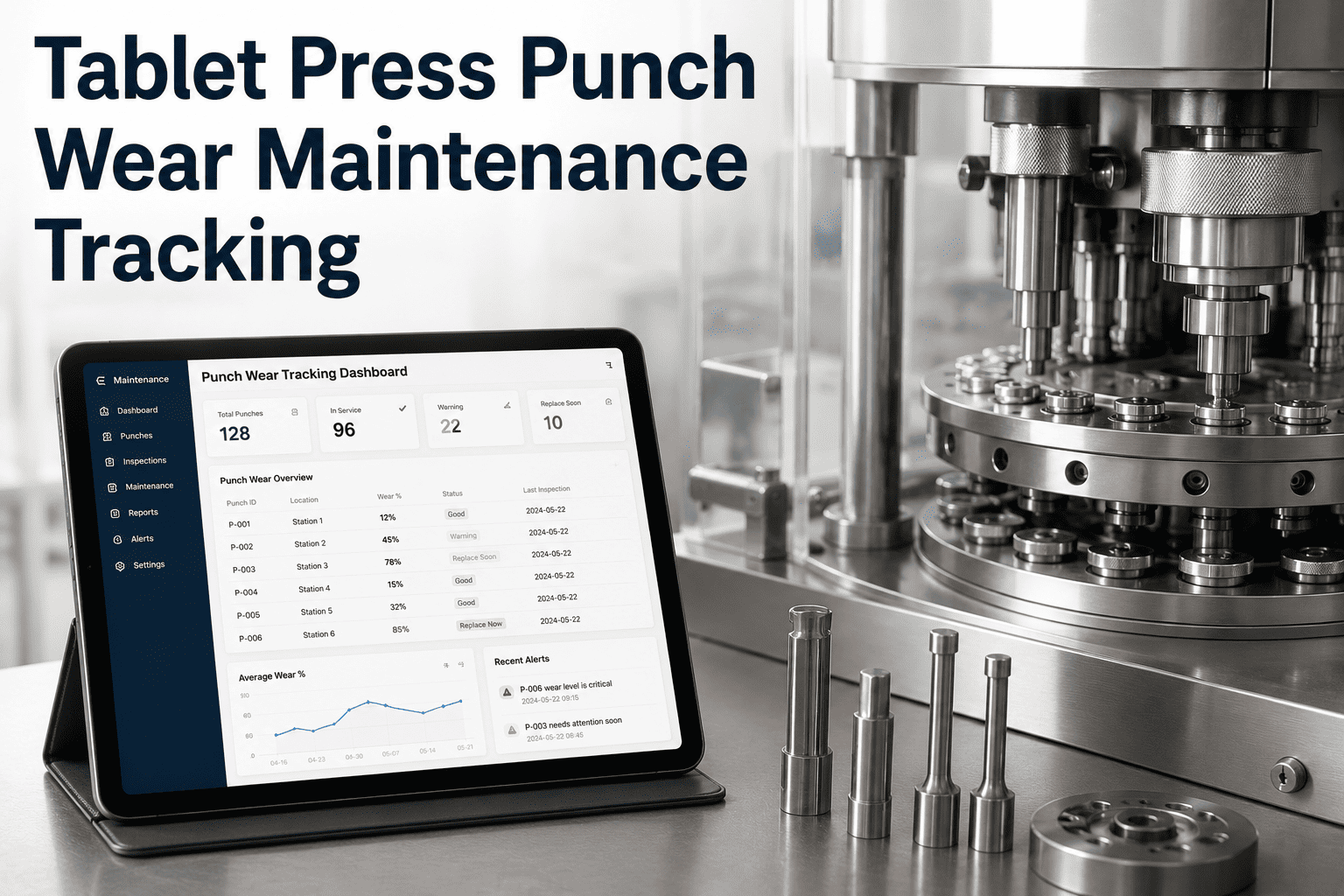
Yes — predictive punch lifecycle management shifts inventory strategy from safety stock buffering to just-in-time replacement based on actual wear rate data. Traditional approaches stock 2-3 full punch sets per press as safety inventory because replacement timing is uncertain and unplanned punch failures create production emergencies. With AI-based wear prediction, facilities know 2-3 weeks in advance when each punch set will require replacement, allowing procurement lead time to align with actual need rather than maintaining excess inventory. Oxmaint clients report 40-55% reductions in punch spare parts inventory value while simultaneously reducing emergency stockouts. The system tracks compression force variation per punch station as a proxy for tip wear, then applies formulation-specific wear rate models to forecast remaining useful life. For multi-product facilities, the model accounts for the fact that abrasive APIs degrade punches faster than standard lactose-based formulations — something time-based schedules cannot accommodate.
How does compression force monitoring support regulatory inspections and quality deviation investigations?
During FDA or EMA inspections, investigators increasingly request electronic batch records that include process parameter trends — not just summary statistics. Oxmaint provides per-tablet compression force data with complete audit trails including timestamps, operator IDs, and alarm acknowledgment records that meet 21 CFR Part 11 electronic signature requirements. When a quality deviation occurs — for example, a batch fails dissolution testing — the investigation team can retroactively query compression force data from the specific production timeframe to identify whether force anomalies coincided with tablet defects. This cuts investigation cycle time from weeks to days and provides objective evidence for root cause analysis rather than relying on operator recollection or incomplete manual logs. For facilities under consent decree or enhanced regulatory oversight, comprehensive process monitoring documentation is often an explicit requirement in corrective action plans. Oxmaint archives all monitoring data for 7+ years in compliance with pharma record retention requirements.
Stop Chasing Quality Deviations After Batches Are Complete
Oxmaint gives pharmaceutical manufacturing teams real-time compression force analytics, predictive punch replacement, and automated quality correlation — eliminating tablet defects before they enter your batch record. No lengthy validation cycles. No disruption to existing press control systems. Regulatory-compliant monitoring from day one. Join pharma manufacturers that reduced tablet rejection rates by 87% and cut investigation time by 72%.