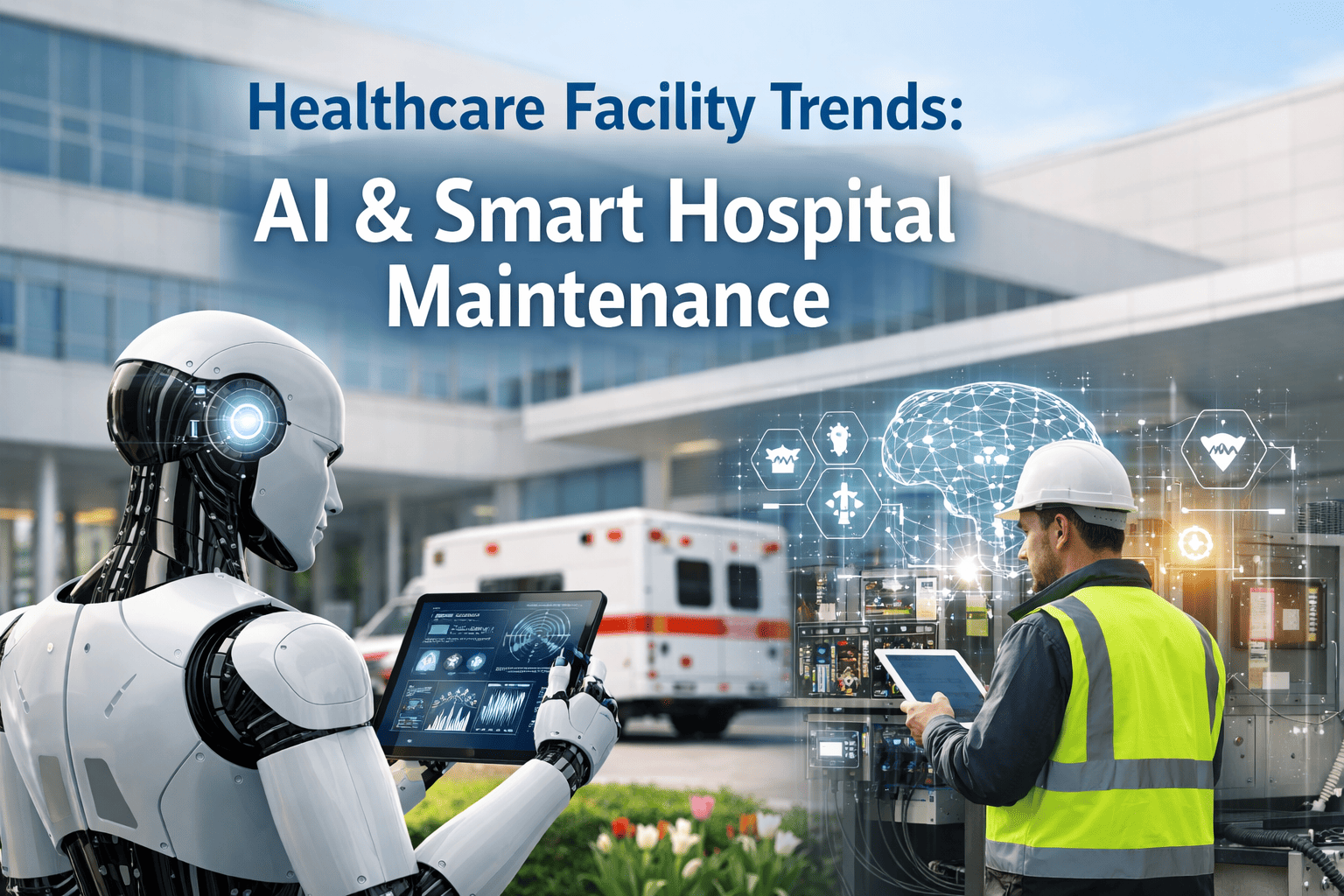
Hospital maintenance is undergoing its most significant operational transformation in a generation. The convergence of AI-driven predictive analytics, IoT sensor networks, accelerating regulatory scrutiny, and post-pandemic workforce constraints has permanently altered how healthcare facilities plan, execute, and measure equipment upkeep. The twelve trends shaping 2026 are not theoretical — they are being implemented right now by biomed and facilities teams at forward-thinking health systems across the country. See how Oxmaint supports the trends shaping hospital maintenance in 2026.
Industry Analysis · 2026 · Hospital Maintenance
Top 12 Hospital Maintenance Trends Driving 2026 Industry Conversations
AI ops, IoT condition monitoring, digital twins, decarbonization, autonomous repair, cyber-physical maintenance, workforce transformation, and more — the shifts every biomed and facilities leader needs to understand this year.
4,800+
Monthly searches for hospital maintenance trends
$8.2B
Global healthcare CMMS market projected by 2027
62%
Hospitals implementing IoT maintenance monitoring by end of 2026
The 12 Trends at a Glance
01AI-Driven Predictive Maintenance
02IoT Condition Monitoring at Scale
03Digital Twin Infrastructure
04Decarbonization-Linked Maintenance
05Cyber-Physical Maintenance Security
06AEM Program Expansion
07Workforce Competency Platforms
08Real-Time Regulatory Readiness
09Service Contract Optimization
10Mobile-First Maintenance Operations
11Sustainability ESG Reporting
12CMMS-EHR Data Integration
Trends 01–04: Technology and Infrastructure
Hospitals are moving from scheduled preventive maintenance to AI-triggered condition-based work orders. Machine learning models trained on failure patterns across thousands of similar devices generate maintenance alerts 2–8 weeks before observable symptoms appear. Early adopters report 23–31% reductions in unplanned equipment downtime. The primary barrier in 2025 was data quality in legacy CMMS systems — 2026 implementations are addressing this by structuring historical work order data for model training first.
31%avg downtime reduction
2–8 wksearlier failure detection
68%of large health systems piloting in 2026
IoT sensor deployment in hospitals has crossed the tipping point in 2026 — from pilots covering a handful of assets to facility-wide networks covering HVAC, medical gas systems, sterilization equipment, and critical care devices. The key 2026 development is not the sensors themselves but the CMMS integration layer: sensors that generate alerts which automatically create work orders, route them to the right technician, and close automatically on verification are replacing alert-only systems that still required manual dispatch.
62%hospitals deploying IoT monitoring by end of 2026
3.4xfaster alert-to-resolution with CMMS integration
$180Kavg annual energy savings per facility from IoT HVAC monitoring
Digital twins — live virtual replicas of physical facility systems — are moving from new construction projects into retrofit deployments at major health systems. A digital twin of an OR suite allows maintenance planners to model the impact of scheduled downtime on surgical capacity, optimize PM scheduling around OR utilization data, and simulate failure scenarios without disrupting clinical operations. In 2026, the leading use case is HVAC and air handling systems, where simulation accuracy is highest and the clinical risk of failure is most direct.
28%of health systems with 500+ beds initiating digital twin projects
17%reduction in scheduled PM disruption to clinical operations
Maintenance departments are becoming sustainability partners in 2026 as hospitals face carbon reporting requirements under state and federal programs. Equipment energy performance is now a maintenance metric, not just an engineering one. Biomed and facilities teams are being asked to track and report maintenance-driven energy consumption changes — connecting work order records to energy meter data to produce auditable Scope 1 and Scope 2 emissions documentation. CMMS platforms that cannot generate this linkage are being replaced by those that can.
41 stateswith active hospital decarbonization reporting mandates or initiatives in 2026
18–25%of hospital energy waste attributable to deferred maintenance
Oxmaint is built for where hospital maintenance is going in 2026
IoT integration, energy-maintenance linking, real-time compliance reporting, and mobile-first workflows — see how Oxmaint supports the trends redefining biomedical and facilities management.
Trends 05–08: Compliance, Workforce, and Risk
Connected medical devices create a new attack surface that maintenance teams are now responsible for securing. Patching firmware, verifying software versions, and documenting security maintenance activities is increasingly a biomed function rather than an IT function — because biomed owns the device life cycle records. In 2026, TJC and CMS are both expanding their scrutiny of medical device cybersecurity maintenance documentation. CMMS systems are being configured to track patch status alongside traditional PM compliance for networked devices.
53%of hospital cyber incidents in 2025 involved networked medical devices
2026TJC adding cybersecurity maintenance documentation to EC standards review
AEM programs — which allow hospitals to replace manufacturer-recommended PM intervals with risk-stratified, evidence-based alternatives — are expanding significantly in 2026 as facilities look to optimize labor allocation. The data requirements for AEM justification are substantial: hospitals need failure history, risk assessments, and ongoing compliance tracking. CMMS platforms that structure AEM documentation at the asset level are a prerequisite for this trend, and facilities without them are leaving cost reduction opportunities on the table.
34%avg PM labor cost reduction with well-implemented AEM program
$420Kavg annual biomed labor savings at 400-bed hospital with AEM
Biomed technician shortages are structurally embedded in the 2026 hospital market — AAMI data indicates a 19% shortage of certified technicians nationally, with rural facilities most severely affected. Health systems are responding with competency management platforms integrated directly into CMMS work order assignment logic: technicians are only assigned to work orders for devices within their verified competency scope, and training completion is tracked in the same system as PM records. This integration reduces liability and improves quality consistency across multi-facility networks.
19%national shortage of certified biomed technicians
44%reduction in technician errors with competency-gated work order assignment
The era of survey-triggered documentation scrambles is ending for health systems that have invested in real-time compliance dashboards. In 2026, leading hospitals maintain a live view of PM compliance rates, overdue work orders, and documentation completeness — updated continuously rather than compiled at survey time. This shift is enabled by CMMS platforms with configurable compliance dashboards and automated alert systems that surface gaps before they become findings. Hospitals with real-time readiness consistently report cleaner surveys and faster accreditation cycles.
Trends 09–12: Operations and Integration
| # |
Trend |
Primary Driver |
2026 Adoption Stage |
Measurable Outcome |
| 09 |
Service Contract Optimization |
Cost pressure + CMMS data availability |
Mainstream |
15–34% contract cost reduction with data-driven renegotiation |
| 10 |
Mobile-First Maintenance Operations |
Technician workforce expectations |
Mainstream |
28% faster work order completion on mobile CMMS vs. desktop-only |
| 11 |
Sustainability and ESG Reporting |
Regulatory mandates and board-level ESG goals |
Growing Fast |
Scope 1 and 2 emissions traceable to maintenance activities at asset level |
| 12 |
CMMS-EHR Data Integration |
Patient safety and device reliability linkage |
Emerging |
Device downtime incidents linkable to maintenance history for root cause analysis |
Expert Review
JH
James Harrington, CHTM, CBET
VP of Clinical Engineering — 12-Hospital Health System, 24 years · Dual Certified (CHTM, CBET) · AAMI Standards Committee Contributor · Former Chair, Healthcare Technology Management Advisory Council
The 2026 landscape for hospital maintenance is the most consequential moment I have seen in my career — because the gap between facilities that are modernizing and those that are not is widening fast and becoming irreversible. The trends around AI-driven predictive maintenance and real-time regulatory readiness are not optional enhancements anymore; they are becoming the baseline expectation from health system leadership, from accreditation bodies, and from payers who are connecting equipment reliability data to value-based reimbursement calculations. What strikes me about this set of trends is how interconnected they are — you cannot pursue decarbonization-linked maintenance without CMMS data quality, you cannot expand AEM programs without failure history, and you cannot achieve real-time survey readiness without a platform designed for that purpose from the ground up. The biomed leaders who will be most successful in the next three years are those who are treating their CMMS selection as a strategic decision, not an administrative one. Platforms like Oxmaint that are being built with these trend vectors in mind are worth serious evaluation.
Frequently Asked Questions
Which hospital maintenance trend has the fastest ROI for a mid-sized facility in 2026?
For a 200–400 bed facility, service contract optimization (Trend 09) consistently delivers the fastest measurable ROI — typically within 12–18 months of implementation — because it directly reduces a large, fixed cost line using data the CMMS already collects. IoT-linked predictive maintenance has higher long-term ROI but requires 6–12 months of data accumulation before predictions become actionable. AEM program expansion is the second-fastest ROI driver for facilities with documented maintenance history — it directly reduces PM labor hours without capital expenditure.
Start building the data foundation for all three with Oxmaint's free tier.
Is the digital twin trend realistic for community hospitals, or only large academic health systems?
In 2026, full digital twin deployments remain most practical for large health systems with dedicated facilities engineering teams — the implementation complexity and ongoing data synchronization requirements exceed what most community hospital maintenance departments can absorb. However, lighter-weight digital twin concepts — such as using CMMS asset records to model PM schedule impacts on clinical department availability — are accessible to any facility using a modern CMMS. Community hospitals should focus on building structured asset data in their CMMS now, which positions them to integrate with true digital twin platforms as costs decrease over the next 3–5 years.
How is TJC incorporating cybersecurity maintenance into EC standards in 2026?
The Joint Commission's 2026 EC standards update includes expanded review of networked medical device security maintenance documentation under EC.02.04.01. Surveyors are now asking facilities to demonstrate that software and firmware versions on networked biomedical devices are current, that patch application is tracked and documented, and that there is a process for removing or isolating devices that cannot be patched. Facilities using CMMS platforms that track software version and patch history alongside traditional PM records are significantly better positioned for these reviews. This is an area where early configuration of CMMS asset fields for cybersecurity attributes produces outsized survey readiness returns.
Book a demo to see how Oxmaint tracks device security attributes.
What does Oxmaint support across the 2026 maintenance trend landscape?
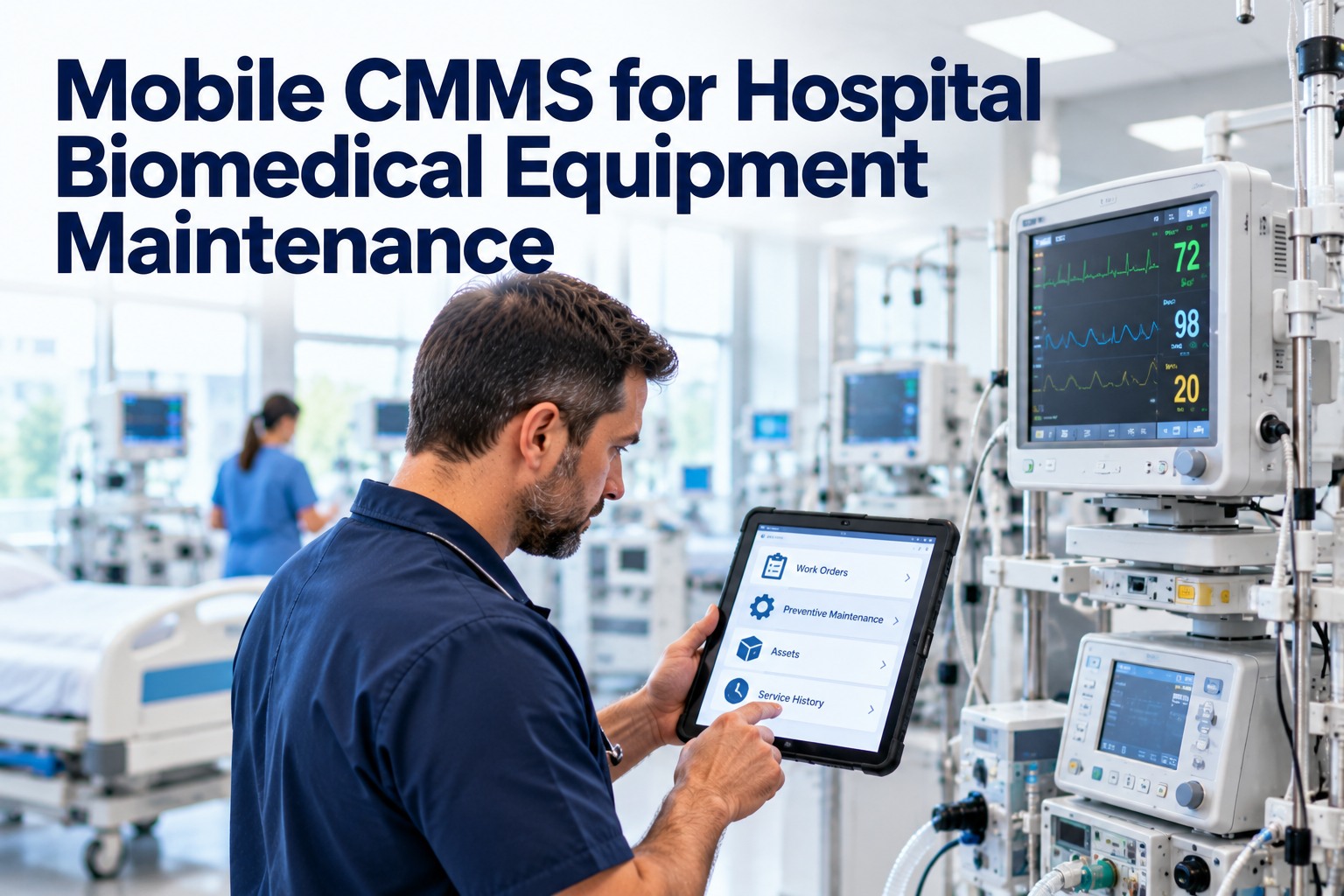
Oxmaint directly supports eight of the twelve trends described in this article: AI-assisted predictive work order generation, IoT sensor integration via OPC-UA and MQTT, real-time PM compliance dashboards for regulatory readiness, AEM program documentation at the asset level, service contract cost analysis from CMMS failure data, mobile-first work order management, energy and ESG reporting linked to maintenance records, and network device security attribute tracking. Oxmaint's development roadmap for 2026 includes digital twin integration via CMMS asset data export and CMMS-EHR integration for device downtime root cause linkage. Start a free account or book a demo to see the full feature set configured for your facility type.
The Hospitals Winning in 2026 Have Already Started
The maintenance trends reshaping healthcare operations are not waiting for laggards to catch up. Oxmaint is built to support the direction hospital maintenance is moving — predictive, connected, compliance-ready, and mobile. Start a free account today or book a 30-minute live demo to see what your facility's maintenance program looks like running on Oxmaint.