Ventilator Maintenance Checklist for ICU Safety

By Jack Edwards on April 2, 2026

ventilator-medical-device-maintenance-checklist

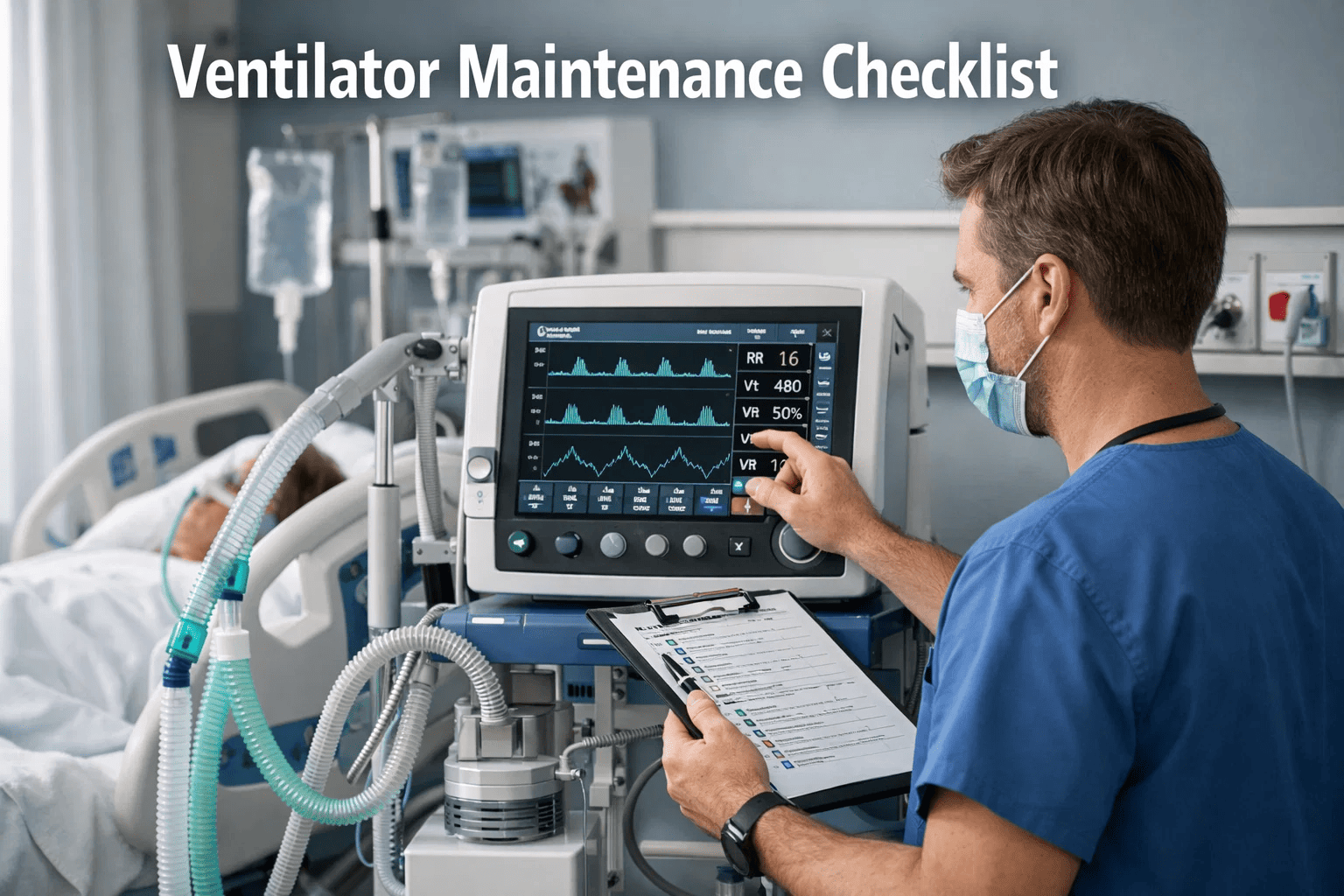
A ventilator failure in the ICU is not a maintenance inconvenience — it is a patient safety event. Studies show that 23% of ventilator-related adverse incidents are directly traceable to skipped or incomplete preventive maintenance steps. Yet across hospitals, the most common documentation of a ventilator check is a paper form with a single technician signature and no timestamp. This page is built for biomedical engineers, HTM technicians, and ICU facility teams who want a clinically rigorous, audit-ready approach to ventilator maintenance — one that satisfies TJC EC.02.04.01, AAMI standards, and manufacturer service intervals simultaneously. If your team is still tracking vent PMs in binders or disconnected spreadsheets, start a free trial or book a demo to see what digital, timestamped compliance looks like in practice.

ICU Equipment Safety · Biomedical Engineering · 2026

Complete Ventilator Maintenance Checklist for ICU Safety

A field-grade reference for biomedical engineers and HTM teams covering every maintenance interval, inspection category, and compliance requirement for life-critical respiratory devices.

23% Of ventilator adverse events linked to missed PM steps

$82K Average liability cost per ventilator-related incident

94% TJC survey pass rate with structured digital PM records

6 yrs Minimum documentation retention under CMS CoP standards
Get Started

Stop Managing Ventilator PMs on Paper

Every ventilator PM your team performs should generate a timestamped, technician-attributed, audit-ready record — automatically. If your current system cannot produce a complete vent maintenance history in under 60 seconds when a TJC surveyor walks in, that is a compliance gap that costs hospitals an average of $75,000 per citation. Oxmaint makes every checklist item a digital, immutable record tied to the asset. Start a free trial and run your first digital vent PM today, or book a demo to walk through a live compliance workflow with our healthcare team.

PM Framework

Ventilator Maintenance Intervals at a Glance

Ventilator PMs operate across four time horizons. Conflating them — or missing interval transitions — is the most common source of documentation gaps during TJC surveys. Each interval carries distinct inspection scope and documentation requirements.

Daily
Clinical Safety Check
Alarm limit verification — high/low pressure, apnea, FiO2
Circuit integrity and leak test
Humidifier water level and temperature
Battery charge status and backup power
External filter inspection — replace if visibly contaminated
Owner: Respiratory Therapy / Nursing
Weekly
Extended Clinical Check
Flow sensor calibration check and zero verification
Pressure transducer drift assessment
Exhalation valve seating and diaphragm condition
All audible and visual alarm function test
Patient data port integrity and waveform display accuracy
Owner: Respiratory Therapy with Biomed review
Monthly
Biomedical Inspection
Oxygen sensor electrochemical cell test and reading log
Full battery load test — runtime under simulated demand
Internal filter inspection per manufacturer specification
Electrical safety: ground bond resistance, leakage current
Tidal volume accuracy check at three flow settings
Patient circuit compliance compensation verification
Owner: Biomedical Engineering (HTM)
Annual / Per Mfr
Full Preventive Maintenance
Complete internal cleaning and sterilizable component service
Oxygen sensor cell replacement (or per hours logged)
All consumable seals, O-rings, and diaphragms replaced
Compressor/blower performance and pressure output test
Software and firmware version verification
Full calibration against traceable reference standards
Manufacturer self-test completion and pass documentation
Complete work order with technician digital signature
Owner: Biomedical Engineering — documented PM work order required
The Full Checklist

Annual Ventilator PM Checklist: 8 Inspection Categories

This is the full-scope annual PM checklist aligned to AAMI standards, TJC EC.02.04.01, and major manufacturer service requirements (Medtronic Puritan Bennett, Dräger, Hamilton, GE, Maquet). Each category must produce documented pass/fail findings with technician attribution and exact timestamp.

01
Visual Inspection & Physical Integrity
Confirm no physical damage that could compromise patient safety or device operation
Chassis, housing, and panel for cracks, dents, or broken mounts
Display screen — no dead pixels, cracks, or backlight failure
All controls, knobs, and touchscreen response — functional test
Power cord and strain relief — no fraying, kinking, or exposed conductor
Gas inlet connections — DISS fittings, thread integrity, no cross-thread
Patient circuit connectors — ISO 22 mm, no wear or deformation
Exhalation port and valve housing — no debris or biofilm accumulation
Wheels, brakes, and transport locking mechanism — secure and functional
02
Electrical Safety Testing
Per NFPA 99 and IEC 60601-1 — required annually for all patient-connected equipment
Earth ground bond resistance — must be <0.1 ohm (IEC 60601-1)
Chassis leakage current — normal condition, <100 µA
Chassis leakage current — single fault condition, <500 µA
Patient leakage current (applied parts) — <10 µA NC / <50 µA SFC
Isolation transformer output voltage and regulation within spec
Record all readings on calibrated safety analyzer with serial number
03
Oxygen Sensor & FiO2 Calibration
Critical life-safety check — FiO2 errors can cause hypoxia or oxygen toxicity
O2 sensor cell age — replace if > manufacturer life or reading unstable
Two-point calibration: 21% (room air) and 100% O2 reference
FiO2 accuracy at 21%, 40%, 60%, and 100% set points — tolerance ±3%
O2 sensor response time — reading stabilizes within 30 seconds of change
FiO2 alarm activation — high and low alarm at ±5% of set value
Record calibration gas lot number and expiry on work order
04
Flow, Volume & Pressure Accuracy
Core ventilation parameters — calibration error directly impacts tidal delivery accuracy
Tidal volume: 200, 500, 800 mL — verify ±10% of set value at each point
Peak inspiratory flow: low, medium, high — match set vs. delivered
Peak inspiratory pressure: 20, 40 cmH2O — transducer accuracy ±2 cmH2O
PEEP accuracy: 5, 10, 15 cmH2O — tolerance ±1 cmH2O
Mean airway pressure display vs. reference measurement
Inspiratory:Expiratory ratio display accuracy against set values
Patient circuit compliance compensation — verify algorithm active
Reference equipment: calibrated flow analyzer (e.g., Fluke VT305) — log S/N
05
Alarm System Verification
All alarms must activate within specified response time — non-functional alarms are an immediate patient safety risk
High pressure alarm — activates at set threshold, audible >60 dB at 1m
Low pressure / disconnect alarm — triggers within 15 seconds of circuit loss
Apnea alarm — activates after set apnea interval (test at 10 and 20 sec)
High/low FiO2 alarm — activates when O2 deviates beyond set limits
High/low minute volume alarm — VE above and below threshold
Power failure alarm — audible alert on AC loss, battery backup engages
Low battery alarm — activates at manufacturer-specified charge level
All visual alarm indicators (LED/display) — confirm color and priority coding
06
Battery & Power System
Transport and power failure safety — battery must sustain ventilation for minimum 30–60 min depending on model
Full charge cycle — confirm battery charges to 100% within rated time
Load test — run at simulated clinical load, record runtime to low-battery alarm
Battery capacity vs. manufacturer minimum — flag for replacement if <80%
Automatic switchover — AC disconnect to battery, confirm <20ms transition
Battery age and cycle count — log and compare to replacement threshold
Internal power supply voltages — within ±5% of rated output at each rail
07
Internal Components & Consumables
Consumable replacement drives long-term reliability — most manufacturer PM kits specify these at annual or hours-based intervals
Internal bacterial filter — inspect and replace per manufacturer interval
External inlet filter — replace or clean per condition and site protocol
Exhalation valve diaphragm — inspect for deformation, replace if specified
Inspiratory and expiratory valve seals — O-ring condition and replacement
Safety relief valve — test actuation pressure within manufacturer spec
Compressor or blower — pressure output, noise level, bearing condition
Record all parts replaced: part number, lot number, expiry on work order
Document firmware version — confirm matches current recommended release
08
Final Functional Test & Documentation Closure
No PM is complete without a full self-test pass and a timestamped, signed work order in the CMMS
Manufacturer self-test — run full automated sequence, confirm PASS status
Simulated patient breath cycle — confirm waveform, volume, pressure at display
Ventilation modes available — confirm all licensed modes initiate correctly
Circuit leak test — automated and manual, confirm <manufacturer leak spec
PM label affixed — date completed, next PM due, technician initials
Work order closed in CMMS with: tech name, timestamp, all findings, parts used
Open findings documented — any deferred item gets a linked corrective action
Digital signature applied — technician authorization confirmed in system
How Oxmaint Helps

From Paper Checklists to Audit-Ready Digital Records

Every item on this checklist should generate a digital, timestamped, immutable record — not a checkmark in a binder. Here is how Oxmaint operationalizes ventilator PM compliance for biomedical teams.

01
Digital Checklist Enforcement
Load this exact checklist into Oxmaint as a structured PM template. Technicians cannot close the work order until every mandatory field — pass/fail result, measurement value, part number — is populated. No more incomplete records reaching audit.
02
Exact Timestamp at Field Entry
Each checklist item is timestamped at the moment the technician enters the result in the field — on mobile, at the device. NFPA 99 and TJC require time-of-inspection, not date. Oxmaint captures both, immutably.
03
Asset-Linked PM History
Every PM record ties to the specific ventilator — by asset ID, serial number, and location. The full maintenance history, from acquisition through last PM, lives in one record. EC.02.04.01 compliance becomes a single export.
04
Overdue PM Escalation
Ventilators approaching PM due dates trigger automatic escalation — 30 days, 14 days, 7 days, and same-day alerts to the responsible biomedical team. Life-safety assets never go overdue without a documented decision.
05
GMP-Compliant Photo Attachments
Technicians attach photos of failed components, calibration analyzer readings, and PM label placement directly to the work order from their mobile device. Inspection photos are timestamped and cannot be altered after submission.
06
Survey-Ready Export in 60 Seconds
When a TJC surveyor asks for six months of ventilator PM records, generate a formatted compliance package — every PM work order, finding, part replaced, and technician signature — filtered by asset, date, or regulatory standard. No scramble.

Your HTM team is already doing the work. The question is whether it is creating defensible compliance or disappearing into a binder. Start a free trial and digitize your first ventilator PM template in under an hour, or book a demo to see a live compliance workflow built for biomedical engineering teams.

Before vs. After

Paper PM Records vs. Digital Audit Trails: The Real Gap

Audit Dimension Paper / Spreadsheet Oxmaint Digital PM
Record completeness 62% average — missing fields not enforced 100% — mandatory fields before closure
Timestamp accuracy Date only — exact time lost Exact timestamp at field entry
Technician attribution Signature only — often supervisor sign-off Digital signature linked to user account
Survey retrieval time 3–5 days of manual record pulling Under 60 seconds on-demand export
Overdue PM detection Found during survey or incident review Automated alert 30 days before due
Parts traceability Invoice only — not linked to asset record Part number, lot, expiry on work order

Ready to close the gap? Start a free trial or book a demo with our healthcare compliance team.

Outcomes

What Digital Ventilator PM Documentation Delivers

100%
Work Order Completeness
Mandatory field enforcement at closure eliminates partial records — the leading cause of EC.02.04.01 citations.
85%
Reduction in Compliance Penalties
Facilities with structured digital PM programs average 85% fewer compliance penalties versus paper-based counterparts.
40%
Less Documentation Time
Biomed technicians spend 40% less time on PM paperwork when checklists enforce structure at point of completion.
0
Missed PMs on Life-Safety Assets
Automatic escalation prevents any ventilator from going overdue without a documented decision and authorization trail.
FAQ

Frequently Asked Questions: Ventilator Maintenance

01 How often must ventilators be serviced under TJC and CMS requirements?

TJC EC.02.04.01 requires hospitals to maintain medical equipment per an established PM program tied to manufacturer recommendations, risk criteria, or an AAMI-compliant alternative equipment maintenance (AEM) strategy. For ventilators, manufacturer PM intervals are typically annual for full internal service, monthly for biomedical inspection, and daily/weekly for clinical safety checks performed by respiratory therapy. CMS Conditions of Participation align to state law for minimum retention but do not override manufacturer-required intervals for patient-connected life-safety devices. Any deviation from manufacturer-recommended PM frequency must be documented under an AEM strategy with written risk justification — not simply skipped.

TJC EC.02.04.01Annual + monthly intervalsAEM documentation required
02 What calibration equipment is required to perform a proper ventilator PM?

A complete annual ventilator PM requires a calibrated flow analyzer capable of measuring tidal volume, flow rate, pressure, and respiratory rate simultaneously — the Fluke VT305 and Rigel VENT-PRO are the most widely used in HTM practice. Electrical safety testing requires a patient safety analyzer meeting AAMI ES1 or IEC 60601-1 standards (Fluke ESA615, Metron QA-ES, or equivalent). For FiO2 calibration, a reference oxygen analyzer with certified calibration gases at 21% and 100% O2 is required. All reference instruments must have current calibration certificates traceable to NIST or equivalent national standards, and their serial numbers must be logged on the PM work order for complete traceability.

Calibrated flow analyzerNIST-traceable referencesLog instrument S/N on work order
03 Can Oxmaint handle different PM templates for different ventilator models?

Yes — Oxmaint supports model-specific PM templates tied to individual asset records. A PB 980 has a different PM procedure than a Dräger Evita or a Hamilton G5, with different parts lists, calibration tolerances, and self-test sequences. In Oxmaint, each ventilator model carries its own PM template with device-specific checklist items, field types (pass/fail, measurement entry, photo requirement), and consumable part numbers pre-loaded. When a PM work order generates for a specific asset, the technician receives the correct procedure for that exact model — eliminating the risk of applying a generic checklist to a model-specific requirement.

Model-specific templatesPer-asset PM assignmentPre-loaded parts lists
04 What documentation must be retained after each ventilator PM for TJC surveys?

For each completed ventilator PM, your documentation must include: the asset ID and serial number, the date and exact time of service, the name and credentials of the technician(s) who performed the work, every inspection item with its pass/fail finding or measurement result, all parts replaced with part numbers and lot numbers, the reference equipment used with serial numbers and calibration due dates, any findings deferred with documented justification and scheduled corrective action, and a technician digital signature on closure. TJC expects this to be retrievable on demand — not reconstructed from memory the day of a survey. Oxmaint generates this complete record automatically at work order closure, filterable by asset, date range, or regulatory category.

Asset ID + serial numberAll findings with valuesDigital signature required
Your Next TJC Survey Is Closer Than You Think

Turn Every Ventilator PM Into an Audit-Ready Record — Automatically

Oxmaint gives biomedical engineering teams the digital checklists, mandatory field enforcement, exact timestamps, and one-click survey exports to walk into any TJC, CMS, or state inspection fully prepared. No lengthy onboarding, no implementation fees, and no paper binders. Complete, compliant ventilator PM documentation from day one — across every asset, every technician, and every site.
Share This Story, Choose Your Platform!