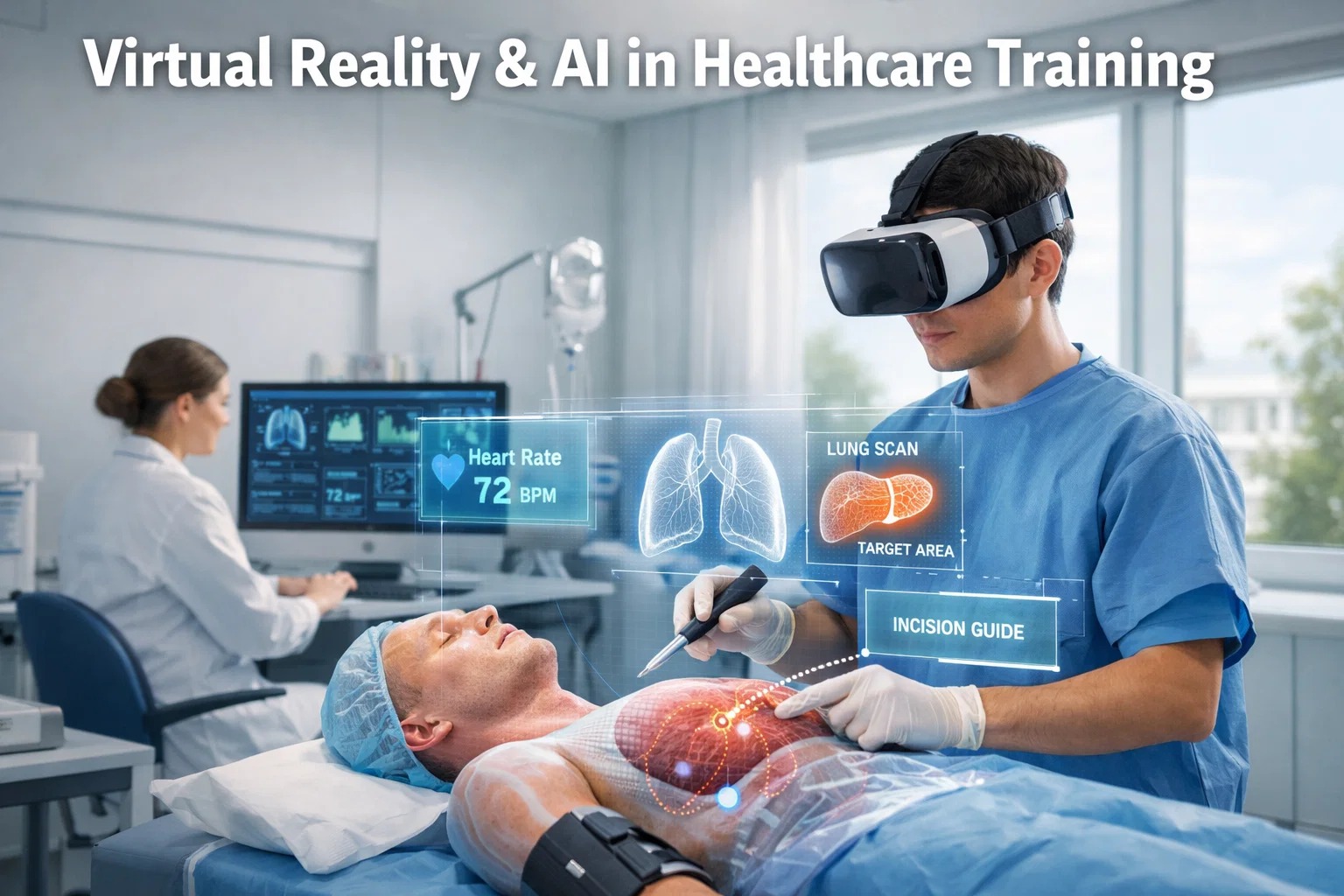
Healthcare is undergoing one of its most profound transformations in decades — not inside operating theatres or ICUs, but inside training rooms equipped with headsets, haptic gloves, and AI engines that adapt in real time. Virtual Reality and Artificial Intelligence are converging to create simulation environments where surgeons can rehearse complex procedures 200 times before touching a live patient, where nurses can respond to cardiac arrests without risking a single life, and where medical students build clinical intuition that textbooks simply cannot deliver. The stakes are clear: medical errors remain among the leading causes of preventable death globally. Every advancement in training quality is a direct investment in patient safety. Start a free trial for 30 days and explore how smarter operations support better healthcare outcomes, or book a demo to see it in action.
Virtual Reality and AI in Healthcare Training
Immersive Simulation for Surgeons, Nurses, and Medical Professionals
See How Oxmaint Keeps Your Simulation Lab at 99%+ Uptime
One unplanned VR server failure cancels an entire training cohort. Oxmaint's preventive maintenance engine, asset lifecycle tracking, and 5-year CapEx forecasting give facility managers full control — from individual headset calibration schedules to portfolio-level simulation infrastructure planning. No heavy implementation. Start in days.
What Is VR and AI-Based Healthcare Training?
Virtual Reality in healthcare training is the use of immersive, computer-generated environments that simulate real clinical scenarios — allowing medical professionals to practice procedures, diagnose conditions, and make critical decisions without any risk to actual patients. When combined with Artificial Intelligence, these simulations become adaptive: the system monitors performance, identifies weaknesses, adjusts difficulty, and provides real-time corrective feedback that a human instructor cannot always deliver at scale.
This is not the future. Hospitals in the USA, UK, UAE, and Germany are actively deploying VR simulation labs. Medical universities are replacing traditional mannequin labs with AI-driven environments where digital patients breathe, bleed, and react. For facility and operations managers, this shift means new infrastructure to maintain, new equipment lifecycles to plan, and new compliance standards to meet. Start a free trial to see how Oxmaint helps manage simulation lab assets end to end, or book a demo with our healthcare specialist today.
360-degree clinical scenarios replicated with haptic feedback and spatial audio
Real-time analysis of trainee decisions, technique, speed, and accuracy
Personalised difficulty paths driven by machine learning competency models
Timestamped training logs used for credentialing, compliance, and accreditation
The Four Pillars of AI-Driven Medical Simulation
Every high-performing healthcare training programme built on VR and AI operates across four interconnected pillars. Each one drives measurable outcomes in clinical competency and patient safety.
Multi-fidelity environments — from laparoscopic surgery suites to emergency triage bays — that replicate pressure, noise, time constraints, and team dynamics. Studies show 68% better situational awareness vs. skills labs.
Machine learning models track every trainee movement, decision delay, and protocol deviation. Instructors receive granular dashboards — not just pass/fail. Objective scoring removes assessor bias entirely.
Physiologically accurate AI patients that respond to interventions in real time. These models replicate rare conditions — septic shock, anaphylaxis, rare paediatric presentations — that trainees may encounter only once per decade in real practice.
AI engines personalise each training session based on prior performance data. A trainee struggling with suture tension receives targeted repetition. One excelling gets complexity escalation. 55% faster time-to-competency on average.
Surgical teams, anaesthesiologists, and scrub nurses train together inside the same virtual theatre. Crisis resource management scenarios reveal communication breakdowns before they occur in real operations rooms.
Training records sync with hospital credentialing systems. Automatic documentation for OSHA, CQC, and NABH standards. Audit logs are generated without manual entry — saving 12+ admin hours per trainee per year.
Why Traditional Healthcare Training Is Failing
The pressure to train more clinicians faster, at lower cost, with better outcomes is intensifying globally. Traditional methods are hitting structural limits that no amount of extra budget can solve.
Cadaver labs cost $400–$700 per session. Simulated patient programs run $1,200+ per trainee annually. VR simulation reduces per-session costs by up to 62% once infrastructure is in place.
A surgical resident may see only 2–3 rare haemorrhagic presentations in a 5-year training programme. AI simulation generates thousands of scenarios on demand. Competency gaps close before trainees reach independent practice.
Traditional assessors introduce 23–31% inter-rater variability in surgical skills scoring. AI removes this entirely — every trainee is measured against the same objective benchmarks, every session, without fatigue or bias.
A VR headset failure, haptic glove calibration fault, or server outage cancels entire training cohorts. Without preventive maintenance schedules for simulation hardware, hospitals experience 18–24% unplanned downtime in simulation labs annually.
Training data sits in multiple LMS platforms, paper sign-off sheets, and email chains. When a trainee moves between hospitals, competency history is lost. Credentialing teams spend 6+ hours per clinician reconciling records manually.
VR headsets, haptic systems, and AI servers degrade on 3–5 year lifecycles. Without rolling asset forecasting, hospitals face sudden capital expenditure spikes — budget surprises that delay equipment replacement and extend training gaps.
These are not technology problems. They are operations and asset management problems. The simulation hardware is as mission-critical as an MRI scanner — it demands the same maintenance rigour. When your simulation lab is down, training stops, competency degrades, and patient risk rises. Start a free trial and take control of your simulation asset lifecycle, or book a demo to see Oxmaint's healthcare module in action.
How Oxmaint Supports Healthcare Simulation Operations
Keeping VR simulation labs operational, compliant, and CapEx-planned is a maintenance management challenge. Oxmaint gives healthcare facility teams the same operational backbone that industrial plants rely on — purpose-built for multi-site hospital portfolios.
Register every VR headset, haptic glove, AI server, and display system with condition scoring, install date, and warranty tracking. Never lose visibility of a single simulation asset across multiple campus locations.
Trigger maintenance tasks by usage hours, training sessions completed, or calendar intervals. Calibration schedules for haptic systems, lens cleaning for headsets, and firmware update cycles — all automated and audit-ready.
When simulation equipment fails, a work order is created, assigned, and tracked from fault report to resolution. Full technician history is stored against each asset — critical for compliance audits and warranty claims.
Connect simulation servers and environmental systems to Oxmaint via IoT sensors. Receive alerts when temperature, power draw, or connectivity thresholds deviate — before they cause a training session disruption.
Rolling CapEx models built on asset condition data tell you exactly when a VR system generation needs replacement. No budget surprises. Present investor-grade forecasts to hospital boards with a single export.
Digital signatures, inspection checklists, and timestamped maintenance records meet NABH, CQC, and OSHA documentation standards. Every simulation lab inspection is logged, searchable, and exportable in minutes.
Traditional Training vs. VR and AI Simulation
The performance gap between conventional healthcare training methods and immersive AI-driven simulation is no longer marginal. The data is definitive.
| Training Dimension | Traditional Training | VR + AI Simulation |
|---|---|---|
| Cost per Training Session | $400 – $1,200 | $45 – $180 (post-setup) |
| Skill Retention at 90 Days | 34% | 72% |
| Rare Case Scenario Access | Limited (2–5 per residency) | Unlimited on-demand |
| Performance Assessment Bias | 23–31% inter-rater variability | Zero — fully objective scoring |
| Time to Clinical Competency | Baseline (100%) | 45% faster average |
| Multi-Trainee Simultaneous Use | Limited by physical resources | Scalable, concurrent sessions |
| Training Record Compliance | Manual, paper-based, fragmented | Automated, timestamped, auditable |
| Equipment Downtime Risk | Physical mannequins — low frequency | High-spec tech — requires CMMS |
The technology advantage is clear — but institutions that invest in VR simulation without investing equally in equipment maintenance infrastructure are trading one risk for another. Simulation lab downtime erodes every cost and time benefit the technology promises. Oxmaint keeps those labs running. Start a free trial to protect your simulation investment, or book a demo and see exactly how Oxmaint reduces simulation asset downtime.
ROI Results: VR Simulation Backed by Operational Excellence
The return on VR and AI simulation investment compounds when the underlying infrastructure is maintained with precision. These are the numbers healthcare organisations report when training technology and asset management work together.
Where VR and AI Simulation Is Delivering Results Today
Across specialties and geographies, immersive simulation is moving from pilot programme to clinical standard. These are the highest-impact applications generating measurable outcomes in 2025 and 2026.
Residents complete 300+ simulated procedures before their first supervised live case. Haptic feedback systems replicate tissue resistance. AI tracks instrument pressure, entry angle, and economy of motion. Institutions report 29% fewer intraoperative errors in VR-trained cohorts.
VR nursing programmes reduce clinical placement hours required by 38% while improving scores on OSCE assessments. Trainees practice IV insertion, medication administration, and rapid response scenarios in adaptive environments that scale difficulty to their progression.
Emergency departments in the UK and UAE are using multi-user VR environments to train full trauma teams simultaneously. The AI tracks individual decision timing, communication quality, and protocol adherence — providing post-simulation debriefs that static training cannot replicate.
Difficult airway management simulation has reduced failed intubation rates by 19% in VR-trained anaesthesia cohorts. AI engines generate unexpected complications mid-procedure — patient deterioration, equipment failure, physiological anomalies — to build crisis management muscle memory.
Your Simulation Lab Is Mission-Critical Equipment. Treat It That Way.
Healthcare organisations investing in VR and AI simulation are gaining a decisive training advantage — but only when the underlying equipment stays operational. One unplanned simulation server failure can cancel a week of training rotations. Oxmaint gives facility and operations managers the preventive maintenance engine, asset lifecycle tracking, and CapEx forecasting tools to keep simulation infrastructure running at 99%+ uptime. No heavy implementation. No long onboarding. Start in days, not months.
VR and AI Healthcare Training — Questions Answered
How does AI personalise a VR healthcare training session in real time?
AI personalisation works through a competency model built from thousands of prior training sessions. As a trainee interacts with the simulation, the engine scores every action against procedural benchmarks — measuring decision latency, technique accuracy, communication quality, and protocol adherence. If the trainee's performance indicates a specific competency gap, the AI immediately adjusts the scenario to provide targeted repetition. If the trainee is excelling, complexity escalates. The result is a 55% faster average time-to-competency versus fixed curricula, because no trainee wastes time on skills they have already mastered. Most platforms process these adjustments within 200 milliseconds — effectively invisible to the trainee. Oxmaint supports the operations layer behind these platforms by keeping simulation servers and hardware maintained and at peak availability. Start a free trial or book a demo to see the maintenance module designed for healthcare simulation labs.
What is the typical return on investment for VR simulation in a hospital training programme?
ROI on VR simulation investment typically reaches break-even within 18–30 months for hospitals training 50 or more clinical staff annually. The primary cost drivers that VR eliminates or reduces are cadaver and manikin lab costs ($400–$700 per session), external simulation centre fees, and the extended supervised practice time required when trainees have insufficient scenario exposure. Institutions report training cost reductions of 45–62% post-deployment. The compounding ROI driver is patient safety — measurable reductions in preventable adverse events reduce litigation costs, extended stay costs, and readmission penalties. In Australia and Germany, where regulatory compliance mandates are strict, the audit-ready training records generated by AI simulation also reduce administrative labour costs by 12–15 hours per trainee annually. Keeping simulation equipment operational through preventive maintenance is essential to achieving these returns — downtime directly delays training cohorts and erodes the cost advantage VR provides.
How does VR simulation meet healthcare compliance requirements in the USA, UK, and UAE?
Regulatory compliance for healthcare training simulation varies by region but shares a common requirement: verifiable, timestamped evidence that specific competencies were achieved. In the USA, OSHA and Joint Commission standards require documented training for procedures involving risk. In the UK, CQC and Health Education England frameworks mandate structured competency assessment records. In the UAE, HAAD and DHA accreditation processes require standardised simulation logs for procedural credentialing. AI-driven VR platforms generate all of this documentation automatically — every session is logged, scored, and stored with digital signatures. Oxmaint complements this by maintaining the simulation equipment audit trail: calibration records, maintenance logs, and inspection certifications that regulators require for accreditation of simulation-based training programmes. Start a free trial and see how our compliance documentation module works, or book a demo with our healthcare compliance specialist.
What maintenance challenges are specific to VR and AI simulation hardware in healthcare settings?
Healthcare simulation hardware has unique maintenance demands that standard IT asset management tools are not designed to handle. VR headsets require lens cleaning and sanitisation between every user session — a hygiene requirement that doubles as a maintenance touchpoint. Haptic feedback systems need regular calibration checks, as drift in force feedback accuracy directly compromises training validity. AI simulation servers operate under sustained compute loads that accelerate thermal degradation — requiring stricter temperature monitoring and cooling maintenance than standard server environments. Battery systems in wireless headsets degrade on 300–500 charge cycles, requiring proactive replacement planning rather than reactive replacement. Overall, simulation labs that operate without a formal preventive maintenance schedule experience 18–24% more unplanned downtime than labs on structured PM regimes. Oxmaint addresses all of these through production-based maintenance triggers (sessions completed, hours of use, charge cycles), IoT sensor alerts for temperature thresholds, and rolling CapEx models that plan hardware replacement 3–5 years in advance. No budget surprises, no training disruptions.
Ready to Protect Your Simulation Investment?
Oxmaint is already trusted by maintenance teams managing complex, multi-site healthcare and industrial portfolios. Our platform is mobile-first, zero heavy implementation, and purpose-built to give operations managers the asset visibility, PM scheduling, and CapEx forecasting they need to eliminate unplanned downtime. If your hospital or training institution is deploying VR and AI simulation technology, the operations backbone needs to match the clinical ambition. Join the teams already running their simulation labs on Oxmaint — start a free trial today and see the difference in 30 days, or book a personalised demo with a healthcare operations specialist.


.png)