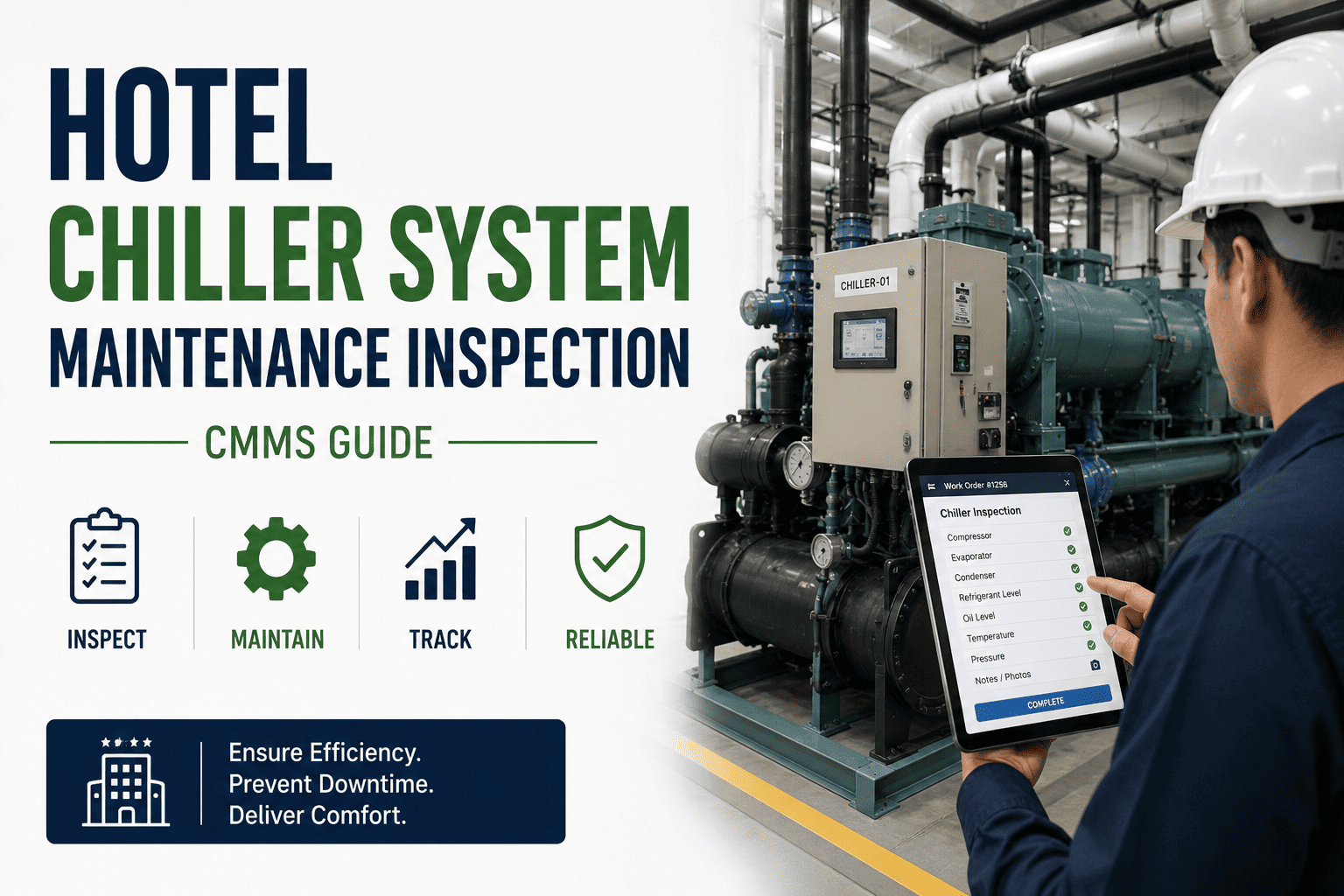
Central chiller plants typically account for 35–50% of a full-service hotel's electricity consumption, making them the single largest energy asset on the property — and the most consequential point of failure. A single chiller trip on a 95°F July afternoon can push 300+ guest rooms above 78°F within hours, triggering refunds, comped nights, and negative reviews that linger for months. This guide walks through a complete hotel chiller maintenance and inspection program, from seasonal PM and condenser tube cleaning to refrigerant charge verification and controls optimization, all scheduled and documented inside a CMMS. Ready to digitize your chilled-water plant reliability? Start Free Trial and build your first chiller PM calendar in under an hour.
Can your central plant survive a July heat wave without a single guest complaint?
One unscheduled chiller outage during peak cooling season can take an entire hotel offline — costing $15K–$60K per day in lost revenue, comped rooms, and emergency repair premiums. A CMMS-driven maintenance program keeps chilled water available through every occupancy surge at the lowest possible energy cost.
The 12-month chiller maintenance calendar
Hotels that follow a seasonally-tuned PM calendar experience 60% fewer unplanned chiller shutdowns. Below is a month-by-month framework engineered for lodging properties — each phase scheduled, assigned, and auto-escalated inside a CMMS.
Eddy-current tube inspection, refrigerant leak survey, oil analysis, controls calibration, and capacitor bank checks. Lock-out chillers in rotation so the plant stays online at 30% redundancy.
Condenser tube brush cleaning, cooling tower descaling, water treatment rebalancing, and full controls logic review. Verify staging sequences and reset schedules before the first 80°F day.
Weekly log review (approach temperature, refrigerant saturated temp, oil pressure), daily vibration spot-checks, and trending-based alerts. The CMMS auto-generates work orders when approach temp drifts beyond 3°F.
Partial load optimization, compressor overhaul scheduling, refrigerant recovery for seasonal storage, and a year-end reliability report exported directly from CMMS history for capex planning.
Tiered chiller PM checklist for hotel engineering teams
Organize tasks by frequency and skill level so the on-property team handles recurring work while specialists tackle quarterly and annual deep inspections. Every item below becomes a templated work order inside the CMMS.
- Log chilled-water supply & return temps
- Record approach temperature on each circuit
- Check oil level, pressure, and refrigerant sight glass
- Inspect for unusual vibration or noise at compressor
- Verify cooling tower makeup water flow
- Confirm BMS staging and alarms are active
- Refrigerant charge verification (superheat / subcooling)
- Condenser water treatment chemistry panel
- Pump motor amperage and seal inspection
- Clean condenser coil fins and verify airflow
- Test safety controls (low-pressure, high-pressure)
- Export CMMS trend report for review
- Eddy-current tube inspection (every 3–5 yrs)
- Mechanical and chemical tube cleaning
- Compressor oil change and analysis
- Refrigerant leak detection (electronic + dye)
- Vibration analysis and bearing assessment
- Controls retrofit and sequence optimization
The cost of one July chiller failure
A 412-room full-service resort in the Southeast ran a 600-ton centrifugal chiller on a reactive-only maintenance plan. When the compressor seized on a 96°F Saturday — three weeks past an overdue oil analysis — the fallout was immediate and quantifiable.
Optimizing chiller performance between PM events
Maintenance keeps the plant alive; optimization keeps it efficient. Hotels that continuously tune chiller sequencing and reset schedules typically cut chiller energy use by 12–22% without any capital investment. These four levers are tracked as KPIs inside the CMMS dashboard.
When condenser approach exceeds 3°F above design, the CMMS auto-generates a tube-cleaning work order. Every 1°F reduction in approach saves roughly 1.5% in chiller energy.
Modern centrifugal chillers should achieve 0.5–0.6 kW/ton at 50–70% load. Trending this metric weekly in the CMMS flags refrigerant loss, fouling, or controls drift early.
Raising supply water setpoint from 42°F to 56°F during low-load hours reduces compressor lift and saves 5–8% annually — automated through the BMS and logged in the CMMS.
Maintaining design condenser flow and a 10°F temperature range across the tower maximizes heat rejection. Flow deviations are flagged by CMMS integration with BMS trending data.
Turn your chiller plant into a reliability asset
Schedule a 30-minute walkthrough and see how OxMaint auto-generates your full chiller PM calendar, tracks approach-temperature alerts, and builds audit-ready maintenance history.
Hotel chiller maintenance — common questions
Daily operator walkarounds capture running parameters, monthly technician checks verify refrigerant charge and water chemistry, and annual deep inspections cover tube cleaning, oil analysis, and eddy-current testing. The CMMS auto-schedules each tier and escalates overdue tasks to the Chief Engineer so nothing slips through peak season.
Condenser tube fouling and untreated water chemistry account for roughly 40% of unscheduled chiller trips in hotels. As approach temperature rises, compressor energy climbs and head pressure trips eventually force a shutdown. Weekly approach trending in the CMMS catches this drift weeks before a failure occurs.
Yes — when PM is scheduled, assigned, and tracked in a CMMS, overdue tasks become visible to leadership instead of buried in a clipboard. Hotels using OxMaint report 60% fewer unplanned shutdowns because oil analysis, vibration surveys, and tube cleanings happen on calendar triggers, not memory. Book a Demo to see the chiller PM template in action.
Properties that implement chilled-water reset, condenser-water optimization, and staging-logic review typically reduce chiller energy consumption by 12–22%. For a 500-ton plant running 4,500 equivalent full-load hours annually at $0.12/kWh, that translates to $32,000–$59,000 per year — often recovered within the first cooling season.
Inspectors typically want dated logs of refrigerant inventory (EPA Section 608), pressure-vessel inspections, water treatment reports, safety-control tests, and eddy-current tube surveys. A CMMS like OxMaint stores every work order, reading, and attached report against the asset record, producing an audit-ready history in seconds. Start Free Trial to digitize your plant records today.
Build your chiller PM calendar this week
Join hundreds of hotel engineering teams using OxMaint to keep chilled water flowing through every peak-season surge — at the lowest possible energy cost.
Free 14-day trial · No credit card