A housekeeper spots a leaking pipe and calls the front desk. The front desk calls engineering. Engineering calls back to confirm the room number. By the time a technician arrives, 40 minutes have passed and the guest has already left a note at reception. This is how most hotels handle maintenance requests today — and it is why 47% of guest complaints trace directly to maintenance failures. An AI chatbot connected to your CMMS collapses that chain to a single message and a 30-second work order, from any channel, in any language, at any hour.
Every Maintenance Request Becomes a Work Order Instantly
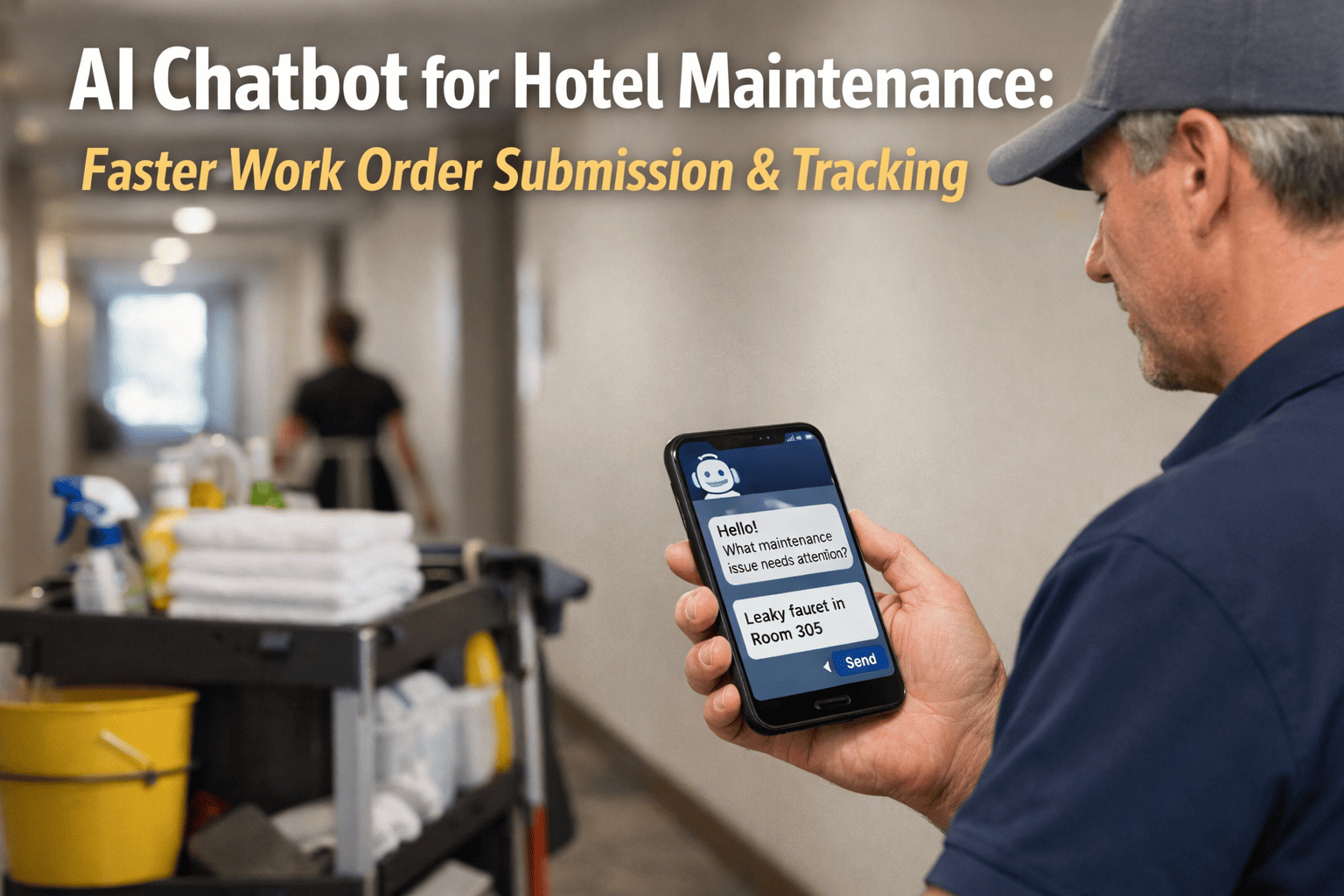
OxMaint's AI chatbot interface connects guests, housekeeping, front desk, and engineering on one intake channel — converting natural language reports into structured work orders, automatically routed and tracked to resolution.
The Problem With How Hotels Report Maintenance Issues Today
Most hotel maintenance requests travel through a chain of verbal handoffs — guest to front desk, front desk to engineering, engineering to technician — before a single structured record is created. Each handoff introduces delay, ambiguity, and the possibility that the original description gets distorted or lost entirely. The result is slow response times, misrouted work orders, and a paper trail that does not exist until someone manually enters data into a system they may not be near. An AI chatbot with direct CMMS integration eliminates every link in that chain. Sign up free to see how OxMaint structures chatbot intake for your property today.
What a Maintenance AI Chatbot Actually Does
A maintenance AI chatbot is not a FAQ bot. It is a conversational intake interface that accepts plain language from any user — "the AC in 412 smells burnt," "there's water under the sink in my room," "the gym treadmill is making a grinding noise" — and converts that description into a complete, structured work order inside the CMMS without any human operator involved. The distinction from a basic ticketing form is significant. The chatbot asks clarifying questions, understands context, and handles ambiguous descriptions that a form field cannot process. Book a demo to walk through a live intake conversation for your property type.
Every Staff Role Has a Different Interface — The Chatbot Handles All of Them
Different hotel roles interact with maintenance differently. A housekeeper notices a physical defect mid-clean. A front desk agent receives a verbal complaint from a guest at check-in. A duty manager spots an equipment fault during a rounds walk. An AI chatbot adapts its intake flow to each context — asking relevant clarifying questions and routing work orders with the right priority for each role and scenario.
Reports defects found during room turns — damaged fixtures, HVAC issues, plumbing faults. Chatbot confirms room number, logs findings against the asset, and notifies housekeeping supervisor of any rooms that cannot be released until repair is complete.
Logs guest-reported issues relayed verbally during check-in, check-out, or phone calls. Chatbot classifies the issue, sets priority based on room occupancy status, and creates the work order — without the agent switching between systems or filling out a separate maintenance form during a busy shift.
Technicians receive chatbot-generated work orders directly on their phone with full context — asset ID, location, fault description, required parts, and procedure. They can update status, add findings, attach photos, and close work orders from the field without returning to a desk or making a call.
Receives real-time alerts for high-priority and overdue work orders. Can query the chatbot for status updates across any open job by room, floor, or asset type without navigating the full CMMS dashboard. Escalation and reassignment happen through a single message.
Deployment Channels: Where the Chatbot Lives
A maintenance chatbot delivers value only where the people reporting issues actually are. OxMaint's intake interface deploys across every touchpoint where maintenance issues surface — from in-room QR codes to staff WhatsApp to the front desk desktop. One consistent intake experience, regardless of how the report originates. Sign up free to configure your first intake channel.
A QR code on the TV card, welcome booklet, or bathroom mirror opens the chatbot in the guest's browser — no app download required. Guests describe the issue in plain language, receive an immediate acknowledgment, and get an estimated response time. The property responds faster and the guest feels heard before picking up the phone.
WhatsApp messages are opened over 90% of the time — far higher than email or in-app notifications. Staff who already use WhatsApp can report issues without switching apps. Guests who prefer messaging over calls get the response speed they expect. Multilingual support means no language barrier for international guests or non-English speaking staff.
Front desk agents handle verbal complaints from guests during check-in and check-out without leaving their PMS screen. The chatbot interface sits alongside existing tools and creates the work order in the background — capturing the asset, location, fault type, and priority from a brief natural language description in under 60 seconds.
Technicians receive work orders on mobile, can voice-note or text additional findings mid-repair, and close jobs with photo evidence from the field. Offline capability means basement and plant room access is never a dead zone for data capture. All entries sync automatically when connectivity is restored.
From Chat Message to Closed Work Order: The Full Lifecycle
Report Received in Natural Language
A guest, housekeeper, front desk agent, or technician sends a plain language message through any intake channel. No form fields, no maintenance terminology required — "the light above the mirror is flickering" is enough.
AI Classifies, Clarifies, and Structures
The NLP engine identifies the asset type, fault category, location, and urgency from the message. Where information is ambiguous, the chatbot asks one clarifying question — never a long form. Misrouted work orders are reduced by up to 67% compared to free-form manual entry.
Work Order Created in OxMaint
A complete work order is auto-generated with asset ID, location, fault type, priority level, reporter details, and timestamp. No manual entry required. The work order is available in the CMMS dashboard, on the assigned technician's mobile device, and in the duty manager's real-time view — simultaneously.
Technician Assigned and Scheduled
The system routes the work order to the right technician by skill, shift, and live workload. Occupancy data from the PMS determines whether the repair can proceed immediately or is scheduled for a check-out window. The technician is notified on mobile with the full job context.
Reporter Receives Status Updates
The guest or staff member who reported the issue receives automatic status updates through the same channel they used to report — acknowledged, in progress, resolved. No follow-up calls to engineering, no chasing the front desk. The feedback loop closes without any additional human action.
Pattern Data Surfaces Preventive Triggers
Chatbot data aggregates across rooms, asset types, floors, and time periods. When the same HVAC fault appears in three east-facing rooms over two weeks, the system flags a preventive maintenance task automatically — converting a pattern of reactive repairs into a single scheduled intervention.
Frequently Asked Questions
Does the AI chatbot work for non-English speaking staff?
Yes. OxMaint's chatbot interface supports multilingual input — staff can report in their preferred language and the system classifies and structures the work order in the CMMS regardless of the language used. This is particularly relevant for housekeeping and F&B teams in international hotel environments where English is not the primary working language.
Can guests use the chatbot without downloading an app?
Yes. Guest-facing intake via QR code opens a browser-based chatbot interface — no app download, no account creation, no friction. The guest scans, types their issue, and receives an acknowledgment. WhatsApp intake requires no account creation either — guests simply message from their existing app. Sign up free to configure your first guest intake channel.
What happens when the chatbot cannot classify an issue confidently?
When the AI confidence score falls below a defined threshold, the work order is flagged for engineering supervisor review before dispatch rather than auto-routing. The supervisor sees the original message, the AI's suggested classification, and can confirm or correct it in one tap. The escalation path is always available, and 75% of hotel chatbot conversations resolve without any human intervention at all.
How does the chatbot know which technician to assign?
OxMaint routes work orders based on the technician's skill certifications relevant to the fault type, their current shift status, and their live workload at time of assignment. Occupancy data from your PMS also determines the scheduling window — so the right person gets the job at the right time, without a dispatcher manually checking three separate systems. Book a demo to see the routing logic for your team configuration.
Does the chatbot integrate with existing hotel messaging platforms?
Yes. OxMaint's chatbot intake connects with WhatsApp Business API, in-app hotel messaging, and web-based interfaces. For hotels already using a guest messaging platform, the chatbot layer can be configured to intercept maintenance-specific messages and route them to the CMMS while non-maintenance messages continue to the existing platform. Integration architecture is confirmed during the onboarding call.
Stop the Phone Chain. Start the Work Order.
OxMaint's AI chatbot connects every reporting channel — guest QR codes, staff WhatsApp, front desk desktop, and technician mobile — into one intake flow that creates work orders instantly, routes them automatically, and closes the feedback loop without a single phone call. Start free and have your first intake channel live this week.