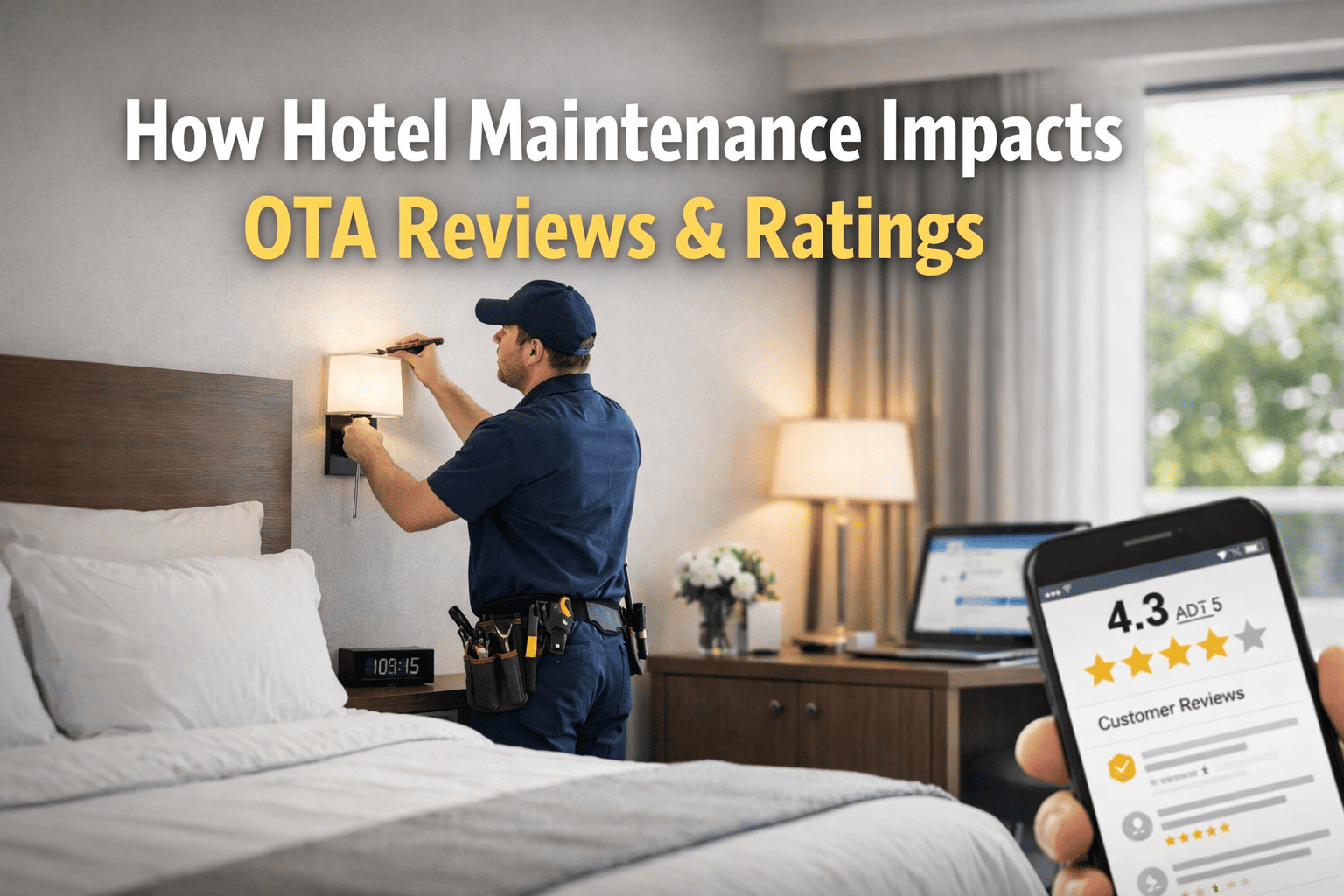
When a guest's air conditioning fails mid-stay, the maintenance ticket isn't the only thing that opens — a one-star review is already forming. Across OTA platforms, maintenance-related failures are among the top three drivers of negative ratings, and a single 0.5-point drop in your Booking.com or TripAdvisor score can reduce booking conversion by up to 12%. Start your free trial to see how Oxmaint prevents the maintenance failures that become the reviews you can't afford.
The Data: How Maintenance Directly Moves Your OTA Score
OTA ratings are not abstract sentiment — they are the mathematical output of guest experiences. And maintenance-related failures are disproportionately represented in the negative reviews that pull those scores down. The link isn't anecdotal. It is measurable, predictable, and preventable.
81%
of travelers check OTA reviews before booking — and rate cleanliness and facility condition as top factors
1 in 4
guest reviews across 50,000+ hotels mention cleanliness or facility condition as a significant factor
48%
of travelers write reviews after negative experiences — compared to just 40% after positive stays
52%
of guests will file a complaint, leave a negative review, or warn others when a facility expectation goes unmet
The Maintenance-to-Review Failure Chain
Every unplanned equipment failure has a predictable downstream path. Understanding where maintenance breakdowns enter the OTA score is the first step to interrupting the chain before it reaches a guest-facing platform.
Missed PM or deferred repair
HVAC filter overdue. Shower drain ignored. Elevator lubrication skipped. The work order never opened because the schedule didn't exist.
In-room equipment failure during guest stay
Guest checks in. HVAC doesn't cool. Wi-Fi drops. Shower drains slowly. The problem that could have been fixed on Tuesday is now happening to a paying guest on Friday night.
Front desk complaint — slow response
Guest calls front desk. Maintenance ticket created on paper or verbal. Technician not notified for 2 hours. Guest's frustration compounds with every unanswered follow-up call.
Post-checkout OTA review published
"Room was hot all night." "Shower wouldn't drain." "Waited 3 hours for maintenance." Each line drops the score — on a platform seen by every future booker.
OTA algorithm demotes listing — bookings fall
Platforms weight review recency and sentiment. A cluster of maintenance-driven negatives pushes the property down search results — compounding the revenue impact beyond the complaint itself.
Break the Chain Before It Reaches Your OTA Score
Oxmaint's hotel maintenance platform prevents guest-facing failures at the source — condition-based PM schedules, automated work order routing, and room readiness sign-offs before every check-in. Book a demo to see the guest experience protection workflow.
Top Maintenance Failures That Appear in OTA Reviews
Analysis of review text across major OTA platforms consistently surfaces the same failure categories. These are not random — they are the direct output of deferred maintenance and reactive-only operations.
01
HVAC & Climate Control
"room was too hot"
"AC didn't work"
"no heat in winter"
Most common maintenance complaint category across all OTA platforms. Comfort is non-negotiable — guests sleep in the room.
02
Plumbing & Bathroom
"slow drain"
"dripping tap"
"no hot water"
Bathroom failures feel deeply personal. Guests interpret plumbing issues as evidence of systemic neglect — not isolated incidents.
03
Wi-Fi & In-Room Tech
"Wi-Fi kept dropping"
"TV didn't work"
"no USB charging"
Business and leisure travelers now treat connectivity as infrastructure. Failed in-room tech generates reviews disproportionate to its cost to fix.
04
Elevator & Common Areas
"elevator was broken"
"pool was closed"
"gym equipment broken"
Shared facility failures affect every guest simultaneously. Pool closures during peak season or broken elevators in high-rise properties generate cluster complaints.
05
Cleanliness & Housekeeping-Adjacent
"mold in bathroom"
"musty smell"
"stained fixtures"
Often rooted in deferred maintenance — grout sealing, ventilation servicing, drainage clearance. Guests classify these as cleanliness, but the fix sits with maintenance.
06
Response Time to In-Stay Complaints
"waited 3 hours"
"no one came"
"issue never resolved"
Even when equipment fails, fast response recovers the review. 79% of guests expect a response within 24 hours — slow routing turns a fixable problem into a permanent 1-star.
How Oxmaint Protects OTA Scores Through Maintenance Operations
Oxmaint turns hotel maintenance from a reactive cost centre into a proactive OTA score protection system. Every module is built to catch failures before they reach a guest room.
01
Guest-Impact Asset Prioritisation
HVAC, plumbing, elevators, pool systems, and in-room electronics are classified as top-priority assets with tighter PM intervals and faster escalation rules. Guest-facing equipment failure rates reduce 40–55% within 90 days.
Result: 40–55% fewer guest-facing failures within 90 days
02
Room Readiness Sign-Off Before Every Check-In
Every room passes a maintenance checklist before assignment — HVAC function, plumbing flow, TV and in-room tech, lighting. Rooms that fail are flagged to front desk automatically before a guest is assigned. Issues are caught at housekeeping, not reported by the guest at midnight.
Result: Room-related complaints eliminated at the source
03
Automated Work Order Routing — No Lost Tickets
When housekeeping or front desk staff log a room issue on mobile, a work order is created, assigned to the right technician, and tracked to completion automatically. No paper slips. No inbox requests that sit unread for 4 hours while a guest waits.
Result: 60–80% of failures caught before guest impact
04
Condition-Based PM Schedules — Not Calendar Guesswork
PM schedules tied to actual usage and condition data — not generic OEM intervals. HVAC units serviced before seasonal peaks. Plumbing inspected before occupancy surges. Elevator lubrication scheduled on run-hour cycles, not quarterly calendars.
Result: 68% reduction in unplanned equipment failures
Every Resolved Work Order Before Guest Impact Is a Review That Never Gets Written
Oxmaint gives hotel maintenance teams the PM schedules, room readiness workflows, and automated routing needed to protect OTA scores before issues ever reach a guest. Start your free trial today.
Maintenance KPIs That Predict OTA Score Movement
Reactive maintenance operations are readable in OTA scores before the reviews even accumulate. These are the maintenance metrics that correlate directly with rating trajectory — and the targets that separate 4-star from 5-star performers.
| Maintenance KPI |
Reactive Operations (OTA Score Risk) |
Proactive Target (OTA Score Protection) |
| Guest-facing PM compliance rate |
Below 60% — high probability of in-stay failures |
83%+ compliance — failure rate falls below threshold for review mention |
| In-stay complaint response time |
2–4 hours average — guests give up and write the review at checkout |
Under 45 minutes — fast response converts complaints to recovery moments |
| Room readiness pass rate |
No pre-check-in inspection — issues discovered by arriving guests |
100% pre-check-in sign-off — faults caught by maintenance, not guests |
| Reactive vs planned work ratio |
60%+ reactive — operations constantly fire-fighting during peak occupancy |
Below 30% reactive — planned work scheduled around occupancy patterns |
| Mean time to repair (MTTR) in-stay |
3–6 hours — often spans the entire evening of a one-night stay |
Under 60 minutes for guest-critical assets — below review-triggering threshold |
| Repeat failure rate per asset |
Same HVAC unit fails repeatedly — identical complaints appear in successive reviews |
Root cause addressed after first failure — no repeat review mention from same asset |
Frequently Asked Questions: Hotel Maintenance & OTA Scores
QHow directly does hotel maintenance affect OTA review scores?
The correlation is direct and measurable. Analysis of review text across 50,000+ hotels shows that 1 in 4 reviews mention facility condition or equipment function. Maintenance failure categories — HVAC, plumbing, in-room tech, and common area equipment — consistently appear in the review text that drives sub-score reductions on cleanliness, facilities, and comfort. On platforms like Booking.com and TripAdvisor, cleanliness and facility scores are weighted heavily in the overall rating calculation, meaning a cluster of maintenance-driven negatives can reduce the total score even when service and location scores remain strong.
Book a demo to map your current PM compliance against your OTA score trend.
QWhich maintenance failures most commonly trigger negative OTA reviews?
In order of review frequency: HVAC and climate control failures (room temperature complaints), plumbing and bathroom issues (drain, hot water, leaking fixtures), in-room technology failures (Wi-Fi, TV, charging), common area equipment breakdowns (elevator, pool, gym), and cleanliness-adjacent maintenance defects (mold, musty smell, stained fixtures from deferred maintenance). Critically, slow response time to in-stay complaints generates its own review category — even when the underlying fault is minor, a 3-hour wait turns a fixable issue into a permanent negative.
QHow much does a 0.5-point drop in OTA rating affect hotel bookings?
The revenue impact is significant. OTA algorithms weight review recency and sentiment — a decline in rating reduces a property's placement in search results, which compounds the direct effect of lower conversion rates from the score itself. Properties consistently above a 4.3 on Booking.com or an 8.5 on TripAdvisor appear in filtered results that a large share of travelers use — dropping below those thresholds removes the property from entire booking segments. 97% of travelers consult review sites, and 79% specifically prefer properties with higher scores, making OTA rating maintenance a direct revenue protection activity.
Start your free trial to activate OTA score-relevant PM tracking.
QWhat maintenance workflows specifically protect OTA scores?
Three workflows deliver the most direct OTA score protection. First, a pre-check-in room readiness sign-off that validates all guest-critical equipment before assignment — catching failures at housekeeping, not at 11 PM with a guest on the phone. Second, automated work order routing that gets in-stay complaints to a technician within 30 minutes — fast response converts complaints into recovery moments rather than checkout reviews. Third, condition-based PM schedules for guest-critical assets that prevent seasonal failures before they occur, particularly HVAC before summer and heating before winter. Oxmaint deploys all three workflows out of the box.
QHow quickly does proactive maintenance improve OTA scores?
Hotels using Oxmaint's guest-impact prioritisation framework typically see measurable reductions in maintenance-related review mentions within 30–60 days of full deployment. The fastest gains come from the room readiness workflow and automated work order routing, which eliminate the most common complaint triggers immediately. OTA score improvement follows the review accumulation cycle — as new reviews stop referencing maintenance failures, the score distribution shifts over the subsequent 60–90 days.
Book a demo to see the full OTA score protection workflow.
Protect Your OTA Score With Maintenance That Runs Before Guests Check In
Oxmaint gives hotel operations teams condition-based PM schedules, room readiness sign-offs, automated work order routing, and real-time compliance tracking — the complete system for preventing the maintenance failures that become the reviews you can't undo. Book a 30-minute demo for your hotel.