The most advanced hotels operating today are not waiting for maintenance failures to surface through guest complaints or technician inspections. Their equipment is already talking — broadcasting vibration signatures, temperature deviations, energy anomalies, and pressure readings to AI systems that diagnose, prioritise, and dispatch repairs without a single human initiating the process. This is the self-healing hotel facility: a building where AI and IoT form a continuously operating nervous system that detects, decides, and acts — before guests ever notice a problem. Start your free trial to see how Oxmaint's AI-IoT platform builds the foundation your autonomous maintenance operation requires today.
$45K
annual savings per 200-room hotel from IoT-driven predictive maintenance and HVAC optimisation
85–92%
AI failure prediction accuracy for major hotel equipment failure modes within 90 days of deployment
60–80%
of incipient failures caught before guest impact when AI monitoring is active on critical hotel assets
30 days
to first AI-predicted intervention on guest-critical equipment after IoT sensor integration is complete
What "Self-Healing" Actually Means in a Hotel Context
The term self-healing is not science fiction. It describes a specific operational architecture where building systems, IoT sensors, AI analytics, and CMMS work order management combine into a loop that runs without human initiation. Understanding what that loop contains — and where the intelligence sits — is the foundation for building it.
The Self-Healing Maintenance Loop
Sense
IoT sensors monitor vibration, temperature, pressure, energy, and flow 24/7 across every critical asset
Analyse
AI cross-references live readings against baseline models and historical failure patterns to classify anomaly severity
Decide
AI assigns priority, selects the correct repair procedure, checks parts availability, and identifies the best-qualified available technician
Act
Work order created and dispatched automatically. Technician receives task on mobile with full asset context, parts location, and repair procedure
Learn
Outcome data from every repair feeds back into the AI model — improving failure prediction accuracy and tightening future anomaly thresholds
Build Your Self-Healing Hotel Maintenance Foundation Today
Oxmaint connects IoT sensors, AI anomaly detection, automated work orders, and mobile technician dispatch — the complete autonomous maintenance stack for hotel operations teams.
The Five Layers of an Autonomous Hotel Maintenance System
A self-healing facility is not a single technology — it is five distinct layers working in sequence. Hotels that try to jump to Layer 4 or 5 without the foundation of Layers 1–3 in place consistently fail to realise the promised returns. The architecture matters as much as the technology.
IoT Sensor Network — The Nervous System
Dense sensor coverage across all critical hotel assets: vibration sensors on HVAC compressors and fan motors, temperature and pressure monitors on chiller circuits, flow sensors on hot water systems, power quality meters on electrical panels, and occupancy sensors tied to HVAC setback logic. Room-level temperature deviation, pipe flow anomaly before a leak reaches a guest area, elevator bearing wear signatures — all flowing continuously into the platform.
Available in Oxmaint today via IoT integration and BMS API connectivity
AI Anomaly Detection — The Diagnostic Brain
Physics-based fault detection begins immediately on data connection — identifying abnormal discharge pressure, high amperage, temperature deviation without needing historical data. After 2–4 weeks of baseline learning per asset, AI failure forecasting activates, projecting when specific components will fail with 85–92% accuracy. At 90 days, the model knows your building's equipment better than any single technician on your team.
AI failure prediction active in Oxmaint — first predicted intervention typically at week six
Autonomous Work Order Creation — The Decision Layer
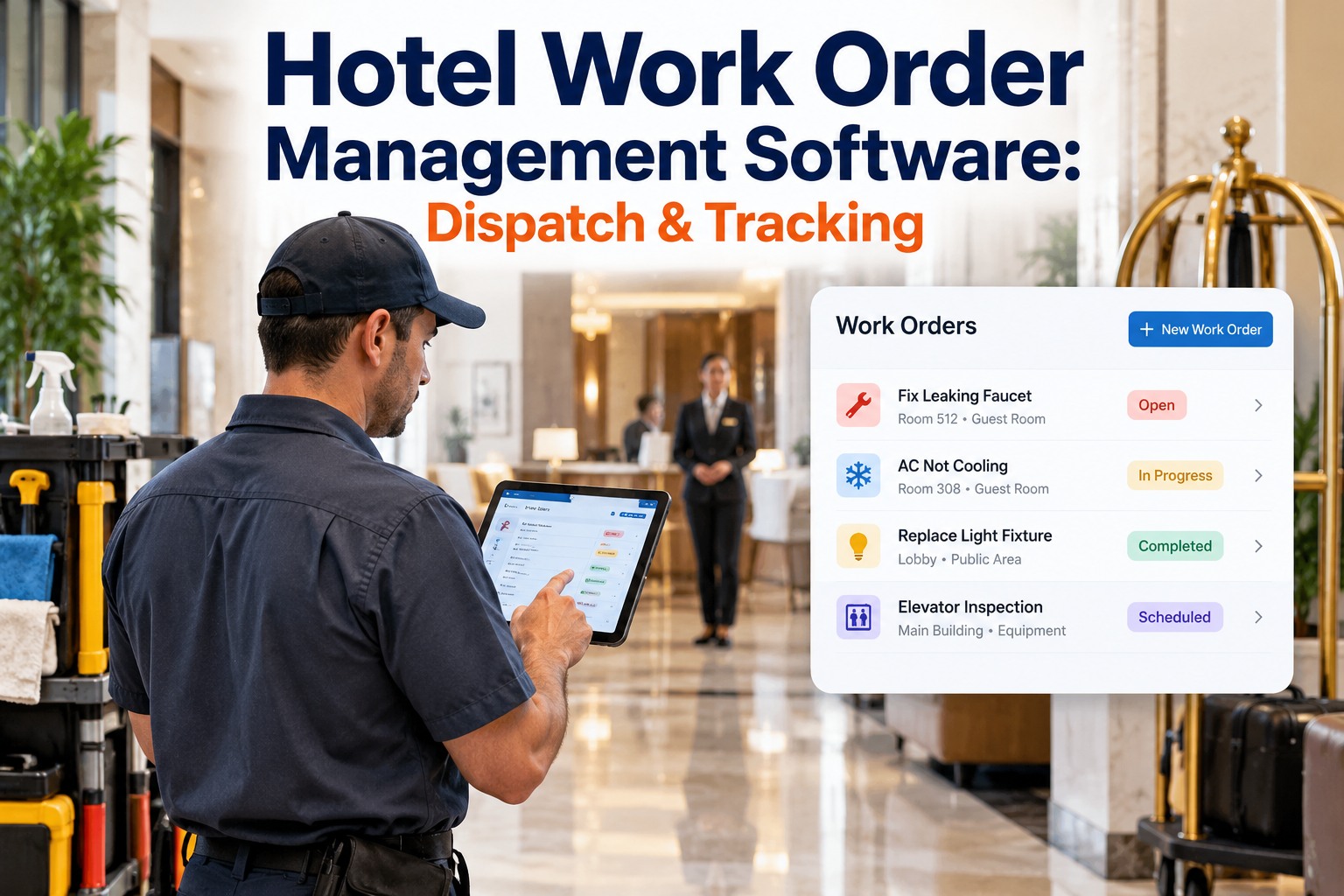
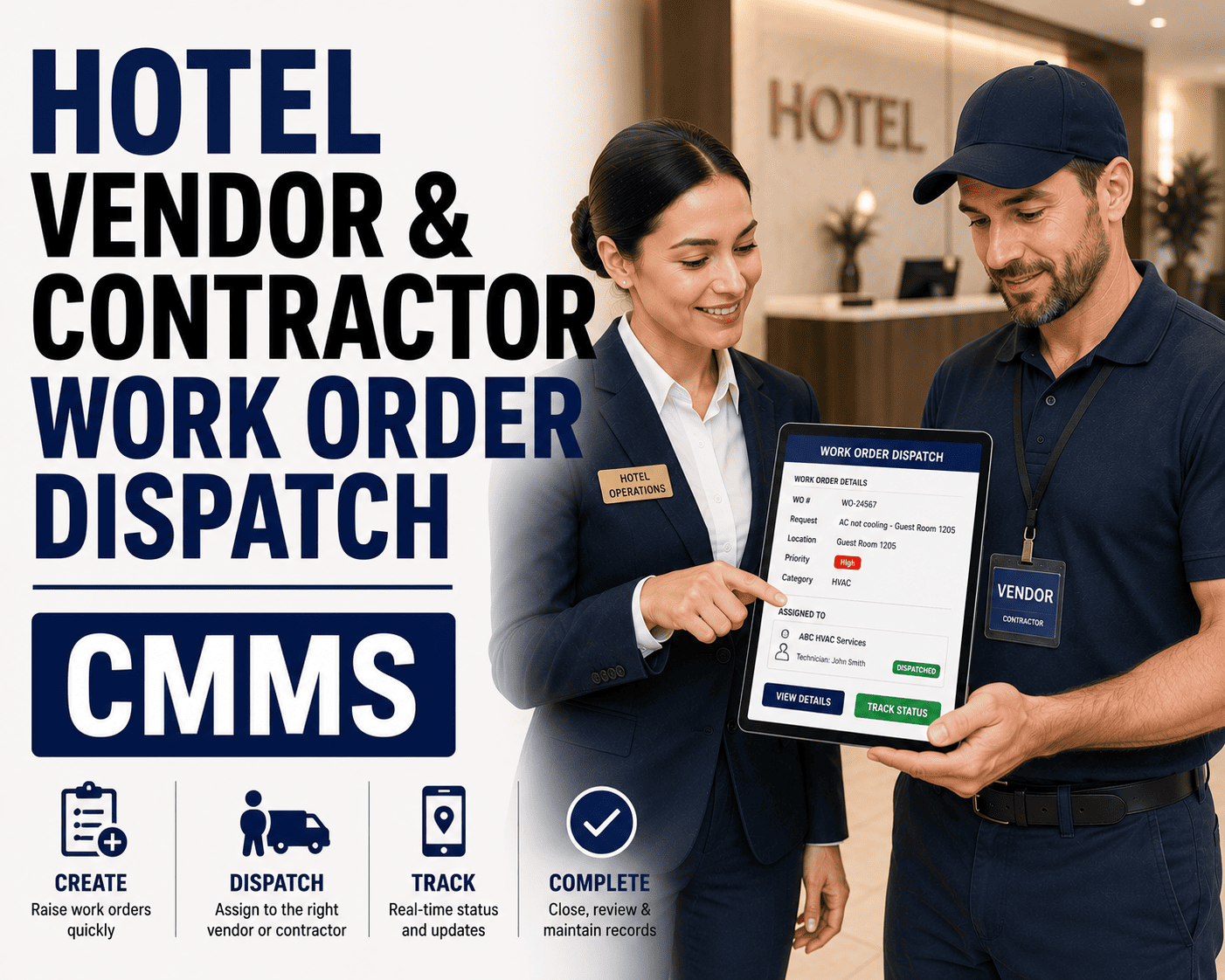
When an AI alert crosses the intervention threshold, a work order is created automatically — populated with asset details, fault description, repair procedure, parts required, and priority level. No front desk call. No manual entry. No overnight delay. The technician's mobile app receives the task the moment the AI decides intervention is needed, with the full context required to complete the repair in one visit.
Automated work order creation from sensor alerts operational in Oxmaint today
Smart Dispatch & Scheduling — The Coordination Layer
AI dispatch logic considers technician skill set, current workload, location within the property, and occupancy data from the PMS before assigning a task. Critical repairs during check-in peaks are routed to available staff without disrupting guest-facing operations. Non-urgent predictive tasks are batched and scheduled into maintenance windows around occupancy — zero disturbance to guests, maximum efficiency for the team.
Occupancy-aware scheduling — active in Oxmaint via PMS integration
Continuous Learning & Self-Optimisation
Every completed repair feeds outcome data back into the AI model. A bearing replacement that occurred 12 days after the first vibration anomaly narrows the alert threshold for the same failure mode across all similar assets. PM intervals auto-adjust based on actual MTBF data — compressing inspection cycles on assets showing degradation, extending intervals on assets performing above baseline. The system gets more accurate with every cycle.
MTBF-based PM auto-adjustment live — full closed-loop learning model in active development
AI Signal Library: What Hotel Equipment Tells the System Before It Fails
Self-healing maintenance is built on the principle that every failure has precursor signals — detectable anomalies that precede catastrophic breakdown by days or weeks. The AI's job is to read these signals before a technician would ever notice them visually.
Chiller / HVAC Compressor
AI signalRuntime ratio anomaly + short-cycling + slow temp recovery
Failure predictedRefrigerant loss or control failure — 5–14 days before breakdown
Cost prevented$3,000–$8,000 food inventory loss + health violations if walk-in fails overnight
AI signalVibration frequency shift + amperage spike pattern developing over 7–21 days
Failure predictedBearing wear before locked rotor event — caught 2–3 weeks ahead
Cost prevented$180 bearing job vs $2,800 motor replacement + 6–12 hours guest-facing downtime
AI signalUsage pattern shift + current draw variance + door cycle time creep
Failure predictedDrive belt or door mechanism wear — weeks before entrapment or shutdown risk
Cost preventedEmergency call-out + regulatory inspection + OTA reviews from stranded guests
AI signalFlow rate decline + recovery time increase + temperature stratification anomaly
Failure predictedScale buildup or element failure — detected before guest-facing cold shower complaints
Cost preventedCluster of 1-star bathroom reviews + emergency plumber call-out at weekend premium rates
AI signalHarmonic distortion increase + neutral current imbalance + thermal anomaly on breakers
Failure predictedOverloaded circuit or failing capacitor — identified weeks before trip or fire risk
Cost preventedFull property power event, fire risk, insurance claim, and regulatory investigation
AI signalPump flow rate decay + chemical dosing frequency increase + filter pressure buildup
Failure predictedPump impeller wear or filter blockage — before mandatory closure and health authority notification
Cost preventedPool closure OTA review cluster + health authority inspection + refund liability
Start with AI Anomaly Detection on Your 5 Highest-Risk Assets
Oxmaint's AI monitoring goes live in 5–10 business days. Physics-based fault detection begins immediately — no weeks of training required before the first alerts fire. Book a demo to map the signal library to your specific asset fleet.
The Data Foundation: Why Most Hotels Cannot Deploy AI Yet
Here is the critical constraint that most AI vendors do not explain clearly enough: AI maintenance systems require clean, structured, historical data to perform. Failure prediction, smart dispatch, and autonomous scheduling are all trained on your building's specific asset history. A hotel without a structured CMMS in place today is a hotel that will not be able to deploy AI in 2027 — because the training data simply will not exist.
Level 1
Fragmented
Paper work orders, verbal maintenance requests, no asset register. AI deployment: not possible. Data to train on: zero.
Most hotels today
Level 2
Connected
CMMS in place with structured work orders, asset hierarchy, and PM schedules. IoT sensor feeds being collected. AI deployment: conditional — 12–18 months of data needed.
Starting point for AI
Level 3
Intelligent
2+ years of clean CMMS data, IoT baseline established, AI anomaly detection active. Autonomous work orders firing. Physics-based alerts supplemented by ML predictions.
AI actively protecting OTA scores
Level 4
Autonomous
Self-healing loop fully operational. Anomaly detected, diagnosed, and dispatched without human initiation. Technicians execute AI-prescribed repairs. PM intervals self-optimise from outcome data.
The self-healing facility
The Data Advantage
Every AI and autonomous maintenance capability that matters in 2027–2028 requires 2–3 years of clean maintenance data. Hotels deploying Oxmaint today build a data advantage their competitors cannot shortcut. The time to start is not when AI is ready — it is now, so your data is ready when AI arrives.
Start building your data foundation today.
Frequently Asked Questions: Self-Healing Hotel Maintenance
What does a self-healing hotel maintenance system actually do without human intervention?
In its current state, autonomous hotel maintenance handles the detection-to-dispatch sequence without any human action: IoT sensors identify an anomaly, the AI classifies it against known failure patterns and assigns a priority level, a work order is created and populated with the repair procedure and required parts, and the task is dispatched to the right technician's mobile app — all in under 5 minutes from the moment a sensor reading crosses the alert threshold. The technician still performs the physical repair; the system eliminates every administrative step between signal and action.
Book a demo to see the autonomous dispatch workflow in Oxmaint.
How long does it take for AI failure prediction to reach useful accuracy in a hotel?
Physics-based fault detection — identifying conditions like abnormal discharge pressure, high amperage, or temperature deviation — begins immediately on data connection, before AI models are trained. Predictive failure forecasting, projecting when a specific component will fail, requires 2–4 weeks to learn each asset's healthy baseline. Most hotel teams report their first AI-predicted intervention at week six. Full model accuracy of 85–92% for major failure modes is typically achieved within 90 days.
Start your free trial to begin the baseline learning period now.
What existing hotel systems does autonomous maintenance need to connect to?
The core integrations for autonomous hotel maintenance are: the Building Management System (BMS) for HVAC, chiller, and electrical data; IoT sensor gateways for vibration, temperature, and flow readings; and the Property Management System (PMS) for occupancy data that drives smart scheduling. Oxmaint connects to BMS and existing sensor networks via standard APIs — most hotels complete implementation in 5–10 business days, with no hardware installation and no IT infrastructure changes required.
Will autonomous maintenance replace hotel maintenance technicians?
No — and the distinction matters. Autonomous systems replace the administrative and diagnostic labour: the human initiating a work order after a guest complaint, the engineer manually reviewing sensor logs to decide whether to act, the coordinator calling to check if a technician is available. The physical repair still requires a skilled technician. What changes is that technicians spend zero time on reactive emergency calls they didn't know were coming — they spend their entire shift on planned, AI-prescribed work with full context and the right parts already staged.
What is the ROI case for investing in AI and IoT for hotel maintenance today?
The measurable returns arrive in three categories: direct cost avoidance from failures prevented ($45,000+ annually per 200-room property from HVAC optimisation and predictive maintenance alone), OTA score protection from eliminating the guest-facing failures that generate negative reviews, and labour reallocation from reactive emergency work to planned maintenance that costs 3.2x less per hour of technician time. For most properties, the IoT sensor and AI monitoring investment reaches full payback within 12–18 months on HVAC savings alone — before failure prevention and OTA score impact are accounted for.
Book a demo to model the ROI case for your property's asset fleet.
The Hotels Building Self-Healing Operations Are Starting Today — Not in 2028
Every AI capability that matters in three years requires clean data from the next two. Oxmaint gives hotel maintenance teams structured asset records, IoT-ready condition monitoring, automated work orders, and the predictive intelligence foundation that future autonomous operations build on. Start now, and the data advantage compounds every month.