AI Vision for Hotel Chillers: Detect Failures Before Breakdown
By Mark Strong on April 17, 2026
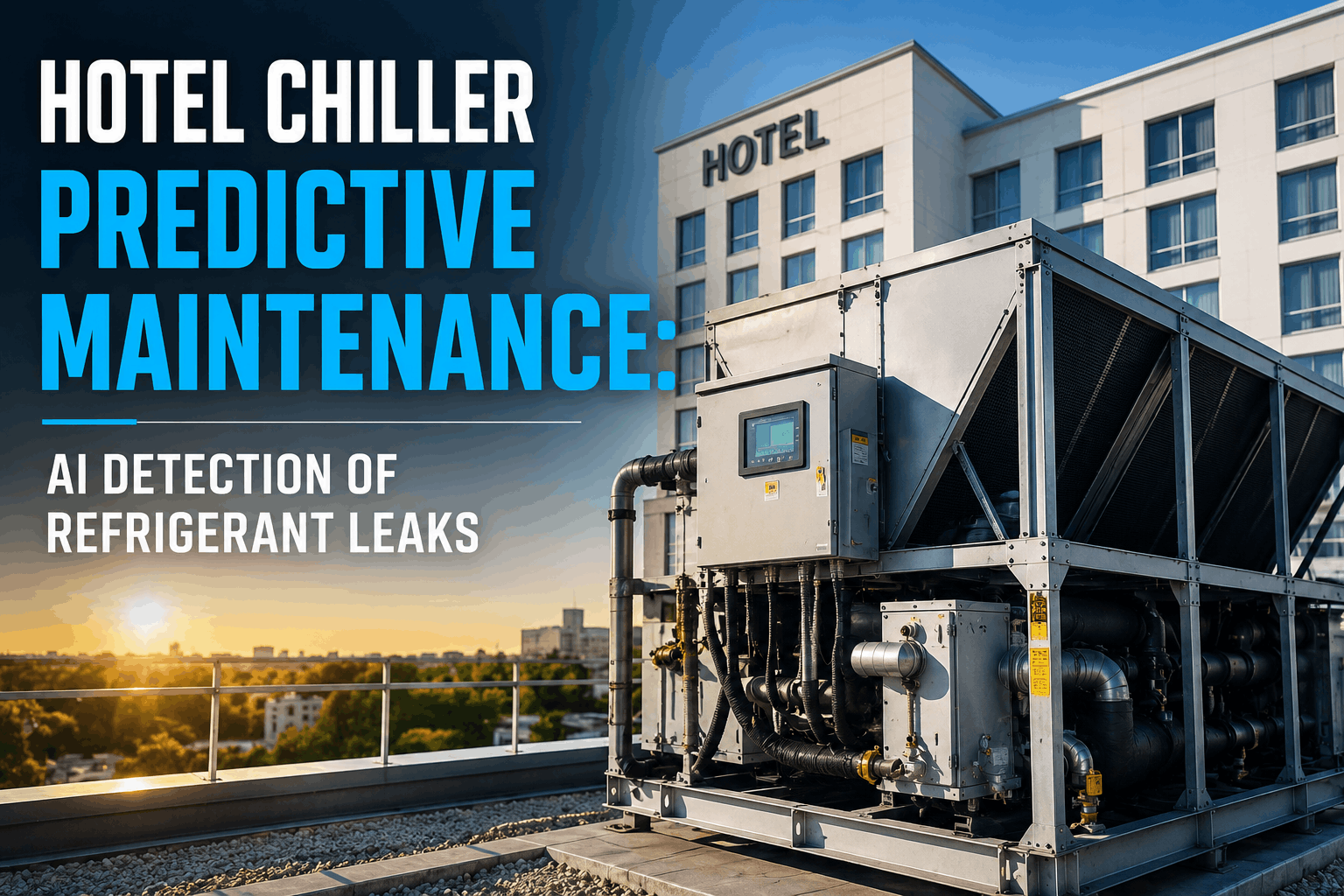
A hotel chiller does not announce its failure in advance. It degrades silently — condenser tubes slowly fouling, compressor bearings developing micro-wear, refrigerant circuits losing charge through pinhole leaks invisible to any scheduled inspection. By the time a technician notices a performance drop, the chiller is already weeks into a failure path that thermal cameras and AI vision could have flagged months earlier. Start your free trial to see how Oxmaint's AI vision monitoring detects hotel chiller degradation before it becomes an emergency.
$18K–$45K
cost of a single unplanned chiller failure during peak hotel occupancy — repair, guest relocation, and compensation
85–90%
of chiller degradation faults detectable through thermal AI before any performance loss is measurable
70%
more failures caught in advance by continuous AI thermal monitoring versus quarterly handheld IR surveys
30–50%
reduction in chiller downtime when thermal predictive maintenance replaces reactive repair cycles
What AI Vision and Thermal Cameras Actually See in a Chiller Plant
The gap between what a trained engineer sees during a visual inspection and what an AI thermal camera sees continuously is enormous. An engineer visits the plant room once a week — for minutes. A fixed thermal camera watches every compressor, condenser, heat exchanger, and electrical panel surface continuously, at pixel-level resolution, building a dynamic baseline that detects changes too gradual and subtle for any human inspection schedule to catch.
Cannot see inside heat exchangers, pipe walls, or electrical enclosures
Temperature readings from handheld spot pyrometer — point-in-time, single location
Gradual fouling, micro-bearing wear, early refrigerant loss — all invisible
Failure found after guest impact or major performance drop
AI Thermal Camera — Continuous
24/7 coverage — every second of every operating hour
Detects surface temperature anomalies at sub-1°C resolution across entire asset surface
Reveals fouling patterns, hot spots, cold zones, and asymmetric heat distribution
Full thermal map of compressor housing, condenser face, pipe runs — updated continuously
Load-normalised baseline — distinguishes genuine degradation from expected operational variation
Failure flagged weeks before performance loss — alert with repair context pre-filled
See What Your Chiller Plant Is Telling You Right Now
Oxmaint's AI vision monitoring integrates with fixed thermal cameras and existing BMS sensors to watch your chiller plant continuously — converting anomaly detections into prioritised work orders automatically.
Six Chiller Degradation Modes AI Vision Detects Early
Each failure mode in a hotel chiller plant has a characteristic thermal signature that appears weeks before measurable performance loss. AI vision systems trained on chiller failure datasets identify these signatures and classify them against known fault patterns — generating diagnostic alerts that tell engineers not just that something is wrong, but precisely what and where.
Condenser Tube Fouling
Thermal signatureUneven surface temperature distribution across condenser face — cooler zones indicating blocked tube bundles, warmer patches where flow is restricted
Lead time: 4–8 weeks before measurable COP degradation
Thermal signatureAsymmetric heat pattern on compressor housing — localised hot spot developing on bearing housing, diverging from baseline temperature profile
Lead time: 3–6 weeks before vibration becomes detectable
Thermal signatureEvaporator surface shows colder-than-baseline zones as refrigerant charge drops — AI correlates thermal pattern with pressure trend data to confirm leak
Lead time: 2–5 weeks before system trips on low pressure
Untreated: Complete cooling loss during peak season — guest evacuation risk
Heat Exchanger Scaling
Thermal signatureInlet-to-outlet temperature differential narrows as scale buildup reduces heat transfer — AI tracks delta-T trend against load-normalised baseline
Lead time: 6–12 weeks of gradual degradation before operational impact
Untreated: 20–30% energy cost increase as chiller works harder to meet setpoint
Drive & Panel Overheating
Thermal signatureHot spots on VFD enclosure panels, busbar connections, or contactor banks — visible 4–8 weeks before nuisance tripping or insulation failure
Lead time: 4–8 weeks before trip or electrical failure event
Untreated: Drive replacement $8,000–$22,000 + hours of chiller downtime
Cooling Tower Fouling
Thermal signatureNon-uniform thermal distribution across tower fill — blocked distribution zones appear warmer as water flow bypasses fouled sections
Lead time: 3–6 weeks before condenser water return temperature rises measurably
Untreated: Cascading chiller efficiency loss — full system COP drops 18–28%
Map Every Degradation Mode to Your Chiller Fleet — Live in 10 Days
Oxmaint's AI vision integration connects to fixed thermal cameras and existing sensor networks in 5–10 business days. Physics-based fault detection begins immediately — no weeks of training required before the first diagnostic alerts fire. Book a demo to see the chiller degradation detection library.
How AI Vision Processes Thermal Data — From Camera to Work Order
Understanding the signal chain from thermal camera output to actionable maintenance work order is essential for hotel engineering directors evaluating whether AI vision delivers genuine operational value or simply adds monitoring complexity.
1
Continuous thermal image capture
Fixed LWIR thermal cameras stream radiometric data continuously — every pixel delivers a temperature value, building a complete thermal map of the chiller plant. Frame rates of 1–9Hz provide near-real-time surface temperature profiles for all monitored assets simultaneously.
2
Load-normalised baseline establishment
AI builds dynamic baselines for each asset — learning what "normal" looks like at every load level, ambient temperature, and operating mode. A chiller working at 80% load on a 35°C day legitimately runs hotter than the same unit at 40% load in winter. AI subtracts these variables before flagging anomalies, eliminating the false alarm flood that plagues static threshold systems.
3
Anomaly classification against fault library
When temperature patterns deviate from the normalised baseline, AI cross-references the deviation pattern against a trained library of chiller fault signatures. Asymmetric compressor housing heat maps to bearing wear. Uneven condenser face distribution maps to tube fouling. Each classification includes a confidence score and estimated lead time to operational impact.
4
Automated work order creation with diagnostic context
Alert crosses the intervention threshold. Work order created automatically in Oxmaint — populated with asset ID, fault classification, thermal image evidence, recommended corrective action, required parts, and urgency level. The technician receives the task on mobile with everything needed to arrive prepared, not just symptom-aware.
5
Outcome learning — thresholds tighten over time
Completed repair data feeds back into the AI model. A bearing replacement confirmed at a specific vibration-thermal correlation point narrows the alert threshold for that failure mode across similar assets. Accuracy improves with every intervention cycle.
Thermal AI vs Periodic IR Survey: The Detection Gap
Many hotel engineering teams conduct quarterly or annual handheld infrared surveys — a technician with a thermal gun walking the plant room for a few hours. This captures a snapshot of plant condition during one moment in thousands of operating hours. The comparison with continuous AI thermal monitoring is not marginal.
Capability
Periodic IR Survey (Quarterly)
Continuous AI Thermal Monitoring
Coverage frequency
4 hours per quarter — 0.02% of operating time
24/7 — every second of every operating hour
Load normalisation
None — single reading at ambient and load conditions of that day
Dynamic baseline at every load and ambient condition
Fault detection rate
Visible problems at survey moment only
70% more failures detected in advance vs periodic surveys
Trend analysis
Point-in-time — no trend data between surveys
Continuous degradation curves — rate of change tracked per day
Transient failure events
Invisible — occur between survey windows
Captured in real time — timestamped and logged automatically
Work order generation
Manual report written post-survey — days to action
Automated — work order created and dispatched within minutes of detection
Frequently Asked Questions: AI Vision for Hotel Chiller Maintenance
IoT sensors measure discrete data points — a pressure transducer reads one pressure value, a temperature sensor reads one temperature. A thermal camera reads thousands of temperature values simultaneously — producing a spatial map of the entire asset surface. This spatial dimension reveals asymmetric degradation patterns that no number of point sensors would detect: a hot spot developing on one side of a compressor housing, a cold zone on a quarter of a condenser face, an uneven temperature gradient across a heat exchanger surface. AI vision and IoT sensors are complementary — the best hotel chiller monitoring systems use both, with thermal cameras providing the spatial intelligence that point sensors cannot.
Fixed LWIR (Long-Wave Infrared) thermal cameras mounted at strategic positions to cover compressor housings, condenser faces, heat exchanger pipe runs, and electrical drive panels. Modern uncooled thermal sensors are compact, low-maintenance, and significantly more affordable than three years ago. A typical hotel chiller plant room requires 3–6 camera positions for comprehensive coverage. Cameras connect to a cellular gateway or BMS network for data transmission — no specialised IT infrastructure required. Oxmaint's AI engine connects to the camera data stream via standard API, and most hotel implementations complete in 5–10 business days. Book a demo to see camera positioning recommendations for your plant room layout.
Lead times vary by fault type. Condenser tube fouling becomes thermally visible 4–8 weeks before measurable COP degradation. Compressor bearing wear produces a detectable asymmetric heat pattern 3–6 weeks before vibration sensors would flag it. Heat exchanger scaling trends are visible 6–12 weeks before energy bills reflect the efficiency loss. In all cases, the thermal signal appears significantly earlier than any other detection method — giving engineering teams time to schedule repairs in a planned maintenance window rather than reacting to an emergency during peak hotel occupancy.
Load normalisation is the core mechanism. A chiller at 90% load on a 38°C ambient day will legitimately run hotter than the same unit at 40% load in cooler conditions. Static threshold systems flag this as an anomaly — generating false alarms that train engineers to ignore all alerts. Oxmaint's AI establishes dynamic baselines at every load level and ambient condition, comparing current readings only against what is expected for the current operating state. True anomalies are deviations from the load-normalised baseline — not deviations from a fixed temperature limit. This is what separates AI thermal monitoring from simple high-temperature alarms, and why continuous AI monitoring produces actionable alerts rather than alert fatigue.
A single avoided unplanned chiller failure during peak hotel occupancy — repair, guest relocation, and compensation — costs $18,000–$45,000. One prevented compressor replacement covers the camera hardware and platform cost for two years. Beyond avoided failures: hotels report $45,000 per year in HVAC energy savings from continuous efficiency optimisation, and 30–50% reductions in overall chiller maintenance costs from replacing reactive emergency work with planned interventions. For a hotel operating 2–3 chillers in continuous service, the AI thermal monitoring investment typically reaches full payback within 8–14 months. Book a demo to model the ROI case for your chiller fleet.
Your Chiller Plant Has Been Degrading in Silence. AI Vision Changes That.
Oxmaint's AI thermal vision platform connects to your chiller plant in 5–10 business days — continuous fault detection, load-normalised anomaly classification, and automatic work order creation from the moment a degradation signature emerges. No more discovering failures after guests complain. No more emergency repairs on peak-occupancy weekends.