Hotel plumbing failures are the single fastest path from a quiet maintenance ticket to a five-figure water-damage claim, because a 2 AM slow leak inside a guest-room wall can saturate drywall, short electrical, and the room below before anyone files a report. This guide is built for engineering directors and chief engineers who want to stop treating plumbing as reactive plumbing-as-emergency work and start running it as a CMMS-driven rotating maintenance program covering leak detection, drain PM, water-pressure verification, and backflow compliance. The math is unforgiving: a single undetected supply-line leak can discharge 40–60 gallons per hour, meaning a 12-hour delay turns into a 700-gallon floor-through event and a 3–5 room out-of-order block. A CMMS like Oxmaint collapses detection-to-response time, schedules rotating fixture inspections, and documents backflow tests for your annual health department audit — Start Free Trial to operationalize the program in under 48 hours.
A single undetected guest-room leak can cost more than your annual plumbing PM budget. What is your detection-to-response time right now?
A 200-room property averages 2.4 plumbing incidents per month. Without a rotating CMMS-driven fixture inspection program, 38% of those incidents escalate into multi-room damage events — at an average claim of $11,400 per occurrence. Oxmaint compresses leak-detection response to under 18 minutes and schedules preventive drain PM before occupancy spikes.
The real cost of a slow plumbing response
Plumbing is the one trade where minutes — not days — separate a $90 fix from a $14,000 rebuild. Every figure below is drawn from mid-scale hotel engineering benchmarks.
A four-tier protocol that catches leaks before the guest does
Tiered response is what separates a property that catches a weeping angle stop at the PM visit from one that discovers it when the ceiling collapses. Each tier below maps to a CMMS work-order type with its own SLA.
Continuous monitoring + guest complaint intake
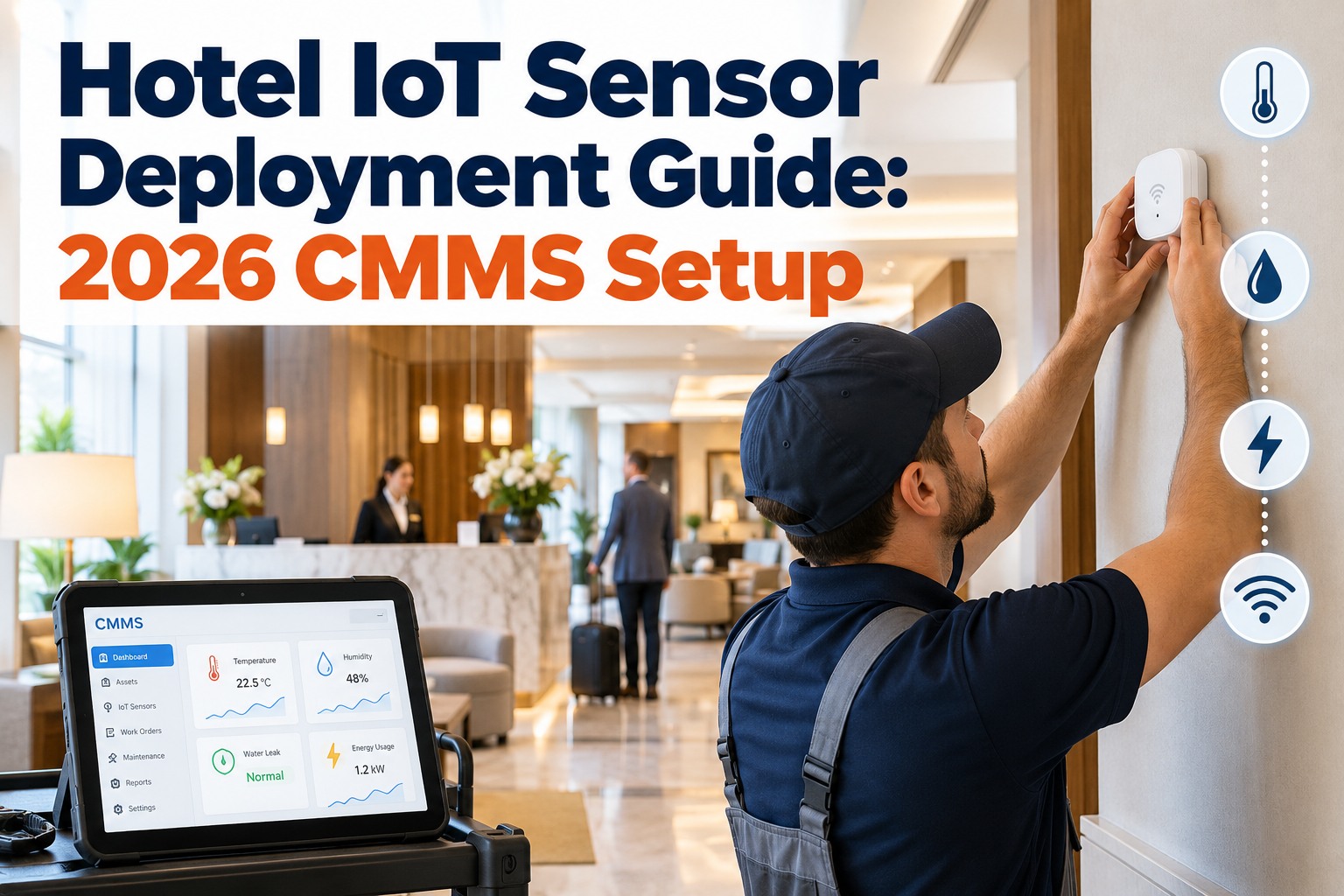
Wireless flow sensors on main risers flag continuous-flow events above 0.5 GPM for more than 15 minutes. Guest calls reporting "low pressure," "musty smell," or "warm spot on carpet" auto-generate Tier-1 work orders inside the CMMS with an 18-minute dispatch SLA.
Thermal imaging + moisture mapping
Engineering responds with a thermal camera and pinless moisture meter. Suspect walls are scanned in a 6-foot grid; readings above 18% moisture trigger a Tier-3 escalation. The CMMS attaches thermal photos and moisture readings to the work order for insurance documentation.
Shut-off + affected-area isolation within 35 minutes
Source confirmed, local shut-off valve closed, power killed to affected outlets, and a containment barrier raised. Adjacent rooms below and beside are flagged in the CMMS for next-shift moisture re-checks every 4 hours for 48 hours to catch latent wicking.
Drying + fixture replacement + failure analysis
Commercial dehumidification runs 48–72 hours to sub-15% moisture. Failed component is tagged, photographed, and replaced — not just repaired. Every Tier-4 event generates a CMMS root-cause record so the same fitting model or riser section is flagged for accelerated inspection across the property.
Rotating drain PM that targets the four highest-clog zones
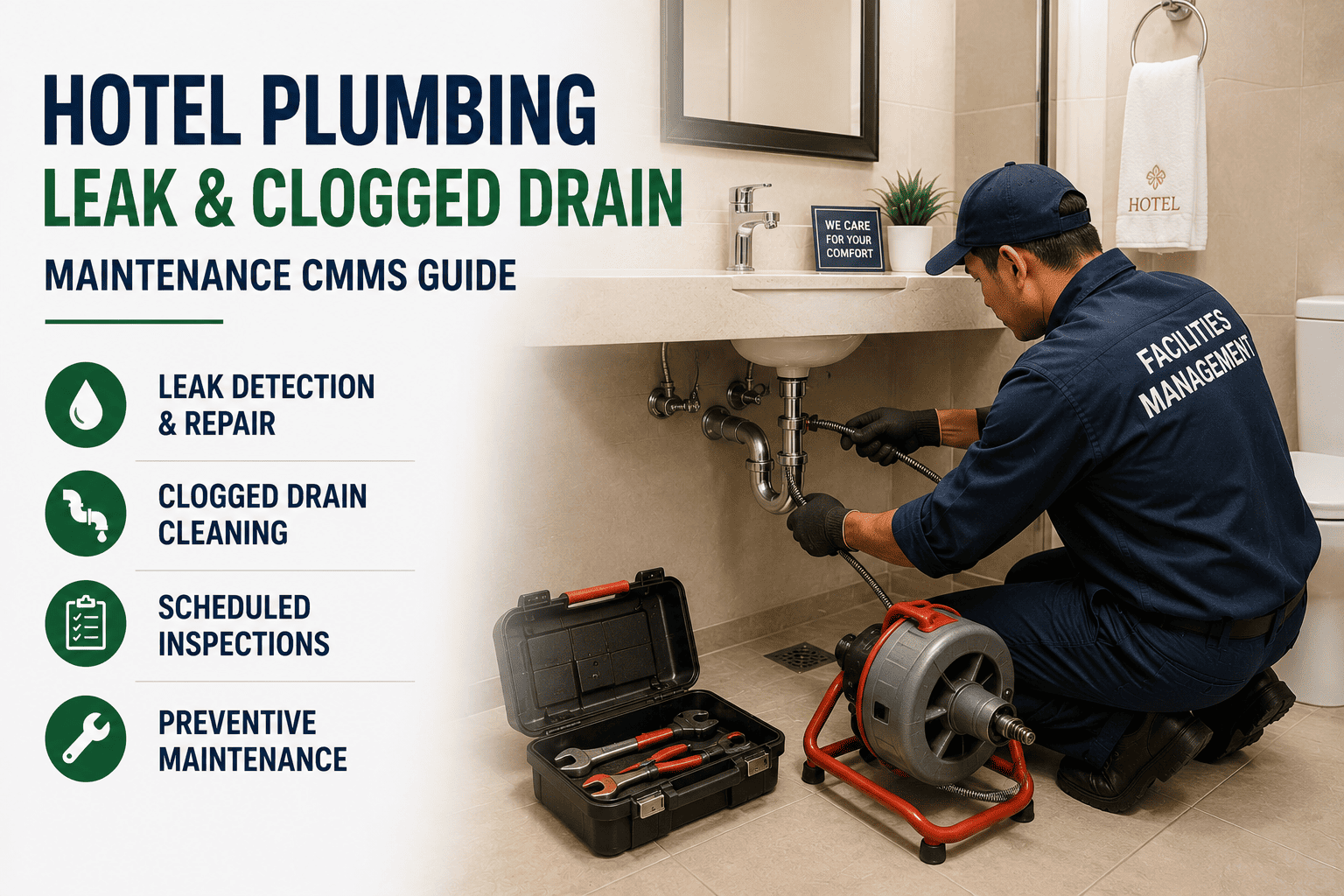
Drain clogs are predictable. Hair + soap scum in showers, grease in kitchen drains, mineral scale in boiler-fed lines, and foreign objects in public restrooms account for 91% of hotel drain stoppages. A rotating CMMS schedule prevents 80% of them.
Guest-room shower drains
Remove hair trap, enzyme-treat the P-trap, flush with 140°F water for 90 seconds. CMMS auto-schedules the next 25 rooms on every Tuesday rotation so no room goes beyond 95 days.
Kitchen & bar grease lines
Monthly mechanical snaking of the grease line from the three-compartment sink to the interceptor. Weekly biological dosing logged in the CMMS. Interceptor pumped every 90 days, photo-logged.
Public restroom floor drains
Floor drains dry out and let sewer gas in. CMMS schedules a 2-gallon prime pour weekly and a full cleanout with enzymatic cleaner every 60 days. The trap-prime line is verified for flow on every walk-through.
Rooftop & main stack cleanouts
Stack cleanouts are opened, snaked, and flushed semi-annually. A push-camera inspection is run yearly to catch scale build-up before it becomes a 14-room backup event on a sold-out Friday night.
The 12-month CMMS rotation that covers every fixture at least twice
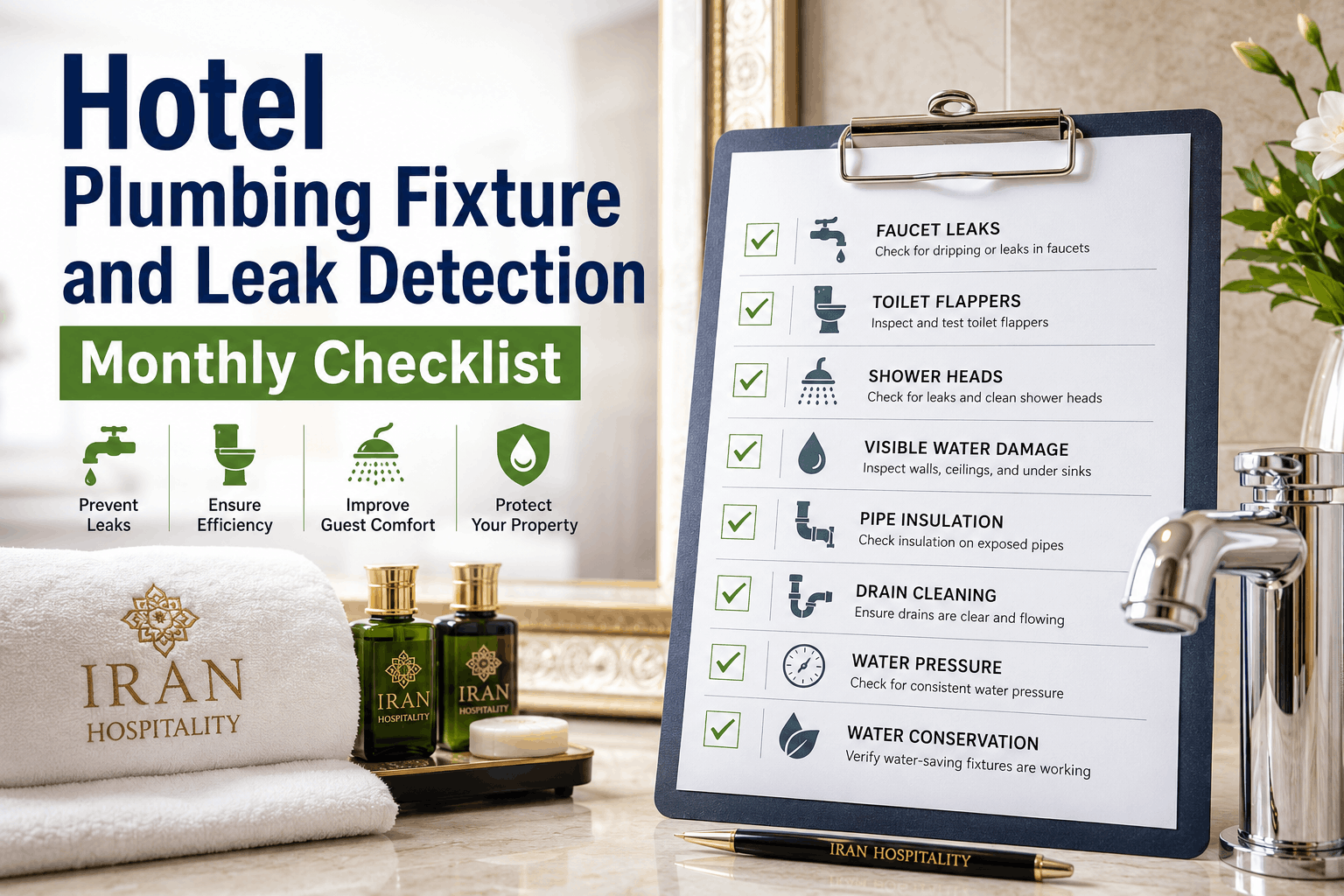
A 200-room property carries roughly 1,400 plumbing fixtures. The rotating-sample approach inspects a statistically representative 12% sample each month so every fixture sees a documented inspection within a 90-day window — without pulling an engineer off shift for a full-property sweep.
From $42K in annual plumbing claims to $7.1K in 11 months
A 200-room, 9-floor select-service hotel in the Southeast was running plumbing on a paper logbook with no rotating PM. The CMMS rollout tells a clean before-and-after story.
Pressure verification + RPZ documentation that survives an audit
Municipal code in most jurisdictions requires annual reduced-pressure-zone (RPZ) backflow preventer testing on every domestic water service line — and the documentation has to survive a health-department audit years later. CMMS makes this automatic.
Static pressure verification
Test at the farthest fixture from each riser monthly. Acceptable range: 40–80 PSI. Anything above 80 PSI requires PRV adjustment; below 40 PSI triggers a flow-test on the riser to rule out a partially closed valve or scale build-up.
RPZ backflow testing
Every RPZ assembly is tested annually by a certified tester. The CMMS stores the test gauge serial number, tester certification number, pass/fail result, and a photo of the completed test form — auto-tagged to the device asset record.
Thermal expansion verification
After any water-heater replacement or PRV adjustment, the thermal expansion tank is checked for pre-charge pressure and diaphragm integrity. A failed expansion tank is the #1 hidden cause of T&P valve weeping — and a precursor to a 40-gallon flood.
Audit-ready documentation
Every backflow test, pressure reading, and fixture inspection is time-stamped, geo-tagged, and attached to the asset record. A health-department auditor can be handed a single CMMS export instead of a binder — and it covers 3 years of history in under 60 seconds.
What chief engineers say after 90 days on the program
"We caught a weeping angle stop behind the drywall on a Tier-2 thermal scan before it ever hit the ceiling below. That single catch paid for the CMMS for two years. The rotating fixture sample is now non-negotiable on my property."
"The 12-month rotation schedule means I never have to explain to the GM why a guest-room toilet failed inspection. Every fixture has a date-stamped record. The health inspector took one look at the RPZ export and moved on."
"After-hours plumbing calls dropped from almost three a week to under one. The drain PM rotation on the kitchen grease line alone eliminated our Friday-night backup during banquet service. That was a recurring $2,500 emergency-plumber bill."
Stop discovering leaks when the ceiling collapses.
Deploy a CMMS-driven plumbing program in under 48 hours. Your rotating fixture schedule, drain PM calendar, and backflow compliance log go live on day one.
Hotel plumbing CMMS — what engineers ask first
How fast can we get the rotating plumbing PM schedule running?
Most properties are live in 36–48 hours. You import your fixture inventory from an existing spreadsheet or PMS room list, Oxmaint auto-generates the 12-month rotating sample based on your room count and floor plan, and the first week's work orders hit your engineers' mobile app on day one. You can Start Free Trial and be scheduling drain PM by tomorrow morning.
Does the CMMS handle backflow preventer test documentation for audits?
Yes. Every RPZ assembly is an asset record with its own test history. When your certified tester completes the annual test, the gauge serial number, tester cert number, pass/fail result, and a photo of the signed form are attached to that asset. A 3-year or 7-year audit export is a single click — no binder, no scramble.
What leak-detection sensors integrate with the platform?
Oxmaint ingests continuous-flow alerts from most wireless flow sensors (Moisturelogic, Phyn, Flume, and building-management system BACnet points). When a sensor flags a continuous-flow event above your threshold, the CMMS auto-generates a Tier-1 work order with an 18-minute dispatch SLA and pages the on-duty engineer.
How does the rotating fixture sample decide which rooms to inspect each month?
The algorithm selects a statistically representative 12% sample stratified by floor, riser, and fixture type so that every fixture sees a documented inspection within a 90-day window. Occupied rooms are auto-rescheduled to the next available turnover, and the CMMS reconciles the sample at month-end so nothing drifts past the 95-day ceiling.
Can we justify the cost against our current plumbing spend?
The benchmark is consistent: a 200-room property spending $42K annually on plumbing damage claims and after-hours call-outs typically drops to under $10K within the first year — a payback window under 9 weeks. The CMMS annual cost is roughly $4,800 against $34,900 in claim savings plus recovered room-night revenue. You can walk through the exact math on a 30-minute call — Book a Demo and we'll model it against your property's actuals.
Turn hotel plumbing from reactive emergency work into a documented, rotating PM program.
Get leak detection, drain PM, pressure verification, and backflow compliance running on one platform — with an audit-ready record for every fixture in your building.
Free 14-day trial · No credit card