An absorption chiller has no large compressor to fail — but it hides three things a vapor-compression machine never worries about: a deep vacuum that a pinhole leak can destroy, a lithium-bromide solution that can set solid as rock salt, and tube bundles whose quiet fouling drains efficiency long before anything alarms. These machines give few obvious warning signs before performance collapses, which is why disciplined, measurement-based PM matters more here, not less. This guide covers what to inspect and when — and OXMAINT AI, the AI-powered maintenance management software, keeps every task on schedule and every reading on a work order.
Industrial HVAC · Absorption Chiller Maintenance Guide · 2027
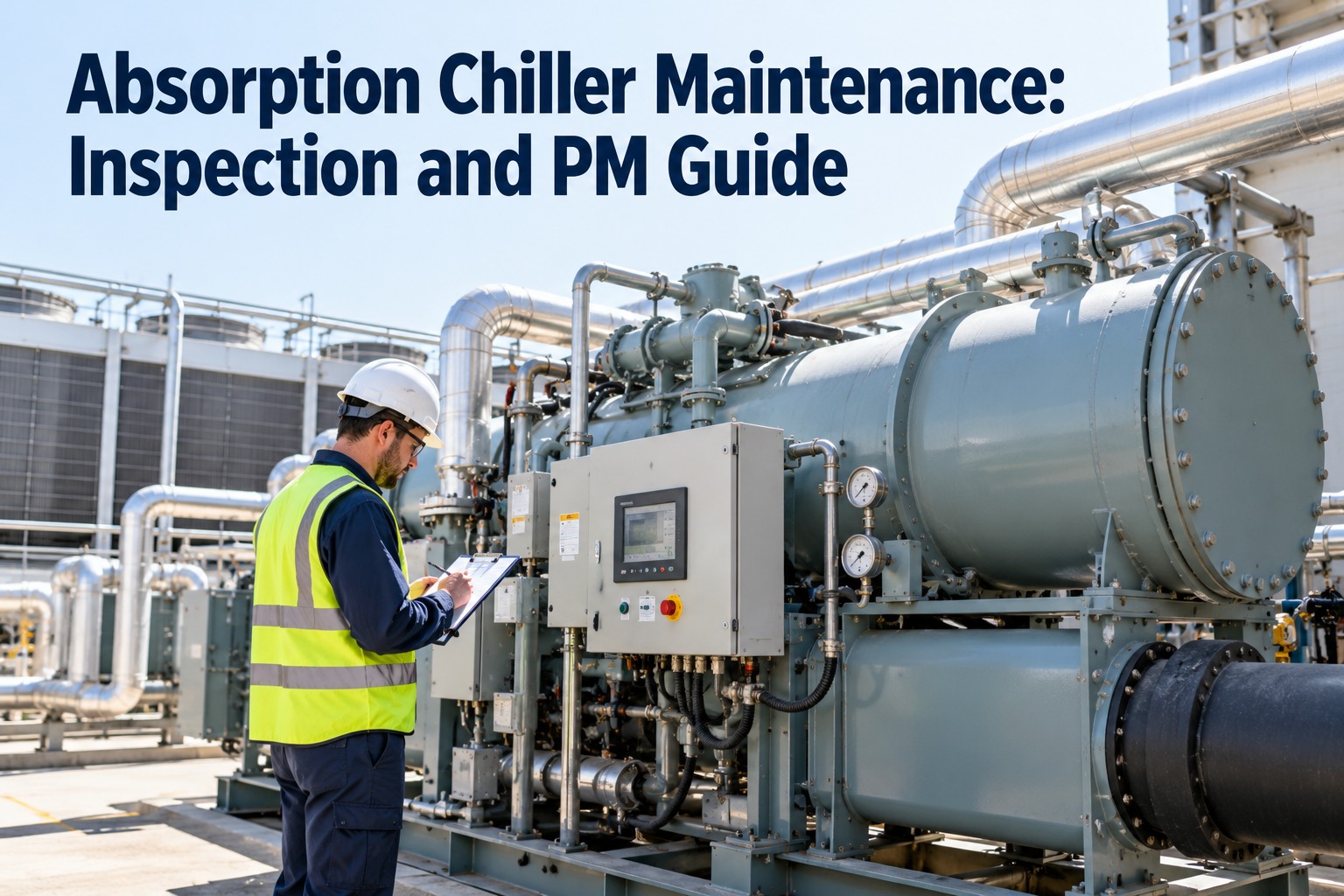
Absorption Chiller Maintenance: Inspection & PM Guide
Heat-driven cooling with no big moving parts — but the reliability lives in the chemistry, the vacuum and the tubes. This guide walks the absorption cycle vessel by vessel, the failure modes unique to each, and the PM that keeps COP where it should be. OXMAINT AI runs the schedule behind it.
1GeneratorHeat boils off refrigerant
→
2CondenserVapour condenses to water
→
3EvaporatorWater boils under vacuum, cools
→
4AbsorberLiBr soaks vapour back up
Three Things That Fail — and None of Them Is a Compressor
Maintain a vapor-compression chiller and you watch a compressor. Maintain an absorption machine and you watch chemistry, pressure and metal. Get these three right and the chiller holds its rating; neglect any one and capacity bleeds away quietly. Start free and put all three on a monitored schedule in OXMAINT AI.
The Solution Chemistry
LiBr concentration, inhibitor level and pH decide whether the chiller runs or crystallizes. Chemistry is the number-one thing to trend.
The Vacuum
The machine works because water boils at low temperature under deep vacuum. A tiny air leak raises pressure and quietly cuts capacity and COP.
The Tube Bundles
Fouled absorber, condenser and generator tubes rob heat transfer — fouling alone can take a sizeable bite out of COP before any fault shows.
Crystallization: The Failure You Design Maintenance Around
If the LiBr solution gets too concentrated or too cold, it crystallizes — turning to a solid that blocks the machine and can take days to recover. It is the single most expensive, most preventable absorption-chiller failure, and most of the PM routine exists to keep it from ever happening. Book a demo to trend solution concentration and get ahead of crystallization in OXMAINT AI.
Watch ThisWhat Pushes Solution Toward Crystallizing
!
Concentration creeping above the safe band (typically about 62%)
!
Air in-leakage raising pressure and driving concentration up
!
An uncontrolled shutdown with no dilution cycle run
!
Low cooling-water temperature over-cooling the solution
The PM Schedule by Interval
Absorption-chiller PM is a rhythm of daily readings, weekly chemistry trends, periodic tube and purge work, and an annual teardown of the heat-transfer surfaces. Here's the core cadence — always run to your OEM manual's intervals and limits. Start free and load this schedule onto your chiller in OXMAINT AI.
Daily
Log chilled-water and cooling-water temperatures, steam pressure, and evaporator pressure; note any alarm or deviation.
Weekly
Trend solution specific gravity (concentration), check the purge pump operation and non-condensable level, and scan for leaks.
Monthly
Check solution and refrigerant pumps — seals, bearings, flow and vibration — and review performance against design COP.
Quarterly
Send a solution sample to a lab for concentration, corrosion inhibitor, pH and dissolved metals; dose inhibitor if low.
Semi-annual
Test steam traps and control valves; clean condenser and absorber tubes where cooling-water quality is poor.
Annual
Clean absorber and condenser tubes (brush + eddy-current), inspect generator tube bundle and heat exchanger, overhaul the purge system and pumps.
Inspect It Vessel by Vessel
Each vessel in the cycle has its own way of going wrong. Walking the machine in cycle order — generator, condenser, evaporator, absorber — makes sure the failure mode specific to each gets checked, not just the easy ones. Book a demo to map each vessel's checks to its asset in OXMAINT AI.
Failure modes and checks above reflect common absorption-chiller maintenance practice; exact limits, intervals and procedures come from your machine's OEM manual and your plant's water-treatment program.
An Absorption Chiller Rarely Alarms Before It Loses Capacity.
By the time COP has slipped, the solution has been drifting and the tubes fouling for weeks. The OXMAINT AI maintenance management software trends the readings that move first — concentration, vacuum, approach temperatures — and raises a work order the moment one drifts, so you act on the leading signal, not the lagging symptom.
Read the Chiller by Its Numbers
Because the warning signs are subtle, the numbers do the talking. These are the readings that tell you a problem is building — each one a trigger for a diagnostic work order when it drifts off its band. Start free and set these alert thresholds on your chiller in OXMAINT AI.
Solution concentration
55–65% LiBr
Trend weekly; alert approaching ~62% — the crystallization zone.
Evaporator pressure
0.5–1.0 mmHg
A rise toward 3 mmHg means air in-leakage or a purge problem.
Performance (COP)
vs design
Below ~85% of design COP, raise a diagnostic — tubes, purge, concentration.
Chilled water out
at setpoint
More than ~1°C above setpoint flags lost capacity worth investigating.
How OXMAINT AI Keeps an Absorption Chiller Healthy
An absorption chiller rewards discipline — the right reading taken on the right day, trended, and acted on before it drifts. The OXMAINT AI maintenance management software runs that discipline: scheduled PM, trended readings, lab-sample tracking and a work order on every drift. Book a demo to see the full chiller workflow in OXMAINT AI.
PM SCHEDULE
Daily-to-annual tasks scheduled automatically with overdue escalation, so tube cleaning and purge overhauls never slip.
TREND READINGS
Concentration, pressure and approach temperatures trended over time, so a slow drift is visible long before it alarms.
DRIFT → WO
A reading off its band raises a diagnostic work order automatically, with the asset and value attached.
LAB SAMPLES
Quarterly solution-analysis results logged against the chiller, with inhibitor dosing tracked as a job.
TUBE & EDDY LOG
Cleaning and eddy-current test history per vessel, so wall-thinning trends inform the next overhaul.
FULL HISTORY
Every reading, sample and repair tied to the chiller — audit-ready and ready for reliability review.
Expert Review
This is a general maintenance framework for lithium-bromide absorption chillers. Exact concentration limits, pressures, intervals, dilution-cycle steps and crystallization-recovery procedures come from your machine's OEM manual and your plant's water-treatment program, which take precedence — the ~62% and 55–65% figures and pressure bands here are typical references, not set points for any one machine. Crystallization recovery and vacuum work should follow the OEM procedure and a qualified technician. OXMAINT AI schedules the PM, trends the readings and keeps the chiller's history; it supports the maintenance program your HVAC and reliability teams own, not OEM guidance or operator judgement.
Frequently Asked Questions
What makes absorption chiller maintenance different from a regular chiller?
There's no large compressor to maintain — instead the reliability lives in three things a vapor-compression chiller doesn't have: a lithium-bromide solution that must stay in a safe concentration band, a deep vacuum a small air leak can spoil, and tube bundles whose fouling quietly cuts efficiency. It's chemistry, pressure and heat-transfer monitoring rather than compressor work.
Book a demo to see absorption-chiller PM in OXMAINT AI.
What is crystallization and how do you prevent it?
Crystallization is when the LiBr solution gets too concentrated or too cold and turns solid, blocking the machine — the most expensive, most preventable absorption-chiller failure. Prevent it by trending concentration weekly, running a dilution cycle before planned shutdowns, keeping the vacuum tight, and confirming concentration on restart after any uncontrolled trip.
Book a demo to trend concentration and get ahead of it.
How often should absorption chiller tubes be cleaned?
Condenser and absorber tubes are typically cleaned annually by brushing, with eddy-current testing to catch wall thinning, and semi-annually where cooling-water quality is poor. Generator tube bundles get an annual inspection. Fouling can take a meaningful bite out of COP before anything alarms, so keeping to the cleaning interval matters.
Book a demo to track tube cleaning and eddy-current history.
Why does the vacuum matter so much?
The chiller works because water (the refrigerant) boils at a low temperature under deep vacuum. Non-condensable gases from air in-leakage raise the pressure, which directly cuts capacity and COP — which is why the purge system and leak detection are core PM items, and evaporator pressure is a reading to watch.
Book a demo to see vacuum and purge tracking in OXMAINT AI.
How does a CMMS help maintain an absorption chiller?
It schedules the full daily-to-annual PM so tube cleaning, purge overhauls and lab samples never slip, trends the readings that move first — concentration, vacuum, approach temperatures — and raises a diagnostic work order the moment one drifts. It also keeps every reading, sample and repair tied to the chiller for overhaul planning and audits.
Book a demo to see the full chiller workflow in OXMAINT AI.
Keep the Chemistry, the Vacuum and the Tubes in Spec.
Run absorption-chiller maintenance on the OXMAINT AI maintenance management software — scheduled PM across every interval, trended readings that catch drift early, lab-sample and tube history, and a work order on every deviation. Protect COP and stay clear of crystallization, one tracked check at a time.