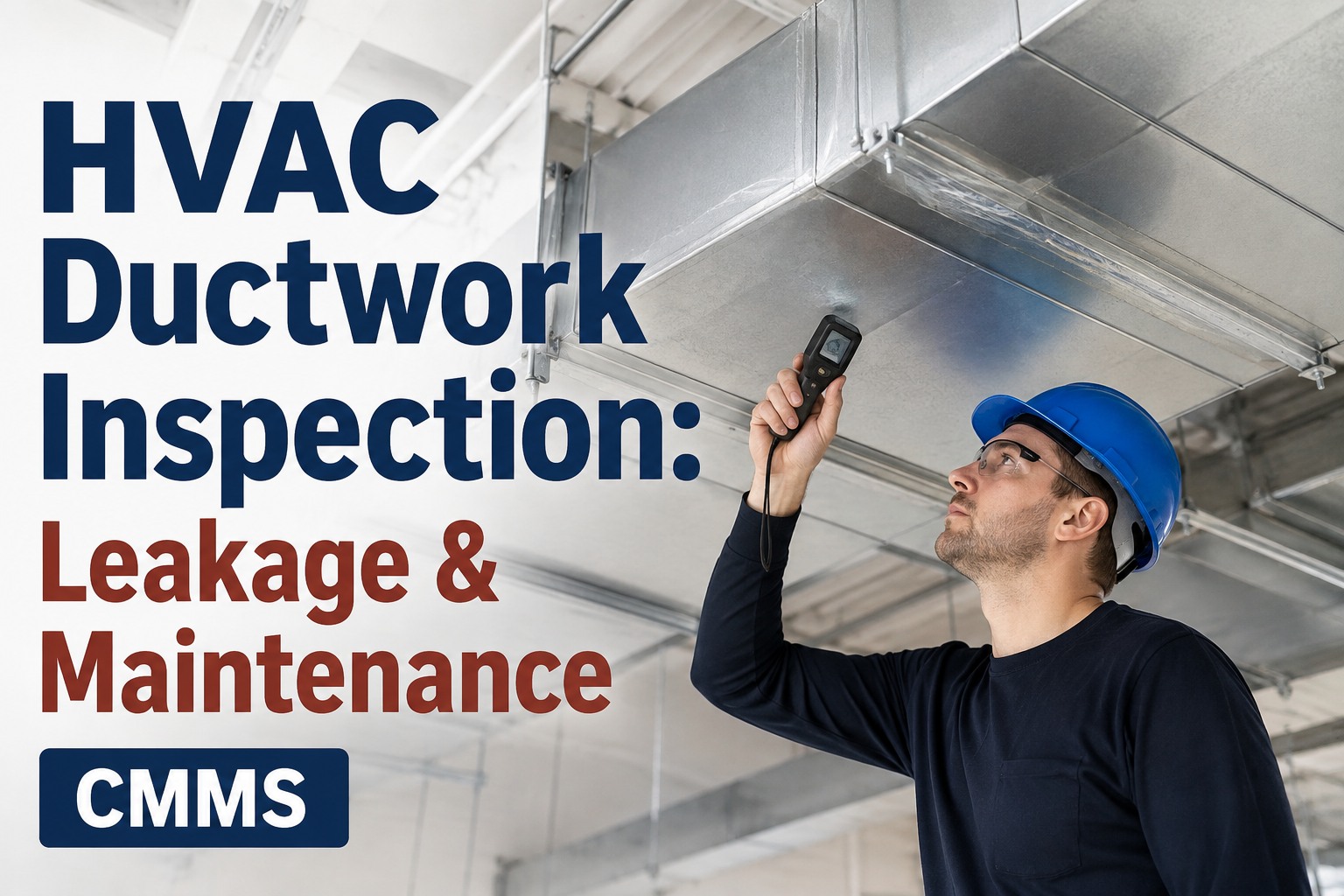
Ductwork is the most consistently under-maintained component in commercial HVAC systems — and the one with the highest energy impact per dollar of neglect. Studies show that leaky, fouled duct systems waste 25–40% of conditioned air before it reaches the intended space, adding directly to utility bills while degrading occupant comfort. A structured duct inspection and cleaning programme recovers that lost energy and extends the life of every piece of equipment connected to the duct network. Sign in to OxMaint to schedule ductwork inspection and cleaning cycles as recurring asset PM work orders, or book a demo to see the HVAC asset lifecycle and energy optimisation module.
Checklist / Energy Efficiency
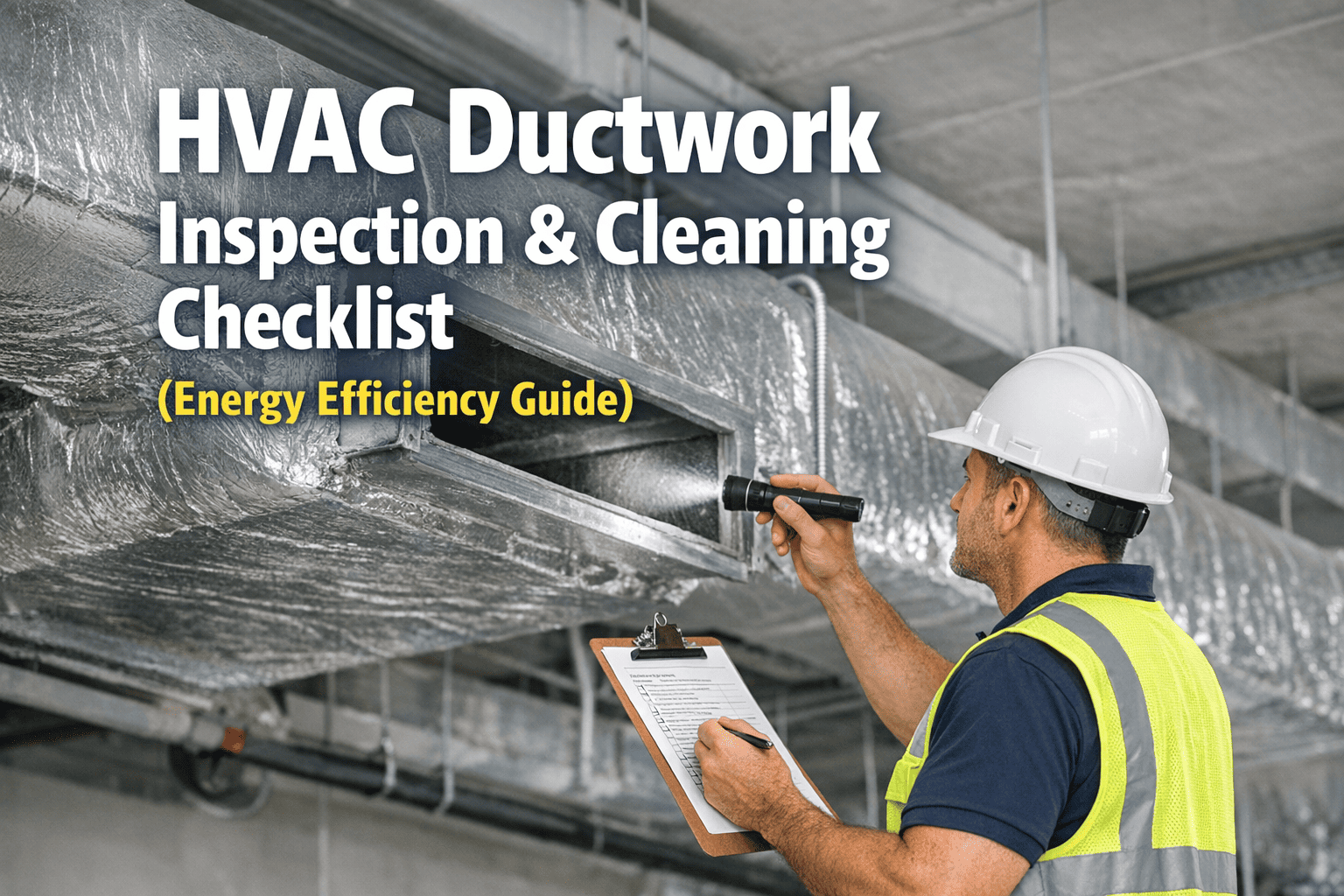
HVAC Ductwork Inspection & Cleaning Checklist (Energy Efficiency Guide)
Duct leak detection, airflow measurement, contamination assessment, cleaning verification, and sealing protocols — the complete inspection and maintenance framework for commercial HVAC duct systems.
25–40%
Conditioned air lost through leaky commercial ductwork
15–30%
Energy savings achievable through duct sealing and cleaning
NADCA
Recommends inspection every 3–5 years; cleaning when contamination is confirmed
AHU-3 Supply Duct: Duct leakage 28% — blower door test failed · Auto work order created
Return Duct Zone B: Static pressure drop 18% below design — restriction detected
Floors 4–6 Duct Network: Post-cleaning airflow restored to 98% design · Closed
The Energy Cost of Ignored Ductwork
L
Duct Leakage
Supply air escaping through unsealed joints, disconnected sections, and corroded seams into unconditioned plenum spaces. Every CFM lost is energy that was paid for but never delivered to the occupant.
Energy cost impact: $0.12–$0.38 / sqft annually
F
Fouled Ductwork
Accumulated dust, debris, and biological growth on duct surfaces increases resistance to airflow — forcing fans and blowers to work harder to maintain design airflow. Increased static pressure = increased energy, increased wear.
Static pressure increase: 10–25% from significant fouling
I
Insulation Failure
Damaged, wet, or missing duct insulation causes conditioned air to gain heat before delivery — the supply air temperature rises as it travels through the duct network, requiring the cooling system to work harder to compensate.
Cooling load increase: 8–15% from failed duct insulation
Duct Inspection Checklist — Visual & Instrument Assessment
Visual Inspection — Access Points & Plenums
Inspect all accessible duct sections for physical damage — dents, tears, collapsed sections, or disconnected joints at branch connections
Check all duct joint tape and mastic sealant for cracking, peeling, or separation — especially at elbow joints and supply/return transitions
Inspect flexible duct connections — verify no kinks, excessive sag, or compression that reduces airflow cross-section by more than 10%
Check duct insulation condition — look for moisture staining, compression, tears, or areas of missing insulation on supply ducts in unconditioned spaces
Inspect AHU supply plenum — check for debris accumulation, condensate pooling, or signs of biological growth on interior surfaces
Verify all access panels are intact, sealed, and secure — open or missing access panels are direct air leaks and contamination entry points
Airflow & Pressure Testing
Measure static pressure at AHU supply and return plenums — compare against design specifications. Elevated static pressure indicates restriction or leakage.
Perform duct leakage test (blower door or duct pressurisation test) on accessible duct sections — measure CFM leakage at 25 Pa. ASHRAE 90.1 allows max 4 CFM25/100 sqft for new construction; existing systems with leakage above 10% warrant sealing.
Measure supply airflow at each diffuser or grille — compare against design CFM. Significant deviation (above 20%) indicates restriction, leakage, or balancing issue requiring investigation.
Check return air grille and filter pressure drop — verify delta-P across filter bank is within design limits. Excessive pressure drop indicates overloaded filter or undersized return.
Test VAV box operation across full range — verify minimum and maximum positions achieve design airflow. Document actual vs. design at each zone.
Contamination Assessment
Inspect duct interior at access panels and register locations — photograph findings. NADCA defines cleaning as necessary when a 1-cm dust layer is present or visible mould/biological growth is confirmed
Check for biological growth (mould, algae) in return air sections and areas with moisture risk — any confirmed growth requires remediation before HVAC system restart
Inspect supply diffusers and grilles for dust buildup — heavy grille fouling is a strong indicator of duct interior contamination
Collect dust sample if contamination is suspected — send for analysis to identify composition (construction debris, mould spores, biological) before specifying cleaning scope
Energy Impact: Before vs. After Duct Sealing & Cleaning
HVAC Fan Energy (kWh/day)
Supply Air Delivery vs. Design (%)
Cooling Energy per Month (kBtu)
Schedule Ductwork Inspections as Recurring PM Work Orders in OxMaint
Every duct section, plenum, and VAV zone linked to an asset record. Inspection findings trigger corrective work orders. Cleaning verification records stored against the asset for next inspection comparison. Energy baseline updated automatically after each intervention.
Duct Cleaning & Sealing — Verification Checklist
| Task |
Acceptance Criterion |
Record Required |
Frequency |
| Pre-cleaning airflow measurement |
Baseline documented — compare against design CFM for each zone |
Airflow report by zone with test equipment ID |
Before every cleaning |
| Mechanical agitation cleaning (NADCA ACR) |
Contact cleaning of all accessible surfaces — vacuum extract in same pass |
Contractor completion report per duct section |
When contamination confirmed |
| Post-cleaning visual inspection |
No visible dust layer on surfaces >1 cm — photographic evidence |
Before and after photos at same inspection points |
After every cleaning |
| Duct leakage test post-sealing |
Leakage below 4 CFM25/100 sqft floor area (ASHRAE 90.1 new) or below 10% of total flow |
Test report with pressure and leakage readings at all test points |
After sealing intervention |
| Post-cleaning airflow measurement |
All zones within 10% of design CFM — document change from pre-cleaning baseline |
Airflow report — same measurement points as pre-cleaning |
After every cleaning |
| Energy consumption comparison |
Fan kWh measurably lower at same outdoor conditions — document as cost avoidance |
30-day post-cleaning energy baseline vs. pre-cleaning 30-day baseline |
30 days post-cleaning |
"
Duct systems are the invisible infrastructure of commercial HVAC — out of sight in ceiling plenums and mechanical shafts, so they are out of the maintenance schedule too. I have audited buildings where the duct system had not been formally inspected since original commissioning 12 years earlier. The leakage test showed 34% loss — meaning one-third of all energy spent conditioning that building's air was being delivered to a ceiling plenum rather than to the occupants. The facility manager knew energy costs were high and assumed the equipment was to blame. The equipment was fine. The duct system was the problem. Systematic duct inspection with documented leakage testing is one of the highest-ROI maintenance investments available to a commercial building operator — and one of the rarest. In my experience, fewer than 20% of commercial buildings have had a formal duct leakage test in the past five years.
James Okonkwo, PE, CEM, CMVP
Professional Engineer · Certified Energy Manager · Certified Measurement & Verification Professional · 21 years building energy systems and HVAC commissioning · Former Principal Engineer, national energy services firm · Specialist in duct system energy optimisation, commissioning, and HVAC asset lifecycle management
Frequently Asked Questions
How often should commercial HVAC ductwork be inspected and cleaned?
NADCA (National Air Duct Cleaners Association) recommends formal inspection every 3–5 years for commercial systems, with cleaning performed when inspection confirms contamination meeting NADCA's defined thresholds — not on a fixed time interval. High-occupancy environments like schools, hospitals, and food processing facilities may require more frequent inspection due to higher particulate and biological loading. Duct leakage testing should be performed after any significant HVAC modification, after major construction or renovation activity, and whenever energy costs increase without an identifiable equipment cause.
Sign in to OxMaint to schedule duct inspection cycles as recurring PM work orders per duct zone.
What is the most cost-effective duct energy improvement for an existing commercial building?
Duct sealing consistently delivers the highest energy ROI of any duct intervention — typically $0.80–$1.40 saved per $1 invested in sealing labour and materials in the first year alone. The reason is the direct relationship between leakage reduction and system energy consumption: every CFM returned to the supply circuit reduces fan work, reduces cooling and heating load on mechanical equipment, and improves comfort without any equipment upgrade. Aerosol sealing products can access duct sections that are not accessible for mastic application — and can reduce leakage by 70–90% in a single treatment. Document leakage before and after to quantify the saving.
Can OxMaint track duct inspection and cleaning records across a multi-building facility portfolio?
Yes — duct sections, plenums, and VAV zones can be registered as sub-assets linked to the parent AHU in OxMaint. This allows duct inspection work orders to be scheduled per zone, with before-and-after measurement data, contractor completion records, and photo evidence stored against each duct asset. At portfolio level, the OxMaint multi-site dashboard shows which buildings have had duct inspections within the recommended cycle and which are overdue — giving the energy manager a portfolio-level duct compliance view without site-by-site investigation.
Book a demo to see duct asset configuration and energy optimisation tracking in OxMaint.
25–40% of Your Conditioned Air Is Escaping Your Duct System. OxMaint Tracks the Fix.
Schedule duct inspections as recurring PM work orders. Log leakage test results against each duct zone. Track energy consumption before and after cleaning. Prove ROI on every duct intervention — automatically.