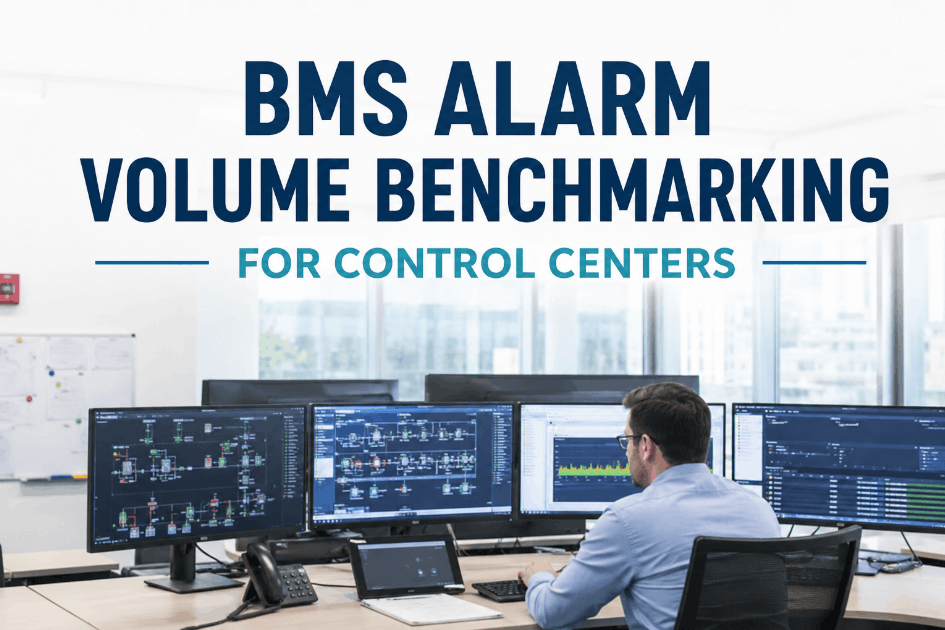
Control room operators stop trusting an alarm system long before anyone admits the system has a problem. When a building management system generates hundreds of alarms a day and most of them repeat the same nuisance fault, operators start acknowledging and dismissing without reading — and the one alarm that signals a real failure gets buried in the noise. Benchmarking alarm volume against a defined baseline is the only way to know whether your BMS is reporting real conditions or just repeating itself. Sign Up Free to see how Oxmaint benchmarks and groups BMS alarm activity by event type — or Book a Demo to review your own alarm volume against industry benchmarks.
BMS Alarms · Control Center Operations · Noise Reduction
Find Out How Much of Your Alarm Volume Is Actually Noise
Oxmaint benchmarks alarm rates per operator, per system, and per point against accepted control room thresholds — then groups repeat sources so your team can trim them.
The Overload Problem
Why Alarm Volume Benchmarking Matters for Control Center Teams
150+
Daily alarms per operator commonly cited as the point where acknowledgment quality drops sharply in control room studies.
~80%
Share of alarms in unbenchmarked systems that typically trace back to a small set of repeat point types or chattering sensors.
10:1
Rough ratio of nuisance to actionable alarms reported in BMS environments without grouping or volume review.
Benchmarking Process
How Oxmaint Benchmarks BMS Alarm Volume Before Tuning Begins
Cutting alarm volume without first benchmarking it is guesswork — you risk silencing something that actually mattered. Oxmaint runs a structured four-step benchmarking pass before any tuning recommendation is made, so every suppressed or grouped alarm is a documented decision rather than a guess. Sign Up Free to run this benchmark against your own alarm history, or Book a Demo to see a sample benchmarking report.
01
Establish Baseline Volume Per Point and Per System
Historical alarm logs are pulled by point ID and system to establish a per-point baseline rate, separating chronic high-frequency points from genuinely rare ones.
02
Group Alarms by Event Type and Root Cause
Repeat alarms are grouped into event-type categories — sensor drift, setpoint deviation, communication loss — so the volume is visible by cause, not just by raw count.
03
Compare Against Accepted Operator Load Thresholds
Per-operator and per-shift alarm rates are compared against recognized control room load thresholds to identify where volume exceeds sustainable acknowledgment capacity.
04
Flag Repeat Noise Sources for Targeted Tuning
Points contributing disproportionate volume are flagged with a recommended action — deadband adjustment, delay timer, or priority reclassification — for engineering review.
| Metric | Before Benchmarking | After Tuning |
|---|
| Avg. daily alarms per operator | 210 | 68 |
| Repeat alarms from top 5 noisy points | 54% of volume | 12% of volume |
| Alarms acknowledged within target time | 61% | 93% |
| Critical alarms missed or delayed | Tracked manually | Flagged automatically |
Benchmark First, Tune Second
Know Which Alarms Are Worth an Operator's Attention
Oxmaint benchmarks your BMS alarm volume against control room load thresholds and groups repeat sources before any tuning recommendation is made.
FAQs
Frequently Asked Questions
What is BMS alarm volume benchmarking?
It is the process of comparing alarm rates per point, system, and operator against accepted control room thresholds to identify excessive or repeat noise.
Does Oxmaint group alarms automatically by event type?
Yes. Alarms are grouped by event type and root cause so control center teams can see which categories drive the most volume.
Will benchmarking reduce alarms before any tuning happens?
Benchmarking itself does not suppress alarms — it identifies which points and event types are candidates for tuning, with engineering review before changes are made.
Can Oxmaint track alarm acknowledgment performance per operator?
Yes. Acknowledgment time and alarm load per operator and per shift are tracked to confirm volume is within sustainable limits.
Less Noise, More Signal
Bring Structured Benchmarking to Your Control Center
Oxmaint helps control center teams separate genuine faults from repeat noise with structured alarm volume benchmarking and grouped reporting.