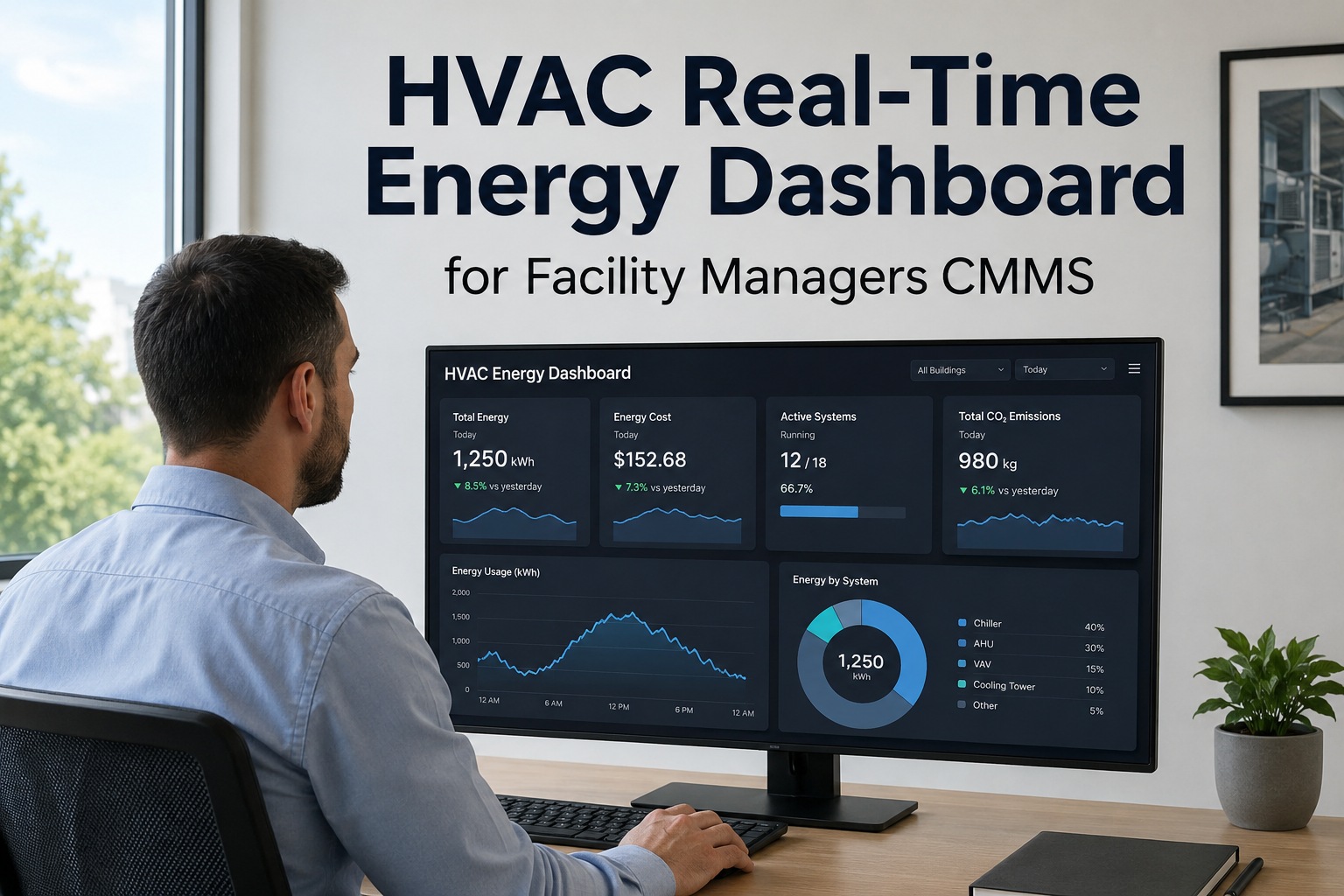
The chiller plant is responsible for 40 to 60 percent of a commercial building's total energy consumption during cooling season — making it the single highest-leverage system for energy cost reduction. Yet most facility teams manage chillers through calendar-based maintenance intervals and monthly energy bills, missing the real-time performance deterioration that costs $30,000 to $120,000 in wasted energy annually before anyone acts. Linking chiller plant runtime data and energy analytics to maintenance tasks in Oxmaint creates a continuous performance loop where maintenance actions are measured by their energy impact — not just their completion.
Chiller Systems · Energy & ESG Reporting · Blog · P1 Critical
Chiller Plant Optimization with CMMS and Energy Analytics
Link chiller energy performance data to maintenance scheduling, runtime history, and PM tasks — so every maintenance action is justified by its energy return and every inefficiency triggers an action.
0.65 kW/ton
Best-in-class chiller plant efficiency (COP 5.4). Most underperforming plants run at 0.9–1.2 kW/ton
1°C
Condenser water temperature rise from fouling = 3% more chiller energy. Detectable in 2 weeks without analytics
$84K
Average annual energy saving at a 500-ton chiller plant optimised through CMMS-linked analytics
The Optimisation Gap
Why Chiller Plants Underperform — and Stay That Way
Chiller performance degrades through a combination of maintenance-linked factors — condenser fouling, refrigerant loss, heat exchanger scaling, and bearing wear — and operational factors including poor sequencing, incorrect setpoints, and suboptimal chilled water temperatures. The problem for most facility teams is that these two domains are managed separately: energy management happens in the building management system, maintenance happens in work orders, and neither system talks to the other. The result is that a chiller running at 120 percent of its design kW/ton gets a scheduled PM completed on time while continuing to waste $3,000 to $8,000 per month in avoidable energy costs.
Maintenance Without Energy Data
- PMs completed on calendar schedule regardless of equipment condition
- No measurement of energy improvement after maintenance actions
- Condenser tube fouling undetected until approach temperature is obvious
- Refrigerant loss invisible until capacity drops enough to cause complaints
Energy Data Without Maintenance Link
- Energy anomalies flagged with no automatic path to a maintenance action
- Performance ratio declines logged but not diagnosed or actioned
- No asset service history context for interpreting energy deviations
- Optimisation recommendations generated but not executed or tracked
Oxmaint: Both Connected
- Energy anomaly triggers maintenance work order with asset history attached
- Post-maintenance energy delta measured and logged automatically
- Condenser fouling detected from approach temp trend — work order raised before it compounds
- PM trigger adjusted based on actual performance data, not fixed calendar
Key Performance Metrics
Chiller Plant KPIs to Track in Real Time
| KPI |
Formula / Source |
Target Range |
Maintenance Trigger |
Energy Impact |
| kW/ton (IPLV) |
Total chiller kW ÷ tons cooling |
< 0.7 kW/ton |
>10% above baseline |
High |
| Approach Temperature |
LCW – ECWS (condenser side) |
≤ Design + 1°C |
Rising trend > 2°C vs baseline |
High |
| Chilled Water Delta-T |
CHWR – CHWS temperature |
6–8°C design |
Delta-T < 4°C consistently |
Medium |
| Compressor Current Draw |
Amps at rated load |
Per nameplate ± 5% |
>8% above rated at equivalent load |
High |
| Condenser Water Flow |
GPM per ton design |
Per design specification |
Flow < 90% of design GPM |
Medium |
| Refrigerant Suction Pressure |
Low-side pressure at design conditions |
Per refrigerant spec ± 5% |
Trending down >3% over 4 weeks |
High |
| Plant Load Factor |
Actual tons ÷ Total installed tons |
40–80% for best efficiency |
Consistently <30% — sequencing review
Medium |
Connect Your Chiller Energy Data to Oxmaint Maintenance
Real-time KPI dashboard, anomaly-triggered work orders, and post-maintenance energy verification — the complete chiller optimisation loop in one platform.
23%
Average chiller energy saving in year one with CMMS-linked analytics vs calendar maintenance alone
5.2 yr
Extended chiller lifespan from condition-based maintenance replacing fixed-interval overhaul scheduling
Maintenance Actions With Measured Energy Return
Which Chiller Maintenance Tasks Deliver the Highest Energy ROI
01
Condenser tube cleaning
3–8% energy reduction
Approach temp rise > 1.5°C from baseline
02
Refrigerant recharge to spec
5–15% energy reduction
Suction pressure trending down > 3% over 4 weeks
03
Chilled water setpoint reset optimisation
4–10% energy reduction
Part-load operation > 60% of hours at fixed setpoint
04
Chiller sequencing review
6–12% plant energy reduction
Plant load factor consistently outside 40–80% optimal band
05
Evaporator coil inspection and clean
2–5% energy reduction
Delta-T narrowing trend > 6 weeks with same load profile
06
VFD calibration and pump speed optimisation
8–18% pump energy reduction
Pump running at fixed speed with variable load conditions
Expert Review
What Chiller and Energy Specialists Say
"The facilities that achieve the best chiller plant efficiency are not those with the newest equipment — they are those with the most disciplined performance monitoring and the tightest connection between their energy data and their maintenance workflows. Condenser fouling is the most common and most preventable source of chiller inefficiency, and it is entirely invisible without regular approach temperature trending against a documented baseline."
— ASHRAE Journal, Chiller Plant Efficiency Optimisation, 2024
"CMMS-integrated energy analytics has fundamentally changed how we evaluate maintenance ROI on chiller plants. Before, maintenance was a cost. Now, every condenser tube cleaning or refrigerant recharge has a measured energy saving attached — usually within 48 hours of the work order closing. That verification data changes the capital conversation: maintenance is no longer a budget item, it is an investment with a calculable return."
— Facilities Management Journal, HVAC Energy Management Feature, Q3 2024
Common Questions
Frequently Asked Questions
How does Oxmaint connect chiller energy data to maintenance work orders?
Oxmaint ingests chiller performance data — kW draw, tons cooling, approach temperatures, refrigerant pressures — via BMS integration or IoT sensor connection. When performance metrics deviate from the asset's established baseline beyond configured thresholds, Oxmaint automatically generates a maintenance work order with the energy anomaly data, the probable cause, and the asset's maintenance history attached. After the work order is completed, Oxmaint measures the post-intervention energy performance against the pre-fault baseline, calculating the verified energy saving from that specific maintenance action. This creates a financial record of maintenance ROI that supports budget justification.
Sign up free to begin chiller performance baseline configuration.
What is the most effective chiller PM trigger — calendar, runtime, or condition?
The evidence strongly supports condition-based triggering over calendar or runtime intervals for most chiller PM tasks. Condenser tube cleaning, for example, is typically scheduled annually — but a cooling tower in a dusty urban environment may require cleaning every 4 months to maintain approach temperature, while a well-controlled system in a clean environment may remain within spec for 18 months. Oxmaint allows PM triggers to be set based on monitored parameters — approach temperature rising above a defined threshold triggers a tube cleaning work order regardless of calendar date. This approach reduces unnecessary PM costs by 15 to 30 percent while eliminating the performance degradation that occurs when fixed intervals are too infrequent.
Book a demo to configure condition-based PM triggers for your chiller plant.
Can Oxmaint track multiple chillers in a sequenced plant configuration?
Yes. Each chiller is registered as an individual asset in Oxmaint with its own performance baseline, maintenance history, and energy dashboard. The plant-level view aggregates all chiller data to show total plant kW/ton, combined capacity utilisation, and sequencing efficiency. When the system identifies that plant load factor is consistently outside the optimal 40 to 80 percent range for the installed chiller configuration, it can flag a sequencing review work order for the maintenance planner or energy manager. Lead and lag chiller assignments and staging setpoints can be documented and tracked as configurable parameters in the Oxmaint asset record.
How does chiller analytics in Oxmaint support NABERS or ENERGY STAR reporting?
Oxmaint's chiller energy data feeds directly into the building-level energy consumption records used for NABERS, ENERGY STAR, and GRESB submissions. Chiller plant efficiency metrics — seasonal IPLV, hours at rated load, peak demand contribution — are aggregated into the annual ESG and energy performance report alongside all other monitored building systems. For NABERS ratings, the 12-month metered consumption data export from Oxmaint covers all the required input parameters for the chiller plant category without requiring manual data compilation from separate BMS reports and maintenance logs.
Turn Your Chiller Data Into a Maintenance and Energy Optimisation Engine
Real-time KPIs, condition-triggered PM schedules, energy-verified work orders, and ESG reporting — all connected in Oxmaint for your chiller plant.