A 15-year-old centrifugal chiller running at 78% of original efficiency is not just consuming 22% more energy than its nameplate rating — it is accumulating a replacement liability that grows invisibly until the day a compressor bearing fails and the capital request lands on the CFO's desk with no advance notice and no business case. Asset lifecycle management in commercial HVAC is not about tracking warranty expiry dates in a spreadsheet. It is about knowing, at any moment, the health trajectory of every chiller, AHU, cooling tower, and pump in a portfolio — and making replacement decisions with data rather than with reactive urgency. OxMaint's Asset Lifecycle Management platform tracks health scores, lifecycle cost accumulation, warranty status, and replacement planning for every HVAC asset in a large facility portfolio — so capital budgets reflect planned replacement decisions, not emergency failures.
Article · Asset Lifecycle Management · HVAC Systems
HVAC Asset Lifecycle Management for Large Facilities
A complete framework for tracking HVAC asset health, forecasting lifecycle cost, planning capital replacement, and managing warranty, spare parts, and service history — across multi-site commercial facility portfolios.
30–40%
Of HVAC capital replacements are reactive — no advance planning or budget reserve
3.2×
Higher 5-year maintenance cost for reactive vs lifecycle-managed HVAC portfolios
15–25 yrs
Typical commercial chiller lifecycle — shortened to 10–12 years without structured PM
28%
Average energy saving from replacing chillers at end-of-lifecycle vs run-to-failure
The HVAC Asset Lifecycle — 5 Stages Every FM Director Must Manage
HVAC asset lifecycle management is not a single decision — it is a continuous management process across five stages that span the full operating life of every piece of equipment. Missing any stage creates cost exposure at the next.
1
Commissioning & Baseline
Year 0–1
Asset registered in CMMS with full nameplate data, design performance specifications, warranty terms, and OEM PM requirements. Baseline performance readings (kW/ton, cfm, approach temperatures) recorded as the benchmark all future readings are compared against.
OxMaint action: Asset profile creation, warranty calendar, baseline KPI log
→
2
Active Warranty Period
Year 1–5
Warranty compliance PM must be documented precisely — many OEM warranties require specific service intervals performed by certified technicians with records maintained. Warranty claims require complete service records. Untracked warranty work orders leave significant financial exposure unclaimed.
OxMaint action: Warranty-linked PM scheduling, compliance documentation, claim record generation
→
3
Peak Operating Life
Year 5–12
Highest reliability period with proper PM. Lifecycle cost per year is at its lowest. Performance trending begins — annual kW/ton readings compared to baseline, vibration trends compared to commissioning data. Early degradation indicators trigger investigation, not replacement.
OxMaint action: Performance trend dashboard, predictive maintenance alerts, oil analysis tracking
→
4
End-of-Life Planning
Year 12–18
Maintenance cost per year rises. Parts availability narrows. OxMaint flags assets when cumulative maintenance spend crosses 40% of replacement cost — the standard threshold for replacement evaluation. Capital replacement plan built 3–5 years in advance of actual replacement date.
OxMaint action: Lifecycle cost accumulation alert, replacement planning workflow, capex forecast
→
5
Replacement & Decommission
Year 15–25
Planned replacement with complete asset history transferred to new equipment profile. Decommission record confirms refrigerant recovery, electrical disconnection, and disposal compliance. New asset registered with updated baseline — lifecycle restarts with current-generation efficiency standards.
OxMaint action: Decommission record, asset history archive, new asset commissioning workflow
HVAC Asset Health Dashboard — What OxMaint Tracks Per Asset
01
Health Score
Composite score from PM compliance rate, performance trend vs baseline, vibration data, and maintenance cost trajectory. Red/amber/green status visible at portfolio level — no diving into individual records to find troubled assets.
Score: 0–100 · Alert at <65
02
Lifecycle Cost Accumulation
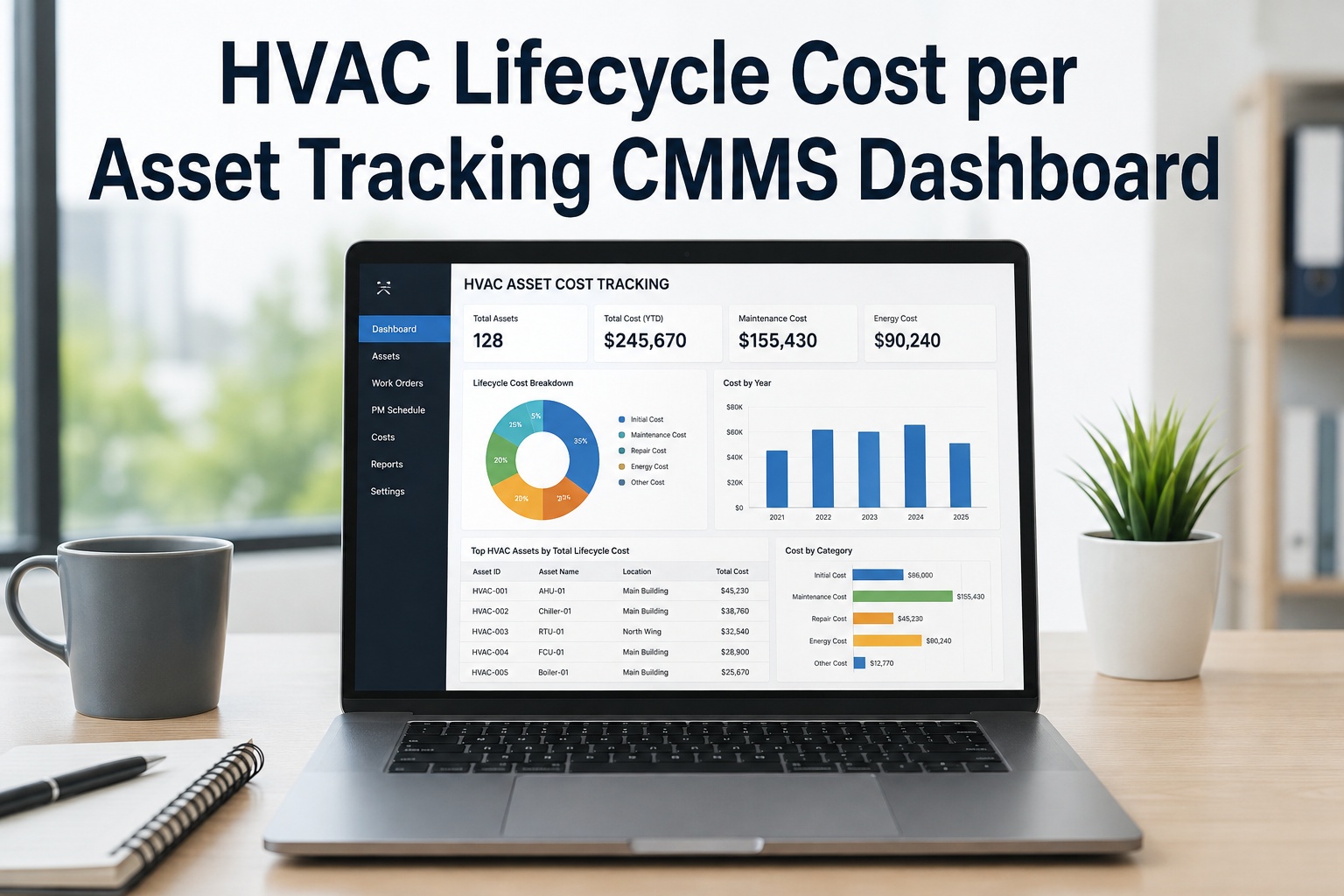
Running total of all labour, parts, contractor, and reactive repair costs since commissioning — compared to current replacement cost. When cumulative spend crosses 40% of replacement value, replacement evaluation is automatically flagged.
Trigger: Cumulative cost > 40% of replacement value
03
Performance Trend
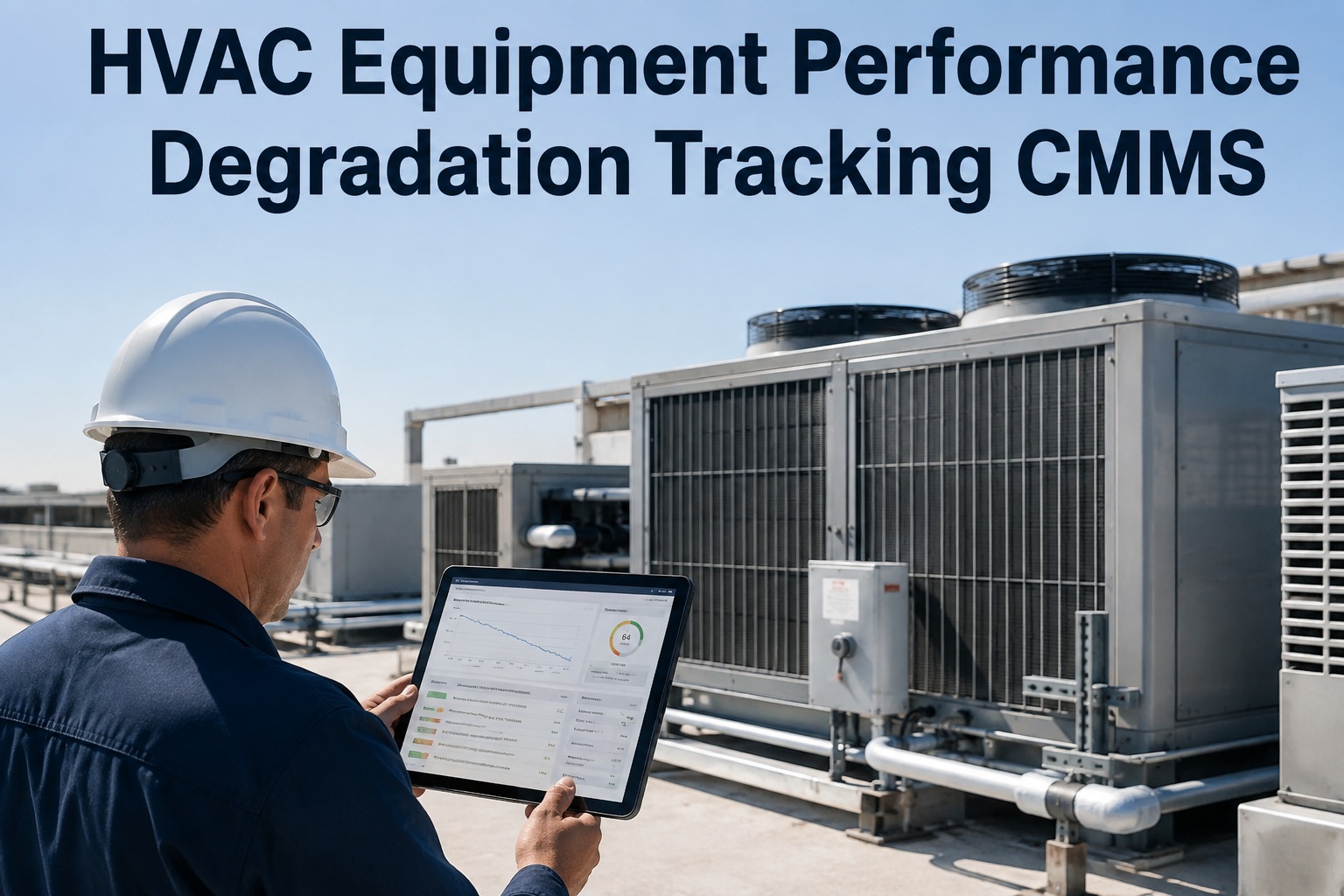
Annual kW/ton readings plotted against commissioning baseline. Efficiency degradation of more than 15% from baseline triggers investigation. Trend line projects remaining useful life based on historical degradation rate.
Alert: >15% efficiency loss from baseline
04
Warranty Tracker
Active warranty terms, expiry dates, and compliance requirements for each asset. PM work orders linked to warranty conditions — records auto-generated in warranty-claim format. Alerts at 90 days and 30 days before expiry.
Alert: 90 days and 30 days before expiry
05
Spare Parts Inventory
Critical spare parts linked to each asset — filters, belts, bearings, contactors, control boards. Minimum stock levels set per asset criticality. Auto-reorder triggered when stock falls below minimum. Parts obsolescence flagged for end-of-life assets.
Auto-reorder below minimum stock threshold
06
Complete Service History
Every work order, PM completion, contractor invoice, oil analysis report, and inspection certificate linked to the asset record — permanent, searchable, and exportable. Asset history transfers to the new owner when equipment is relocated or sold.
Full history: commissioning to decommission
OxMaint gives FM directors a live health score, lifecycle cost position, and replacement timeline for every HVAC asset in their portfolio — from one dashboard, without drilling into individual work order records.
Lifecycle-Managed vs Reactive HVAC Portfolio — 10-Year Cost Comparison
The cost gap between lifecycle-managed and reactive HVAC portfolios widens dramatically past year 8 — the point where deferred maintenance begins triggering compounding equipment failures.
Annual Reactive Repair Cost ($/asset)
78% lower reactive costs
Unplanned Replacement Events (per 100 assets/10 yr)
82% fewer emergency replacements
Asset Useful Life Extension (years)
67% longer asset lifespan
PM Compliance Rate (%)
96% compliance with OxMaint
HVAC Asset Lifecycle KPI Reference
| KPI |
Measurement Method |
Benchmark |
Action Trigger |
| Asset Health Score |
OxMaint composite (PM + performance + cost) |
≥ 75/100 |
<65 → review maintenance plan |
| Cumulative Maintenance Cost Ratio |
Total spend ÷ replacement cost |
< 40% |
>40% → replacement evaluation |
| Chiller Efficiency vs Baseline |
Annual kW/ton vs commissioning kW/ton |
< 10% degradation |
>15% → major service or replacement |
| Mean Time Between Failures |
Operating hours ÷ number of failures |
Trending up year-on-year |
Declining MTBF → escalate review |
| Warranty Compliance PM Rate |
Warranty-required PMs completed on time |
100% |
Any miss → warranty risk alert |
| Spare Parts Coverage Rate |
Critical spares in stock ÷ total required |
≥ 95% |
<90% → auto-reorder triggered |
"The conversation I have most often with FM directors who have just experienced an emergency chiller replacement is this: they tell me the chiller was fine and then suddenly it wasn't. When I pull the asset history — if there is one — the data almost always shows three years of rising reactive repair costs, efficiency declining 2–3% annually, and a maintenance cost-to-replacement-value ratio that crossed 40% eighteen months before the failure. None of that was 'sudden.' It was a trajectory that was perfectly visible and perfectly predictable — but only if someone was looking. That's what asset lifecycle management in a CMMS does. It doesn't prevent equipment from wearing out. It makes the wearing-out process visible months and years in advance, so the capital decision is made on your schedule — with a proper specification, competitive bids, and a planned installation window — not at 11pm when the building is cooking and the tenant is calling every fifteen minutes."
Marcus Obi, CFM, MRICS, BIFM Fellow
Certified Facility Manager · RICS Member · BIFM Fellow · 26 years commercial HVAC asset management and FM strategy · Former Director of Asset Management, pan-European commercial real estate portfolio (8.2M sq ft) · IFMA Board of Directors contributor
Frequently Asked Questions
What is the optimal HVAC asset replacement threshold for commercial facilities?
The standard FM industry benchmark for HVAC replacement evaluation is when cumulative maintenance cost reaches 40–50% of current replacement cost, OR when equipment age exceeds the manufacturer's published design life, OR when efficiency has degraded more than 20% from commissioning baseline — whichever occurs first. In practice, most FM teams use the 40% cumulative cost threshold as the trigger for a formal replacement evaluation, since it provides advance warning 2–4 years before failure while still accounting for assets that age exceptionally well with excellent PM programmes.
OxMaint tracks this threshold automatically for every asset in your portfolio.
How does HVAC asset lifecycle management differ from standard preventive maintenance?
Preventive maintenance is the task-level execution — scheduling and completing specific inspection and service tasks at defined intervals. Asset lifecycle management is the strategic layer above PM — tracking the cumulative effect of PM compliance, performance trends, and maintenance cost accumulation to answer the capital question: should this asset be repaired, refurbished, or replaced? Both are required. Excellent PM execution produces the data that makes lifecycle management decisions reliable. Without PM records, lifecycle cost tracking is incomplete and replacement decisions revert to reactive urgency rather than strategic planning.
How does OxMaint track HVAC asset health across a multi-site portfolio?
OxMaint provides a portfolio-level asset health dashboard where every HVAC asset across all sites is visible with its current health score, lifecycle cost position, age, and next PM due date. FM directors can filter by asset type, site, health score range, or replacement timeline to identify assets requiring attention without reviewing individual records. Health scores are calculated automatically from PM compliance rate, performance trend data, and maintenance cost trajectory — updated in real time as work orders are closed and readings are logged. No manual reporting required.
Book a demo to see the portfolio health dashboard live.
What HVAC asset data should be captured at commissioning to support lifecycle management?
The minimum commissioning data set for effective lifecycle management includes: manufacturer name, model number, and serial number; installation date and commissioning date; full nameplate data (capacity, voltage, refrigerant type and charge weight, design airflow, design kW/ton); warranty terms and expiry dates; OEM-specified PM intervals and requirements; baseline performance readings (kW/ton, approach temperatures, motor amperage, airflow); and design documentation links. This data set, captured once at commissioning and stored in OxMaint, provides the reference point against which all future performance readings and cost accumulation are compared for the full asset life.
Know the Replacement Date of Every HVAC Asset — Before the Failure Decides It For You
OxMaint Asset Lifecycle Management tracks health scores, lifecycle cost, efficiency trends, and warranty status for every chiller, AHU, and pump in your portfolio — so capital decisions are planned years in advance, not made at midnight.