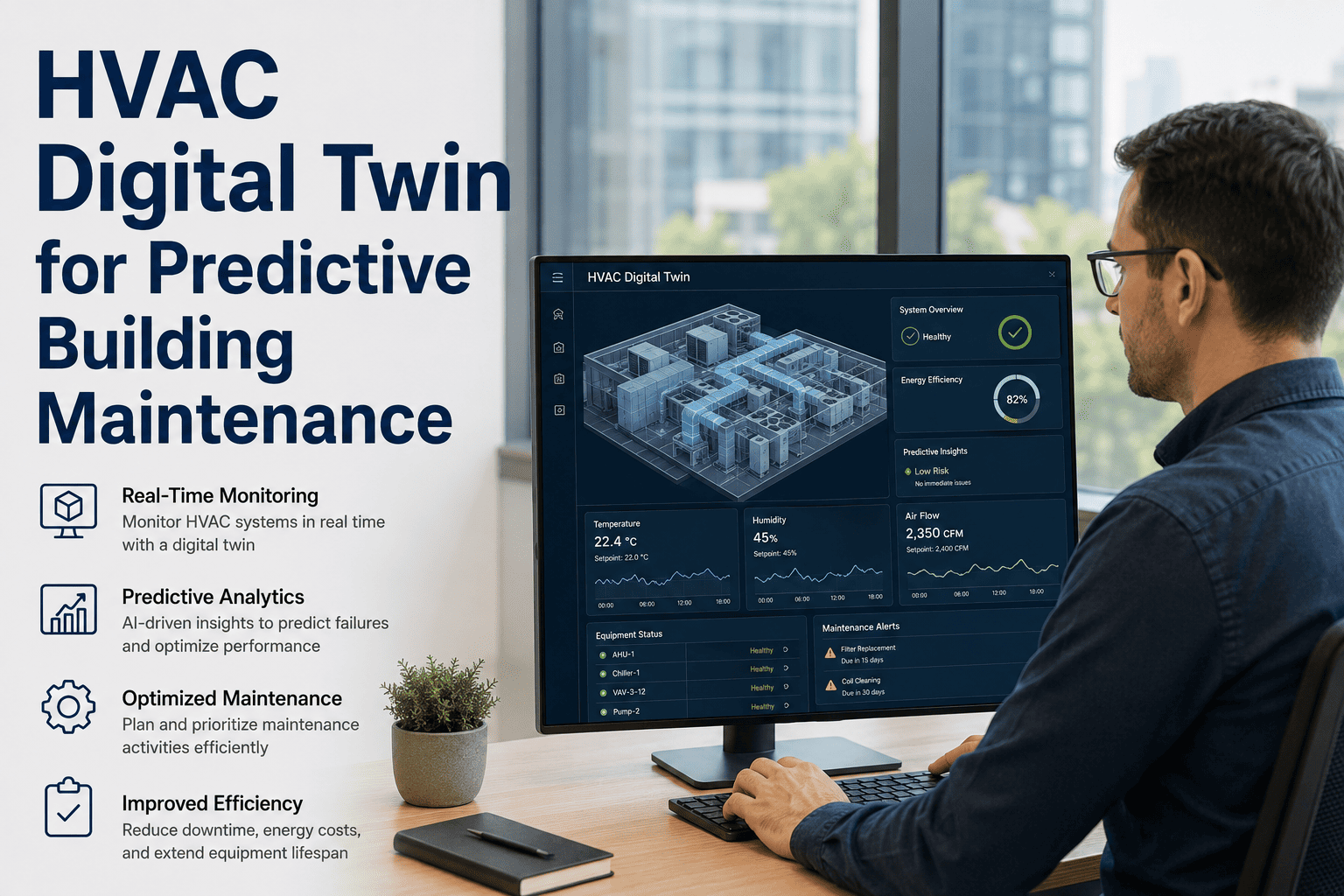
A digital twin is not a dashboard — it is a live, continuously updated virtual replica of your HVAC system that runs in parallel with the physical equipment, predicts failures before they occur, and simulates operational changes before you implement them in the real world. The AI-powered digital twin HVAC market reached $1.38 billion in 2024 and is growing at 28.6% annually — driven by facility operators discovering that traditional reactive and scheduled maintenance cannot keep pace with the complexity of modern building systems. When a digital twin alerts you that your chiller's condenser approach temperature has deviated 3°F from its simulated baseline and projects compressor surge risk in 18 days, your maintenance team can intervene with a planned tube cleaning — not an emergency call at midnight. Start connecting your HVAC data to OxMaint's predictive engine — free.
$1.38B
HVAC digital twin market size 2024
28.6%
Annual market growth rate through 2033
40%
Energy use reduction demonstrated by AI HVAC optimisation (Airedale/Modine 2025)
47.9%
CAGR of broader digital twin market 2025–2030 (MarketsandMarkets)
How It Works
What a Digital Twin Actually Does in an HVAC System
01
Sensor Data Ingestion
IoT sensors across the HVAC system — temperature, pressure, flow, vibration, power — stream live data continuously to the digital twin platform. The twin receives every data point in real time, building a second-by-second operational picture.
02
Virtual Model Baseline
The twin runs a physics-based or data-driven model of how the HVAC system should perform under current load and ambient conditions. This becomes the baseline against which actual sensor readings are compared — not a static design spec, but a live expected-vs-actual comparison.
03
Anomaly Detection & Fault Prediction
When sensor readings deviate from the model baseline, the twin classifies the anomaly — identifying whether it is tube fouling, refrigerant drift, bearing wear, or sensor failure — and calculates the projected time to failure based on degradation rate. Faults are caught weeks before physical symptoms appear.
04
Work Order Generation & Simulation
Confirmed anomalies trigger prioritised CMMS work orders with fault type, affected asset, urgency window, and recommended action. The twin also simulates proposed operational changes — setpoint adjustments, sequencing modifications, load balancing — before you implement them, eliminating trial-and-error optimisation.
Use Cases
Where HVAC Digital Twins Deliver the Most Value
Predictive Maintenance
Detect Faults 4–8 Weeks Before Failure
Bearing wear, tube fouling, refrigerant loss, and coil fouling all show measurable deviation signatures in sensor data weeks before they cause failure or comfort impact. Digital twin fault classification converts these signals into timestamped, prioritised maintenance actions.
Avg 60% reduction in unplanned HVAC downtime
Energy Optimisation
Continuous Setpoint and Sequence Optimisation
The twin continuously evaluates whether current chilled water setpoint, condenser water reset, and chiller sequencing represent the minimum energy operating point for current load and ambient conditions. It adjusts automatically or recommends specific control changes.
10–40% energy reduction documented in field deployments
Commissioning Support
Validate System Performance at Handover
A digital twin baseline created during commissioning captures how the system performs at handover. Any subsequent deviation from commissioning-verified performance is immediately detectable — turning retro-commissioning from a periodic project into a continuous real-time process.
Eliminates performance drift between commissioning cycles
Capacity Planning
Simulate Future Load Scenarios
Before adding IT load to a data center, changing occupancy in a commercial building, or retrofitting HVAC equipment, the digital twin simulates the impact on system performance, identifies capacity constraints, and quantifies the energy and maintenance implications.
Replace physical stress testing with validated simulation
OxMaint's IoT and AI predictive engine connects to your HVAC sensors, builds performance baselines, and converts detected anomalies into prioritised work orders automatically — no manual analysis required.
Technology Comparison
Digital Twin vs Traditional HVAC Monitoring Approaches
| Capability |
Manual Inspection |
BAS / SCADA Alarms |
HVAC Digital Twin |
| Fault detection timing |
After visible failure or complaint |
After threshold breach |
4–8 weeks before failure |
| Fault classification |
Technician diagnosis at site |
Alarm type only — no root cause |
Automated root cause identification |
| Energy optimisation |
Periodic retro-commissioning only |
Fixed setpoint schedules |
Continuous real-time optimisation |
| Scenario simulation |
Not possible without physical test |
Not available |
Pre-implementation virtual testing |
| Maintenance trigger |
Reactive or fixed calendar |
Alarm-driven |
Condition-based with failure projection |
Expert Perspective
What Building Technology Leaders Say
"The value of a digital twin is not the visualisation — it is the physics model running underneath it. When the model tells you that your chiller should be consuming 180 kW at the current load and ambient conditions, and the sensor says 220 kW, the 40 kW gap is your diagnostic starting point. That conversation is impossible with a BAS alarm system, which only tells you something is wrong after the threshold is already breached."
Senior Building Technology Architect, smart buildings consultancy — 15 years in HVAC AI and digital twin deployment
"The most compelling ROI story for digital twins is not energy savings — it is avoided major failures. One prevented centrifugal chiller compressor failure in a critical facility pays for two to three years of digital twin licensing. The detection window is what matters: catch tube fouling at 3°F approach temperature deviation, and you have a planned cleaning. Catch it at 8°F, and you are looking at surge damage and compressor replacement."
Chief Engineer, critical facility management group — 22 years in central plant operations and predictive technology
FAQs
Frequently Asked Questions
What sensors are needed to build an HVAC digital twin?
The minimum sensor set for a meaningful HVAC digital twin includes supply/return temperature and flow at major equipment, power consumption per major load, refrigerant pressure and temperature at key points, and ambient conditions. Modern digital twin platforms can build initial models with existing BAS sensor points and improve accuracy as additional IoT sensors are deployed. OxMaint ingests data via OPC-UA, BACnet, Modbus, and REST API — no full sensor replacement is required for most installations.
Book a demo to assess your existing sensor coverage.
How is a digital twin different from a BAS alarm system?
A BAS alarm triggers when a measured parameter crosses a fixed threshold — it reports a problem that has already occurred. A digital twin compares live sensor readings against a physics-based model of expected performance and detects deviations before they reach alarm levels. The twin identifies the type of fault, its root cause, and projects when it will reach a critical threshold — enabling planned intervention rather than reactive response. This early-detection window typically ranges from 4 to 8 weeks for common HVAC failure modes.
See OxMaint's predictive anomaly detection capability free.
How long does it take to implement HVAC digital twin technology?
Cloud-based HVAC digital twin platforms using existing BAS data can be operational in 2–6 weeks for most commercial buildings. The initial phase involves sensor integration, data validation, and baseline model creation — typically requiring 2–4 weeks of clean operating data before fault detection and anomaly scoring become reliable. Full predictive maintenance capability is usually active within 4–8 weeks of initial connection. OxMaint's IoT integration is designed for non-disruptive deployment alongside existing infrastructure.
Book a demo to see the deployment timeline for your building.
Your HVAC System Knows It Is Going to Fail. Listen to It.
OxMaint's AI predictive engine turns your HVAC sensor data into early fault warnings, energy optimisation recommendations, and automated work orders — weeks before problems become failures.