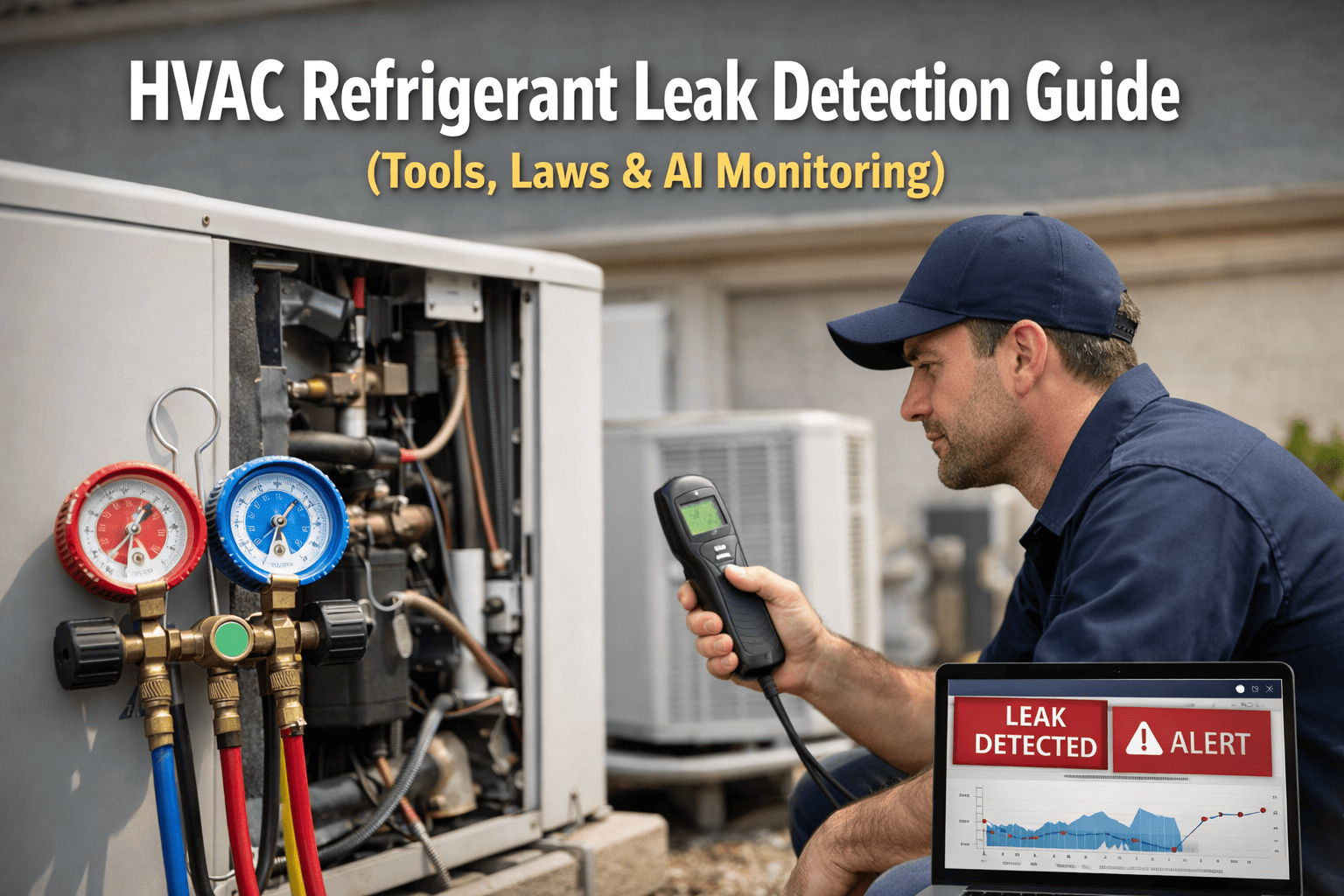
HVAC Refrigerant Leak Detection Guide (Tools, Laws & AI Monitoring)

By James smith on April 14, 2026

hvac-refrigerant-leak-detection-guide-ai-monitoring

A refrigerant leak does not announce itself on a dashboard alert — it reveals itself slowly through declining cooling capacity, rising compressor head pressure, increased energy consumption, and eventually a regulatory compliance violation when a technician discovers the loss during annual service. The EPA Section 608 regulations require leak inspection at defined thresholds (150 lbs. charge and above) and refrigerant loss tracking — and violations carry civil penalties up to $44,539 per day per violation. Oxmaint's compliance and predictive AI module monitors refrigerant charge levels via pressure and temperature trend analysis, logs every leak event with regulatory-required detail, and triggers inspections at EPA-defined loss thresholds automatically — before a leak becomes a penalty.

Article · Compliance + Predictive AI

HVAC Refrigerant Leak Detection Guide: Tools, Laws & AI Monitoring

How to detect refrigerant leaks using electronic sensors, ultrasonic tools, and AI trend analysis — with EPA Section 608 compliance requirements, violation penalties, and CMMS-integrated leak tracking.

EPA Civil Penalty
$44,539
Per day, per violation — for improper refrigerant handling or failure to repair leaks within required timeframes
AI Refrigerant Monitoring — Live

Rooftop Unit 4 — Suspected R-410A Leak
Suction pressure -8.2 PSI from baseline · 7 min ago · Work order created
Critical

Chiller #2 — Charge Trending Low
Subcooling: 4.2°F (design: 10°F) · Gradual decline 14 days
Watch

Split Unit Bank — All Units Nominal
Pressure and temperature within baseline · Last verified 2 hrs ago
Normal

Refrigerant Leak Detection Tools — Comparison & Best Use

Detection Method Technology Sensitivity Best For Limitation Cost Range
Electronic Leak DetectorsHeated diode / infrared cellDown to 0.1 oz/yearAHU, coil, compressor leak locationRequires technician present$200–$800
Ultrasonic DetectorsAcoustic emission detectionDetects pressurized gas escapeHigh-pressure side, valve seatsBackground noise interference$400–$1,500
UV Fluorescent DyeUV lamp + tracer dyeVisual confirmation of leak siteLocating confirmed leaks preciselyContamination risk in some systems$50–$200 (dye kit)
Fixed IoT Refrigerant SensorsElectrochemical / IR gas cell1–10 ppm continuousMachine rooms, equipment spacesHigh initial cost, requires calibration$500–$2,000/sensor
AI Pressure/Temp Trend AnalysisBAS data + ML algorithmsDetects subcooling/superheat driftAny system with BAS instrumentationRequires historical baseline dataCMMS software cost only
Nitrogen Pressure TestSystem pressurization + soapConfirms and locates leaksAfter repairs — verificationSystem must be empty of refrigerantEquipment cost only

Refrigerant Leak Regulations — What Facilities Must Do

150 lbs+
Inspection Trigger
Systems with 150 lbs or more of refrigerant charge must be inspected annually. Equipment with leak rates exceeding EPA annual leak rate thresholds must be repaired within defined timeframes.
30 days
Repair Deadline (Comfort Cooling)
Once a leak is identified in comfort cooling equipment, repair must be completed within 30 days under EPA regulations. Extensions available upon application to EPA with documented reasons.
120 days
Industrial Process Repair
Industrial process refrigeration systems have a 120-day repair window from leak discovery. Documentation of discovery date, repair actions, and technician certification must be maintained for 3 years.
3 years
Record Retention
All refrigerant purchase, transfer, recovery, and leak repair records must be retained for minimum 3 years and available for EPA inspection on demand. Digital CMMS records satisfy this requirement.
Compliance + Predictive AI

Detect Refrigerant Leaks Before EPA Thresholds Are Triggered

Oxmaint's AI monitoring tracks subcooling, superheat, and suction pressure trends across all refrigerant systems — flagging drift patterns that indicate developing leaks weeks before they reach EPA reportable loss thresholds.

How AI Detects Refrigerant Leaks Before They Become Reportable

Step 1
Baseline Establishment
AI models establish normal pressure, temperature, subcooling, and superheat profiles for each system under varying load conditions. Seasonal variation and occupancy patterns are factored into the baseline — not a single static setpoint.
Step 2
Drift Pattern Detection
Gradual decline in suction pressure, increasing superheat above design, and subcooling below design — under constant load conditions — triggers an early-warning alert. A 2 PSI drift over 14 days that a technician would never notice is detected immediately.
Step 3
Leak Probability Scoring
Multiple parameters are combined into a leak probability score — pressure trend, energy consumption deviation, runtime increase for same setpoint achievement, and seasonal adjustment factors. Systems above 60% probability trigger investigation work orders.
Step 4
CMMS Work Order + EPA Log
Oxmaint automatically creates an inspection work order, logs the detection date (critical for EPA compliance timelines), and tracks the repair event against the 30 or 120-day deadline — with automated escalation if repair is not completed on time.

Reactive vs. AI-Monitored Refrigerant Management

Average Refrigerant Loss Before Leak Detection
Manual inspection
18–30 lbs average loss
AI monitoring
Under 3 lbs
Time from Leak Start to Detection
Manual
Weeks to months
AI + IoT
2–5 days
"

The shift from reactive leak detection to AI-powered trend monitoring changes the entire economics of refrigerant management. A system that loses 20 lbs before a technician notices costs three times more in refrigerant, compressor wear, and energy penalty than one caught at 2 lbs of loss through subcooling trend analysis. More importantly, it changes the compliance risk profile entirely. Under EPA Section 608, the clock starts ticking from the date of discovery — not from when the leak became large enough to find manually. AI monitoring systems that detect drift within days of leak initiation give facilities the maximum available repair window and the documented discovery date that satisfies EPA recordkeeping requirements. Every facility managing more than 150 lbs of refrigerant charge should consider AI trend monitoring a compliance tool, not just a maintenance convenience.

Michael Torres, PE, CMS
Environmental Compliance Engineer — EPA Section 608 Specialist / 17 Years in Refrigerant Management and HVAC Regulatory Compliance

Refrigerant Leak Detection — Frequently Asked Questions

When does EPA Section 608 require a refrigerant leak inspection?
EPA Section 608 regulations require annual leak inspections for systems with 150 lbs or more of refrigerant charge, regardless of whether a leak has been detected. Beyond scheduled inspections, when a technician observes a system with a leak rate exceeding EPA's annual threshold (currently 30% for comfort cooling and industrial refrigeration), repair must be initiated immediately. The discovery date must be documented, as EPA repair deadlines (30 days for comfort cooling, 120 days for industrial process) run from the date of documented discovery. Failure to document discovery date and repair completion can result in penalties up to $44,539 per day per violation. Oxmaint logs discovery dates and tracks repair deadlines automatically.
How can AI detect a refrigerant leak without a dedicated leak sensor?
AI leak detection works through thermodynamic analysis — comparing actual system pressure, temperature, subcooling, and superheat values against baseline models calibrated to each unit under varying load and ambient conditions. A developing refrigerant leak causes predictable shifts: suction pressure declines gradually, superheat increases above design, subcooling decreases, and energy consumption rises to maintain the same setpoint. These trends are individually subtle but collectively distinctive — and AI models trained on normal system behavior detect the pattern within days of leak initiation. This approach works on any system with BAS instrumentation, requiring no additional hardware investment beyond the CMMS integration. Book a demo to see AI refrigerant trend analysis applied to your systems.
What records must be kept for EPA Section 608 refrigerant compliance?
Facilities subject to EPA Section 608 must maintain records for a minimum of 3 years covering: refrigerant purchase and use records (quantity, refrigerant type, supplier), technician certification numbers for anyone who purchases or handles regulated refrigerants, leak inspection dates and results for systems above 150 lbs charge, documented discovery date and repair completion date for any identified leaks, and refrigerant recovery and reclaim records. Digital CMMS records satisfy EPA recordkeeping requirements provided they include the required fields and are accessible for inspection on demand. Oxmaint generates EPA Section 608-compliant refrigerant records automatically.
What is the most reliable tool for locating the exact site of a refrigerant leak?
Electronic leak detectors (heated diode or infrared cell types) are the most widely used and reliable tools for locating refrigerant leaks in HVAC equipment, with sensitivity down to 0.1 oz per year on most refrigerant types. UV fluorescent dye systems are the most precise for pinpointing a confirmed leak location once electronic detection has narrowed it to a component or section. Ultrasonic detectors work well on the high-pressure side of the system where refrigerant escapes under significant pressure. For sealed or inaccessible systems, nitrogen pressure testing combined with soap bubble solution is the definitive leak verification method after refrigerant recovery. Book a demo to see how Oxmaint tracks leak detection and repair work orders.
Proactive Refrigerant Compliance

Catch Refrigerant Leaks Before EPA Finds Them First

Oxmaint's AI trend analysis monitors pressure and temperature patterns across all refrigerant systems, detects developing leaks within days of initiation, logs EPA-required discovery dates automatically, and tracks repair deadlines to closure — keeping your facility compliant without manual record-keeping.

Share This Story, Choose Your Platform!