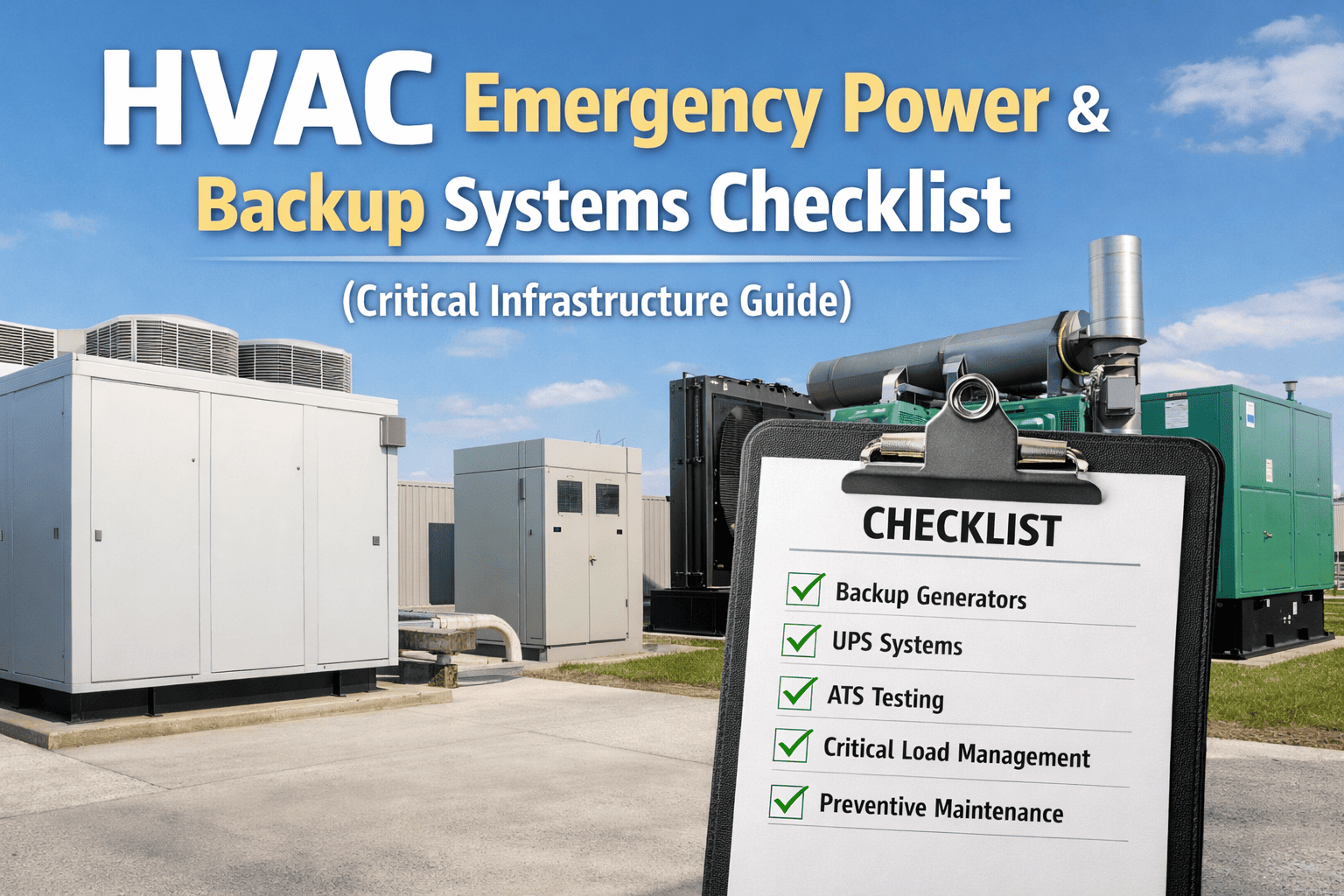
When utility power fails at 2 AM during peak summer, your HVAC backup system has one job — keep critical spaces conditioned and equipment protected until grid power is restored. Hospitals that lose cooling in server rooms, data centers that overheat, and pharmaceutical storage that drifts outside temperature range all trace the same root cause: a backup power system that was never properly tested under load conditions. Oxmaint's preventive maintenance and risk management module schedules generator load tests, UPS battery capacity checks, and ATS transfer switch tests automatically — so your backup systems are verified, documented, and ready when the grid goes down.
Critical Infrastructure — Emergency Preparedness
HVAC Emergency Power & Backup Systems Checklist
Complete generator, UPS, ATS, and critical load management verification framework — with test schedules, pass/fail criteria, and documentation requirements for HVAC uptime during power failure events.
G
Emergency Generator — 500 kVA
Last load test: 12 days ago · Next: 18 days · Status: Ready
Ready
U
UPS System — AHU-1 Critical Load
Battery capacity: 76% — below 80% threshold · Test overdue 5 days
Attention
A
ATS Transfer Switch — Critical Panel
Last transfer test: 28 days ago · Transfer time: 8.2 sec
Verified
!
Fuel Level — Generator Day Tank
Current: 42% — Minimum 75% required for 8hr run · Refuel work order created
Work Order
Risk Impact Framework
What Happens When Backup Systems Fail Under Real Load
01
Data Center Overheating
$50K–$500K per event
Servers begin throttling at +5°F above setpoint. Hardware failure cascade begins within 20–30 minutes without cooling restoration. Critical operations halt within the hour.
02
Pharmaceutical Cold Chain
$100K–$2M product loss
Temperature-sensitive medications lose efficacy and become unsaleable if excursions exceed defined limits — even briefly. A 4-hour power failure without backup HVAC can destroy entire storage inventory.
03
Hospital Patient Areas
Regulatory + liability risk
Joint Commission requires emergency ventilation to critical areas within defined time limits. Failure to maintain ventilation in OR, ICU, and isolation rooms triggers immediate regulatory investigation and potential CMS survey.
04
Industrial Process Cooling
Production downtime
Unplanned HVAC shutdown in manufacturing areas can damage work-in-progress, force production line restarts, and create safety hazards from heat accumulation around high-powered equipment and electrical rooms.
Verification Checklist
HVAC Emergency Power Backup Systems Checklist
01
Emergency Generator — Inspection & Load Testing
| Check Item | Test Method | Pass Criteria | Frequency | NFPA Reference |
| Engine oil level and condition |
Dipstick + visual |
Full, no contamination |
Weekly |
NFPA 110 §8.3 |
| Coolant level and freeze protection |
Dipstick + refractometer |
Full, -20°F protection min. |
Monthly |
NFPA 110 §8.3 |
| Fuel level — day tank and main tank |
Tank gauge / dipstick |
Minimum 75% capacity |
Weekly |
NFPA 110 §8.3.6 |
| Battery electrolyte level + load test |
Battery analyzer |
Charge above 80%, load test pass |
Monthly |
NFPA 110 §8.3.4 |
| No-load run test |
Auto-start test, 30-min run |
Starts within 10 seconds |
Monthly |
NFPA 110 §8.4.2 |
| Full load test (30% minimum load) |
Load bank or actual building load |
Stable output, no alarms |
Annual |
NFPA 110 §8.4.2.1 |
| Transfer time to full load |
Timed from utility loss to full output |
Under 10 seconds (Level 1) |
Annual |
NFPA 110 §8.4.1 |
02
UPS Systems — HVAC Critical Loads
| Check Item | Test Method | Pass Criteria | Frequency |
| Battery capacity test |
UPS discharge test |
Above 80% rated capacity |
Semi-annual |
| Runtime under actual load |
Simulated utility loss |
Meets design runtime requirement |
Annual |
| Battery cabinet temperature |
Thermal probe / IR camera |
Below 77°F (25°C) — life critical |
Monthly |
| UPS output voltage and frequency |
Power analyzer |
Voltage ±3%, frequency ±0.5 Hz |
Quarterly |
| Battery age and replacement schedule |
Installation record review |
Replace at 80% end-of-life |
Annual review |
03
ATS Transfer Switch Testing
| Item | Pass Criteria | Frequency |
| Utility-to-generator transfer time |
Under 10 sec (Level 1) |
Monthly test |
| Retransfer to utility |
Under 15 min after utility stable |
Monthly test |
| Contact condition inspection |
No arcing/burning marks |
Annual |
| Control wiring inspection |
No loose or damaged wiring |
Annual |
| Manual override operation |
Full transfer in manual mode |
Semi-annual |
04
Critical Load Management
| Item | Verification | Frequency |
| Critical load list current |
Review vs. actual connections |
Annual |
| Load shedding sequence |
Test automatic sequence |
Annual |
| Generator capacity vs. critical load |
Load calculation review |
When loads change |
| HVAC priority assignments |
Verify AHU, chiller priority |
Annual |
Preventive Maintenance + Risk Management
Never Discover a Failed Backup System During an Actual Outage
Oxmaint schedules generator load tests, UPS capacity checks, and ATS transfer tests automatically — with reminders before due dates and audit-ready records for every test event, fully documented for NFPA 110 compliance.
Before vs. After Structured Testing
What Regular Backup System Testing Prevents
Generator Start Failures During Outage Events
UPS Runtime Shortfall (below design spec)
Expert Review
"
The most dangerous backup HVAC system is one that passes visual inspection but has never been tested under full critical load. A generator that starts on a no-load monthly run test is not the same as a generator that can carry 80% of your critical HVAC load for 8 hours. NFPA 110 requires annual load bank testing for exactly this reason — but the majority of facilities I audit either defer it or conduct it at insufficient load levels. The same principle applies to UPS battery capacity — a battery that shows 100% state of charge on the display can have 60% of its rated runtime capacity due to cell degradation that only reveals itself under a discharge test. Oxmaint's automated test scheduling and load test documentation closes this verification gap before it becomes a disaster recovery failure.
Robert Callahan, PE, CEM
Critical Facilities Engineer — Healthcare + Data Center HVAC / 24 Years in Emergency Power System Design and Commissioning
FAQs
Emergency Power & Backup Systems — FAQs
How often must emergency generators be tested under NFPA 110?
NFPA 110 requires monthly no-load (or minimum 30% load) run tests for Level 1 emergency generators serving critical life safety systems, and annual full load testing at a minimum of 30% of rated load for a minimum of 4 continuous hours. Facilities with critical HVAC loads — hospitals, data centers, pharmaceutical storage — should conduct annual load bank tests at 80–100% of rated capacity to verify generator performance under realistic conditions. Test records including date, load percentage, output voltage, frequency, and any alarms must be maintained and available for inspection by the Authority Having Jurisdiction.
Oxmaint schedules and documents NFPA 110 generator tests automatically.What is the minimum fuel level that should be maintained for emergency HVAC generators?
NFPA 110 Section 8.3.6 requires emergency generator fuel storage sufficient for the design runtime — typically 8 hours for Level 1 systems, or as specified by the AHJ. Most critical facilities maintain a minimum of 75% tank capacity at all times to ensure adequate runtime through extended outages or delayed fuel delivery. Day tank levels should be checked weekly; main storage tank levels monthly. Automated fuel level monitoring integrated with a CMMS generates refueling work orders when levels drop below the minimum threshold, eliminating the risk of discovering a low-fuel condition during an actual power failure.
Book a demo to see automated fuel level monitoring in Oxmaint.How do you know if a UPS battery actually has its rated runtime capacity?
State-of-charge indicators on most UPS systems report battery voltage, not actual capacity — a battery can show 100% charge while delivering only 60% of its design runtime due to cell degradation. The only way to verify actual runtime capacity is a controlled discharge test, where the UPS is placed on battery while connected to its actual critical load (or a calibrated load bank) and the runtime to low-battery cutoff is measured and compared against the design specification. This test should be conducted semi-annually for critical life safety UPS systems and annually for standard commercial applications. Replace batteries when capacity falls below 80% of design runtime on test.
Schedule UPS discharge tests and track battery age in Oxmaint automatically.What should be included in an ATS transfer switch test?
A complete ATS transfer switch test includes: simulated utility failure (open utility breaker or use of test function), measurement of transfer time from utility loss to full generator output on load (pass criteria: under 10 seconds for Level 1), verification that all critical HVAC and life safety loads transfer correctly, retransfer to utility after generator has stabilized, and contact condition inspection for signs of arcing or overheating. NFPA 110 requires monthly transfer tests for Level 1 systems. Contact inspection and manual override testing should be conducted at least annually by a qualified electrical contractor. All test results, transfer times, and corrective actions must be documented.
Book a demo to digitize your ATS test records in Oxmaint.HVAC Uptime Reliability
Your Backup Systems Are Only as Good as Their Last Verified Test
Oxmaint schedules every generator run test, UPS capacity check, and ATS transfer test automatically — with pre-due alerts, mobile work orders for technicians, and NFPA 110-compliant documentation stored digitally and accessible on demand for any regulatory inspection.