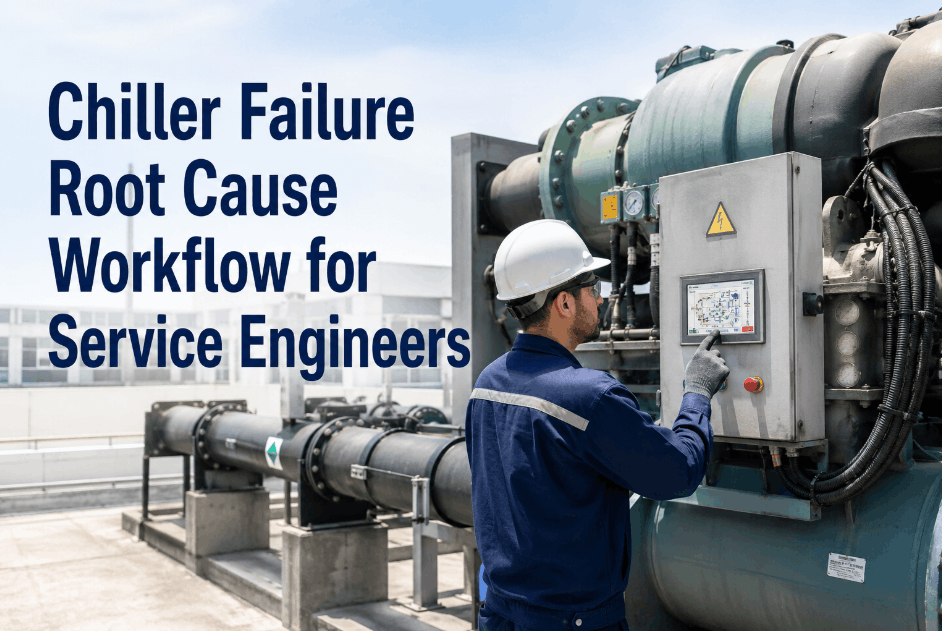
Chiller failure root cause investigation gets harder every time the same symptom shows up without the operating conditions or repair history attached — a tripped compressor on its own tells a service engineer almost nothing about what actually caused it. Teams using Sign Up Free on Oxmaint can log failure symptoms directly on work orders, pull sensor and operating data from connected feeds, and review repair history against the same asset before signing off on a fix. Getting chiller failure root cause analysis right is what keeps a one-time repair from turning into a recurring breakdown.
Why Chiller Failures Get Misdiagnosed Without Full Context
A symptom on its own — high head pressure, a nuisance trip, unusual vibration — rarely points to a single cause, and a repair made without checking prior service history risks fixing the same failure twice. Book a Demo to see how Oxmaint links chiller asset records to sensor data and repair history so engineers can investigate root cause instead of guessing from a single data point.
Five Inputs a Chiller Root Cause Workflow Should Connect
Reliable root cause analysis means reviewing the same set of inputs on every failure, not starting from a blank page each time a chiller trips. Sign Up Free to start logging these inputs against your chiller asset and work order records in Oxmaint.
Reported Symptom and Trip Code History
The initial trip code or reported symptom is the starting point, but only the starting point — patterns across multiple trips reveal more than any single event.
Operating Conditions at Time of Failure
Load, ambient conditions, and run-time leading up to a failure often explain symptoms that look unrelated when viewed in isolation.
Sensor and Trend Data Leading Up to the Event
Vibration, temperature, and pressure trends in the hours or days before a failure frequently show early signs that were missed in the moment.
Prior Repair and Parts Replacement History
A part replaced twice in a year is a signal, not a coincidence — repair history reviewed alongside the current symptom often points straight to root cause.
AI-Flagged Health Score and Anomaly Detection
Asset health scoring built from ongoing sensor analysis can flag the anomaly pattern behind a failure faster than a manual data review.
Root Cause Risk by Chiller Failure Type
Diagnostic risk isn't uniform across failure types — a compressor trip needs different investigation depth than a slow condenser fouling trend. Book a Demo to see how Oxmaint maps root cause workflows to failure type so investigation effort goes where misdiagnosis risk is highest.
| Failure Type | Dominant Investigation Gap | Diagnostic Risk | Risk Level | Oxmaint Planning Lever |
|---|---|---|---|---|
| Compressor Trips | Missing operating data at time of trip | Misattributed to single cause | High | Sensor trend logging |
| Refrigerant Leaks | Incomplete service history | Repeat leak at same point | Critical | Refrigerant service work order linkage |
| Condenser Fouling | Inconsistent inspection records | Gradual efficiency loss missed | Medium–High | Scheduled inspection checklists |
| Control / Sensor Faults | Disconnected fault and repair logs | Recurring nuisance trips | High | Work order and asset history linkage |
| Bearing / Mechanical Wear | No vibration trend baseline | Failure caught too late | Medium | AI vision and predictive monitoring |
How Incomplete Root Cause Analysis Drives Operational Costs
When root cause analysis skips a step, the costs show up well beyond the original service call. Sign Up Free to connect chiller sensor data, symptom logs, and repair history in Oxmaint and start closing the gap between a quick fix and a true root cause.
Using Oxmaint to Standardize Chiller Root Cause Investigation
Diagnostic accuracy improves once symptoms, sensor data, and repair history live in one workflow instead of a technician's memory. Book a Demo to walk through how this roadmap fits your service team's investigation process.
Log Symptoms and Trip Codes Directly on the Work Order
Capture the reported symptom and trip code at the point of service in Oxmaint so the original failure detail is never lost or summarized away.
Connect Sensor Data to the Same Asset Record
Link chiller assets to connected sensor feeds in Oxmaint so operating conditions leading up to a failure are available alongside the symptom.
Review Prior Repair and Parts History Before Diagnosing
Pull full repair and parts history for the asset in Oxmaint before finalizing a diagnosis, so recurring patterns aren't missed.
Use AI Health Scoring to Flag Likely Root Cause Patterns
Reference AI-generated asset health scores and anomaly flags in Oxmaint to narrow down likely root cause before committing to a repair plan.
Generate Failure Trend Reports to Catch Recurring Issues
Use Oxmaint reporting to identify chillers with repeat failure patterns, supporting decisions on deeper repair versus planned replacement.
Frequently Asked Questions: Chiller Failure Root Cause Analysis
What is a root cause workflow for chiller failures?
It's a consistent process for connecting reported symptoms, operating conditions, sensor data, and repair history before finalizing a diagnosis.
Why do chiller failures get misdiagnosed?
Symptoms reviewed without operating conditions or prior repair history often point to the wrong cause, leading to repairs that don't resolve the issue.
How does sensor data improve chiller root cause analysis?
Trend data leading up to a failure frequently shows early anomalies that explain a symptom which would otherwise look isolated or random.
How does Oxmaint support chiller failure root cause investigation?
Oxmaint links chiller asset records to sensor data, work order symptom logs, and AI health scoring so engineers can investigate with full context.
Can failure history inform long-term chiller replacement planning?
Yes — trend reports built from logged failure history in Oxmaint help identify chillers where repeat issues signal a need for replacement, not repair.


-not-cooling-18-common-causes,-diagnostics-&-troubleshooting-guide.png)