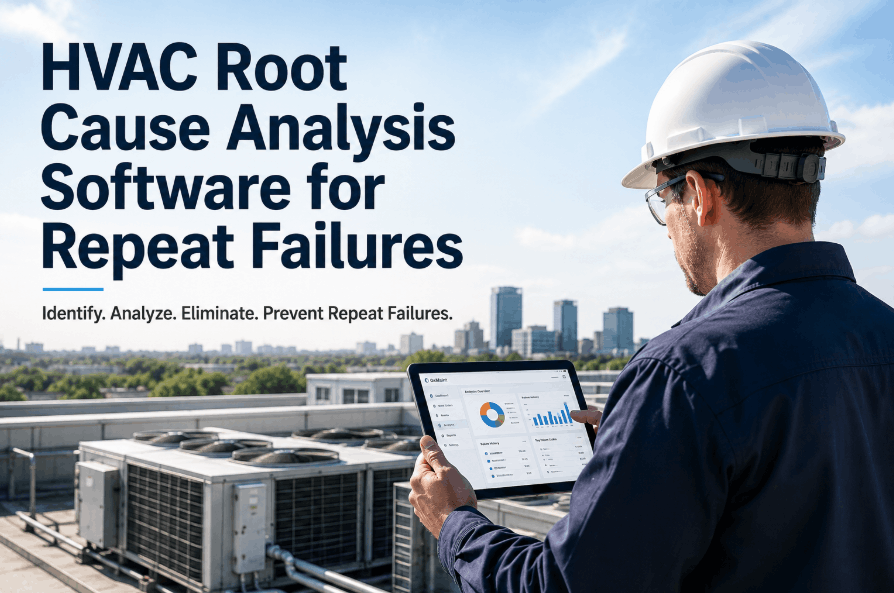
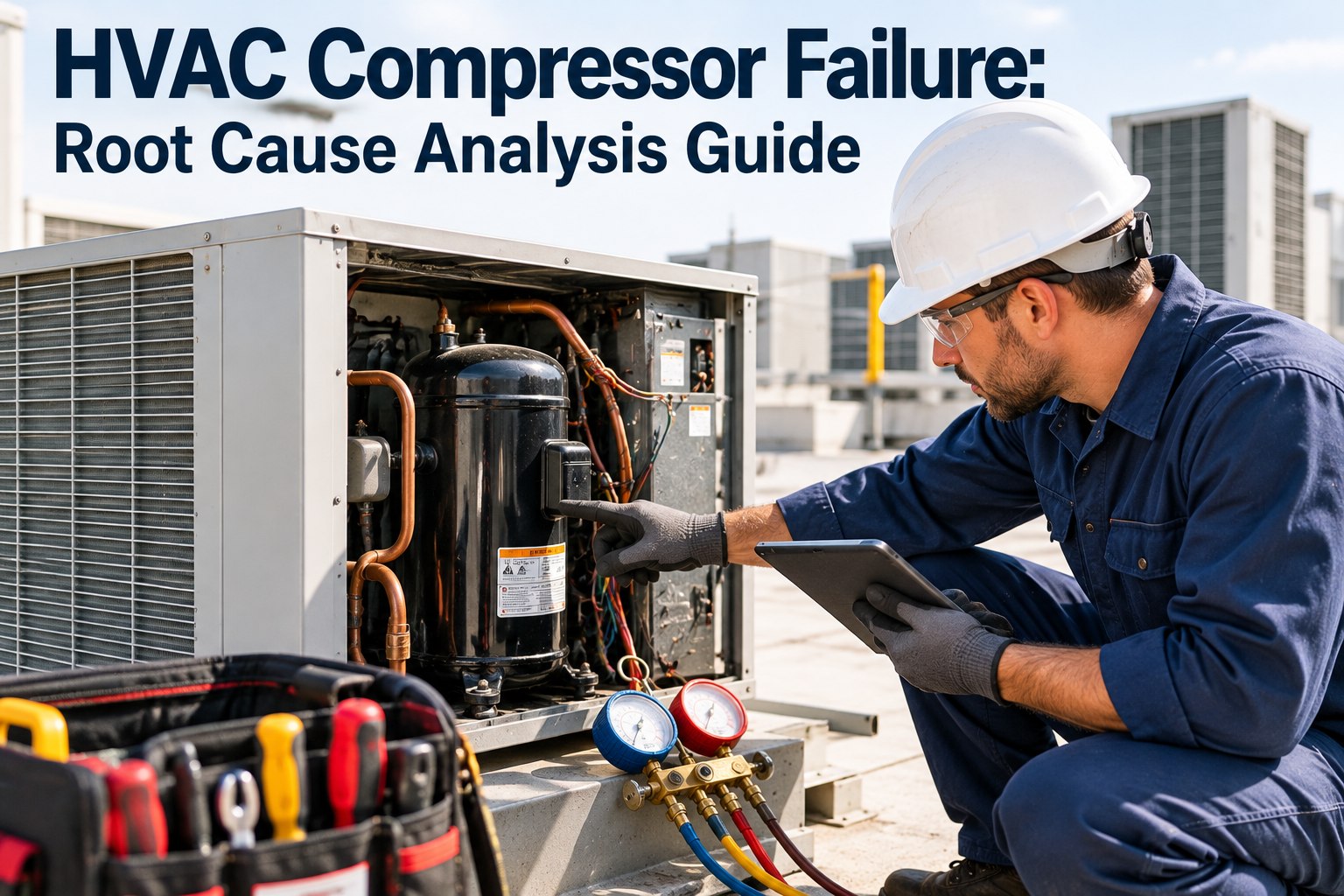
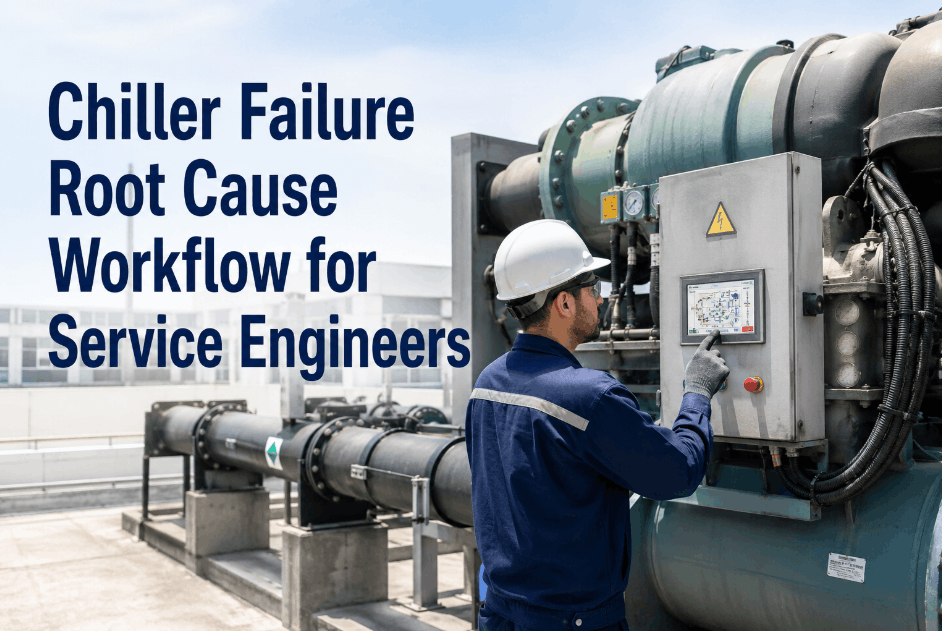
Repeat HVAC failures are rarely bad luck. A chiller that trips the same alarm every eight weeks, an AHU fan motor replaced four times in two years, or a VAV box reheat valve that sticks every cooling season — each suggests an underlying root cause that no single work order captures. Facilities addressing symptoms instead of causes spend 2.3x more on maintenance than teams with structured root cause analysis programs. Sign Up Free to see which assets in your portfolio are trapped in repeat failure loops. Book a Demo to watch AI-driven RCA surface patterns your team cannot see manually — and turn repeat failures into permanent fixes.
OXMAINT HVAC ROOT CAUSE ANALYSIS
Stop Replacing the Same Part. Start Finding the Real Cause.
Oxmaint automates root cause analysis workflows — flagging repeat failures, surfacing pattern data, and tracking corrective actions until problems stay solved.
4 Root Cause Categories That Drive 72% of Repeat HVAC Failures
Recurring failures across commercial HVAC portfolios consistently cluster into four categories. Identifying which category applies to your failure pattern determines whether your next repair finally ends the cycle or simply resets the clock for another breakdown.
01
Incorrect PM Interval — 31% of repeat failures
The maintenance frequency matches OEM specifications for standard conditions but is wrong for actual operating environment. A bearing rated for 4,000-hour lubrication cycles in a climate-controlled plant may need 2,200-hour cycles when operating above 40°C.
Oxmaint analyzes run-hour data against failure intervals, automatically recommending PM frequency adjustments when pattern mismatches surface.
02
Specification Error — 22% of repeat failures
Wrong material grade, lubricant viscosity, filter MERV rating, or part specification is being used. The part installs correctly but fails rapidly because it was never suited for actual operating conditions.
Oxmaint cross-references parts consumption records across multiple failure events on the same asset, flagging specification mismatches invisible to visual inspection.
03
Environmental Factor — 24% of repeat failures
External conditions drive failure — elevated ambient temperature, humidity, dust ingress, or vibration from adjacent equipment. OEM specifications often do not account for site-specific environmental loads.
Oxmaint's AI correlates failure timing with environmental data (weather, adjacent operations), surfacing seasonal or condition-driven patterns that 5 Whys analysis misses entirely.
04
Installation or Repair Defect — 23% of repeat failures
Root cause lies in incorrect torque, misalignment, inadequate clearance, reversed connections, or uncorrected damage to adjacent components during prior repair.
Oxmaint compares MTBF across repairs performed by different technicians or contractors, flagging installation-defect patterns and auto-generating quality verification checklists.
Analytics & Reporting: Turning RCA Data Into Actionable Intelligence
Root cause analysis without performance measurement is guesswork. Oxmaint's analytics engine converts every completed RCA into trackable metrics — cost attribution, recurrence rates, PM compliance impact — so leadership sees exactly which root cause categories drive the largest operational exposure. Sign Up Free to access prebuilt RCA dashboards, or Book a Demo for custom reliability reporting tailored to your asset portfolio.
Cost Attribution by Root Cause Category
Oxmaint tags repeat-failure costs to specific root cause categories — design mismatches, PM interval errors, installation defects — transforming budget requests from opinion into categorized reliability data.
Recurrence Rate Dashboards
Live dashboards track how many assets remain in repeat-failure loops, how many have been permanently resolved, and which root cause categories remain unaddressed across your portfolio.
PM Compliance Impact Analysis
When root cause points to missed lubrication or delayed filter changes, Oxmaint quantifies the relationship between PM compliance gaps and failure frequency — building the business case for schedule discipline.
Corrective Action Closure Tracking
Every verified root cause generates tracked corrective actions. Dashboards show open vs closed actions, aging, and which engineering changes delivered the highest failure reduction ROI.
Failure Codes, Parts History & Technician Notes: The Data Layers That Enable RCA
Root cause analysis depends on complete, structured work order data. Oxmaint captures failure codes, technician notes, parts consumption, and completion timestamps automatically — no missing fields, no manual double-entry. Teams using Oxmaint reduce incomplete closeouts that typically destroy 60% of reliability insights. Book a Demo to see how structured data turns every work order into an RCA intelligence point.
Standardized Failure Code Library
Preconfigured failure code hierarchies ensure consistent classification across every work order — enabling accurate pattern detection across assets, technicians, and sites.
Parts Consumption History
Complete parts records on every work order allow Oxmaint AI to detect specification mismatches — same wrong part replaced repeatedly across multiple failure events.
Technician Notes & Photo Documentation
Mobile app captures field observations, photos of failed components, and diagnostic findings — converting tribal knowledge into searchable RCA evidence attached to every asset record.
Automated Data Capture
No manual entry for completion time, technician ID, or parts consumed. Oxmaint captures structured data automatically, eliminating the human error that makes most RCA efforts impossible.
AI-Matched Failure Patterns
When a new work order closes, Oxmaint AI compares its failure code, parts consumed, and technician notes against historical patterns — auto-flagging matches that suggest an unresolved root cause.
Closed-Loop Learning
Each confirmed root cause updates the failure code library, PM templates, and inspection checklists — ensuring every resolved problem permanently improves future maintenance execution.
Automated RCA Workflow: From Pattern Detection to Permanent Fix
Oxmaint transforms root cause analysis from a periodic exercise into a continuous AI process running in the background of your CMMS — scanning every closed work order, cross-referencing asset classes, and auto-generating investigation tasks when patterns emerge. Sign Up Free to activate automated RCA triggering for your highest-cost repeat failures.
01
Pattern Flagging
Oxmaint monitors every asset's work order history continuously. When the same failure mode appears more than twice within a rolling 12-month window, the asset is auto-flagged for RCA investigation.
02
Factor Cross-Reference
AI cross-references flagged asset's PM compliance record, parts consumption history, technician notes, sensor data, and weather patterns to surface statistically likely contributing factors.
03
Investigation Work Order
Oxmaint auto-generates an RCA work order with complete pattern data, failure timeline chart, and suggested inspection checklist — assigned to senior technician or reliability engineer based on skill tag.
04
PM Template Update
Once root cause is confirmed, Oxmaint updates the asset's PM template automatically — interval adjustment, checklist content revision, or assigned skill level change — embedding correction into future execution.
05
Fleet-Wide Scan
When root cause is identified on one asset, Oxmaint automatically checks every similar asset for the same pattern signature — fixing once, preventing portfolio-wide.
06
Cost Attribution
Oxmaint tags repeat-failure costs to root cause categories — leadership sees not just that repairs are expensive, but specifically that design mismatches cost $47,000/year while PM interval mismatches cost $18,000/year.
AI-POWERED RCA WITH OXMAINT
Turn Repeat Failures Into Permanent Solutions
Oxmaint automates root cause analysis from pattern detection to corrective action tracking — transforming reactive repair loops into strategic reliability gains.
Frequently Asked Questions: HVAC Root Cause Analysis Software
What is HVAC root cause analysis software and why do I need it?
HVAC RCA software automates the detection of repeat failure patterns across your asset portfolio, identifies underlying root causes, and tracks corrective actions until failures stop recurring — eliminating the trial-and-error repair cycle.
How does Oxmaint detect repeat failure patterns automatically?
Oxmaint AI scans every closed work order continuously. When the same failure code, asset, and parts consumption appear more than twice in 12 months, the asset is auto-flagged for RCA investigation — no manual spreadsheet analysis required.
Can Oxmaint integrate with my existing BMS or BAS for failure data?
Yes — Oxmaint ingests BACnet, Modbus, and OPC-UA data streams from existing building automation systems, applying fault detection rules to auto-generate work orders and feed sensor trends into RCA investigations.
What types of root causes does Oxmaint most accurately identify?
Oxmaint AI achieves highest accuracy on incorrect PM intervals, specification mismatches (wrong parts), environmental factors, and installation defects — the four categories driving 72% of repeat HVAC failures.
How does Oxmaint track corrective actions after root cause is confirmed?
Each verified root cause generates tracked corrective actions with assigned owners, due dates, and closure verification. Dashboards show open vs closed actions and which engineering changes delivered highest failure reduction.
What ROI can facilities expect from structured HVAC RCA in Oxmaint?
Facilities implementing structured RCA report 40–60% fewer breakdowns, 85% reduction in repeat failures, and payback periods under 12 months — driven by emergency repair reduction, extended asset life, and eliminated symptom repairs.
STOP REPEATING THE SAME FAILURES
Find Root Causes Your Team Cannot See Manually
Oxmaint AI reads every work order, on every asset, across every building — continuously — and surfaces repeat failure patterns before they cost another emergency repair.