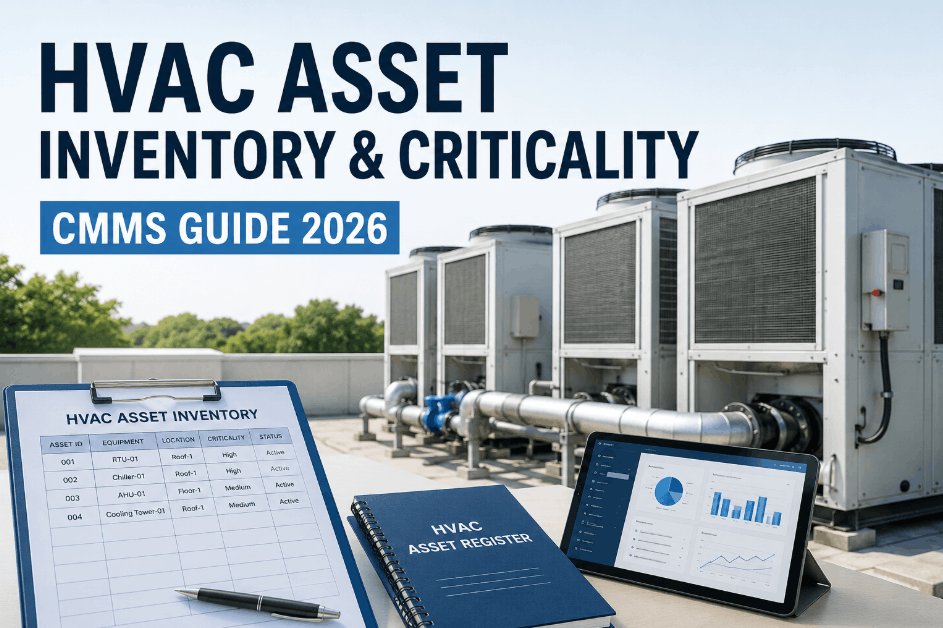
Maintenance planning breaks down when every HVAC asset competes for the same technician hours and PM budget. A choked filter on a non-critical exhaust fan triggers the same work order urgency as a chiller nearing failure in peak summer. This lack of differentiation drives two costly outcomes: critical assets are under-maintained while low-impact equipment consumes resources that should protect production or occupant comfort. Asset criticality ranking replaces the equal-treatment approach with a structured scoring framework. Each asset in your HVAC inventory receives a tier rating based on failure consequence, safety risk, regulatory exposure, and replacement cost. The output determines maintenance frequency, response targets, and spare parts stock levels — ensuring that a central chiller serving an operating room receives fundamentally different attention than a corridor fan coil unit. Facilities that implement a formal criticality matrix reduce unplanned downtime by up to 47% within twelve months. The gap starts with asset registry setup, scoring configuration, and automated strategy mapping. Sign Up Free to establish your HVAC criticality tiers in OxMaint. Book a Demo to see how ranking drives automated PM schedules and work order prioritisation.
Replace Maintenance Guesswork With Asset Criticality Ranking
OxMaint centralises HVAC asset hierarchies, scoring criteria, and automated strategy mapping — turning criticality tiers into differentiated PM frequencies, response targets, and spare parts coverage.
Why HVAC Teams Without Asset Criticality Ranking Over-Maintain Low-Impact Equipment
Most facilities treat every HVAC asset with the same PM frequency and inspection checklists. The result is a fragmented maintenance program that fails to align resources with actual business impact.
Uniform Maintenance Cycles
A rooftop unit serving a storage area receives the same quarterly inspection as a chiller feeding a data centre — consuming technician hours that should be protecting revenue-critical systems.
No Failure-Consequence Differentiation
Without structured criticality scoring, a failed exhaust fan and a failed supply fan trigger the same work order priority — delaying response to failures that shut down operations.
Wasted Spare Parts Investment
Facilities stock identical parts levels across all equipment types — over-investing in spares for non-critical assets while exposing Tier 1 equipment to extended downtime from stockouts.
Reactive Budget Allocation
Without criticality data, maintenance budgets default to squeaky-wheel logic — whoever reported the last breakdown gets attention, regardless of the asset's actual operational impact.
Inconsistent Regulatory Prioritisation
Assets with compliance exposure — refrigerant tracking, ASHRAE ventilation standards, pressure vessel inspections — receive the same scheduling slack as non-regulated equipment.
No Capital Replacement Signal
Without criticality scoring attached to lifecycle cost data, facility managers cannot demonstrate why a specific chiller replacement needs budget approval before a catastrophic failure.
6 Criticality Ranking Workflows OxMaint Automates Across Your HVAC Asset Portfolio
Each workflow below transforms manual ranking efforts into structured, date-driven maintenance strategies. Sign Up Free to activate these workflows across your HVAC asset hierarchy in OxMaint. Book a Demo to explore the scoring engine configuration.
What Is Captured
- Nested asset structures — chiller plant to compressor
- Nameplate data, installation dates, warranty terms
- OEM manuals and QR code links for mobile access
- Building zone and system association
OxMaint Action
OxMaint creates a complete asset hierarchy where every HVAC component becomes a tracked entity with its own criticality rating, maintenance history, and direct linkage to parent systems — eliminating search time and ensuring ranking consistency across your entire portfolio.
What Is Scored
- Production or comfort impact on failure
- Safety and environmental consequences
- Repair cost and replacement lead time
- Regulatory compliance exposure
OxMaint Action
OxMaint's scoring engine evaluates each asset against configurable failure criteria — production loss, safety risk, environmental consequence, compliance exposure, and repair cost. The combined score places the asset into a tier (Critical, Important, Standard, Minor) that drives its entire maintenance strategy.
Book a Demo to configure weighted scoring for your facility risk profile.
What Is Scheduled
- Calendar-based PM intervals
- Runtime meter triggers (compressor hours)
- Condition-based thresholds
- Seasonal load variation adjustments
OxMaint Action
OxMaint translates criticality rankings into automated maintenance strategies — a Tier 1 asset automatically receives more intensive scheduling, shorter work order response windows, and dedicated spare parts stocking, while Tier 4 assets trigger basic inspection checklists or run-to-failure tracking.
What Is Prioritised
- Critical asset failures vs. non-critical
- Emergency response targets by tier
- Technician assignment based on expertise required
- Parts requisition urgency levels
OxMaint Action
OxMaint routes work orders with criticality-derived priority codes. A Tier 1 chiller fault generates an emergency work order with rapid dispatch targets and auto-escalation. A Tier 4 air curtain issue generates a low-priority corrective task without consuming urgent maintenance capacity.
What Is Stocked
- Parts required for Tier 1 and Tier 2 assets
- Minimum stock levels by criticality
- Auto-reorder triggers at configurable thresholds
- Parts consumption tracking by work order
OxMaint Action
OxMaint links spare parts inventory directly to asset criticality — ensuring high-tier equipment has dedicated stock levels while eliminating over-investment in parts for low-impact assets. Work orders auto-deduct consumed parts and trigger replenishment alerts when stock falls below tier-specific minimums.
What Is Tracked
- Asset age and projected remaining life
- Repair frequency and escalation trends
- Cost-to-replace vs. cost-to-repair
- Failure consequence escalation over time
OxMaint Action
OxMaint aggregates asset condition, repair history, and criticality scores to produce replacement forecasts — showing finance teams exactly which high-tier assets have crossed the economic replacement threshold. Capital requests shift from opinion-based to risk-scored financial data.
Sign Up Free to access OxMaint's asset lifecycle analytics.
Connect Your BMS Data to Criticality-Driven Maintenance
OxMaint integrates directly with BACnet, Modbus, and REST API-enabled building automation systems — turning equipment runtime and fault data into criticality-graded maintenance triggers without manual data entry.
HVAC Asset Criticality Scoring Dimensions — What OxMaint Evaluates
Criticality scoring varies significantly by facility type, regulatory environment, and business model. The table below maps each evaluation dimension to typical scoring weights and OxMaint configuration settings. Book a Demo to configure dimension weights for your asset register.
| Scoring Dimension |
Typical Weighting |
What It Measures |
OxMaint Scoring Configuration |
| Production / Comfort Impact |
25–35% |
Percentage of production capacity or occupied zones lost on failure |
Configurable thresholds from minor comfort impact to full facility shutdown |
| Safety Consequence |
25–40% |
Potential for injury, fatality, fire, or hazardous release |
Risk matrix with weight escalation for critical safety applications |
| Repair Cost & Lead Time |
10–20% |
Total cost and time to restore asset to service |
Cost brackets and procurement lead time tiers |
| Regulatory Compliance |
15–25% |
Exposure to fines, audit findings, or lease disputes |
Compliance flags linked to EPA Section 608, ASHRAE, pressure vessel codes |
| Redundancy Level |
5–15% |
Whether backup systems exist to cover failure |
Scores reduced when redundant capacity available |
| Environmental Consequence |
5–10% |
Potential for refrigerant leaks or energy waste |
Environmental impact scoring for green building certifications |
How OxMaint Structures Criticality-Driven Maintenance for HVAC Operations
01
Asset Hierarchy Build
Every HVAC asset entered into the registry — from central plant equipment to zone-level components — with nested relationships and complete documentation.
02
Criticality Scoring Configuration
Weighted scoring across production impact, safety risk, repair cost, compliance exposure, redundancy, and environmental consequence — calibrated to your facility profile.
03
Tier Assignment & Strategy Mapping
Each asset placed into Critical, Important, Standard, or Minor tier. OxMaint automatically maps tiers to PM frequency, work order priority, and spare parts rules.
04
Automated Work Order Generation
OxMaint creates differentiated work orders based on criticality — emergency targets for Tier 1 failures, routine scheduling for Tier 3 equipment, inspection-only for Tier 4.
05
BMS Integration for Dynamic Triggers
OxMaint reads BACnet, Modbus, and REST API-enabled BMS data — generating criticality-aware work orders when runtime thresholds are breached or fault patterns detected.
06
Analytics & Capital Planning Output
OxMaint aggregates repair trends, asset condition, and criticality scores into replacement forecasts — showing finance teams which high-tier assets require budget approval.
Sign Up Free to explore OxMaint's asset criticality dashboard.
Frequently Asked Questions — HVAC Asset Criticality Ranking
What is HVAC asset criticality ranking?
It is a structured scoring process that evaluates every HVAC asset against failure-impact criteria — production loss, safety risk, repair cost, compliance exposure — to assign maintenance tiers that drive differentiated strategies.
How does criticality ranking improve HVAC maintenance planning?
Ranking ensures critical assets receive intensive PM schedules, faster response targets, and dedicated spare parts — while low-impact equipment receives appropriate attention without consuming resources needed for production or comfort protection.
Can OxMaint integrate my existing BMS data into criticality scoring?
Yes. OxMaint connects directly to BACnet, Modbus, and REST API-enabled BMS platforms — reading equipment runtime, fault patterns, and condition data to trigger criticality-graded maintenance responses.
What types of facilities benefit most from HVAC criticality ranking?
Multi-tenant offices, healthcare facilities, data centres, pharmaceutical plants, educational campuses, and any commercial property where HVAC failure impacts occupant safety, revenue, or regulatory standing.
How does OxMaint translate criticality scores into maintenance actions?
OxMaint's scoring engine drives automated PM scheduling, work order prioritisation, spare parts stocking rules, and capital planning forecasts — turning scores into daily operational decisions.
How often should asset criticality rankings be reviewed?
Typically annually, or after major facility changes — new equipment installation, occupancy shifts, or regulatory updates. OxMaint tracks review dates and flags when re-scoring is due.
Take Control of Your HVAC Maintenance With Asset Criticality Ranking
Automated criticality scoring. Tier-driven PM scheduling. Differentiated work order prioritisation. Spare parts optimisation. Capital planning forecasts. One CMMS platform built for facility teams managing HVAC assets at scale.