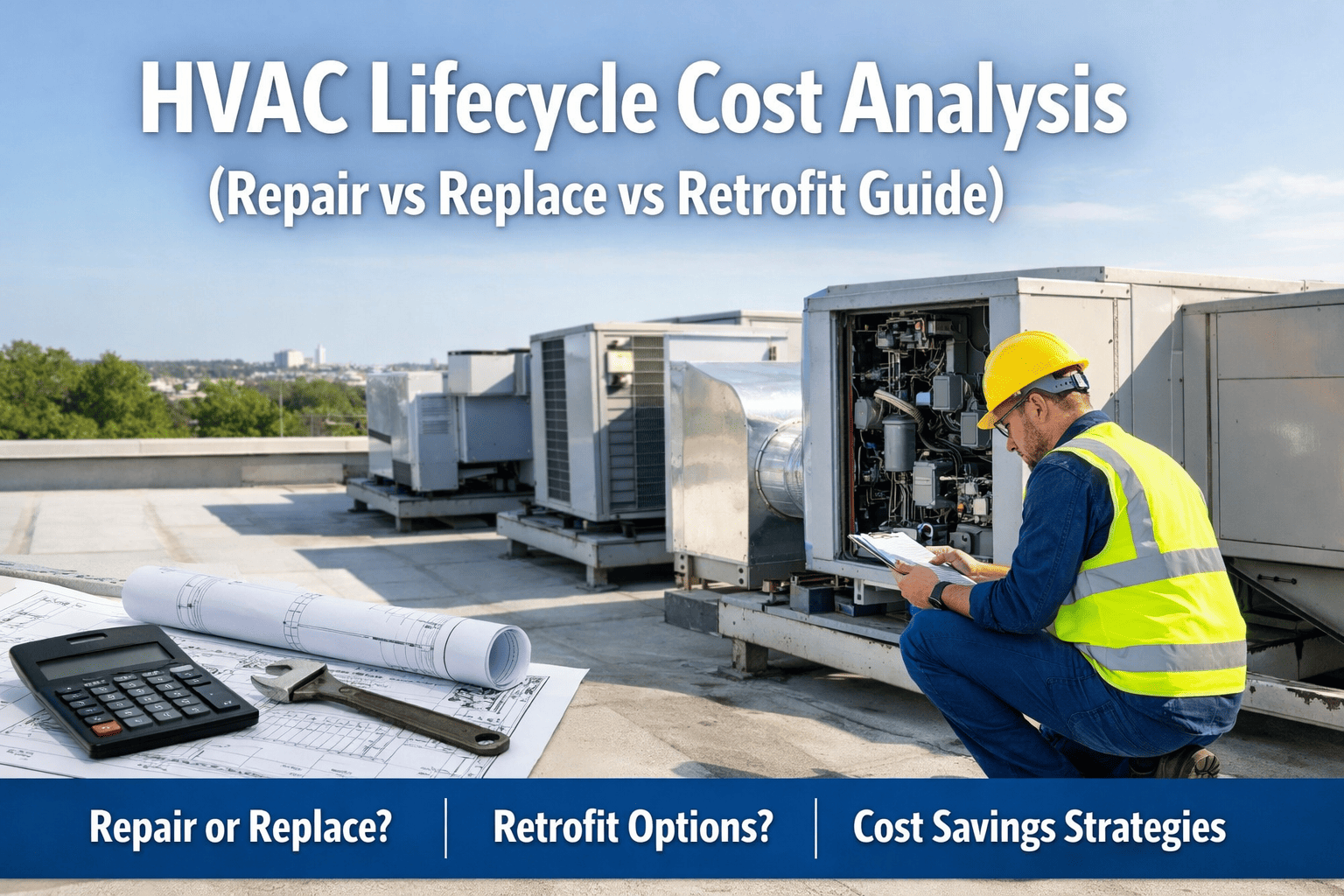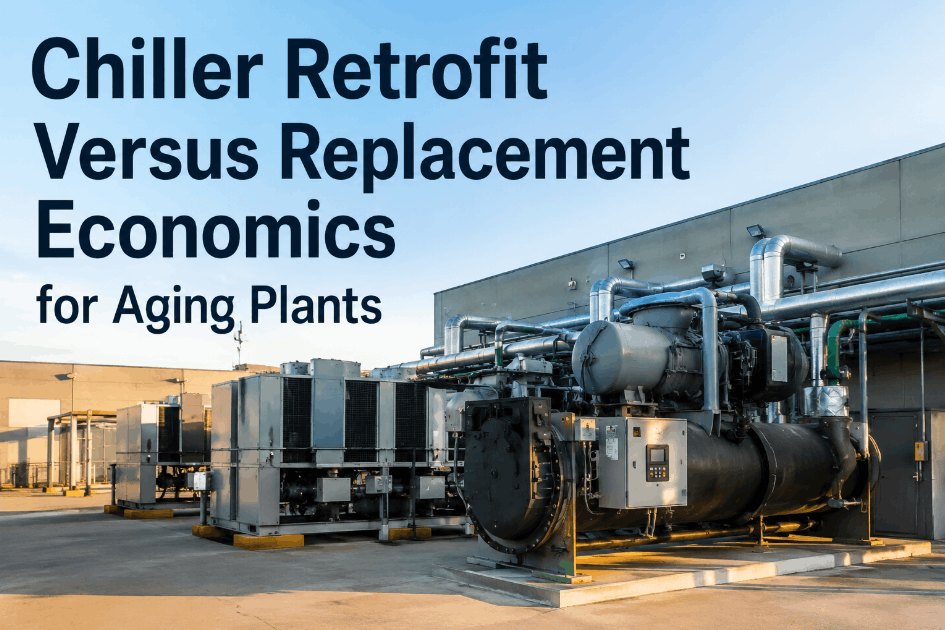
Aging chiller plants present one of the most capital-intensive decisions in facility management — whether to invest in retrofitting an underperforming system or replace it entirely. The answer is never purely about equipment age. It requires a structured economic analysis of energy savings potential, remaining service life, downtime exposure risk, and parts availability before a capital commitment is made. Sign Up Free on Oxmaint to track chiller runtime hours, repair costs, and energy performance trends — the data foundation that makes retrofit versus replacement decisions defensible rather than reactive.
Why Chiller Age Alone Does Not Determine the Replacement Decision
A 20-year-old chiller with a complete PM history, recent compressor rebuild, and documented EUI stability may outperform a 12-year-old unit with chronic refrigerant loss and recurring controls failures. Equipment age sets the context — but actual performance data, energy efficiency trajectory, and parts lifecycle status determine whether retrofit economics or replacement ROI is the correct frame. Book a Demo to see how Oxmaint's asset performance tracking supports capital planning decisions with evidence rather than assumptions.
Retrofit vs Replacement: Economic Comparison Framework
Sign Up Free on Oxmaint and start tracking the chiller performance metrics that feed directly into a defensible retrofit versus replacement analysis.
| Decision Factor | Favors Retrofit | Favors Replacement | Data Source |
|---|---|---|---|
| Equipment Age | 10–18 years, sound structure | 20+ years, obsolete controls | Asset registry, install date |
| Energy Use Intensity | Degraded but recoverable with retrofit | Baseline inefficiency exceeds new unit delta | Utility billing, EUI trend |
| Repair Cost Trend | Stable, isolated component failures | Escalating, multi-system failures annually | CMMS work order history |
| Parts Availability | Parts still manufactured or rebuildable | Obsolete parts, long lead times | Vendor quotes, OEM support |
| Downtime Exposure | Retrofit window manageable off-peak | Failure risk outweighs retrofit delay | Runtime hours, alarm history |
| Refrigerant Compliance | R-410A or compliant refrigerant | R-22 or phased-out refrigerant | Service records, EPA compliance |
Retrofit Scope Options and Associated Cost Ranges
Not all chiller retrofits are equal. Scope ranges from targeted controls upgrades to near-full mechanical replacement of compressors and heat exchangers. Understanding which retrofit path applies to your equipment is the first step before comparing retrofit cost against full replacement pricing. Book a Demo to see how Oxmaint's asset records help facility teams define retrofit scope with documented performance baselines.
Replacing legacy chiller controls with modern DDC panels and BAS integration typically recovers 8–15% energy efficiency at 15–25% of replacement cost. Applicable for mechanically sound equipment with outdated control architecture.
Compressor rebuilds restore mechanical efficiency without replacing the full chiller chassis. Cost-effective when the heat exchanger, shell, and refrigerant circuit remain serviceable — typically 30–45% of new unit cost.
Fouled or scaled heat exchangers reduce chiller efficiency by 10–20% without triggering alarms. Re-tubing or chemical treatment restores performance to near-original specification at a fraction of replacement capital cost.
Systems running phased-out refrigerants (R-22, R-123) face escalating recharge costs and compliance risk. Refrigerant conversion extends service life while eliminating procurement risk — viable when compressor and heat exchanger condition supports continued operation.
Total Cost of Ownership: Retrofit vs Replacement Over 10 Years
Using Oxmaint to Build a Chiller Capital Planning Case
Document Chiller Asset History and Runtime Hours
Register chiller install date, nameplate capacity, refrigerant type, and accumulated runtime hours in Oxmaint. Asset age combined with runtime hours gives a reliable remaining service life estimate for the retrofit versus replacement decision frame.
Pull Repair Cost Trend from Work Order History
Oxmaint's work order history quantifies annual repair spend per chiller. Escalating repair costs — particularly above 3–5% of replacement value annually — signal that the economics are shifting toward replacement regardless of equipment age.
Track Energy Use Intensity Trends by Chiller
Oxmaint's IoT integration captures energy consumption data per asset. Rising EUI without load increase is the primary quantifiable signal that mechanical degradation is costing more annually than the cost of capital investment in retrofit or replacement.
Log Alarm Frequency and Fault Pattern Analysis
High alarm frequency at specific chiller subsystems — compressor protection trips, refrigerant pressure faults, condenser approach temperature alerts — indicates systemic degradation that informs retrofit scope definition or accelerates the replacement timeline.
Build the Capital Case with Documented Performance Evidence
Oxmaint consolidates repair history, EUI trend, PM compliance, and alarm data into a single asset record — giving facilities teams the documented performance evidence needed to support capital appropriation requests for retrofit or replacement investment.