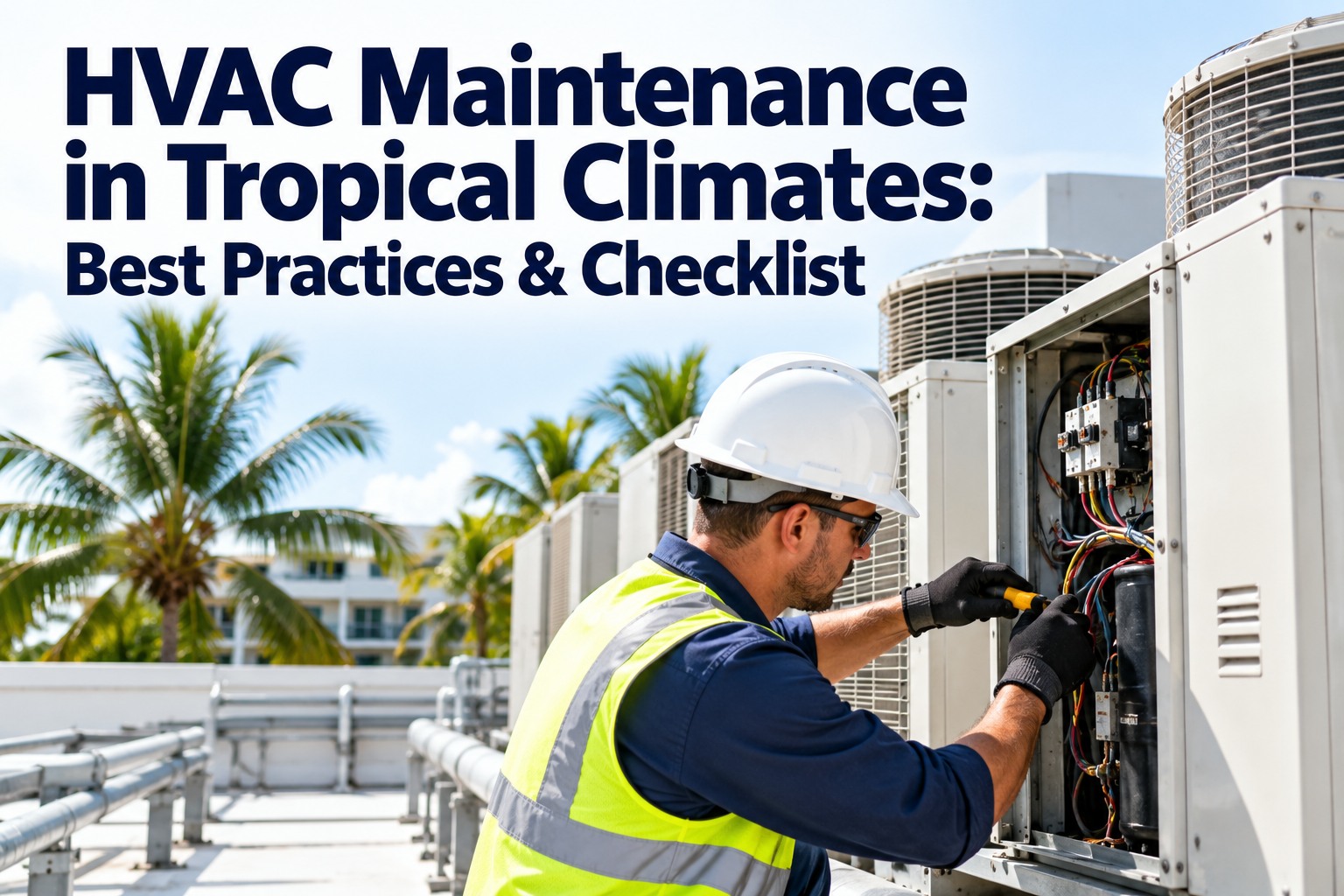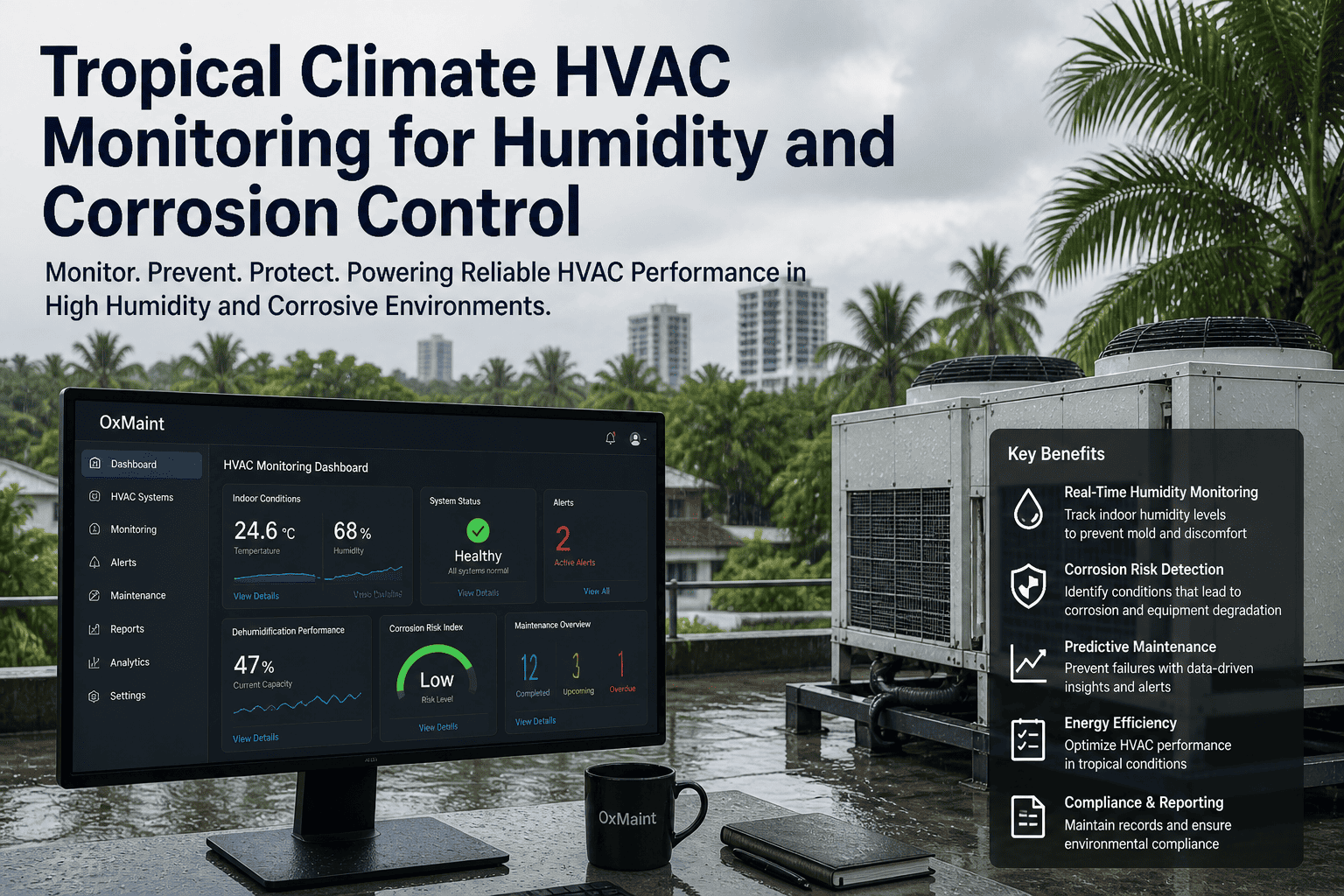
In tropical climates, HVAC systems don't just provide comfort — they fight a constant battle against conditions that accelerate corrosion, promote mold growth, and degrade equipment at two to three times the rate seen in temperate zones. A standard preventive maintenance schedule designed for a Chicago office building will fail a Singapore hotel within 18 months. OxMaint CMMS gives facility teams in high-humidity, coastal, and tropical environments the monitoring frequency, inspection depth, and automated response protocols that these conditions actually demand — not the generic intervals their equipment manual was written for.
The Tropical HVAC Threat Matrix
Three climate-specific forces drive HVAC failure in tropical environments — and each requires a different monitoring and maintenance response.
Standard PM Intervals vs. Tropical-Adjusted Intervals
The single most common maintenance error in tropical facilities is applying temperate-climate PM frequencies to equipment operating in fundamentally different conditions. This comparison shows the adjustment required — and the consequence of not making it.
| HVAC Component | Standard Interval | Tropical-Adjusted Interval | Reason for Adjustment |
|---|---|---|---|
| Evaporator coil cleaning | Annual | Quarterly | Accelerated biofilm and dust-moisture binding in high RH environments |
| Drain pan & condensate line | Semi-annual | Monthly | Algae and mold colonization of standing condensate within 2–4 weeks |
| Air filter replacement | Quarterly | Monthly or 6-week | Humid air causes filter media to load faster and promotes mold in loaded filters |
| Coil fin corrosion inspection | Annual | Quarterly (coastal) | Salt air accelerates fin corrosion; early detection preserves heat transfer and prevents refrigerant leak |
| Electrical connection inspection | Annual | Semi-annual | Humidity-driven oxidation on terminals causes resistance heating and arc risk |
| Refrigerant leak check | Annual | Semi-annual | Corrosion-related micro-leaks develop faster; early detection prevents efficiency collapse and compressor damage |
| RH sensor calibration | Annual | Quarterly | Sensors drift faster in continuous high-humidity environments; drift means the system controls to the wrong setpoint |
How OxMaint Structures a Tropical HVAC PM Program
OxMaint allows facility teams to create climate-specific PM templates with the adjusted intervals and tropical-specific inspection checkpoints that standard CMMS configurations miss. Every task is scheduled automatically, assigned to a technician by zone, and completed via mobile with photo documentation — creating the continuous inspection record that corrosion and mold prevention demands.
Build a Tropical-Grade PM Program in OxMaint
OxMaint's preventive maintenance module lets you create climate-specific inspection frequencies, mobile checklists with photo capture, and automatic work order escalation — so your HVAC program is designed for the conditions your equipment actually operates in.
Humidity Monitoring: The Early Warning System
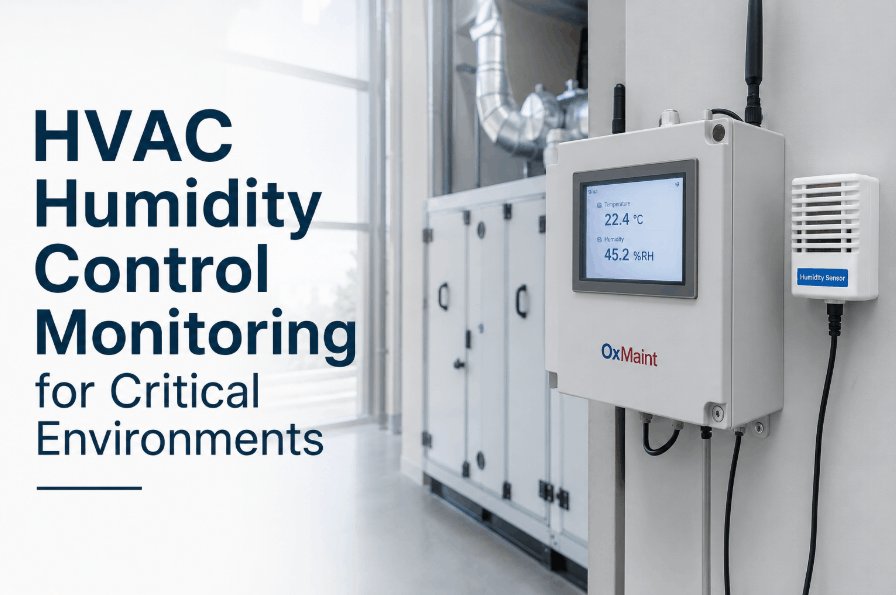
Preventive maintenance is the scheduled response. Continuous humidity monitoring is the early warning system that catches conditions between scheduled visits — and in tropical climates, conditions can shift from acceptable to dangerous in hours, not days.
Corrosion Control: What OxMaint Tracks and Why
| Corrosion Source | Affected HVAC Components | OxMaint Tracking Method | Intervention When Detected |
|---|---|---|---|
| Salt air (coastal) | Condenser coils, aluminum fins, copper refrigerant lines | Quarterly inspection with photo — corrosion severity rating in asset history | Coil coating application, fin replacement work order triggered at severity 3+ |
| Condensate contact | Drain pans (steel), structural supports, coil housings | Monthly drain pan inspection — rust scoring on checklist | Drain pan liner replacement before perforation causes water damage |
| Galvanic (dissimilar metals) | Copper-aluminum joints in coils, brass fittings | Annual inspection with resistance measurement | Dielectric fittings, coating, or component isolation prescribed by OxMaint work order |
| Electrical oxidation | Contactors, terminals, wire terminations | Semi-annual inspection — contact resistance measured against baseline | Terminal cleaning, contact replacement if resistance exceeds threshold |
Expert Review
The most dangerous assumption in tropical facility management is that standard PM intervals are a safe starting point. They are not — they are a starting point for a temperate building. In Kuala Lumpur, Bangkok, Dubai, or Miami Beach, the condensate drain pan that is inspected semi-annually in Chicago should be inspected monthly. The coil that is cleaned annually needs quarterly service. I've seen three-year-old equipment look like it has ten years of wear because the maintenance schedule wasn't adjusted for the operating environment. OxMaint's ability to set climate-specific intervals with mobile photo documentation is exactly what tropical facility teams need — because the evidence of deterioration needs to be captured frequently and systematically before it becomes a remediation project rather than a maintenance task.
Your Climate Demands a Maintenance Program Built for It
Standard CMMS templates won't protect HVAC equipment in tropical or coastal environments. OxMaint's preventive maintenance module lets you build the inspection frequency, checklist depth, and automated escalation that high-humidity conditions actually require. See it in action for your facility type.
Frequently Asked Questions
What indoor humidity level should HVAC systems maintain in tropical climates?
The EPA specifies that indoor relative humidity should be kept below 60% at all times, with the ideal operating range between 30% and 50% RH for occupant comfort and mold prevention. In tropical climates, where outdoor ambient RH routinely exceeds 75–85%, maintaining this target requires HVAC systems that are correctly sized for dehumidification — not just temperature control. The most common tropical HVAC failure is an oversized unit that short-cycles: it cools the space rapidly but doesn't run long enough to remove moisture from the air, leaving indoor RH above 60% even when the thermostat is satisfied. OxMaint's continuous humidity monitoring detects this condition automatically — flagging zones where temperature targets are met but RH remains above threshold, giving facility teams the diagnostic evidence needed to address short-cycling before mold growth begins.
How does salt air corrosion affect HVAC equipment in coastal tropical facilities?
Salt air corrosion attacks HVAC equipment through several simultaneous mechanisms. Sodium chloride particles deposit on condenser coil fins and accelerate galvanic corrosion between aluminum fins and copper tubing — the most common coil material combination. This corrosion degrades fin-to-tube contact and reduces heat transfer efficiency, increasing energy consumption before any visible damage is apparent. Electrical terminals, contactors, and wire terminations oxidize faster in salt-laden humid air, creating resistance heating that triggers nuisance trips and ultimately causes compressor damage. Structural steel supports and drain pans corrode from combined condensate contact and salt air exposure. Facilities within 1 kilometer of the ocean experience these effects at 3–5 times the rate of inland sites. OxMaint's quarterly corrosion inspection schedule with severity-rated photo documentation creates a deterioration trend record that guides protective coating and replacement decisions before failure occurs.
How often should HVAC coils be cleaned in tropical and high-humidity facilities?
Quarterly evaporator coil cleaning is the minimum standard for tropical commercial facilities — compared to the annual cleaning interval typically specified for temperate climates. The accelerated interval is justified by two tropical-specific conditions: first, high ambient humidity causes dust particles to bind to wet coil surfaces much faster than in dry climates, creating a damp particulate layer that both restricts airflow and provides a growth medium for biological fouling; second, biofilm colonization on coil surfaces — which begins within weeks in humid environments — reduces cooling output by 15–25% and generates the musty odors that become tenant complaints. OxMaint automates quarterly coil cleaning work orders with mobile before-and-after photo requirements, creating a documented cleaning history that supports energy efficiency claims and helps identify units where fouling rate is accelerating — which often signals a drain pan or ventilation problem contributing to coil moisture exposure.
Can OxMaint alert facility teams when humidity levels exceed safe thresholds?
Yes. OxMaint's IoT sensor integration connects humidity sensors throughout a facility to the CMMS alert and work order engine. When a sensor reading crosses a defined threshold — for example, indoor RH rising above 60% — OxMaint automatically creates a prioritized work order, sends a mobile notification to the assigned technician, and begins tracking the duration of the excursion. Escalation rules can be configured to notify the facility manager and building owner if the condition persists beyond a defined response window. All excursion events — the humidity level, duration, zone, and response action taken — are permanently logged in the asset and zone records. This creates an auditable compliance record for building health certifications, insurance purposes, and tenant lease obligations that specify indoor air quality standards. The continuous log also enables trend analysis: zones that show recurring high-humidity events can be flagged for HVAC load calculation review before a mold remediation event forces the issue.