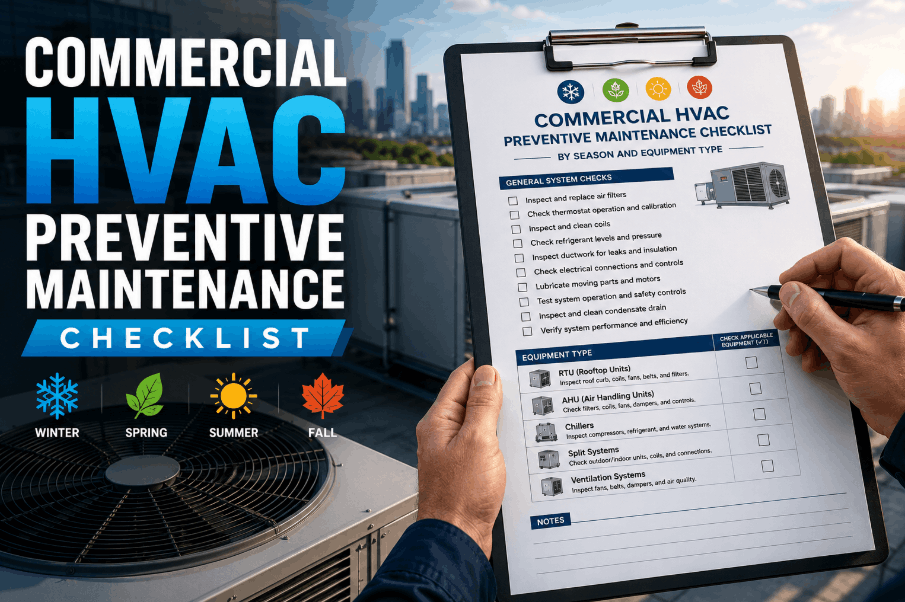
Commercial HVAC Preventive Maintenance Schedule by Frequency
By Riley Quinn on February 6, 2026
Your commercial HVAC system doesn't fail all at once. It fails in layers—a clogged filter this month, a worn belt next month, a compressor that's been overworking for a quarter because nobody cleaned the condenser coils. By the time you get the emergency call on a Friday afternoon, the total repair bill is three to five times what scheduled maintenance would have cost. The U.S. Department of Energy confirms it: comprehensive preventive maintenance programs cut total maintenance costs by 50% compared to reactive approaches. Jones Lang LaSalle put a number on the ROI—545% for commercial HVAC systems with structured PM programs versus those without. The difference between facilities that hit those numbers and facilities that don't comes down to one thing: performing the right maintenance tasks at the right frequency. Not everything needs to happen every day. Not everything can wait until the annual inspection. This schedule breaks it down.
HVAC Preventive Maintenance at a Glance
What to do and when to do it across your entire PM cycle
AnnualFull system audit, performance testing, overhaul
Full day
545%
ROI from structured PM programs (Jones Lang LaSalle)
50%
Reduction in total maintenance costs vs. reactive (U.S. DOE)
5-8yr
Additional equipment lifespan with consistent PM schedules
Daily and Weekly: The Foundation That Prevents 40% of Failures
Most commercial HVAC breakdowns trace back to issues that were visible—or audible—days or weeks before the failure. Daily monitoring takes less than 10 minutes and catches problems when they're cheapest to fix. Weekly inspections build on those observations with hands-on checks that confirm what sensors and walk-throughs suggest. Facilities that sign up for automated daily HVAC task scheduling eliminate the gap between knowing what needs to be checked and actually checking it consistently.
Daily
Routine Monitoring Tasks
Performed by: In-house facilities staff
Monitor system operation indicators
Check control panel displays, alarm status, and system run indicators for abnormalities
Verify thermostat setpoints across zones
Confirm that actual temperatures are within 2°F of setpoints in all occupied zones
Listen for unusual noises or vibrations
Walk near air handlers and RTUs to detect grinding, squealing, rattling, or banging
Note any odors from supply vents
Musty, burning, or chemical smells indicate mold, electrical issues, or refrigerant leaks
Weekly
Inspection and Observation Tasks
Performed by: In-house maintenance team
Inspect air vents and returns for blockage
Ensure no furniture, equipment, or debris obstructs supply and return air paths
Check condensate drain pans and lines
Look for standing water, algae, or clogs that indicate drainage problems
Review BMS/BAS alarm logs
Check building automation for recurring alerts, out-of-range readings, or equipment faults
Visually inspect outdoor equipment
Check condenser units and RTUs for debris accumulation, physical damage, or animal nesting
Monthly: The Tasks That Keep Efficiency From Sliding
Monthly maintenance is where you start touching components—replacing filters, inspecting belts, checking electrical connections. These are the tasks that directly prevent the 5-20% energy waste the DOE attributes to poor HVAC maintenance. A dirty air filter alone can increase energy consumption by 15% immediately. Multiply that by a building with 20 units over several months of neglect, and you're looking at thousands in wasted energy before any mechanical failure even enters the picture.
Monthly
Component Maintenance Tasks
Performed by: Trained maintenance technician
Air Filters
Inspect, clean, or replace all air filters. High-traffic or dusty environments may require biweekly replacement.
Belts and Pulleys
Check tension, alignment, and wear. Replace belts showing cracks, glazing, or excessive slack.
Electrical Connections
Tighten terminals, inspect wiring for wear or corrosion, verify control voltage readings.
Controls and Sensors
Verify thermostat accuracy, test sensor readings, confirm control sequences operate correctly.
Drain Lines
Clear condensate drain lines and pans. Flush with cleaning solution to prevent algae and blockages.
Run Time Logs
Record equipment run hours to establish baselines and identify units working harder than expected.
Quarterly and Semi-Annual: Deep Inspections That Extend Equipment Life
Quarterly visits are where professional technicians earn their keep. These are the inspections that catch refrigerant leaks before they damage compressors, identify motor bearing degradation before it causes fan failure, and clean coils before efficiency drops measurably. A 200-room hotel that implemented quarterly coil cleanings and monthly filter replacements reduced its HVAC energy bill by $18,000 annually. Semi-annual service adds seasonal preparation—ensuring cooling components are ready before summer and heating systems are tuned before winter. Facilities ready to structure these deeper inspections can book a free demo to see quarterly scheduling in action.
Quarterly + Semi-Annual Task Breakdown
Quarterly
Professional Technician Service
Clean evaporator and condenser coils thoroughly
Check and adjust refrigerant levels and pressures
Inspect fan motors, bearings, and blower assemblies
Test all safety and limit controls
Lubricate all moving parts per manufacturer specs
Review and trend system performance data
Semi-Annual
Seasonal Preparation Service
Full heating system inspection before winter
Full cooling system inspection before summer
Calibrate all thermostats and control sensors
Inspect heat exchangers and burner assemblies
Test economizer operation and damper actuators
Inspect and clean ductwork at accessible points
Automate Your Entire HVAC PM Schedule
OXmaint generates recurring work orders at every frequency—daily through annual—so your team always knows what's due, who's assigned, and what's been completed.
Annual: The Comprehensive Audit That Resets Your Baseline
The annual inspection is your facility's HVAC physical exam. This is where a qualified technician evaluates the full system—every component, every connection, every performance metric—against manufacturer specifications and industry standards like ASHRAE 180. It's also where you make capital planning decisions: which units are approaching end of life, which components should be replaced proactively, and where upgrades would deliver the strongest ROI. A poorly maintained 20-ton rooftop unit typically fails after just 9 years, while a well-maintained unit reaches its expected 14-year lifespan or beyond. That difference represents tens of thousands in avoided replacement costs per unit.
Annual
Comprehensive System Audit Checklist
Full-day service by certified HVAC professional
Mechanical Systems
Complete compressor performance analysis
Full motor amp draw and insulation testing
Bearing condition assessment on all rotating equipment
Comprehensive belt and coupling replacement as needed
Electrical and Controls
Complete electrical system inspection and thermography
BMS/BAS programming review and optimization
Full safety control testing and documentation
Sensor recalibration across all zones
Airside and Efficiency
Ductwork integrity inspection and leak testing
Air balance verification across all zones
Full energy performance benchmarking
Equipment lifecycle and capital replacement planning
Expert Perspective: Why Frequency Discipline Separates Top-Performing Facilities
Preventive maintenance reduces equipment breakdowns by up to 40% and increases efficiency by 15-20%. But the real differentiator isn't just having a PM program—it's executing the right tasks at the right cadence. Facilities that perform quarterly coil cleanings instead of annual ones see measurably better energy performance. Those that check filters monthly instead of quarterly catch restrictions before they stress compressors. The discipline of frequency is what turns a maintenance budget into an investment with a 300-500% return.
Consistency Beats Intensity
A 10-minute daily walk-through prevents more failures than a 10-hour annual overhaul alone. Research shows 75% of catastrophic HVAC failures show early warning signs that routine checks would catch. Build the habit first—optimize second.
Document Everything
Maintenance history isn't paperwork—it's a diagnostic tool. Logged run hours reveal overworked units. Repeated repair patterns identify root causes. And complete records protect warranties worth thousands when manufacturers audit claims.
Adjust by Facility Type
Hospitals, data centers, and manufacturing plants need more aggressive schedules. High-traffic retail needs more frequent filter swaps. Climate matters too—Gulf Coast humidity demands quarterly drain line attention that northern facilities can stretch to semi-annual.
The facilities achieving the best HVAC reliability and cost outcomes share one pattern: they've automated their frequency-based schedules in a CMMS platform. No spreadsheets, no memory-based tracking, no missed tasks. Every daily check, monthly filter swap, quarterly coil cleaning, and annual audit generates a work order, gets assigned to the right person, and gets documented upon completion. Managers who are ready to eliminate scheduling gaps can sign up to build automated HVAC PM schedules that run on autopilot and keep every unit on track.
Bringing It All Together: Your Frequency-Based PM Program
A frequency-based HVAC preventive maintenance schedule isn't a nice-to-have—it's the operational backbone that protects your equipment investment, controls your energy spend, and eliminates the emergency calls that disrupt operations and blow budgets. The data is clear: facilities with structured PM programs see 50% lower total maintenance costs, 5-8 years longer equipment life, and ROI exceeding 500%. The facilities without them spend three to five times more on emergency repairs and replace equipment years earlier than necessary.
Start where you are. If you're doing nothing, begin with daily walk-throughs and monthly filter changes. If you already have a basic program, add quarterly professional inspections and semi-annual seasonal prep. And when you're ready to stop managing schedules manually and start running a program that tracks, assigns, and documents every task automatically, schedule a free demo to see how OXmaint handles it.
Build Your HVAC PM Schedule in Minutes
OXmaint lets you set up daily, weekly, monthly, quarterly, and annual HVAC maintenance schedules with automated work orders, technician assignments, and completion tracking—all in one platform.
How often should commercial HVAC systems receive professional maintenance?
At minimum, commercial HVAC systems should receive professional service twice per year—once before cooling season (spring) and once before heating season (fall). However, most HVAC experts and industry standards recommend quarterly professional service for commercial systems, as this frequency catches issues before they cause efficiency losses or equipment damage. High-use facilities like hospitals, data centers, and manufacturing plants may require monthly professional inspections. Between professional visits, in-house staff should perform daily monitoring and weekly visual inspections.
What's the most impactful preventive maintenance task by frequency?
Monthly air filter replacement delivers the highest impact-to-effort ratio. A dirty filter can increase energy consumption by 15% immediately and accelerate wear on fans, compressors, and coils. At the quarterly level, coil cleaning is the highest-impact task—dirty coils reduce heat transfer efficiency significantly and can raise compressor operating temperatures to the point of premature failure. At the annual level, comprehensive performance benchmarking helps identify units that are declining in efficiency and approaching the point where replacement becomes more cost-effective than continued repair.
How much does a commercial HVAC preventive maintenance program cost annually?
Most commercial facilities budget $500-$2,000 per unit per year for comprehensive preventive maintenance, with the exact cost depending on system size, complexity, number of units, and service frequency. Annual maintenance contracts that include quarterly visits typically range from $1,000-$10,000+ depending on facility size. While this seems significant, it compares favorably against the alternative: emergency repairs averaging $450-$1,000 per truck roll (25% of which require return visits), and full system replacement starting at $6,000 for a unit serving just 1,000 sq/ft. The JLL study found PM programs deliver 545% ROI over equipment lifetime.
How does a CMMS help manage frequency-based HVAC maintenance?
A CMMS (Computerized Maintenance Management System) automates the entire frequency-based schedule by generating recurring work orders at each interval—daily, weekly, monthly, quarterly, semi-annual, and annual. It assigns tasks to specific technicians, sends reminders before due dates, tracks completion status, and stores the full maintenance history for every HVAC asset. This eliminates missed tasks, provides audit-ready documentation for compliance (ASHRAE 180, OSHA), and gives managers data to optimize schedules based on actual equipment performance rather than generic guidelines.
Should maintenance frequency change based on facility type or climate?
Absolutely. The baseline schedule should be adjusted based on several factors. High-traffic facilities (retail, restaurants, schools) need more frequent filter changes—often biweekly instead of monthly. Humid climates require quarterly condensate drain line service instead of semi-annual. Facilities with continuous 24/7 operations (hospitals, data centers, manufacturing) should increase all frequencies by at least one tier. Dusty or polluted environments require more frequent coil cleanings. And systems older than 10 years generally benefit from quarterly professional service even if newer systems of the same type could operate on semi-annual cycles.