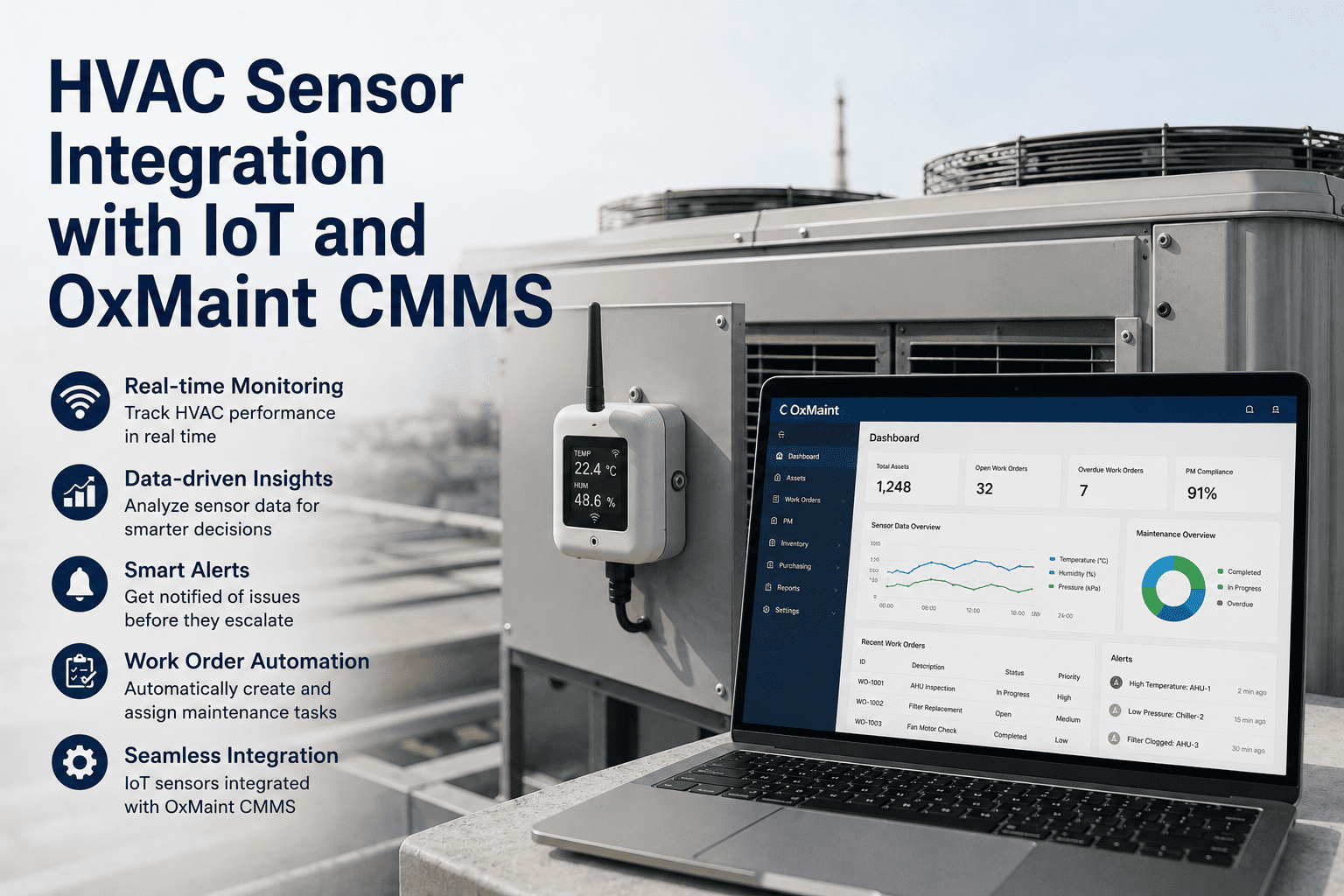
An HVAC system that is failing does not fail silently — it sends signals for days or weeks before the breakdown: rising vibration on a bearing that will seize, a slow refrigerant leak tracked by pressure drift, a fouled condenser coil causing progressive efficiency loss, a fan motor drawing more amps as the belt frays. The problem is not that the signals are absent — the problem is that no one is listening. OxMaint's IoT sensor integration connects vibration, temperature, humidity, pressure, airflow, and energy sensors directly to the CMMS — so the signals become alerts, alerts become work orders, and work orders become resolved faults before the equipment fails and the building loses cooling.
Article · IoT HVAC · Sensor Integration
HVAC Sensor Integration with IoT and OxMaint CMMS
Vibration · Temperature · Humidity · Pressure · Airflow · Energy — All Sensors. One Platform.
Live Sensor Feed · Building A
Chiller-1 Bearing
Vibration
4.2 mm/s
Anomaly Detected
AHU-05 Supply Air
Temperature
14.8°C
Normal
Cooling Tower Basin
Water Temp
31.4°C
Above Setpoint
FCU-B3 Motor
Current (A)
3.1A
Normal
Chiller-1
kW Draw
+18% baseline
WO Auto-Created
72%
Of HVAC failures are predictable when sensor data is monitored continuously vs reactive inspection
3–5x
Earlier fault detection with IoT sensors vs quarterly PM inspections alone
35%
Average energy savings when HVAC performance is continuously benchmarked against sensor baselines
Auto
Work orders created by OxMaint when sensor readings breach defined thresholds — zero manual intervention
HVAC Sensor Types — What Each One Detects and Prevents
01
Vibration Sensors
Chillers · AHU Fans · Pumps · Cooling Tower Fans
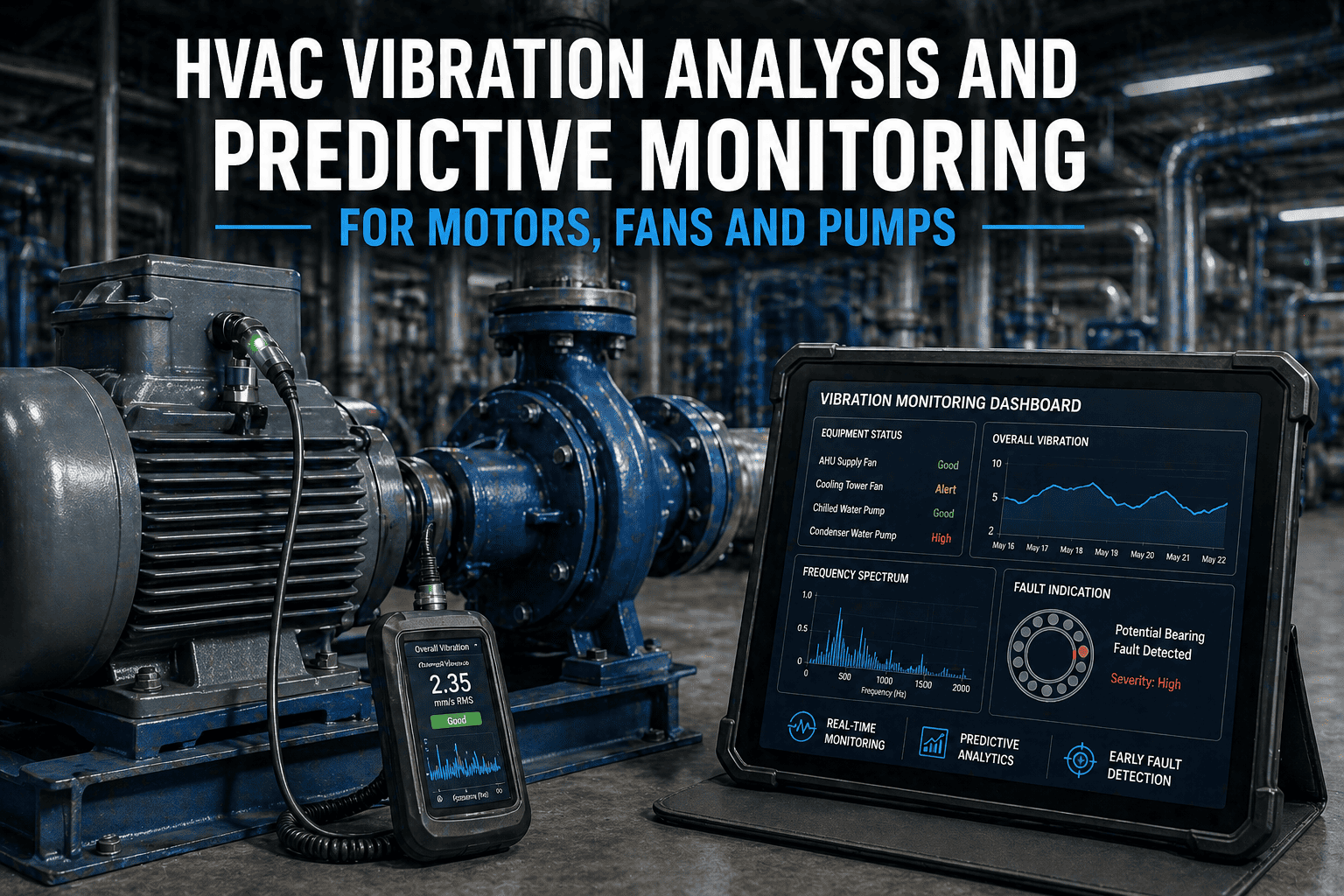
Vibration monitoring detects bearing wear, imbalance, and misalignment weeks before mechanical failure. A chiller bearing approaching failure generates a distinctive vibration signature detectable at 2–4 mm/s before seizure occurs at 7+ mm/s.
Prevents: Bearing seizure · Shaft failure · Catastrophic motor burnout
02
Temperature Sensors
Supply/Return Air · Condenser · Evaporator · Motor Windings
Temperature deviation from baseline is the earliest indicator of coil fouling, refrigerant loss, or valve failure. A 3°C rise in supply air temperature on an AHU signals filter loading or coil condition deterioration that will reach guest-impact level within weeks.
Prevents: Comfort complaints · Coil damage · Refrigerant overcharge events
03
Humidity Sensors
AHU Discharge · Server Rooms · Cold Stores · Hospital Zones
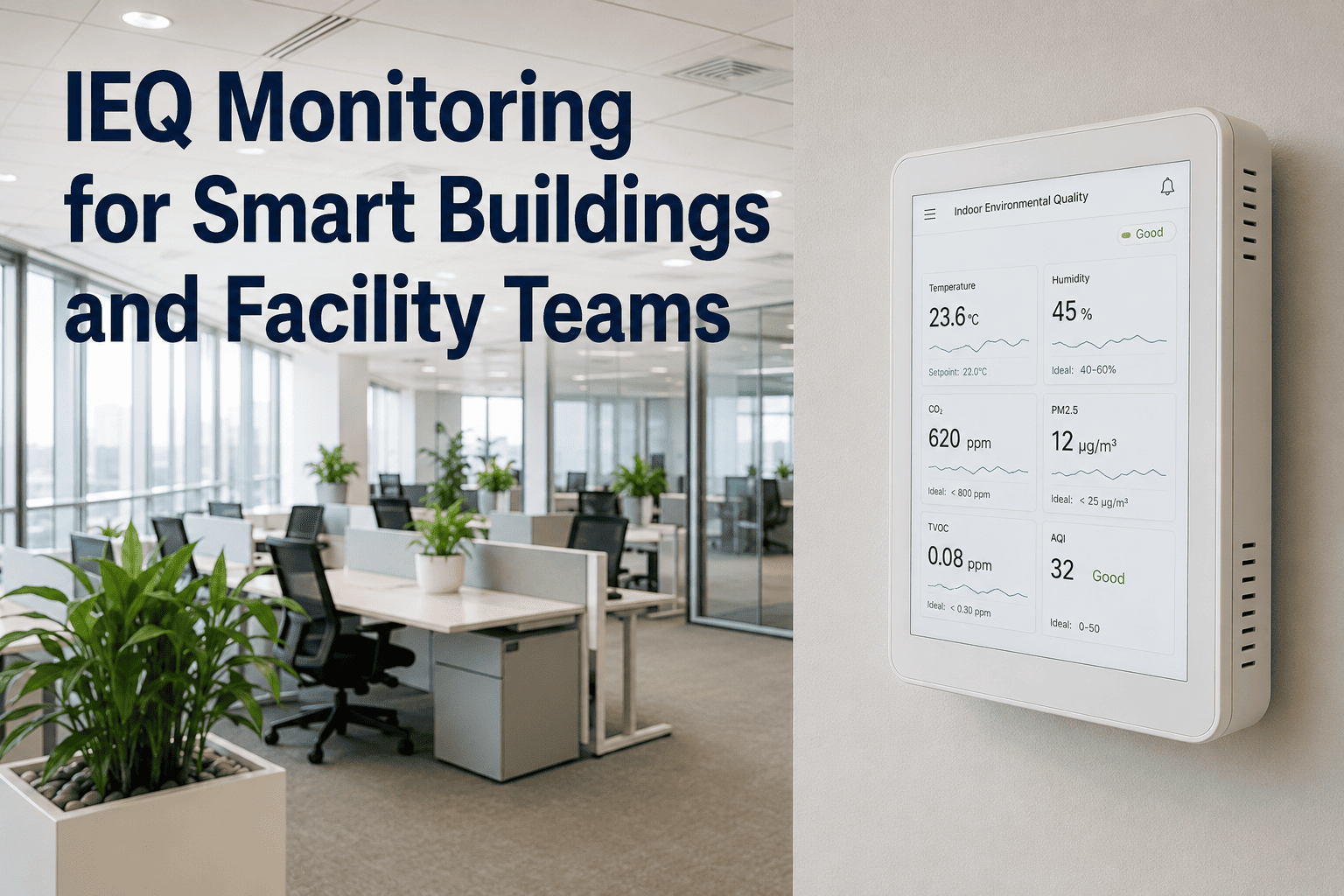
Humidity drift above 65% RH in server rooms triggers condensation and equipment damage within hours. In hospital environments, humidity control is a clinical compliance requirement. Sensor integration flags humidity deviation instantly, not at the next inspection.
Prevents: Server failure · Mould growth · Compliance breach · Condensation damage
04
Pressure Sensors
Refrigerant Circuits · Ductwork · Chilled Water Loops · Filter Banks
Suction and discharge pressure trends identify refrigerant leak rates before low charge causes compressor damage. Duct static pressure monitoring detects filter loading between PM visits. Chilled water differential pressure tracks pump and valve performance in real time.
Prevents: Compressor failure · Filter bypass · Pump cavitation · Valve failure
05
Airflow Sensors
AHU Supply/Return · VAV Boxes · Exhaust Systems · Clean Rooms
Airflow monitoring detects belt slip, damper failure, and duct obstruction in real time. In clean rooms and hospitals, flow rate is a compliance metric. In standard commercial buildings, airflow deviation is the first indicator of filter pressure drop and fan performance degradation.
Prevents: IAQ failure · Compliance breach · Belt damage · Undetected damper fault
06
Energy / Current Sensors
Chillers · AHU Motors · Pumps · VRF Outdoor Units
kW draw deviation from baseline is the most reliable single indicator of mechanical degradation in HVAC equipment. A condenser running 18% above baseline kW/ton before the next PM is a condenser cleaning event that, if missed, costs the difference in energy until the next scheduled service.
Prevents: Energy waste · Undetected fouling · Motor overload · Missed efficiency events
IoT Alert to Work Order — How OxMaint Closes the Loop
Sensor Threshold Breach
Vibration on Chiller-1 bearing reaches 4.2 mm/s — above the 3.5 mm/s warning threshold set in OxMaint.
Automatic Alert Generated
OxMaint creates an alert tagged to Chiller-1 with sensor reading, trend chart, and breach time — pushed to supervisor's mobile dashboard instantly.
Work Order Auto-Created
A priority work order is auto-generated: "Inspect Chiller-1 bearing — vibration anomaly detected. Asset history and vibration trend attached." Assigned to next available senior tech.
Technician Inspects and Resolves
Tech scans QR code, confirms bearing wear, replaces bearing during planned access window. Work order closed with parts used, readings logged, and resolution photo uploaded.
Sensor Confirms Resolution
Vibration returns to 1.1 mm/s baseline. OxMaint logs resolution against the asset record. Chiller failure prevented. Zero unplanned downtime. Full audit trail created.
Your HVAC Equipment Is Already Sending Signals. Start Listening.
OxMaint integrates with leading IoT sensor platforms via MQTT, BACnet, Modbus, and REST API — connecting your existing sensor infrastructure to automated work order management without replacing hardware.
Sensor Integration Performance — Real Facility Outcomes
500-ton Chiller
Vibration + Energy
2 unplanned failures/yr · $34,000 repair cost
0 failures · Bearing replaced predictively · $4,200 cost
20-unit AHU floor
Temperature + Airflow
Filter overdue on 8/20 units at any given time
Auto-WO on pressure rise · 100% filter compliance
Server Room FCU
Humidity + Temp
2 server rack failures from humidity spike
Instant alert on 65% RH breach · Zero rack events
Cooling Tower
Water Temp + Flow
Manual water tests only — Legionella risk gap
Continuous monitoring · Auto-alert on temp drift
"
The missing layer in most building CMMS deployments I have reviewed is not data — it is the connection between data and action. Facilities teams often have BMS readings, sensor dashboards, and energy monitoring running in parallel with their maintenance system, with no automated link between them. A vibration spike that sits in a BMS trend graph is just a number; the same spike that auto-creates a priority work order in the CMMS is a prevented failure. OxMaint's IoT integration is architecturally the right approach because it treats sensor data as a maintenance trigger, not a monitoring dashboard — and that distinction is exactly what separates predictive maintenance programmes that deliver ROI from those that produce reports nobody acts on. Facilities deploying OxMaint with IoT sensor integration should expect to recover the integration cost in averted failures within the first six months.
James Ogilvie, CEng, MCIBSE
Principal Mechanical Engineer · Building Services Consultancy · 25 Years Smart Building and HVAC Systems Design · Chartered Engineer (IMechE) · Member of the Chartered Institution of Building Services Engineers · Specialist in IoT sensor architecture, BMS integration, and CMMS-linked predictive maintenance systems for commercial and industrial portfolios
Frequently Asked Questions
What sensor protocols and IoT platforms does OxMaint integrate with?
OxMaint integrates with IoT sensors and platforms via MQTT, BACnet/IP, Modbus TCP/RTU, and REST API — covering the majority of commercial building automation and IoT sensor hardware available today. Compatible sensor platforms include AWS IoT Core, Azure IoT Hub, Siemens Desigo, Honeywell Enterprise Buildings Integrator, and leading independent IoT sensor vendors such as Samsara, Monnit, and ifm. For existing BMS systems, OxMaint can pull data via API or direct integration without replacing the existing building management infrastructure.
Start a free trial and test OxMaint IoT integration with your sensor setup.
How does OxMaint determine when a sensor reading should trigger a work order?
OxMaint allows facilities managers to configure threshold rules per asset and sensor type — for example, a vibration alert at 3.5 mm/s warning and auto-work-order at 4.0 mm/s, or a chiller energy alert when kW draw exceeds 115% of the 30-day rolling baseline. Rules can be set as absolute thresholds, percentage deviations from baseline, or rate-of-change triggers for gradual drift conditions. Each rule is linked to a specific asset, so a chiller and a fan coil unit can have completely different threshold sets that reflect their operational characteristics. Threshold rules can be adjusted at any time based on seasonal operating conditions or post-maintenance baseline resets.
Book a demo to configure threshold rules for your HVAC assets.
What happens to sensor-triggered work orders if the maintenance team cannot respond immediately?
OxMaint's IoT-triggered work orders follow the same escalation workflow as manually created work orders — if a priority alert work order is not acknowledged within the configured response window, automated escalation notifications are sent to the next supervisor level and the work order priority can be automatically upgraded. Sensor readings continue to be logged against the open work order in real time, so when the technician does attend, they arrive with a trend chart showing how the reading has behaved since the initial alert — providing critical diagnostic context that a one-time snapshot cannot supply. All sensor readings associated with the fault are permanently archived against the asset record for root cause analysis.
Explore work order escalation settings in a free OxMaint trial.
OxMaint · IoT Sensor Integration
From Sensor Signal to Closed Work Order — Automatically.
OxMaint connects your HVAC IoT sensors to automated work order management — so vibration anomalies, temperature drift, and energy deviation become resolved maintenance events, not missed failures.