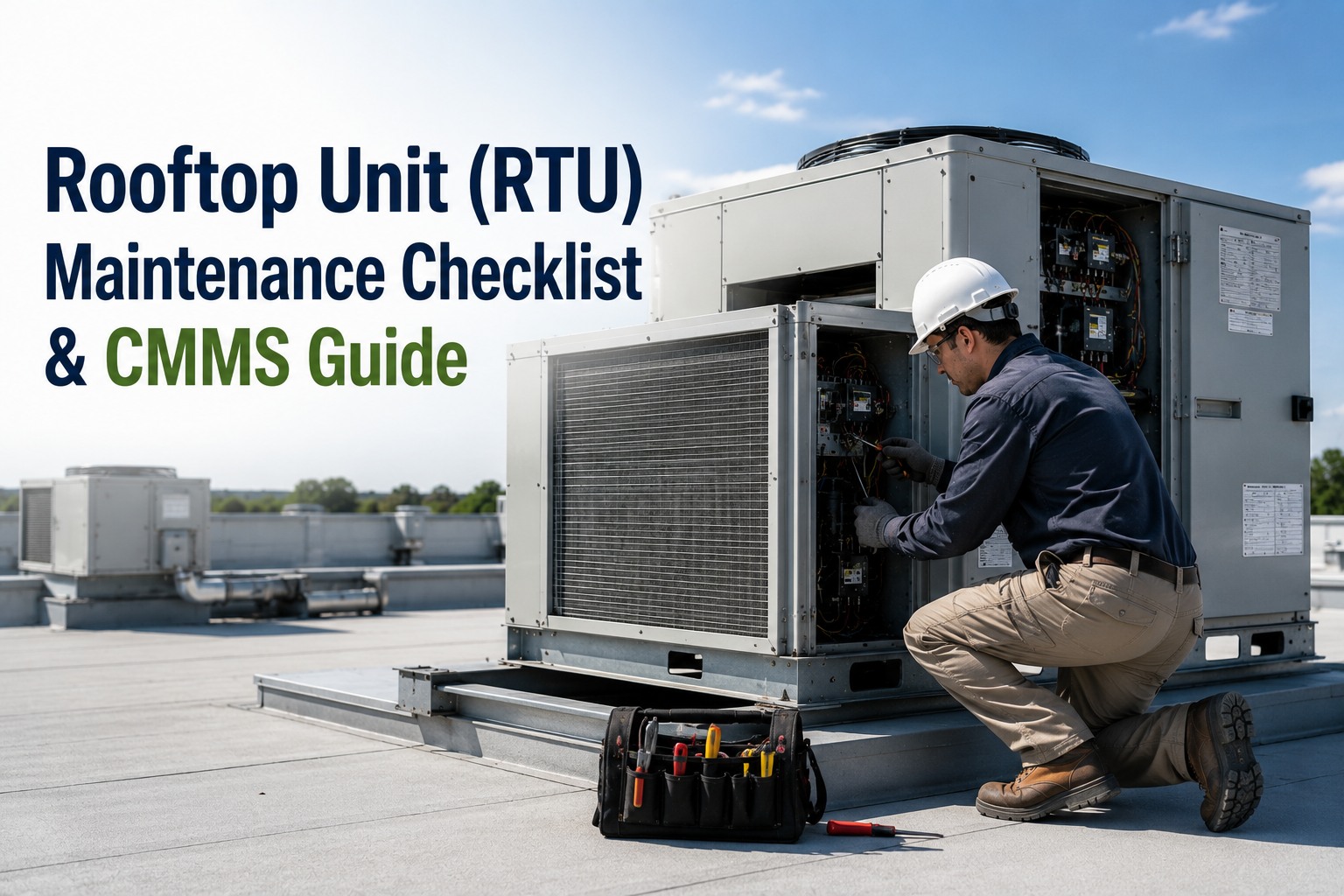
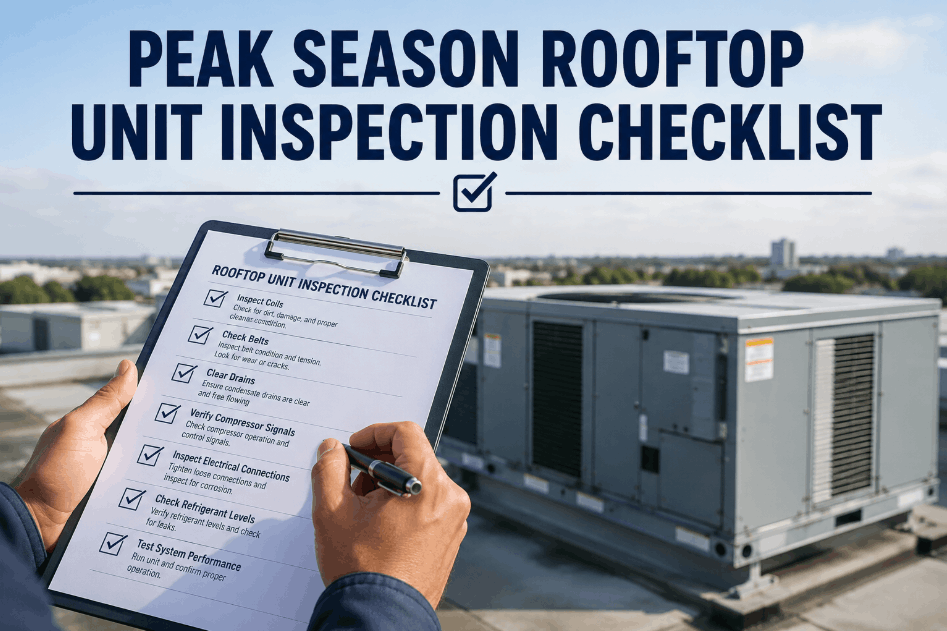
Commercial rooftop units (RTUs) handle up to 50% of a building's total HVAC load — yet most facilities inspect them only when something breaks. Use this digital-ready RTU maintenance checklist to prevent the three most common failure causes: clogged filters, fouled coils, and neglected belts. OxMaint's Preventive Maintenance platform digitizes every checklist item into scheduled work orders, so no inspection step is skipped, and every completed task is timestamped and auditable. Book a demo to see how OxMaint automates RTU checklists across your fleet.
40%
of RTU failures are filter‑related and preventable
3–5x
more costly to fix reactive RTU failures vs planned PM
15–20%
energy savings achieved with economizer maintenance
2 yrs
average RTU lifespan added with consistent PM programs
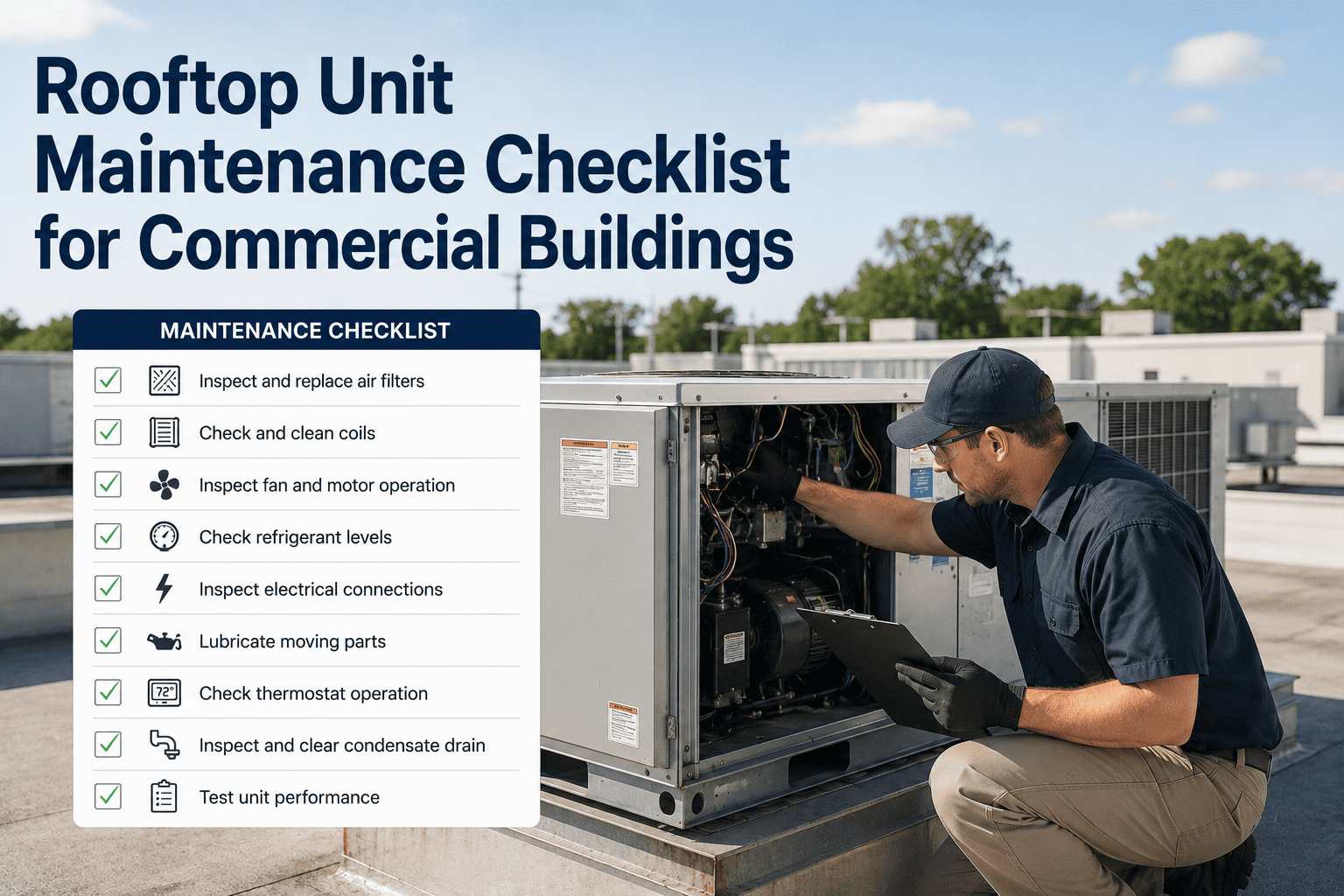
Complete RTU maintenance checklist
Organised by inspection zone. Each task is ready to be loaded as a recurring work order in your CMMS.
01 Air filters Monthly
Replace filters according to MERV rating schedule
Inspect filter housing for bypass gaps or frame damage
Log filter static pressure differential before/after replacement
Record filter MERV rating and manufacturer part number
02 Evaporator & condenser coils Quarterly
Inspect coil fins for fouling, corrosion, or physical damage
Clean evaporator coil with approved no‑rinse coil cleaner
Verify condenser coil airflow — check for debris blockage
Log coil surface temperature approach differential
03 Belts & pulleys Quarterly
Check belt tension — deflection 1 inch per foot of span
Inspect belt for cracking, glazing, or fraying
Verify pulley alignment with straightedge
Record belt size and replacement date in work order
04 Compressor & refrigerant circuit Semi‑annual
Check suction and discharge pressures against manufacturer spec
Inspect compressor for oil leaks and abnormal vibration
Verify superheat and subcooling readings are within range
Log refrigerant type and check for EPA 608 compliance
05 Economizer & dampers Quarterly
Inspect economizer damper operation — full open, modulating, closed
Check enthalpy or dry‑bulb sensor calibration
Lubricate damper linkage and actuator pivot points
Verify low‑limit control setpoint per ASHRAE 90.1
06 Condensate drain & pan Monthly (cooling season)
Flush condensate drain line with water or nitrogen
Inspect drain pan for standing water, algae, or debris
Check float switch and overflow sensor operation
Verify drain slope — minimum 1/8 inch per foot toward outlet
07 Electrical & controls Semi‑annual
Inspect all electrical connections for looseness or corrosion
Check contactor contacts for pitting or burning
Verify thermostat setpoints and calibration
Test high‑pressure, low‑pressure, and freeze safety controls
08 Heat exchanger (gas units) Annual
Inspect heat exchanger for cracks, rust, or scaling
Check burner ignition and flame sensor operation
Verify flue gas temperature and combustion efficiency
Test CO detection where required by code
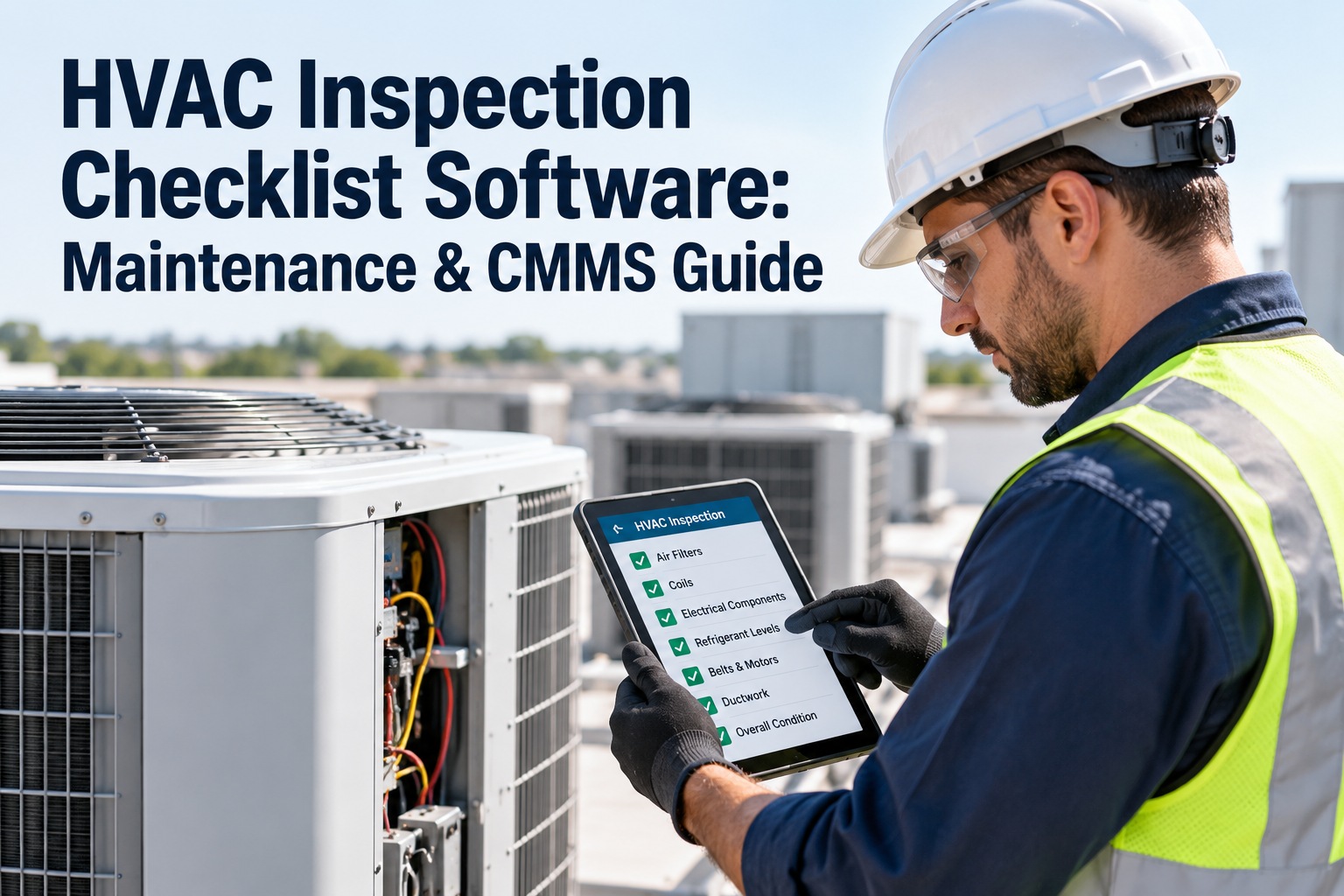
Turn this checklist into auto‑scheduled work ordersOxMaint converts every RTU inspection zone into digital PM tasks with asset history and parts list ready.
RTU inspection frequency reference
Based on ASHRAE 180 and SMACNA commercial HVAC guidelines.
| Inspection item | Monthly | Quarterly | Semi‑annual | Annual |
|---|
| Air filter replacement | ✓ | | | |
| Condensate drain flush | ✓ | | | |
| Coil cleaning | | ✓ | | |
| Belt tension & alignment | | ✓ | | |
| Economizer calibration | | ✓ | | |
| Refrigerant pressure check | | | ✓ | |
| Electrical connection inspection | | | ✓ | |
| Heat exchanger inspection | | | | ✓ |
| Full combustion analysis | | | | ✓ |
Expert review
RK
Raymond Kowalski
Senior HVAC Systems Engineer — ASHRAE Member, 18 years in commercial RTU commissioning
The economizer is the most neglected component on any RTU and also the most expensive to ignore. A stuck economizer damper in the open position can add 20% to a building's annual cooling energy cost — and most facilities never attribute the energy increase to the damper because they never inspect it systematically. A structured checklist that includes economizer calibration every quarter, with a timestamped record in a CMMS, is the difference between catching a $200 actuator problem and paying for a $40,000 annual energy overage. RTU maintenance programs that skip the economizer are not preventive maintenance programs — they are deferred maintenance programs with extra steps.
Top 5 RTU failures caused by skipped checklist steps
01Compressor burnout — dirty condenser coils raise head pressure. Caught with quarterly coil inspection.
02Frozen evaporator coil — restricted airflow from clogged filters. Monthly filter check prevents 100% of freeze events.
03Belt failure mid‑season — cracked belts fail without warning. Quarterly tension checks extend belt life 2–3x.
04Water damage from drain overflow — blocked condensate lines flood ceilings. Monthly drain flushing eliminates risk.
05Economizer energy waste — faulty sensors run mechanical cooling when free cooling is available. Semi‑annual calibration recovers 15% energy loss.
Frequently asked questions
How often should a commercial RTU be fully inspected?
A full RTU inspection covering all eight zones should be performed at minimum quarterly for most commercial applications. High‑use facilities (hospitals, data centers, 24/7 retail) should increase coil cleaning and filter checks to monthly. ASHRAE Standard 180 provides the authoritative schedule for commercial HVAC preventive maintenance, and
OxMaint's PM scheduler applies these intervals automatically based on asset class and usage profile.
What is the most common cause of RTU failure in commercial buildings?
Compressor failure is the most expensive RTU failure mode, and it is almost always preceded by weeks of elevated head pressure caused by dirty condenser coils or low refrigerant charge — both detectable through routine inspection. Dirty filters are the most frequent cause of service calls, responsible for approximately 40% of RTU emergency repairs. A consistent PM checklist that includes monthly filter checks and quarterly coil cleaning eliminates both failure modes before they reach the compressor stage.
What does an economizer do and why does it need maintenance?
An economizer allows an RTU to use outdoor air for free cooling when conditions are favorable. When sensors drift or damper actuators fail, the unit either runs mechanical cooling unnecessarily or fails to use free cooling when available, both wasting energy. Quarterly calibration of economizer sensors and annual actuator inspection keep this component — responsible for 15–20% annual energy savings — performing as designed.
Book a demo to see how OxMaint tracks economizer PM compliance.
Can OxMaint manage RTU checklists across multiple buildings?
Yes. OxMaint's multi‑site PM module manages RTU maintenance schedules across every building in a portfolio from a single dashboard. Each RTU is registered as an individual asset with its own PM schedule, inspection history, and parts log. Directors see portfolio‑wide PM compliance in real time, and facility managers receive alerts when any RTU inspection is approaching its due date. Work orders are assigned to the site technician automatically, with the full checklist embedded in the mobile task.
Ready to automate RTU preventive maintenance?
OxMaint schedules, assigns, and tracks every checklist item on your RTU fleet. Your team gets mobile work orders. You get real‑time completion data and audit‑ready records.