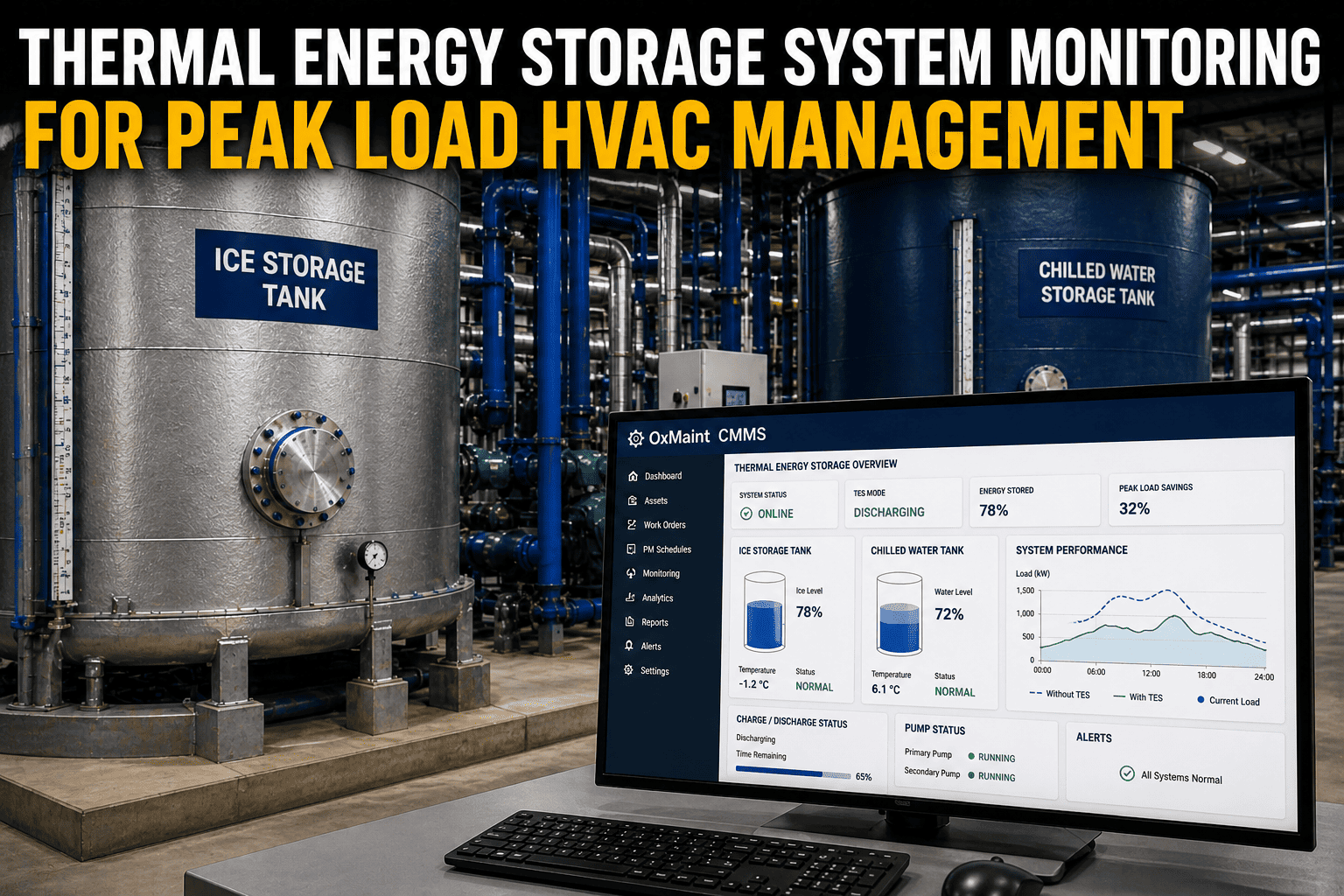
Buildings that use thermal energy storage (TES) to shift HVAC peak loads typically save $80,000–$400,000 annually in demand charges — but only when the system is operating as designed. Ice storage tanks lose capacity from glycol degradation. Chilled water stratification breaks down from poor inlet diffuser maintenance. Control valve sequencing drifts out of calibration. Each deviation quietly erodes the energy savings the system was installed to deliver. OxMaint's Preventive Maintenance module gives facility engineers a structured monitoring and inspection framework for TES systems that protects both equipment reliability and energy economics throughout the year.
Energy Optimization · Thermal Storage · Preventive Maintenance
Thermal Energy Storage System Monitoring for Peak Load HVAC Management
Ice storage and chilled water TES systems cut peak demand charges by 30–60% — but degraded glycol, failed stratification, and miscalibrated controls silently destroy those savings. This guide shows what to monitor, when to act, and how digital PM protects your energy economics.
30–60%
peak demand charge reduction from functional TES
15%
capacity loss from unchecked glycol degradation
$120K
avg. annual savings recovered by proactive TES PM
24/7
continuous charge/discharge monitoring via OxMaint
System Types
Ice Storage vs Chilled Water TES: Failure Profiles Compared
Both TES types deliver peak load shifting but have distinct maintenance requirements. Misidentifying the failure mode means applying the wrong fix — and continuing to lose savings.
Ice Storage
Glycol-Based Ice Bank Systems
Ice is formed overnight during off-peak rates and melted during peak hours to supplement chiller capacity. System performance depends entirely on glycol quality, evaporator coil condition, and control sequencing accuracy.
Glycol pH drift → coil corrosion, capacity loss
Freeze point deviation → incomplete ice formation
Evaporator scaling → reduced heat transfer rate
Control valve drift → poor charge/discharge timing
Chilled Water TES
Stratified Chilled Water Tank Systems
Large insulated tanks store cold water at 4–6°C during off-peak hours. Effective storage depends on maintaining stable thermal stratification — warm and cold water layers that must not mix. Diffuser condition and tank insulation are critical.
Diffuser damage → stratification breakdown, mixing
Tank insulation failure → thermal gain, lost capacity
Water treatment gap → legionella and scaling risk
Level sensor drift → incorrect charge state reading
PM Reference Table
Thermal Energy Storage: Full Maintenance Schedule
| Component |
System |
Task |
Interval |
Savings Impact if Deferred |
| Glycol solution |
Ice storage |
pH, freeze point, inhibitor concentration test |
Quarterly |
Up to 15% capacity loss |
| Evaporator coil |
Ice storage |
Visual inspection + scaling check |
Semi-annual |
Reduced ice formation rate |
| Charge/discharge valves |
Both |
Stroke test + calibration |
Semi-annual |
Off-peak shift failure, demand spike |
| Tank diffusers |
Chilled water |
Visual inspection for damage or blockage |
Annual |
Stratification loss, 20–30% capacity reduction |
| Tank insulation |
Chilled water |
Infrared scan for thermal bridging |
Annual |
Standby losses increase energy cost |
| Water treatment |
Chilled water |
Microbiological + chemical analysis |
Monthly |
Scaling, corrosion, legionella risk |
| Level and temperature sensors |
Both |
Calibration vs reference |
Annual |
Incorrect charge state, control errors |
| BMS control sequences |
Both |
Peak shaving algorithm verification |
Semi-annual |
Full demand charge exposure at peak |
What to Monitor
Five TES Performance Indicators That Warn Before Savings Erode
01
Charge Completion Rate
Full ice or chilled water charge must complete before peak window opens. Charge completion below 95% means the system cannot cover peak load — demand charges spike that day.
Target: >95% nightly
02
Glycol Freeze Point (°C)
Freeze point drift above -6°C for a -3°C ice formation system means incomplete freezing. Tank capacity falls proportionally with every degree of drift left uncorrected.
Target: ≤-6°C (system-specific)
03
Stratification Index (°C delta)
Temperature difference between top and bottom of chilled water tank directly measures stratification effectiveness. Collapse of gradient indicates diffuser damage or mixing.
Target: ≥8°C delta maintained
04
Peak Demand Displacement (%)
The percentage of peak cooling load met by stored energy rather than active chiller. Any sustained decline in this figure indicates TES capacity degradation before billing cycle closes.
Target: match design specification
05
Standby Loss Rate (kWh/hr)
Energy gained by the storage medium while idle measures tank insulation performance. Rising standby loss is the earliest sign of insulation failure and increases net operating cost before the tank is even discharged.
Target: <2% of stored capacity per hour
Preventive Maintenance · TES Monitoring
Your TES System Is Losing Savings Every Day It Goes Unmonitored
OxMaint connects to your BMS, glycol analyzers, and tank sensors to monitor TES charge completion, stratification index, and demand displacement in real time. When a KPI drifts, a PM work order is created before the next billing cycle catches you with a demand spike.
Book a Demo
Expert Review
What Energy Engineers Say About TES System Maintenance
"Glycol degradation in ice storage systems is the most under-monitored problem in commercial HVAC. We see systems running with pH below 6.5 for years — corroding evaporator coils from the inside while the BMS reports normal charge cycles because it only reads temperature, not heat transfer rate."
Senior Energy Systems Engineer
HVAC Commissioning Firm, Western USA
"A chilled water TES tank with a damaged diffuser looks fine on the outside and reads correct level, but the stratification is gone. You are essentially running a mixing tank — no storage benefit, full demand exposure. Diffuser inspection is cheap. A missed demand charge is not."
Thermal Storage Specialist
District Cooling Authority, Middle East
"The BMS control sequence for peak shaving drifts. Setpoints get changed during troubleshooting and never restored. We did a TES audit across 12 commercial buildings and found the control sequence was operating correctly to design spec in only 4 of them."
Building Automation Lead
Facilities Management Group, Singapore
Performance Data
TES System Performance: Maintained vs Unmonitored
| Metric |
Unmonitored TES System |
OxMaint-Monitored System |
| Annual demand charge savings |
$120K–$180K (design: $300K) |
$270K–$310K (near-design) |
| Charge completion rate |
78–85% |
96–99% |
| Glycol freeze point compliance |
62% of quarterly tests pass |
97% of quarterly tests pass |
| Stratification index maintained |
51% of operating hours |
93% of operating hours |
| Unplanned TES outages/year |
3–5 |
0–1 |
| PM compliance rate |
48% |
91% |
Frequently Asked
Thermal Energy Storage Maintenance Questions
How often should glycol in an ice storage system be tested and treated?
Glycol solution in ice storage systems should be tested quarterly for pH, freeze point, inhibitor concentration, and total dissolved solids. pH below 7.0 accelerates aluminum and copper corrosion in evaporator coils, leading to leaks that are expensive to detect and repair. Freeze point drift above the design target reduces ice formation efficiency by a measurable percentage for each degree of deviation. Most manufacturers recommend a full glycol replacement every 5–7 years regardless of chemical condition.
OxMaint schedules glycol testing by system and logs results with trend tracking.
What causes thermal stratification to break down in a chilled water TES tank?
Stratification breaks down when the inlet diffusers that introduce warm or cold water to the correct layer of the tank are damaged, misaligned, or blocked. Diffusers are designed to deliver water at low velocity so it enters its temperature-appropriate layer without creating turbulence that mixes the layers. A cracked or partially blocked diffuser creates a jet that penetrates the thermocline and destroys the temperature gradient. Annual visual inspection of all diffusers with flow verification is the minimum standard for tanks where stratification integrity determines demand charge savings.
Book a demo to see how OxMaint tracks tank inspection history.
How can OxMaint monitor TES system performance alongside HVAC CMMS tasks?
OxMaint integrates with BMS systems via BACnet, Modbus, and OPC-UA to pull TES operational data — charge state, glycol temperature, tank stratification index, and demand displacement — into the same platform that manages PM work orders. When a monitored value crosses a user-defined threshold, a PM or corrective work order is raised automatically and assigned to the responsible technician. This means the same engineer managing chiller PM is also receiving TES alerts — no separate monitoring platform required.
Start your free trial to connect your first TES asset.
How do I verify that my TES BMS control sequence is still delivering peak shaving as designed?
BMS control sequence verification for TES peak shaving should be performed semi-annually and documented against the original commissioning report. Key checks include confirming the charge start time aligns with off-peak rate windows, verifying the discharge priority setpoint activates before peak demand threshold is reached, and confirming that the chiller lockout logic during full TES discharge is still active. Any setpoint modified since commissioning that has not been formally reviewed should be flagged for an energy engineer to validate. OxMaint stores verification records linked to the BMS asset so changes are tracked and auditable.
See how OxMaint tracks BMS configuration history.
TES Monitoring · Energy Savings Protection
Protect the Savings Your TES System Was Installed to Deliver
OxMaint monitors your ice storage and chilled water TES systems around the clock — tracking charge completion, glycol health, stratification index, and demand displacement. When savings start to erode, you know before the utility bill confirms it.