Thermal storage dispatch strategy determines whether a chilled water or ice storage system actually reduces peak HVAC demand, or just sits there as an underused asset. When charge and discharge cycles aren't tied to real load forecasts, sensor health, and chiller condition, facilities miss the utility rate windows that make thermal storage worth the investment in the first place. Sign Up Free to see how Oxmaint connects sensor data, chiller health, and dispatch performance in one view, or Book a Demo to walk through your facility's current peak-shaving gaps with a solutions engineer. Oxmaint gives facility and plant teams the real-time visibility to plan dispatch windows around actual demand instead of habit, and to catch the chiller or tank issues that quietly shrink usable storage capacity before they cost a peak charge.
Facility & Plant Operations · Thermal Storage · 2026
Thermal Storage Dispatch Strategy for Peak HVAC Demand
Track tank charge, chiller condition, and dispatch timing in one place — so thermal storage actually shifts load instead of sitting in reserve.
58%Of facilities dispatch thermal storage manually, with no load forecast integration
−31%Peak demand charge reduction with real-time dispatch monitoring
2.1×Faster detection of chiller or tank performance issues with sensor integration
89%Dispatch-window accuracy with forecast-aligned scheduling
6 Dispatch Signals That Quietly Erode Thermal Storage Savings
Thermal storage underperformance rarely shows up as a single failure — it builds across charge cycles through signals that are easy to miss without structured monitoring. The six patterns below are the dispatch and asset signals Oxmaint surfaces for facility and plant teams managing thermal storage. Sign Up Free to start monitoring these signals for your own dispatch cycle today.
Manual Dispatch Timing
Pattern: Charge/discharge decided by operator habit, not load forecast
Dispatch Risk
Dispatch misses the lowest-rate utility windows, leaving peak-shaving value on the table shift after shift.
Sensor Drift Unnoticed
Pattern: Tank level or temperature sensors drift without recalibration flags
Asset Risk
Charge volume gets reported inaccurately, so dispatch decisions are made on data nobody has verified.
PM Inside the Peak Window
Pattern: Preventive maintenance scheduled during planned discharge hours
Dispatch Risk
Usable storage capacity is cut exactly when demand peaks, defeating the purpose of the dispatch plan.
Chiller Health Blind Spot
Pattern: Chiller efficiency declines with no tracked health score
Asset Risk
Storage capacity shrinks silently, so the dispatch plan no longer matches what the system can actually deliver.
Forecast Mismatch
Pattern: Dispatch plan built on yesterday's load profile
Dispatch Risk
Today's actual peak window gets missed, and the demand charge lands anyway despite the storage asset.
Multi-Site Inconsistency
Pattern: Each site dispatches on its own logic, no shared visibility
Asset Risk
Portfolio-wide peak-shaving performance becomes impossible to compare, benchmark, or improve.
Thermal Storage Dispatch — Without vs. With Oxmaint
The gap between reactive thermal storage management and forecast-aligned dispatch shows up directly on the utility bill, in chiller wear, and in how often a peak charge could have been avoided. Book a Demo to see your facility's current dispatch profile mapped against forecast-aligned scheduling.
Thermal Storage Dispatch Maturity — Where Does Your Facility Sit?
Dispatch control ranges from undocumented charge/discharge decisions to fully forecast-driven scheduling tied to real-time asset health. The framework below helps facility and plant teams pinpoint the gap costing the most peak-shaving value today. Book a Demo to assess your facility's current dispatch maturity with an Oxmaint solutions engineer.
Thermal Storage Dispatch Maturity
Score 5 = real-time, forecast-driven dispatch · Score 1 = no structured tracking
5
Real-Time, Forecast-Driven Dispatch
Charge/discharge scheduled against load forecasts, sensor health monitored continuously, and PM aligned to dispatch windows across every site.
Profile: Thermal storage operates at full peak-shaving value, with capacity protected from maintenance conflicts.
4
Sensor-Monitored, Manually Dispatched
Real-time sensor data is available, but charge/discharge timing is still decided manually and PM is not yet aligned to peak windows.
Action: Connect dispatch timing to live load data and route PM scheduling around discharge hours.
3
Logged But Reactive
Dispatch activity and tank condition are recorded daily, but issues are caught after the fact with no forecast integration.
Gap: Daily logging means a missed window is discovered the next day, not before the peak charge lands.
2
Basic Monitoring, No Dispatch Strategy
Tank levels are tracked, but there is no formal dispatch plan and PM still runs on a fixed calendar regardless of load.
Risk: Storage capacity is being used inconsistently, and nobody can say how much peak charge it's actually avoiding.
1
No Structured Tracking
Dispatch decisions are undocumented and thermal storage value is effectively unmeasured.
Risk: The asset may be costing more in upkeep than it's saving in avoided demand charges.
See Your Facility's Dispatch Performance — Before the Next Peak Window.
Oxmaint tracks tank charge, chiller condition, and dispatch timing per site — giving facility and plant teams the visibility to plan around real demand instead of habit.
How Oxmaint Controls Thermal Storage Dispatch in Real Time
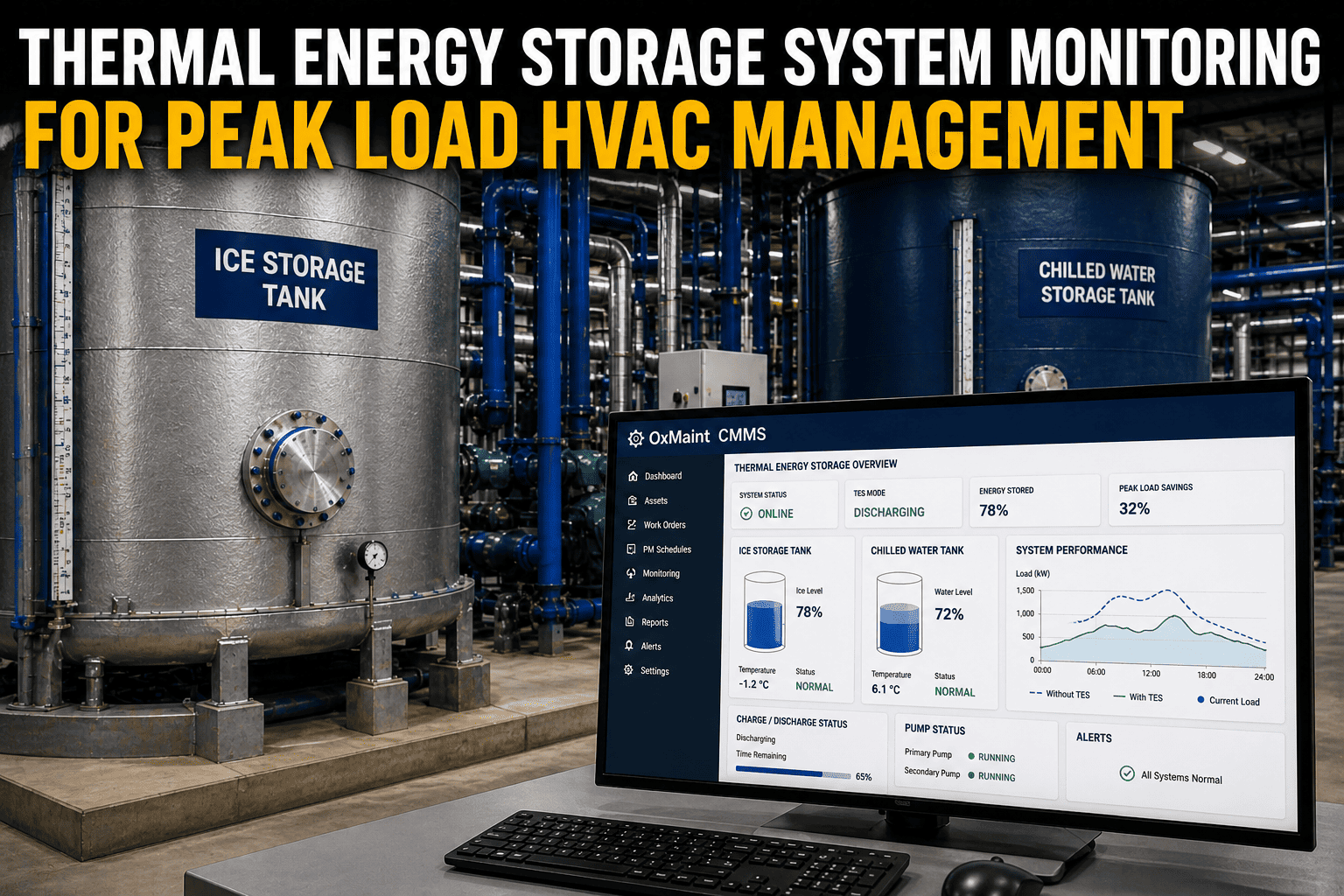
Oxmaint connects directly to the sensors and PLCs already monitoring tank level, temperature, and chiller condition, then ties that data to maintenance scheduling and dispatch performance reporting. Sign Up Free to start tracking your facility's dispatch curve with no hardware changes, or Book a Demo to see how it maps to your current charge/discharge schedule.
PLC & Sensor Integration
Real-Time Tank Data
Tank level, temperature, and chiller condition fed live
Real-time data flows directly into Oxmaint, giving facility teams live visibility into how much storage capacity is actually available for the next dispatch window.
Predictive Maintenance
Early Failure Detection
Chiller and tank trend analysis flags issues early
Trend analysis across vibration, temperature, and runtime data flags chiller or tank performance issues before they cut into usable storage capacity.
Preventive Maintenance Scheduling
Window-Aware PM
PM windows planned around charge/discharge cycles
PM tasks are scheduled around the dispatch plan instead of competing with it, so maintenance never lands during a planned peak discharge.
Analytics & Reporting
Per-Site Dashboards
Dispatch performance and asset health by site
Dispatch performance, peak-shaving impact, and asset health are tracked per site in one dashboard, so portfolio teams can compare and benchmark.
"
We assumed our thermal storage was doing its job because the tanks were full every morning. Once we connected the sensors through Oxmaint, we found the discharge was starting almost two hours after the actual peak window most days. Aligning PM and dispatch around the real load data cut our peak demand charge noticeably within the first billing cycle.
Facility Engineering Lead — Commercial Portfolio, USA
Frequently Asked Questions
What is a thermal storage dispatch strategy?
It's the plan for when a chilled water or ice storage system charges and discharges relative to the building's load and utility rate structure, so cooling demand shifts off the most expensive peak hours.
Why does dispatch timing matter for peak HVAC demand?
Dispatching even an hour off the actual peak window can mean the demand charge lands anyway, despite having a fully charged storage asset on site.
How does Oxmaint help track chiller and tank condition for dispatch?
Oxmaint connects to existing PLCs and sensors to pull real-time tank and chiller data, then layers predictive maintenance analysis on top to flag issues before they shrink usable capacity.
Can Oxmaint manage thermal storage maintenance across multiple sites?
Yes — Oxmaint tracks dispatch performance, asset health, and PM schedules independently per site, with a centralized dashboard for comparing performance across a portfolio.
How quickly can dispatch monitoring be set up in Oxmaint?
Most facilities connect existing sensors and PLC feeds and configure dispatch tracking within a day, with no hardware changes required.
Turn Thermal Storage Into a Measured Peak-Shaving Asset.
Oxmaint tracks tank charge, chiller condition, and dispatch timing per shift and per site — giving facility teams the visibility to plan dispatch around real demand.