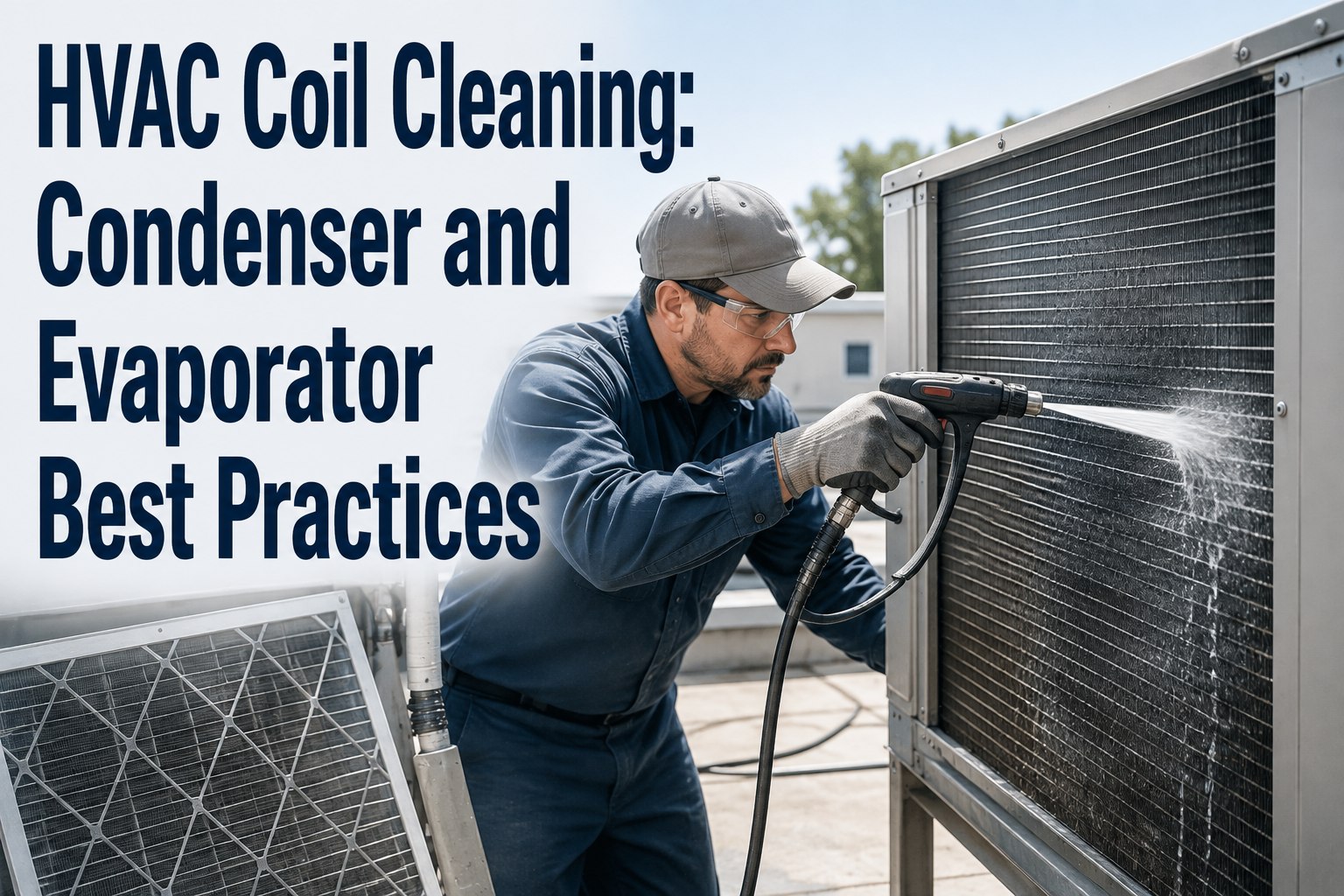
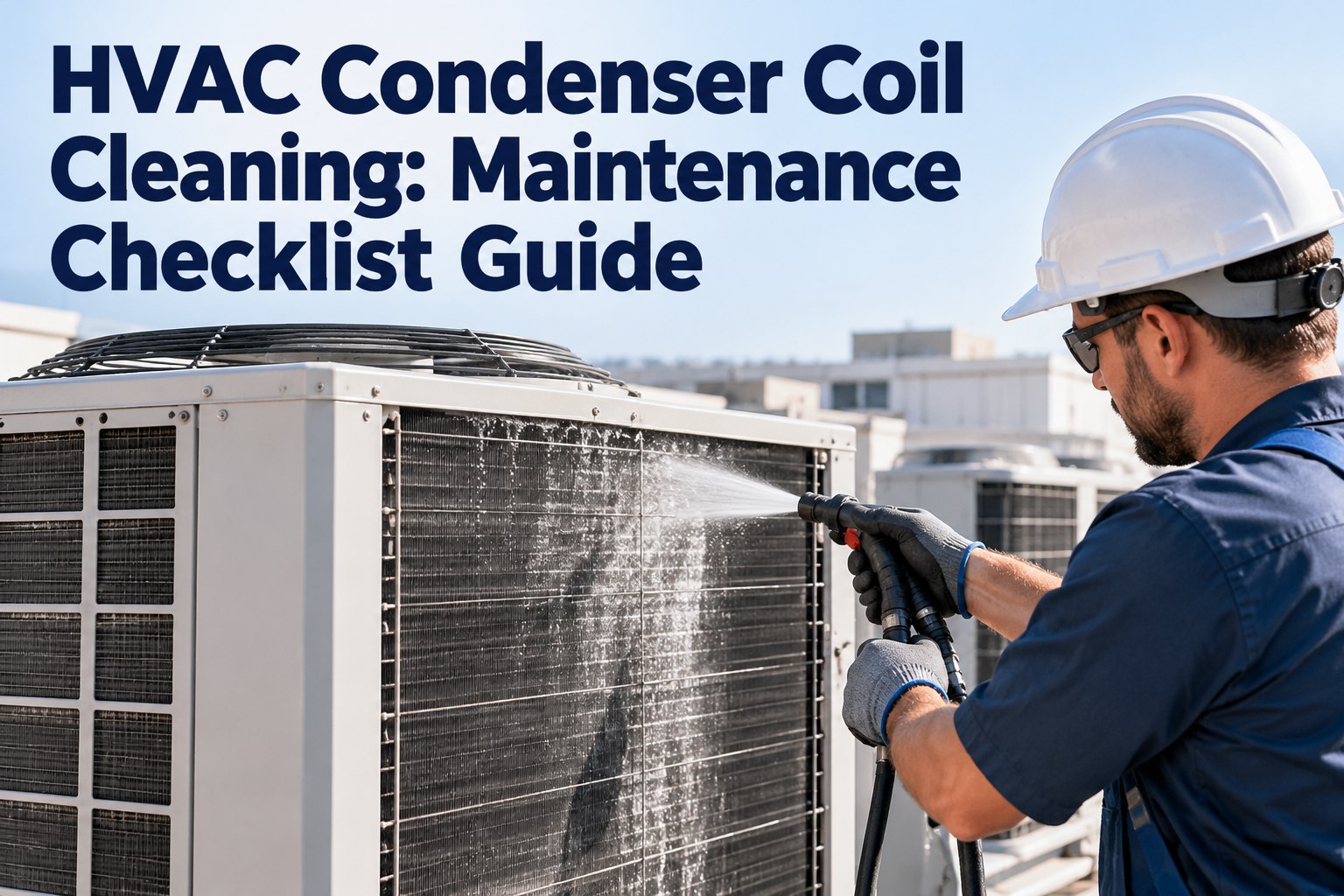
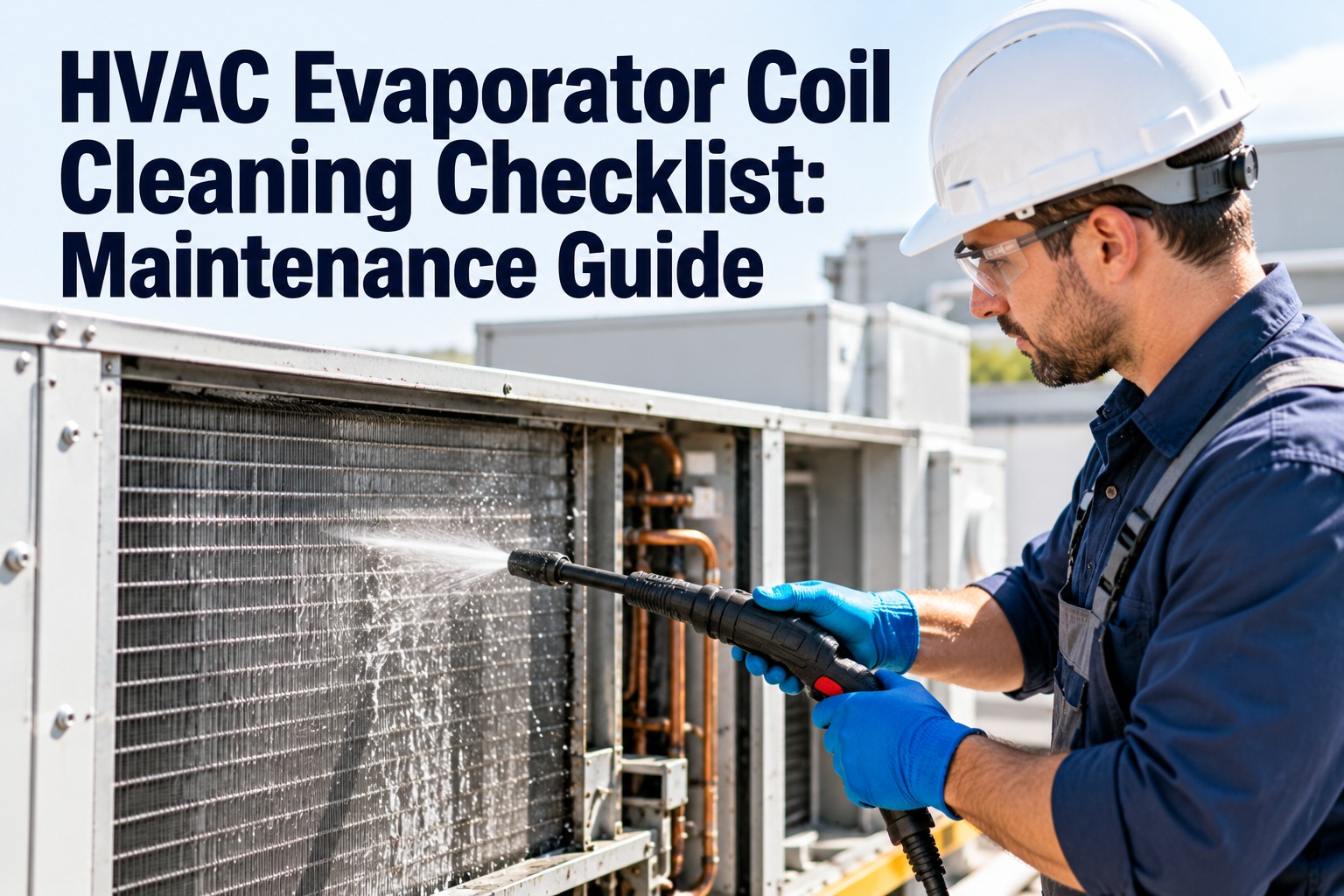
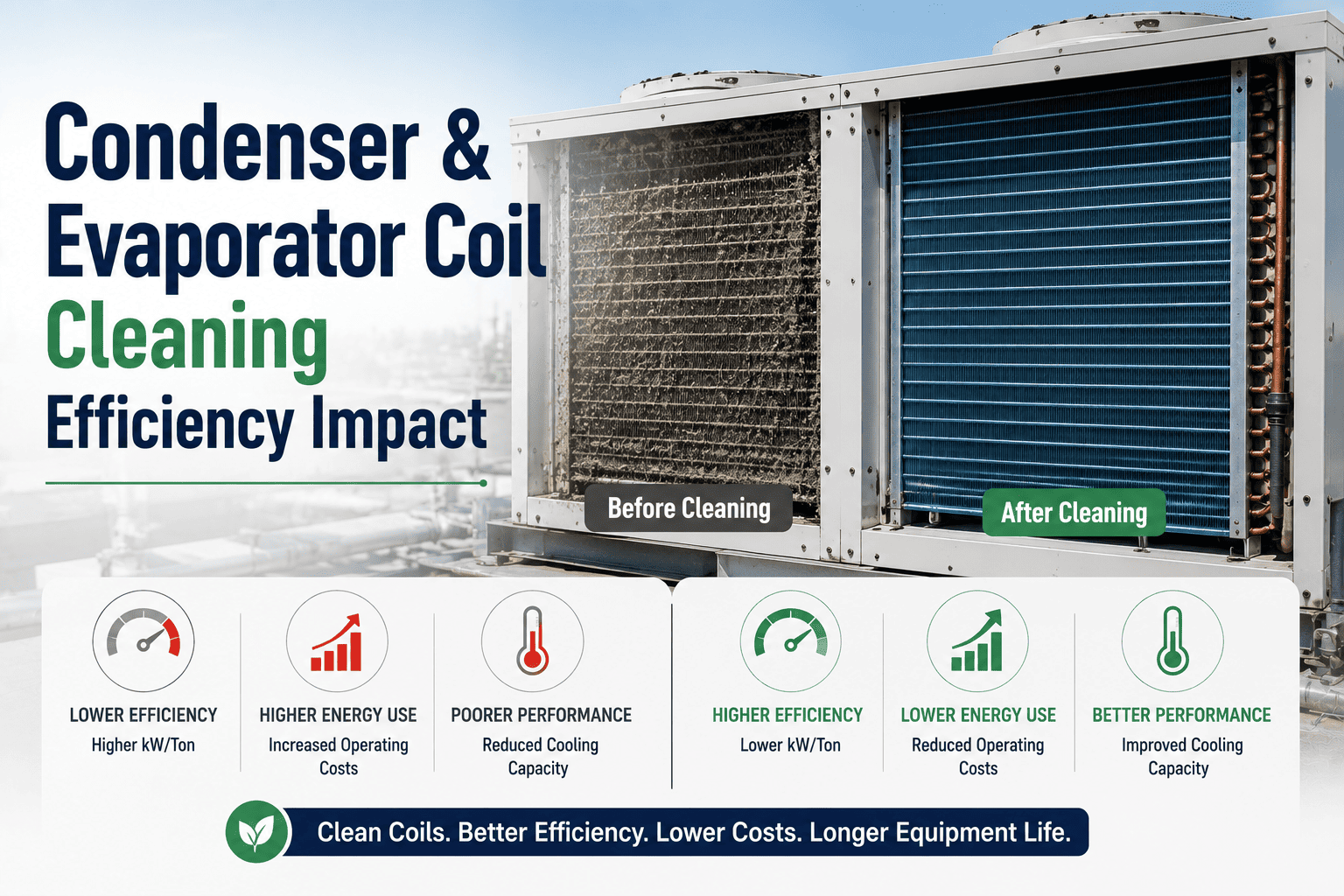
HVAC coil cleaning is one of the highest-ROI maintenance tasks a facility team can run, and one of the easiest to do wrong. ASHRAE research on commercial systems shows that a grime layer just 1/16-inch thick on a condenser coil can cut system efficiency by up to 21%, and the U.S. Department of Energy has documented compressor energy consumption climbing as much as 30% on a fouled condenser — a payback window measured in months on utility spend alone. The catch is that most of the damage on a botched cleaning happens the same day: a pressure washer bends the aluminum fins into a solid airflow wall, an acidic household cleaner starts a slow corrosion path on the copper tubing, or the technician skips lockout and takes a shock. This guide covers the condenser and evaporator procedures separately, the four cleaning-method families and when to pick each one, the seven-step field procedure top service teams actually run, the before-and-after measurement set that turns coil cleaning from routine housekeeping into a documented efficiency saver, and the CMMS structure that keeps the record defensible. Start free on OxMaint to load the coil-cleaning PM template, or book a demo to see before/after measurement capture on your fleet.
HVAC Coil Cleaning · Turn Housekeeping Into a Measured Efficiency Saver
Condenser + evaporator procedures · method selection · before/after capture.
21%
ASHRAE-documented efficiency loss from 1/16" grime layer on a condenser coil
Up to 30%
DOE-documented compressor energy consumption increase on a fouled condenser
1×–2× yr
Recommended cleaning cadence — annual baseline, twice per year in heavy-fouling environments
1–4 hr
Typical duration per unit — 1–2 hr residential, 2–4 hr commercial rooftop or air handler
Condenser vs Evaporator · Two Coils, Two Procedures, Two Chemistries
The single most common cleaning mistake is treating both coils the same. They sit at opposite ends of the refrigeration cycle, they collect different contamination, they live in different environments, and they respond to different cleaners. The comparison below is the field-standard split every service technician and every CMMS PM template should reflect.
Condenser Coil · Outdoor
LocationOutdoor unit — rooftop, ground-mount pad, or condenser bank
FunctionRejects heat absorbed by refrigerant into the outside air
Contamination typeDirt, pollen, cottonwood, leaves, exhaust particulate, algae — dry inorganic dominates
AccessStraightforward — unit exterior, top grille removed
Cleaner specFoaming cleaner (alkaline for organic buildup, mild acid-based for mineral scale — never household acid)
RinseLow-pressure water from the inside out (never pressure washer)
Primary hazardFin damage from over-pressure rinse; electrical exposure if power not isolated at disconnect
Evaporator Coil · Indoor
LocationIndoor air handler above furnace or in fan coil unit
FunctionAbsorbs heat from return air; condensate drips to pan and drain line
Contamination typeDust bound to condensate moisture; microbial biofilm; mold on chronically wet surfaces
AccessRestricted — requires opening the air handler, sometimes cutting an access panel
Cleaner specNo-rinse foaming cleaner (condensate flushes residue) + antimicrobial biocide for mold/bacteria
RinseNo-rinse product — condensate carries residue to pan and drain line during next run
Primary hazardRefrigerant leak if lines disturbed; EPA 608 required for any charge work; condensate drain overflow
Cleaning Method Selection · The Four Families and When to Use Each
There are four cleaning-method families, and they aren't interchangeable. Pick the wrong one and you either leave contamination behind or damage the coil worse than the fouling did. The card grid below is the decision every technician should walk before opening a chemical or plugging in a hose.
Method 01
Foaming Chemical Cleaner
Best for Vertical coils; heavy organic buildup; hard-to-reach fin depth. Foam expands into fin passages and clings during dwell.
Chemistry Alkaline for organic; mild acid for mineral scale. HVAC-formulated only.
Don't use with Any household acid, bleach, or unformulated cleaner — corrodes aluminum & copper.
Method 02
Liquid Spray Cleaner
Best for Horizontal or downward-facing coils where drainage is easy; lighter contamination refresh cleaning.
Chemistry Same alkaline/acid split as foam — spray provides different application, not different chemistry.
Don't use with Vertical coils with light foam requirement — liquid runs off before dwell.
Method 03
Mechanical — Fin Comb + Soft Brush + Vacuum
Best for Large-debris removal (leaves, cottonwood, paper), bent-fin repair, dry-only pre-cleaning before chemistry.
Tools Fin comb sized to fin density (12–16 FPI typical); soft nylon brush; HEPA vacuum.
Don't use with Wire brushes or metal scrapers — permanent fin and coating damage.
Method 04
Low-Pressure Water Rinse
Best for Condenser final rinse post-chemistry. Standard garden hose with adjustable nozzle at moderate pressure.
Direction Always inside-out — push debris out the way it entered, not deeper into the fin pack.
Don't use with Pressure washers of any spec — bends fins permanently. Never on evaporator (drainage risk).
The Seven-Step Field Procedure · What a Clean Run Actually Looks Like
Every credible HVAC coil cleaning follows the same seven-step sequence. The order matters — skipping the pre-inspection or the fin-straightening step is how a cleaning ends up costing more than the fouling did.
01
Pre-Inspection
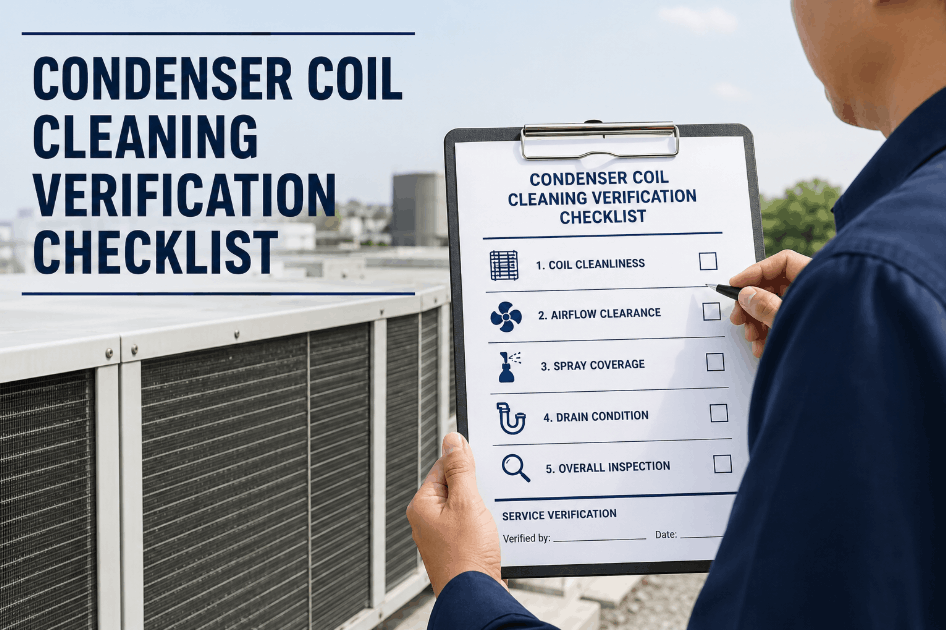
Photograph the coil face, note fouling type (dry inorganic, biofilm, mineral), inspect for bent fins, and log baseline superheat / subcool / delta-T readings for after-comparison.
02
LOTO — Electrical Isolation
Disconnect power at the outdoor disconnect and the breaker; verify zero voltage. For evaporator work also isolate the air handler power and condensate pump.
03
Debris Removal (Mechanical)
Remove large debris by hand or HEPA vacuum before any chemistry — cottonwood, leaves, paper trapped in the grille. Cover electrical components with plastic sheeting.
04
Chemical Application
Apply foaming cleaner top-down, working across the coil face. Use HVAC-formulated chemistry only — alkaline for organic, mild acid for mineral. Never household or unmarked cleaners.
05
Dwell Time (5–20 min)
Allow the cleaner to penetrate and lift contaminants per product label. Longer dwell for heavier fouling; too-short dwell leaves residue that returns as scale.
06
Rinse or No-Rinse
Condenser: low-pressure water inside-out until effluent runs clear. Evaporator: no-rinse formulation lets next run's condensate carry residue to the drain — verify drain pan and line first.
07
Fin Repair & Post-Verification
Straighten bent fins with matched fin comb (12–16 FPI). Re-energize, run 15–20 min, and capture post-cleaning superheat / subcool / delta-T / amperage. Log the delta on the WO.
Never do
Five field-standard don'ts. Never use a pressure washer of any spec — the fins bend and become a solid airflow wall, permanently. Never use bleach or household acid — corrodes aluminum fins and copper tubing, refrigerant leaks follow. Never mix the wrong chemistry (acid on unprotected aluminum, alkaline on light mineral scale). Never skip LOTO — the disconnect is not the same as the breaker; verify both. Never leave bent fins unrepaired — the airflow restriction from a bent fin block undoes the efficiency gain from every hour of cleaning.
Before & After Measurement · The Data That Turns Cleaning Into a Documented Saver
A coil cleaning without measurement is housekeeping. A coil cleaning with baseline and post-verification is a documented efficiency saver with hard numbers on the work order. The six measurements below are the ones every mature service program captures on the same PM record, and the ones an owner will pay attention to when the annual budget line is under review.
| Measurement | Where Taken | Typical Improvement Post-Cleaning |
|---|
| Superheat | Suction line at outdoor unit | Moves toward manufacturer target — dirty evaporator runs high |
| Subcool | Liquid line at condenser | Moves toward target — dirty condenser runs high |
| Delta-T (return vs supply) | Return & supply plenums | Widens to design range (typ. 18–22°F on residential) |
| Static pressure differential | Across the evaporator coil | Drops as airflow restriction clears |
| Compressor amperage | Compressor common terminal | Drops as head pressure relaxes — direct energy savings |
| Discharge / suction pressure | Refrigeration manifold | Discharge falls, suction rises toward design — cycle rebalances |
Load the HVAC Coil-Cleaning PM Template on OxMaint — Free Forever
Sign up on OxMaint's free forever plan and load the 7-step field procedure as a mobile PM template. Baseline readings capture in step 1, post-cleaning readings capture in step 7, and the efficiency delta appears on every completed work order. No card, no time limit.
Cleaning Cadence · When Fouling Assessment Beats the Calendar
Annual cleaning is the field-standard baseline, but the right cadence depends on the environment the coil lives in. The cadence guidance below is the framework mature programs use to move from calendar-driven to condition-driven cleaning intervals.
Baseline
Annual · Pre-Cooling-Season
Standard commercial and residential rooftops in typical urban / suburban environments. Best window: 4–6 weeks before peak cooling load.
Heavy fouling
Twice Per Year
Coastal air (salt), industrial exhaust, cottonwood zones, restaurants (grease-laden exhaust), pollen-heavy locations. Add mid-season cleaning.
Condition-based
Static-Pressure or Delta-T Trigger
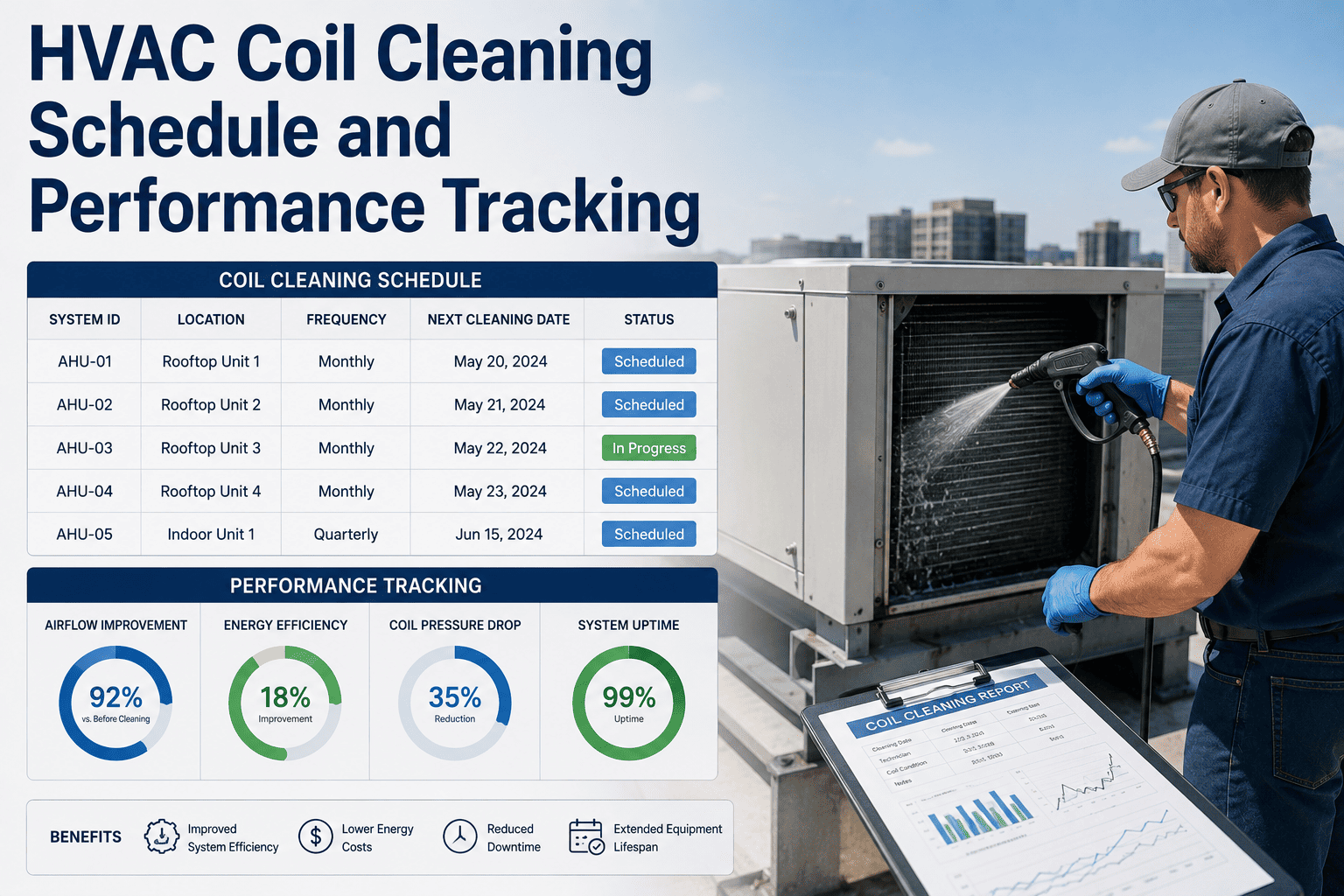
Instrument the unit — auto-trigger a cleaning WO when static pressure across the evaporator or compressor amperage crosses a threshold vs baseline.
How OxMaint Runs the Full HVAC Coil-Cleaning Program
The condenser and evaporator procedures, the four cleaning methods, the seven-step field sequence, and the before/after measurement set all run on one CMMS — mobile PM templates on the phone, baseline and post readings captured with photos, sensor triggers for condition-based cleaning cycles, and an efficiency-delta report per asset that shows the program's contribution to utility spend.
Template
7-Step Mobile PM Per Coil Type
Separate templates for condenser (outdoor, rinse-and-restore) and evaporator (indoor, no-rinse + biocide + drain-line flush) — with mandatory outcomes at each step.
Capture
Baseline & Post Readings
Superheat, subcool, delta-T, static pressure, amperage, discharge/suction pressures captured with photos on the phone. Delta calculated automatically on the WO.
Safety
Digital LOTO Sign-Off
Lockout/tagout step required with e-signature and photo before chemical application — the auditor's expected control on any energized-work PM.
Trigger
Calendar + Condition-Based
Annual calendar trigger by default; sensor-based auto-trigger on static-pressure or amperage excursion for condition-driven cadence on instrumented units.
Trend
Efficiency Delta by Asset
Delta between baseline and post readings tracked per unit across cleaning cycles — the trend is the program's ROI evidence to facilities and finance.
Prove
Photo-Attached PM Record
Every completed PM carries the pre and post photos, the reading deltas, the chemical used, and the technician e-signature — export-ready for owner review or third-party audit.
Turn Coil Cleaning Into a Line Item That Pays for Itself
Free forever plan — no card, no time limit. Load the 7-step template, capture baseline and post readings on every WO, and the efficiency delta per asset builds the ROI case in the background. Or book 30 minutes and we'll walk your rooftop or air-handler fleet end-to-end on the platform.
Frequently Asked Questions
How much efficiency does a dirty coil actually cost?
ASHRAE research on commercial systems shows a grime layer just 1/16-inch thick on a condenser coil can cut system efficiency by up to 21%. The U.S. Department of Energy has separately documented compressor energy consumption climbing as much as 30% on a heavily fouled condenser. The utility-spend payback on a properly-executed cleaning cycle is typically measured in months on commercial rooftops running 8+ months a year, and the equipment-life extension is meaningful on top of that.
Why can't you clean condenser and evaporator coils the same way?
They sit at opposite ends of the refrigeration cycle, they collect different contamination, and they respond to different chemistries. The condenser is outdoors — dry inorganic fouling like dirt, pollen, cottonwood, exhaust particulate — and can be rinsed with low-pressure water from the inside out. The evaporator is indoors, wet from condensate, and grows biofilm and mold as often as dust — so it needs a no-rinse foam plus antimicrobial biocide, with the condensate itself flushing residue during the next run. Rinsing an evaporator with a hose is a drain-pan overflow waiting to happen.
Can a pressure washer be used on a condenser coil?
No. The aluminum fins that carry the airflow are thin and bend permanently under pressure-washer flow — the result is a solid airflow wall that costs more efficiency than the fouling you removed. Field standard is a garden hose with an adjustable nozzle at moderate pressure, sprayed from the inside out so debris exits the way it entered. Bent fins that do occur get straightened with a matched fin comb (12–16 fins per inch typical) as step 7 of the procedure.
What baseline and post-cleaning measurements should get captured on the work order?
Six readings turn a cleaning into a documented efficiency saver: superheat at the suction line, subcool at the liquid line, delta-T between return and supply air, static pressure across the evaporator, compressor amperage at the common terminal, and discharge/suction pressures at the manifold. Capture all six before starting and again after the unit runs 15–20 minutes post-cleaning. The delta on each reading is the ROI evidence — and it goes on the work order alongside the pre/post photos.
Book a demo to see the capture flow in the mobile PM.
How often should HVAC coils be cleaned?
Annually as the baseline, ideally 4–6 weeks before peak cooling season. Twice per year in heavy-fouling environments — coastal (salt), industrial exhaust zones, cottonwood-heavy areas, restaurants with grease-laden exhaust nearby, and high-pollen locations. The most defensible cadence on instrumented equipment is condition-based: auto-trigger the cleaning work order when static pressure across the evaporator or compressor amperage crosses a threshold versus the last cleaning's post-baseline.
Sign up free to configure both cadences on OxMaint.