HVAC Maintenance KPIs and Metrics | Measure Performance & Efficiency
By Riley Quinn on February 6, 2026
Last Tuesday, building 4's rooftop unit failed at 2:17 PM. The compressor had been drawing 18% more amperage than rated for six weeks. Nobody noticed because nobody was measuring. By the time tenants started calling about the heat, the repair estimate was $9,200—plus a three-day wait for the replacement compressor. The real cost? Twenty-two tenant complaints, one lease non-renewal, and a facilities manager who had to explain to ownership why a $340 filter change could have prevented the whole thing. This is what happens when HVAC maintenance runs on instinct instead of data. The right KPIs would have flagged that compressor six weeks ago—when the fix was a filter swap, not a capital expense.
The Numbers Behind HVAC Maintenance Performance
40%
Of total building energy consumed by HVAC—the single largest operating expense
70%
Fewer breakdowns when facilities shift from reactive to predictive maintenance
50%
Lower total maintenance costs with a planned PM program vs. reactive approach
545%
Return on investment documented in preventive HVAC maintenance studies
Sources: U.S. DOE, Jones Lang LaSalle, Energy and Buildings Journal, Es-Sakali et al. (2022)
HVAC systems don't catastrophically fail overnight—they degrade invisibly. A compressor losing 2% efficiency per month won't trigger any alarms, but over a year that's a 24% increase in energy costs for the same cooling output. A clogged coil won't shut down your system, but it forces the compressor to work harder, drawing more power and shortening its life every hour it runs. Without KPIs, these slow-burn problems compound silently until they become emergencies. The U.S. Department of Energy estimates that proper operations and maintenance practices alone deliver 5-20% annual energy savings. Research from the Pacific Partners Consulting Group quantified something even more compelling: every $1 of deferred maintenance eventually becomes $4 in capital renewal costs. Facilities that start tracking HVAC performance through a digital maintenance platform catch these trends in weeks instead of discovering them during catastrophic failures months later.
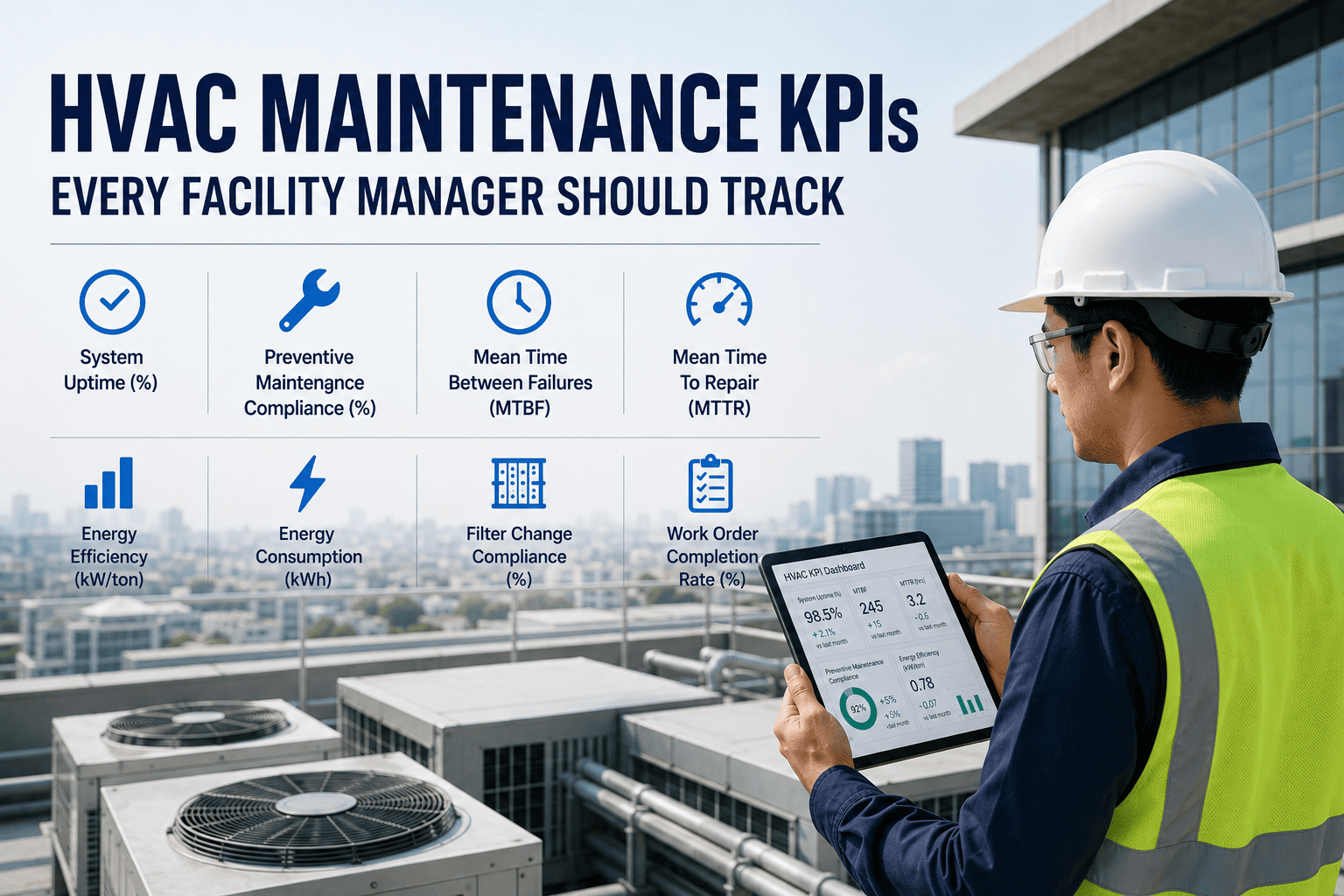
The 8 HVAC KPIs That Separate Top Facilities from the Rest
Each metric answers a critical question about your HVAC maintenance program
01
Mean Time Between Failures (MTBF)
How reliable is my HVAC equipment?
Total Operating Hours ÷ Number of Failures
MTBF measures average run time between breakdowns. Condition-based maintenance increases HVAC MTBF by 90-175 hours. Higher numbers mean more reliable equipment and fewer surprise failures disrupting occupant comfort.
Benchmark
Continuously improving vs. your baseline
02
Mean Time to Repair (MTTR)
How fast does my team resolve HVAC failures?
Total Repair Time ÷ Number of Repairs
MTTR includes diagnosis, parts sourcing, repair, and testing. Leading facilities target 1-5 hours for routine HVAC repairs. One case showed MTTR dropping from 580 to 60 hours/month after CMMS implementation—a 90% reduction.
Benchmark
1-5 hrs for routine repairs
03
PM Compliance Rate
Are we completing scheduled maintenance on time?
(Completed PM Tasks ÷ Scheduled PM Tasks) × 100
Industry best practices target 70-80% preventive with only 20-30% reactive. Facilities hitting 80%+ planned ratios experience 40-50% lower total maintenance costs per square foot. Every $1 of deferred maintenance becomes $4 in capital costs.
Benchmark
90%+ on-time completion
04
Equipment Uptime / Downtime
What percentage of time is my HVAC actually running?
(Total Uptime ÷ Total Scheduled Time) × 100
Industry benchmarks target 95-98% uptime for essential HVAC systems. Emergency repairs cost 50-100% more than standard calls. Tracking downtime by asset reveals which units drain the most resources and need replacement.
Benchmark
95-98% uptime
05
Maintenance Cost per Asset
Which units are money pits—and which earn their keep?
Total Maintenance Spend ÷ Number of HVAC Units
IFMA data shows median facility maintenance costs range from $2.50-$5.59 per square foot. Tracking cost per individual HVAC asset identifies outliers and drives repair-vs-replace decisions with data instead of gut instinct.
Benchmark
Trending down YoY
06
Energy Efficiency (EER / COP)
Is my HVAC converting energy efficiently—or wasting it?
Cooling Output (BTU/h) ÷ Power Input (Watts)
Post-maintenance HVAC systems deliver 10-46% more airflow with 41-60% reduced energy consumption. Regular filter changes alone cut monthly utility bills 5-15%. NIST research found improper maintenance increases HVAC energy use by 30%+.
Benchmark
COP 3.3-4.0 for high-efficiency
07
Work Order Completion Rate
Are maintenance tasks getting done within planned windows?
(Completed Work Orders ÷ Total Work Orders) × 100
Leading organizations achieve 24-48 hour resolution for routine HVAC requests. A growing work order backlog signals understaffing, parts shortages, or process bottlenecks that need immediate attention.
Benchmark
95%+ on-time completion
08
Repeat Failure Rate
Are we fixing the root cause—or just patching symptoms?
(Recurring Failures on Same Asset ÷ Total Failures) × 100
High repeat failure rates signal inadequate diagnostics, wrong parts, or undertrained technicians. Tracking by asset and technician reveals whether the problem is the equipment or the repair quality.
Benchmark
Below 10%
How Your Maintenance Strategy Directly Impacts Every KPI
The numbers don't lie: the maintenance strategy you follow determines the performance you get. Reactive maintenance—the "run it till it breaks" approach—produces the worst metrics across every single KPI. The Department of Energy's data is unambiguous: running equipment to failure costs 3-10 times more than maintaining it properly. Preventive maintenance improves the picture significantly, but predictive maintenance—using real-time data to repair at the optimal moment—delivers the best results across the board. Research published in Energy Reports documented 70-75% reduction in breakdowns and 35-45% decrease in breakdown duration with predictive HVAC maintenance. For facilities considering the shift to data-driven maintenance, a 30-minute walkthrough shows exactly how KPI tracking works in practice.
Maintenance Strategy Impact on HVAC KPIs
Swipe to see full comparison
KPI
Reactive
Preventive
Predictive
MTBF
Low — frequent failures
Improved — scheduled care
Highest — +90-175 hrs gain
MTTR
Longest — emergency scrambles
Moderate — parts ready
Shortest — planned repairs
Uptime
85-90% — uncontrolled
95-97% — managed
98%+ — optimized
Cost / Repair
50-100% premium
Standard rates
Lowest — right-time repair
Energy Efficiency
Degrades unchecked
Maintained at intervals
Continuously optimized
Equipment Life
Shortened 30-50%
Standard lifecycle
Extended 20-40%
3-10xRun-to-failure costs vs. planned maintenance (U.S. DOE)
$5Returned for every $1 spent on preventive maintenance
The CMMS Advantage: From Spreadsheet Guesswork to Real-Time Intelligence
Here's the uncomfortable truth about manual KPI tracking: it doesn't work. Spreadsheet-based maintenance tracking requires hours of manual data entry, creates lag between events and visibility, and almost always gets abandoned within three months. A CMMS automates the entire chain—every work order logged automatically feeds MTTR calculations, every completed preventive task updates PM compliance rates, and every part and labor cost entry adjusts maintenance cost per asset in real time.
How a CMMS Turns Daily Maintenance into Measurable KPIs
Every work order becomes a data point. Every data point becomes a decision.
Issue Reported
Work order auto-created with timestamp and asset ID
Tech Dispatched
Skill-matched, push notification sent
Repair Completed
Time, parts, labor cost auto-logged
KPIs Updated
MTBF, MTTR, costs refreshed instantly
Smarter Decisions
Real-time dashboards drive action
The real power of a CMMS isn't just tracking—it's the speed of insight. When PM compliance drops below 90%, you see it this week, not at end-of-quarter review. When a specific unit's repair costs trend toward replacement value, the system flags it automatically. Facilities that centralize their HVAC maintenance data in a single platform eliminate the months-long delay between problem and awareness that defines reactive management.
See Your HVAC KPIs in Real Time
Watch how automated dashboards track MTBF, MTTR, PM compliance, and maintenance costs from every work order—no spreadsheets required.
Expert Review: The Shift from Reactive Fire Drills to Data-Driven Reliability
The difference between a facility that constantly fights HVAC emergencies and one that runs smoothly isn't budget—it's measurement. KPIs like MTBF, MTTR, and PM compliance aren't abstract metrics. They're early warning systems. When MTBF starts declining on a chiller, that's a signal to investigate before the failure becomes an emergency. When PM compliance slips below 90%, that's a staffing or scheduling problem you can solve proactively. The organizations consistently achieving 95-98% HVAC uptime treat maintenance as a data discipline, not a reactive scramble. Preventive maintenance programs return $5 for every $1 invested—but only when they're measured, tracked, and continuously improved.
Measurement Creates Accountability
When technicians know MTTR is tracked, repair efficiency improves naturally. Data drives a culture of continuous improvement without micromanagement.
KPIs Justify Capital Decisions
Showing that a unit's annual maintenance cost exceeds 50% of replacement value—with documented data—gets capital budgets approved faster than anecdotes.
Benchmarking Exposes Hidden Waste
Comparing KPIs across similar HVAC assets reveals outliers. One unit consuming 30% more energy than its twin is a maintenance issue you can fix—if you're tracking it.
The shift from reactive to KPI-driven maintenance doesn't require tearing out your existing systems. It starts with identifying critical assets, establishing baselines, and connecting your daily workflow to a platform that calculates performance automatically. Facilities that begin automated HVAC maintenance tracking typically establish actionable baselines within 30-60 days—and start making measurably better decisions immediately.
Your 90-Day HVAC KPI Implementation Roadmap
You don't need to track every metric from day one—and trying to will guarantee failure. Start with the five KPIs that have the highest impact on your specific operation, build baselines over 60-90 days, and expand from there. Facilities that want expert guidance setting up their framework can book a free consultation to discuss which metrics matter most for their portfolio.
From Zero to KPI-Driven in 90 Days
01
Days 1-30 — Foundation
Catalog every HVAC asset—model, age, criticality rating, location
Set up CMMS with asset hierarchy and PM schedules
Log every work order—reactive and preventive—with timestamps
Establish initial MTBF and MTTR baselines for critical units
Monitor maintenance cost per asset to identify outliers
Flag repeat failures and record energy consumption baselines
Calculate preventive-to-reactive maintenance ratio
03
Days 61-90 — Optimization
Analyze 60-day trends and adjust PM frequencies based on KPI data
Flag assets where repair costs approach 50% of replacement value
Set formal KPI targets based on baseline performance data
Share dashboard reports with leadership to justify budgets
Stop Guessing. Start Measuring.
Join facility teams using OXmaint to automatically track every HVAC maintenance KPI, reduce unplanned downtime, and turn maintenance data into measurable cost savings.
What is the single most important HVAC maintenance KPI to start tracking?
Start with Mean Time Between Failures (MTBF) for your most critical HVAC assets. MTBF directly measures reliability—the foundation every other maintenance decision builds on. If you know how frequently your equipment fails, you can build PM schedules around actual performance rather than generic manufacturer recommendations. Research shows condition-based maintenance increases HVAC MTBF by 90-175 hours. Once you have MTBF baselines, add MTTR and PM compliance rate to complete the core performance picture.
What PM compliance rate should my facility target for HVAC systems?
Industry best practice is 90% or higher—meaning at least 9 out of 10 scheduled preventive maintenance tasks are completed within their planned window. Facilities consistently below 80% typically see significantly higher emergency repair rates and shorter equipment lifecycles. The financial impact is stark: the Pacific Partners Consulting Group found that every $1 of deferred maintenance eventually costs $4 in capital renewal. Facilities achieving 80%+ planned maintenance ratios experience 40-50% lower total maintenance costs per square foot.
How does tracking energy efficiency KPIs reduce HVAC operating costs?
HVAC systems consume approximately 34-40% of total energy in commercial buildings—the single largest operating expense. Energy metrics like EER and COP help you spot performance degradation before it becomes a major cost driver. Well-maintained systems achieve 5-15% utility bill reductions through regular filter changes alone, and post-cleaning HVAC systems deliver 10-46% more airflow with 41-60% reduced energy consumption for fans and blowers. NIST Technical Note 1848 found that improper maintenance increases HVAC energy use by 30% or more.
How quickly can I expect ROI from HVAC KPI tracking?
Most facilities see measurable improvements within 60-90 days of consistent KPI tracking through a CMMS. The initial value comes from establishing baselines that reveal hidden problems—an HVAC unit with abnormally high failure frequency, a PM schedule being routinely missed, or energy patterns indicating degradation. Financial ROI typically materializes within 6-12 months through reduced emergency repairs, lower energy costs, and extended equipment lifecycles. Industry research shows mature PM programs deliver 300-500% annual returns.
Can a CMMS automatically calculate all these HVAC maintenance KPIs?
Yes. Modern CMMS platforms like OXmaint automatically calculate KPIs from the maintenance data your team already generates through daily work orders. Every repair logged updates MTTR. Every completed preventive task feeds PM compliance rates. Every part and labor cost entry refreshes maintenance cost per asset. This eliminates manual spreadsheet tracking entirely and delivers real-time dashboards showing current performance against targets—turning KPI-driven decisions into a daily workflow rather than a quarterly reporting exercise that's always out of date.