How to Build an HVAC Preventive Maintenance Program (Step-by-Step + Free Template)

By James smith on April 14, 2026

hvac-preventive-maintenance-program-step-by-step-guide

90% of facility managers believe in preventive maintenance — but only 26% are actually practicing it. The gap is not knowledge, it is structure. Organisations without a documented HVAC PM programme spend up to 3–5× more on reactive repairs, experience 70% more system failures, and miss the 545% ROI that structured preventive maintenance reliably delivers. This guide gives you the step-by-step framework to close that gap — and a free template to deploy it immediately. Start free on OxMaint to digitalise your HVAC PM programme, or book a demo to see AI-powered PM optimisation in action.

Blog + Free Template / HVAC PM

How to Build an HVAC Preventive Maintenance Program (Step-by-Step + Free Template)

A proven six-step framework used by facility teams managing 10 to 10,000 HVAC assets — covering asset inventory, PM scheduling, CMMS setup, and AI-based optimisation. Includes a free downloadable PM template.

Live OxMaint Alert Feed
!
AHU-12: High discharge temp 84°F
2 min ago — P1 work order auto-created
~
Chiller-3: Compressor RLA trending up 8%
7 min ago — AI anomaly flagged
+
RTU-07: PM completed on schedule
14 min ago — filter replaced, belt checked
~
Cooling Tower CT-1: Basin temp +3°C
21 min ago — inspection triggered

Why Most HVAC PM Programs Fail Before They Start

74%
of HVAC failures are preventable with scheduled maintenance
3–5×
higher cost of reactive vs. planned HVAC repair
545%
documented ROI from structured preventive maintenance programs
5–20%
annual energy savings from proper HVAC operations and maintenance

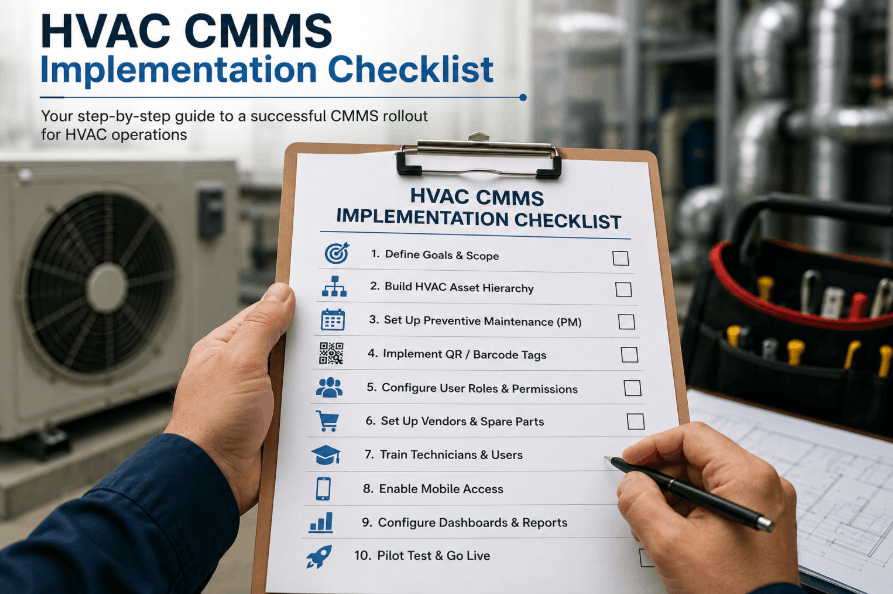
The three most common failure modes are: no formal asset register (teams cannot PM what they have not inventoried), no defined PM scope (every technician maintains differently), and no tracking system (completed PMs are indistinguishable from skipped ones). The six steps below address each failure mode in sequence.

Step-by-Step: Building Your HVAC PM Program

01
Asset Inventory — Know Everything You Maintain
Create a complete register of every HVAC asset: RTUs, AHUs, chillers, cooling towers, FCUs, VAV boxes, exhaust fans. Capture model, serial number, refrigerant type, capacity, age, location, and criticality rating. Without this foundation, every subsequent step is built on guesswork. OxMaint's asset import tool populates your register from nameplate data captured via mobile camera in the field.
Chillers AHUs RTUs Cooling Towers FCUs VAV Boxes
02
Criticality Classification — Not All HVAC Is Equal
Assign every asset a criticality tier (P1–P3) based on failure consequence. A chiller serving a data hall is P1 — failure costs six figures within hours. An exhaust fan in a storage room is P3 — failure is inconvenient, not critical. PM frequency, monitoring intensity, and spare parts strategy all derive from this classification. Misclassification is the most common cause of over-spending on low-risk assets and under-protecting high-risk ones.
03
Define PM Tasks and Frequencies
Map specific PM tasks to each asset class with defined frequencies. Daily, weekly, monthly, quarterly, and annual tasks must be explicitly scoped — not left to technician discretion. Every task should specify what to check, what measurement to record, what the acceptance criterion is, and what action to take if the criterion is not met. A PM checklist without acceptance criteria is an inspection without accountability.
04
Configure CMMS Scheduling and Work Orders
Deploy your PM programme in a CMMS so work orders generate automatically at the correct interval, route to the correct technician, and cannot be closed without capturing mandatory completion data. OxMaint generates PM work orders from the schedule, delivers them to the mobile app, and enforces data entry before closure — creating a complete maintenance record automatically.
05
Establish Performance Baselines
Record baseline condition measurements for every critical asset during the first PM cycle: chiller COP, AHU filter differential pressure, RTU compressor RLA, cooling tower approach temperature. These baselines are the reference against which future readings are compared — the mechanism that turns PM data into predictive intelligence over time.
06
Enable AI Optimisation and Continuous Improvement
Once 3–6 months of PM data has accumulated, AI can identify which assets are failing between PM cycles (PM frequency too low), which are being serviced with no findings ever recorded (PM frequency too high), and which assets show developing trends. OxMaint AI adjusts PM intervals dynamically based on actual condition data — moving from fixed-schedule PM to condition-optimised PM without requiring manual analysis.

Before vs. After: What a Structured PM Program Delivers

Emergency Callouts / Month
Before PM
18.4/mo
After PM
4.9/mo
Annual Maintenance Cost ($K)
Before PM
$340K
After PM
$158K
HVAC Energy Usage (%)
Before PM
Baseline 100%
After PM
82% — 18% saved
PM Completion Rate (%)
Before PM
26%
After PM
96%

Free HVAC PM Template — Key Task Framework

Asset Class Monthly Tasks Quarterly Tasks Annual Tasks Key Measurement
Chiller Refrigerant pressure check, oil level, vibration observation Condenser coil cleaning, water treatment test, bearing inspection Full refrigerant circuit test, tube cleaning, controls calibration COP vs. rated, approach temp
AHU Filter check, drain pan inspection, belt tension Coil cleaning, damper lubrication, duct static check Full coil deep clean, bearing replacement (condition-based), controls test Filter delta-P, supply air temp
RTU Filter replacement, condenser coil visual, drain check Refrigerant charge, electrical tightening, capacitor check Coil deep clean, compressor RLA, belt/bearing full check Compressor RLA vs. nameplate
Cooling Tower Basin level, water treatment, drift eliminator check Fill media inspection, fan blade angle check, motor vibration Basin clean, fill media replacement (condition), gearbox oil change Approach temp, cycles of concentration
FCU / PTAC Filter clean/replace, drain pan check, thermostat test Coil cleaning, fan motor check, refrigerant visual Full strip-down clean, controls calibration, refrigerant check Discharge air temp delta

Deploy This PM Program in OxMaint Today — Free to Start

Pre-built HVAC PM templates for every asset class. Auto-scheduled work orders. AI interval optimisation. Mobile completion from the field. No implementation consultant required.

Live KPI Dashboard — What OxMaint Shows Your Team

94.2%
OEE — HVAC Systems
+6.1% vs last quarter
2.4 hrs
Avg MTTR This Month
Down from 6.8 hrs reactive
847 hrs
MTBF — Critical HVAC
Up from 412 hrs pre-PM
7
Open Work Orders
3 P1 · 2 P2 · 2 P3
96%
PM Completion Rate
Industry avg: 58%
$48K
Cost Avoidance This Month
4 faults caught before failure
"
The most common mistake I see when facility teams try to build HVAC PM programs is starting with the schedule instead of the asset register. You cannot plan maintenance for assets you have not counted. I have audited buildings where the maintenance log referenced equipment that had been replaced three years ago, and new units were being run to failure because no one had added them to the programme. Step one is always the asset register — verified in the field, not assembled from memory or outdated drawings. Once you have an accurate register, everything else follows naturally: the criticality classification tells you the PM frequency, the PM frequency tells you the CMMS configuration, and the CMMS data eventually feeds your AI optimisation. Without step one, steps two through six are expensive guesswork.

Karen Ashby, CPMM, LEED AP
Certified Plant Maintenance Manager · LEED Accredited Professional · 24 years commercial HVAC operations and FM · Former VP Engineering, multi-site healthcare portfolio · Specialist in HVAC PM programme design, CMMS implementation, and AI-based maintenance optimisation

Frequently Asked Questions

How long does it take to build and deploy an HVAC PM programme from scratch?
Most facility teams complete the asset register and initial PM schedule configuration within 30–60 days of starting — the major time investment is field verification of the asset register, not the CMMS setup. OxMaint's mobile asset import tool (QR scan + photo capture of nameplate data) reduces field time significantly. A 50-building HVAC portfolio typically reaches full PM coverage within 60–90 days with a phased rollout starting from the highest-criticality assets. Sign in to OxMaint to access the HVAC PM quick-start template and begin your asset register today.
What is the minimum viable HVAC PM programme for a small facility team?
The minimum viable programme has four elements: a complete asset register with criticality classification, a quarterly PM checklist for every P1 and P2 asset, a CMMS or digital work order system that enforces completion records, and monthly review of PM completion rate and open corrective work orders. Teams with limited resources should prioritise P1 assets first — chillers, AHUs serving occupied spaces, and any HVAC supporting regulated environments. The DOE estimates that even basic structured maintenance achieves 5–20% annual energy savings versus unmanaged operation.
How does AI optimisation differ from a standard fixed-schedule PM programme?
A fixed-schedule programme services every asset at the same interval regardless of condition — this over-maintains low-risk assets and can miss faults developing faster than the PM cycle. AI optimisation uses accumulated measurement data (filter differential pressure trend, compressor RLA history, approach temperature pattern) to adjust PM intervals dynamically: high-fouling assets get more frequent service, consistently healthy assets are extended. OxMaint AI also flags assets approaching failure between scheduled PM visits — converting some preventive work into true condition-based maintenance. Book a demo to see AI interval optimisation configured for your HVAC portfolio.
Your HVAC PM Programme Starts with One Asset Register. Build It Free in OxMaint.
Pre-built PM templates for every HVAC asset class. AI-optimised scheduling. Mobile-first work order completion. Audit-ready maintenance records from day one — no implementation project required.

Share This Story, Choose Your Platform!