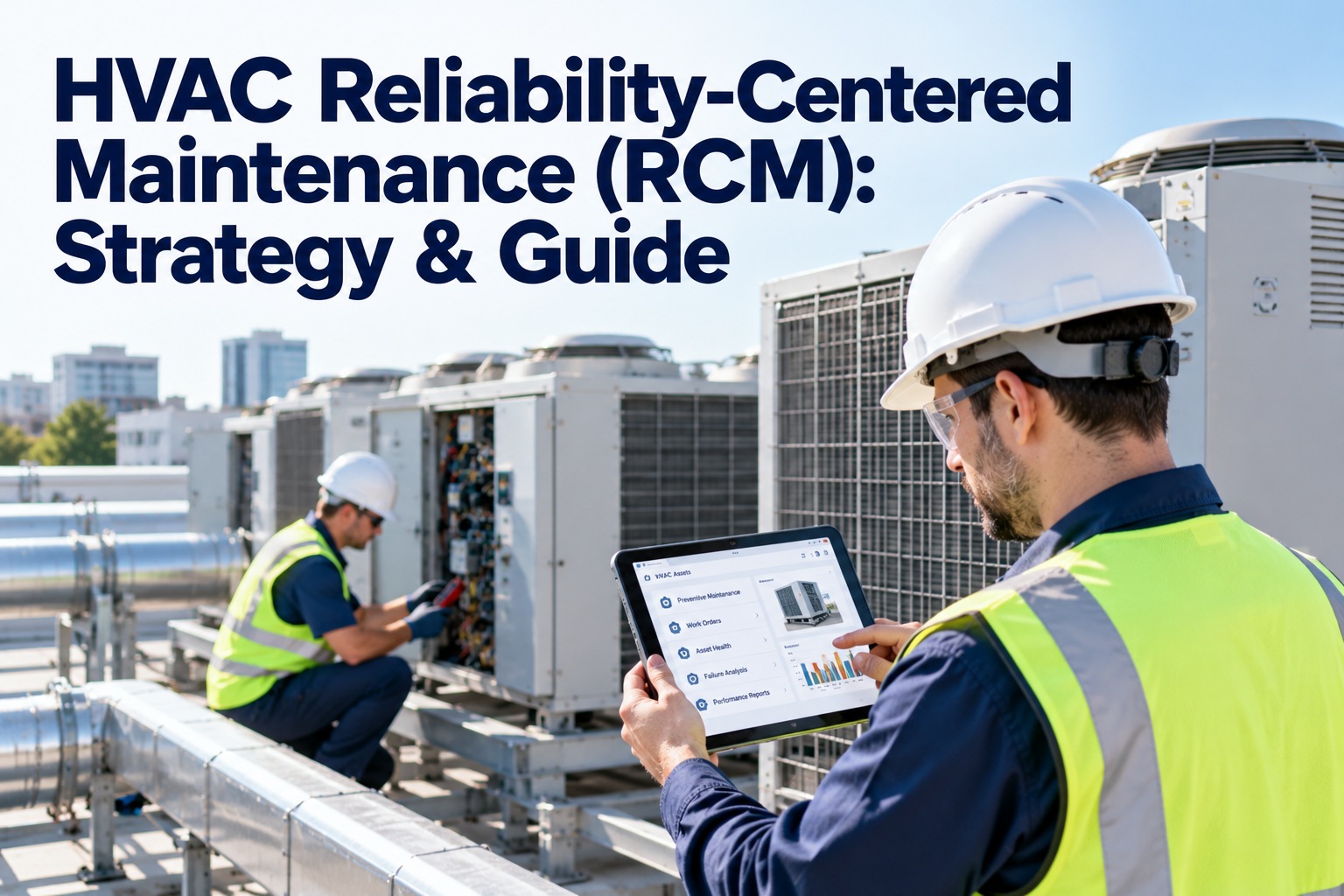
Most HVAC maintenance programs treat every unit the same: same tasks, same interval, same budget. The result is too much time spent on equipment that barely matters and too little on the chiller or air handler that can shut a building down. Reliability-centered maintenance (RCM) fixes that by asking a sharper question: what can fail, what happens when it does, and what is the smartest way to prevent it? This guide walks through an HVAC RCM strategy step by step, and shows how OXMAINT AI, the AI-powered CMMS, turns that strategy into scheduled work orders, condition tracking and reliability reports.
HVAC Reliability-Centered Maintenance: Maintain What Matters Most
RCM focuses effort where failure hurts most. Rank your assets by criticality, understand how they fail, pick the right task for each failure mode, then track results. OXMAINT AI, the AI-powered CMMS and maintenance management software, keeps the whole loop in one system.
Why "Same PM for Every Unit" Doesn't Work
A rooftop unit serving a storage room and a chiller serving a data hall do not deserve the same attention. Calendar-only PMs also ignore how equipment really fails, so some tasks are wasted while real failure modes go unwatched. Book a demo to see criticality-based planning in OXMAINT AI.
Step 1: Rank HVAC Assets by Criticality
Score each asset on two things: how likely it is to fail, and how bad the consequence would be (safety, comfort, production, cost). Plot them and your priorities appear. Start free and tag criticality on every asset.
Step 2: Map Failure Modes and Their Effects
For each critical asset, list how it can fail, why, and what happens next. This is the heart of failure mode and effects analysis (FMEA), and it tells you which tasks are worth doing. Here is a simple example. Book a demo to log failure codes in OXMAINT AI.
| Asset | Failure Mode | Effect | Early Warning |
|---|---|---|---|
| Air handler | Belt wear or slip | Reduced airflow, comfort complaints | Belt tension and vibration check |
| Chiller | Low refrigerant charge | Lost capacity, compressor stress | Pressure and temperature trends |
| Cooling coil | Fouling or clogged drain | Poor efficiency, water damage | Delta-T, visual and drain checks |
| Motor | Bearing failure | Unplanned shutdown | Vibration, temperature, amp draw |
Step 3: Catch Failures Early with the P-F Curve
Many failures give warning before they happen. The gap between the first detectable sign (P) and actual functional failure (F) is your window to act. Inspect at an interval shorter than that window and you fix the problem on your schedule, not the equipment's.
An RCM Plan on a Spreadsheet Is a Plan No One Follows.
Criticality scores, failure modes and task intervals only create reliability when they become scheduled work, completed on time and recorded. OXMAINT AI connects the strategy to the daily work order.
Step 4: Pick the Right Task for Each Failure Mode
RCM does not mean "more maintenance." It means the right kind. Match every failure mode to one of four strategies. Start free and assign strategies by asset in OXMAINT AI.
Step 5: Track the Numbers That Prove It Works
RCM is a loop, not a project. Review these indicators each quarter and adjust intervals and tasks. Book a demo to see reliability reporting in OXMAINT AI.
How OXMAINT AI Runs Your HVAC RCM Program
Each RCM step maps to a capability you can use from day one. Start free and load your HVAC asset list.
We used to service every unit the same way and still got surprised by our biggest failures. Ranking assets and tracking failure causes in one system let us focus on the equipment that matters. Reactive calls dropped and our PM plan finally made sense.
Frequently Asked Questions
Stop Maintaining Everything. Start Protecting What Matters.
Rank your assets, map failure modes, schedule the right tasks and track the results with OXMAINT AI, so your HVAC systems stay reliable and your team stays out of firefighting mode.