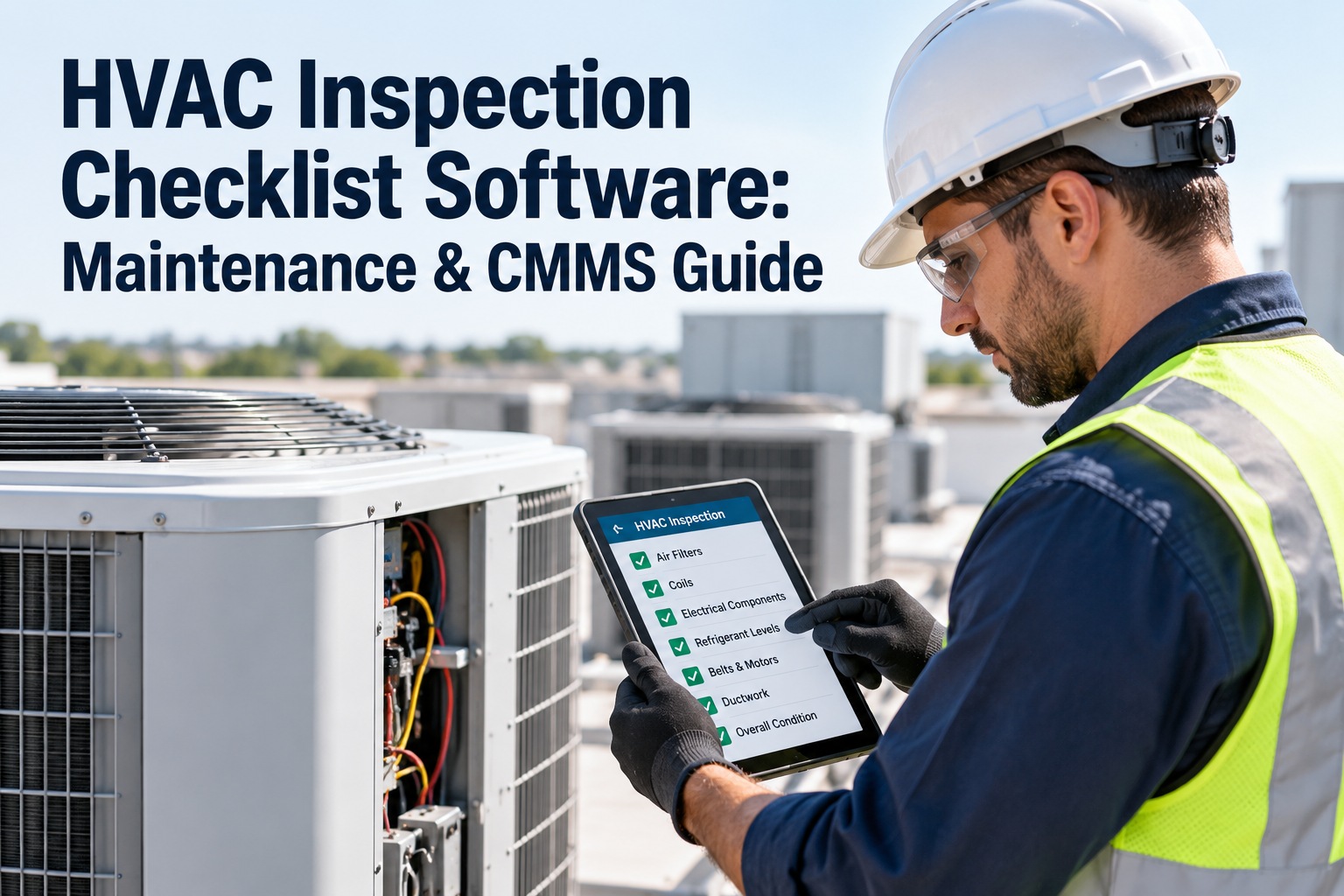
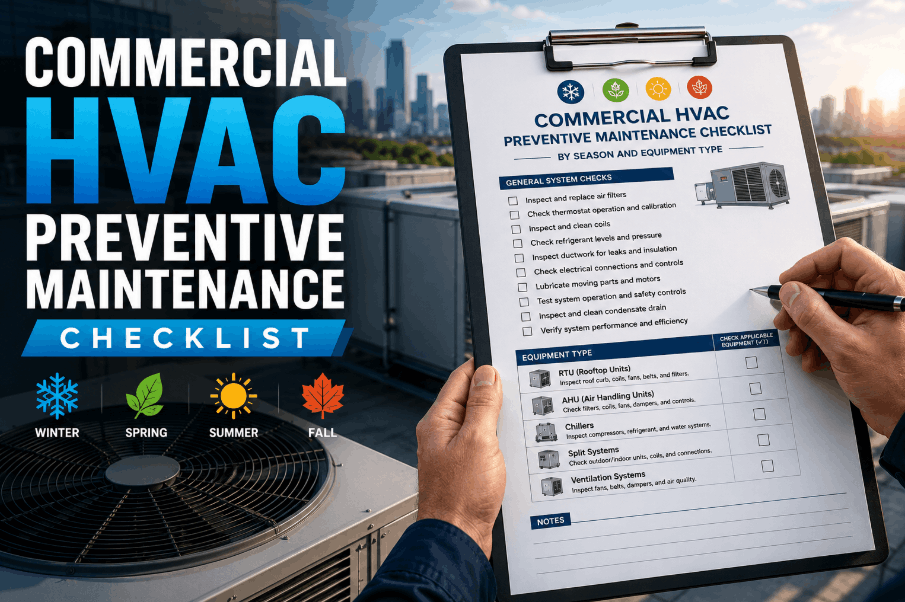
Monday morning, 6:47 AM. A technician at a 200,000 sq ft office complex walks through his daily HVAC rounds. At the third rooftop unit, he catches a faint whistle that wasn't there Friday. He logs it on his mobile checklist, flags it for follow-up, and finishes his round in 14 minutes. By 10 AM, the CMMS has auto-generated a work order. By Wednesday, a maintenance tech discovers a compressor suction valve beginning to fail — a $350 repair that would have become a $4,800 compressor replacement plus 16 hours of emergency downtime if left another three weeks. That's what 15 minutes of structured daily maintenance prevents. ASHRAE research shows consistent maintenance reduces HVAC breakdowns by up to 95%. The EPA documents a 400% return — $4 saved for every $1 spent on preventive care. The U.S. Department of Energy reports properly maintained systems consume 5-20% less energy than neglected ones. And NIST data reveals that skipping maintenance increases HVAC energy waste by 30% or more. Yet according to industry surveys, only 30% of facilities consistently execute scheduled preventive maintenance. The remaining 70% run systems blind, waiting for failures that a 15-minute daily walkthrough would have caught weeks earlier. This checklist transforms that walkthrough into a structured, trackable, audit-ready process — organized into the three inspection categories that commercial HVAC professionals use to catch problems at their earliest, cheapest stage.
Importance of Daily HVAC Maintenance
Every catastrophic HVAC failure starts as a minor anomaly — a bearing that hums slightly louder, a drain pan collecting condensation a millimeter deeper each day, a belt with a hairline crack invisible at normal speed. The difference between a $50 adjustment and a $5,000 emergency repair is usually 10-14 days of ignoring these signals. Research tracking over 100,000 rental units found that preventive maintenance programs reduced HVAC service requests by 31-50%, while facilities implementing condition-based monitoring saw Mean Time Between Failures increase by 90-175 hours. The U.S. Department of Energy estimates that poorly maintained systems account for 30% of a commercial building's total energy consumption — energy that daily checks recover through airflow optimization, filter management, and early leak detection. The math is straightforward: a well-maintained HVAC unit lasts 15-20 years, while a neglected one needs replacement in as little as 10 — that's 5-7 years of additional equipment life worth tens of thousands in avoided capital expenditure. Facilities that sign up to run daily HVAC checklists digitally begin capturing that advantage from the very first walkthrough, converting paper-based guesswork into structured, timestamped reliability data.
System Performance Observations
Before touching a single component, observe. The most valuable diagnostic tool in HVAC maintenance isn't a gauge or meter — it's a trained technician's senses during the first two minutes of a walkthrough. Unusual sounds, temperature inconsistencies, unexpected vibrations, and unfamiliar odors are the earliest signals of developing mechanical problems. Kwak et al.'s 2004 peer-reviewed study published in Building and Environment confirmed that condition-based monitoring increased Mean Time Between Failures by 90-175 hours in commercial HVAC systems. When these sensory observations are logged digitally rather than forgotten by lunchtime, they build trend histories that reveal degradation patterns weeks before instruments register alarm conditions. Maintenance teams that book a demo to see structured observation logging discover how a 3-minute sensory sweep becomes the most cost-effective inspection in their entire program.
Visual Inspection Tasks
Sensors monitor operating metrics. Technician eyes catch everything else — water pooling beneath a unit, corrosion forming on electrical terminals, a belt fraying along one edge, debris choking condenser coils. According to the Department of Energy, improperly maintained HVAC systems lose up to 30% of their operating efficiency, and most of that degradation is visually detectable before it registers on performance dashboards. A dirty filter alone increases energy consumption 5-15% and accelerates evaporator coil fouling that compounds the loss over weeks. These are the five-minute checks that prevent the $5,000 emergency calls. Maintenance managers ready to eliminate paper inspection forms can sign up to build digital visual inspection workflows that auto-generate corrective work orders every time a technician flags an issue.
Safety and Operational Checks
Every other checklist task protects equipment. Safety checks protect people. HVAC systems combine high-voltage electrical components, rotating machinery, pressurized refrigerant, and in many installations, natural gas or combustion byproducts — all in a single enclosure. OSHA's 2025 penalty schedule sets fines at $16,550 per serious violation, with willful or repeated offenses reaching $165,514 each. Lockout/tagout violations alone generated 2,443 citations and $1.95 million in penalties during fiscal year 2024, making it the fifth most-cited standard across all industries. Machine guarding — directly applicable to exposed fan blades, belt drives, and rotating shafts inside HVAC equipment — ranked seventh with 3,249 violations and $2.27 million in penalties. These aren't abstract statistics; they're the exact standards that apply when a technician opens a unit with missing guards or an unlabeled disconnect switch. Facilities that digitize these safety rounds with required fields, photo evidence, and mandatory sign-offs prevent both injuries and citations — turning compliance from a reactive scramble into automated daily proof.
Recording Daily Maintenance Findings
A completed checklist that lives in a filing cabinet protects nobody. The compounding value of daily maintenance checks materializes only when every finding is recorded digitally — timestamped, geotagged to the specific asset, and connected directly to your work order system. Paper-based logs are the single biggest failure point in maintenance documentation: they get lost, lack verifiable timestamps, can be backdated, and cannot trigger automated corrective action. Unplanned downtime costs U.S. businesses approximately $50 billion annually and consumes up to 20% of total productive capacity. Research shows that facilities using CMMS platforms to automate maintenance schedules report 44% reduction in overall downtime and 87% fewer equipment defects compared to manual tracking. Enterprise facilities managing 50+ locations achieve 34% faster maintenance response times when daily findings feed directly into a centralized system. Every observation a technician logs today becomes the trend data that predicts tomorrow's failures. Teams still relying on clipboards can sign up to start digital daily maintenance logging and begin building that intelligence immediately.
Expert Perspective
The most expensive maintenance activity in any commercial facility isn't the scheduled overhaul or the emergency compressor replacement — it's the developing failure that was walkable, visible, and audible during a daily round but went unrecorded and unaddressed. Every bearing hum ignored, every condensate puddle stepped over, every belt that "looked fine" becomes a corrective work order costing 5-10 times what proactive intervention would have required. We consistently see facilities running at 88% or higher PM compliance report 60% fewer emergency service calls, 30% lower total energy consumption, and maintenance labor utilization rates above 75%. The daily checklist isn't administrative overhead — it's the operational foundation that every advanced maintenance strategy, from predictive analytics to condition-based monitoring, is built upon.
The maintenance teams achieving these benchmarks use CMMS platforms that enforce daily checklist completion, auto-generate work orders from flagged findings, and build the trend intelligence that converts routine observations into predictive analytics. If your daily rounds still end with a paper form that nobody reviews, book a demo to see digital HVAC checklists in action — from the technician's phone screen to the facility manager's dashboard in real time.