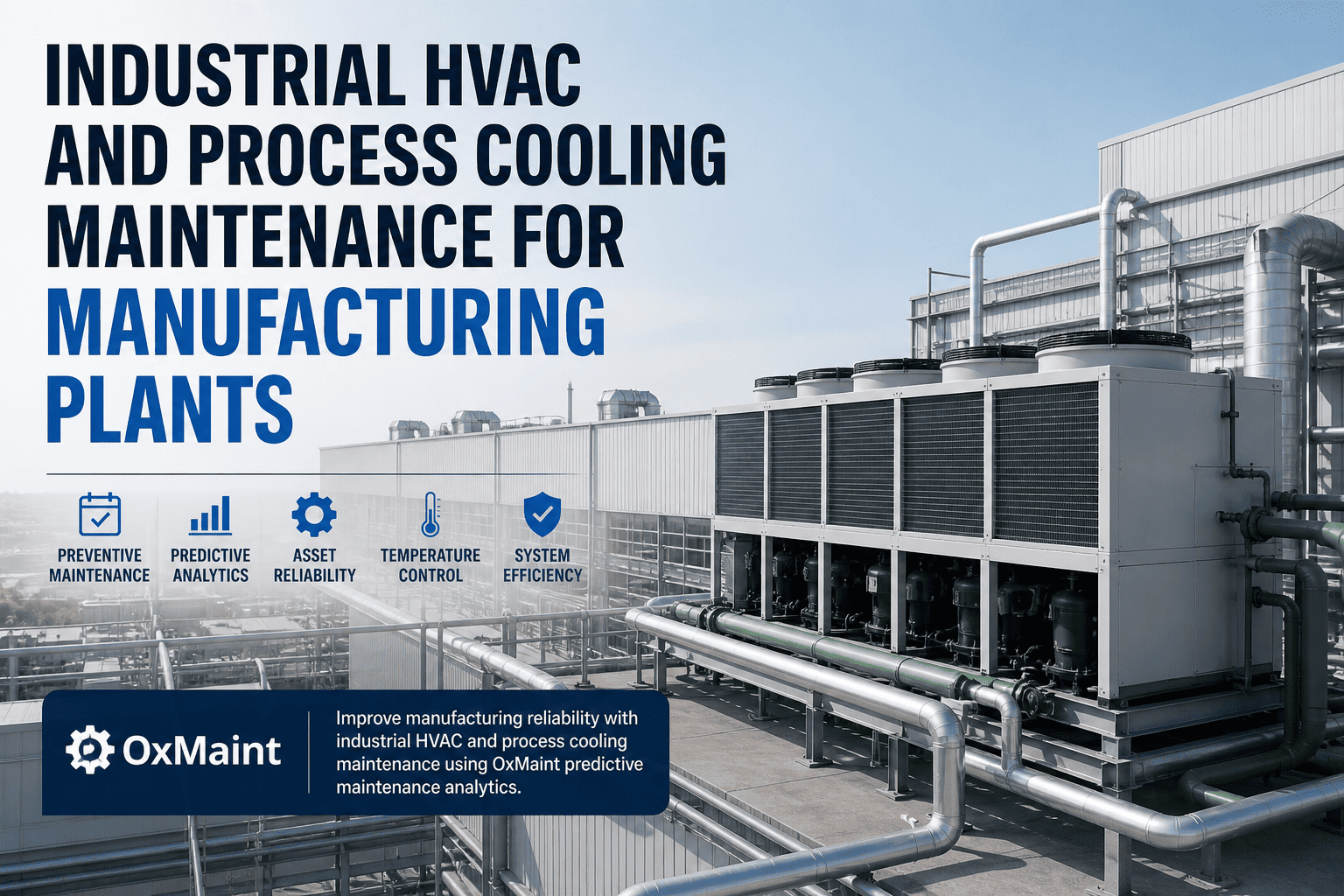
Manufacturing plant HVAC operates under demands that no commercial or institutional building shares. A single production line requires precise temperature and humidity to maintain dimensional tolerances on machined components. A paint booth demands controlled airflow and temperature to achieve consistent coating adhesion. A pharmaceutical API manufacturing area must maintain ISO classification continuously during production. And the same plant's assembly floor requires worker comfort conditions to sustain productivity and reduce heat-related absenteeism. Managing these parallel requirements — process-critical HVAC and comfort conditioning — through the same maintenance programme, with a single maintenance team, against a shared budget, is the operational challenge that separates high-performing manufacturing facilities from those permanently fighting unplanned downtime. Book a demo to see how Oxmaint manages both process and comfort HVAC across your manufacturing facility.
25–35%
Of total manufacturing facility energy consumption attributed to HVAC — process cooling and comfort conditioning combined
4–8x
Cost of process cooling failure in production-critical environments versus planned maintenance intervention at the correct lifecycle point
18%
Average worker productivity drop in manufacturing facilities where ambient temperature exceeds 27°C without adequate comfort conditioning
30%
Maintenance cost reduction achievable in manufacturing plants transitioning from reactive to structured CMMS-driven HVAC programmes
Two HVAC Systems. One Maintenance Programme.
Manufacturing plants require a fundamentally different maintenance approach than commercial buildings. Process HVAC and comfort HVAC must be tracked separately, prioritised differently, and maintained to different standards — but managed through the same system to avoid budget fragmentation and scheduling conflicts.
Process-Critical HVAC
Directly affects product quality and production continuity. Includes precision cooling for CNC machining, cleanroom air handling for electronics or pharma production, temperature control for chemical processes, and humidity management for wood, paper, or food manufacturing. Failure creates scrap, process deviation, or production shutdown — not just discomfort.
Comfort Conditioning
Maintains working environment for assembly floor, warehouse, and office areas. Directly tied to worker productivity, heat stress prevention, absenteeism rates, and OSHA compliance. Neglected comfort HVAC produces measurable productivity losses, higher turnover in production roles, and regulatory exposure in jurisdictions with mandatory workplace thermal comfort standards.
Industrial Ventilation
Manages airborne contaminants, fumes, and particulates generated by manufacturing processes — welding, painting, chemical handling, and soldering. Directly linked to occupational health compliance, OSHA PEL limits, and air permit requirements. Ventilation system failure is both a health and regulatory event, not merely a mechanical failure.
Energy and Utility Impact
Manufacturing HVAC represents 25–35% of total site energy spend. Degraded process chillers, dirty evaporator coils, and undersized cooling tower water treatment inflate utility costs silently — often by $50,000–$200,000 annually in a mid-sized plant before anyone identifies the source. Structured PM is the primary tool for energy cost containment.
Manufacturing HVAC Systems and Their Maintenance Requirements
Each HVAC system type in a manufacturing plant carries a distinct failure mode, PM interval, and consequence profile. A single maintenance programme must address all of them. See how Oxmaint builds asset-specific PM schedules across your full plant HVAC inventory.
| System Type |
Application |
Key PM Interval |
Production Impact if Failed |
| Process Chillers |
CNC cooling, injection moulding, chemical reactors |
Monthly inspection, annual tube cleaning, quarterly water treatment |
Production halt, tooling damage, out-of-spec product — $10,000–$100,000 per unplanned stop |
| Precision AHUs |
Cleanrooms, electronics assembly, pharma production |
Filter monthly, HEPA semi-annual integrity test, coil quarterly |
Classification exceedance, product contamination, batch rejection, regulatory deviation |
| Industrial Exhaust / LEV |
Welding bays, paint booths, chemical handling areas |
Face velocity test quarterly, filter weekly–monthly, fan monthly |
OSHA PEL exceedance, work stoppage, regulatory citation, occupational health liability |
| Comfort AHUs / RTUs |
Assembly floors, warehouses, offices |
Filter bi-monthly, coil bi-annual, belt quarterly |
Worker heat stress, productivity loss, OSHA thermal comfort exposure, absenteeism spike |
| Cooling Towers |
Central process cooling plant |
Weekly water treatment, quarterly basin clean, annual inspection |
Chiller efficiency loss, Legionella liability, cascade failure across all cooled process lines |
| Paint Booth HVAC |
Automotive, industrial, and furniture finishing |
Filter weekly–monthly, airflow balance quarterly, exhaust fan monthly |
Coating defects, VOC concentration above LEL, fire risk, environmental permit violation |
Four Maintenance Failures Costing Manufacturing Plants Production and Margin
These four patterns repeat across manufacturing facilities regardless of industry, plant size, or geography. Each is a predictable and preventable outcome of reactive HVAC management.
01
Process Chiller Failures During Production
Chillers operating without monthly inspections and quarterly water treatment accumulate scale, lose efficiency progressively, and fail under peak thermal load — during the shift with the highest production target, when emergency procurement and contractor mobilisation costs are maximised. Annual tube cleaning alone recovers 10–15% chiller efficiency and prevents the majority of reactive failure events.
02
Industrial Ventilation Deficiencies and OSHA Exposure
Local exhaust ventilation systems serving welding bays and chemical handling areas lose face velocity as filters load and fan belts wear. When capture velocity drops below design, contaminant concentrations at the breathing zone climb toward and beyond OSHA PELs. The liability exposure from a single occupational health event or OSHA inspection finding exceeds the entire annual cost of a structured LEV maintenance programme.
03
Comfort HVAC Neglect and Productivity Loss
Assembly floor and warehouse HVAC is frequently deprioritised in favour of process-critical systems. When ambient temperatures exceed comfort thresholds during peak summer production, productivity drops by 15–20%, error rates increase, and heat-related absenteeism spikes. The production cost of 4 weeks of degraded assembly floor output consistently exceeds the annual cost of structured comfort HVAC maintenance.
04
No Integration Between Process and Facility Maintenance
Process engineering manages process cooling. Facilities manages comfort HVAC. Neither team has visibility into the other's asset condition, PM schedule, or maintenance spend. Capital planning is fragmented, shutdown windows are not coordinated, and the same contractor mobilisation fees are paid multiple times for work that could have been batched. A single integrated CMMS eliminates this structural inefficiency.
Process HVAC and Comfort HVAC in One System. One Dashboard. One Team.
Oxmaint gives manufacturing maintenance teams a single platform for process chiller PM, cleanroom HVAC qualification, LEV compliance scheduling, comfort AHU maintenance, and capital planning — with full visibility across process and facilities assets from the same dashboard.
Reactive vs. Structured Manufacturing HVAC Maintenance
The gap between reactive and structured HVAC maintenance in manufacturing compounds across product quality, regulatory exposure, energy cost, and capital spend — simultaneously and often invisibly until a failure makes the cost visible.
Process Chiller Management
Reactive Management
Chiller efficiency degrades silently through fouled tubes and untreated water. No performance data. Failure occurs at peak production load — $10,000–$100,000 unplanned stop, emergency procurement premiums, and production schedule disruption.
With Oxmaint PM Schedule
Monthly performance checks, quarterly water treatment, annual tube cleaning. COP trended against baseline. Degradation detected and corrected before failure. Planned interventions scheduled during production downtime windows at standard labour rates.
Industrial Ventilation Compliance
Reactive Management
LEV face velocity testing not scheduled. No documentation of filter changes or fan maintenance. OSHA inspection or occupational health incident reveals non-compliance. Citation and corrective action disrupt production. No records to demonstrate due diligence.
With Oxmaint PM Schedule
Quarterly face velocity tests scheduled and documented per work station. Filter changes logged with dates and part numbers. Fan performance trended. Complete LEV maintenance history always available for OSHA inspection without advance notice.
Energy Cost Management
Reactive Management
Dirty coils, loaded filters, and degraded cooling tower performance inflate HVAC energy cost by 15–30%. No system for identifying above-baseline consumption. Energy waste accumulates monthly as a fixed cost treated as normal operating spend.
With Oxmaint PM Schedule
PM completion mapped against energy meter readings. Coil cleaning and filter compliance events correlated to consumption reduction. Above-baseline systems flagged for investigation. Energy recovery quantified per maintenance action for engineering and finance reporting.
Shutdown and CapEx Planning
Reactive Management
Process and facility maintenance teams plan shutdowns independently. HVAC capital needs discovered during annual shutdown — scope expands, costs overrun, production restart is delayed. No forward visibility into asset condition to support CapEx requests to finance.
With Oxmaint PM Schedule
Asset condition data across process and facility HVAC feeds unified 3–5 year CapEx forecasts. Shutdown scope defined months ahead. Parts pre-ordered. Process and facility maintenance coordinated in the same planned window — minimising contractor mobilisation costs and production downtime.
How Oxmaint Manages Manufacturing Plant HVAC Maintenance
Manufacturing HVAC maintenance requires a system that handles both process-critical precision and high-volume facility asset tracking — with the compliance documentation manufacturing plants need for OSHA, ISO, and quality audit purposes. Book a demo to see Oxmaint running on a live manufacturing plant asset register.
01
Unified Asset Registry — Process and Facility HVAC Together
Every process chiller, precision AHU, LEV unit, comfort rooftop unit, and cooling tower registered in a single asset hierarchy — by production zone, ISO classification, and criticality rating. Installation date, OEM specifications, warranty status, and condition score tracked centrally. No separate systems for process engineering and facilities teams.
02
Criticality-Based PM Scheduling
Process-critical HVAC assets receive tighter PM intervals, mandatory completion sign-off, and automatic escalation if overdue. Comfort HVAC assets receive standard intervals. Both are tracked against the same compliance dashboard — giving maintenance managers visibility into where the programme is compliant and where risk is accumulating before a failure makes it visible.
03
LEV and Compliance Documentation for OSHA and ISO Audits
Industrial ventilation maintenance records — face velocity test results, filter change logs, fan performance checks — are captured per work station in the Oxmaint work order system. Every record has a date, technician identity, measurement result, and pass/fail outcome. Complete LEV compliance history exports in under 2 minutes for OSHA inspection, ISO 45001 audit, or internal quality review.
04
Shutdown Planning and Integrated CapEx Forecasting
Asset condition data across process and facility HVAC feeds a single rolling CapEx forecast. Chiller tube replacement, AHU overhauls, and comfort RTU fleet replacement are visible in the same 5-year capital plan — allowing finance teams to budget for the full HVAC capital requirement, not just the process engineering portion that traditionally receives priority.
Manufacturing HVAC Compliance by Region
Manufacturing plants operate under layered HVAC compliance obligations — occupational health, environmental permit, and process quality standards that differ by jurisdiction and industry sector.
| Region |
Key Frameworks |
HVAC Maintenance Implication |
Oxmaint Coverage |
| USA |
OSHA 29 CFR 1910, EPA air permits, ASHRAE 62.1 |
LEV testing, ventilation records, PEL compliance documentation |
LEV PM scheduling, OSHA inspection-ready records, air permit inspection calendars |
| UK |
COSHH Regulations, HSE EH40, RIDDOR |
LEV examination every 14 months for COSHH-regulated processes, retained records |
COSHH examination scheduling, technician sign-off capture, 14-month compliance tracking |
| EU / Germany |
TRGS 900, DIN EN 14175, BetrSichV |
Fume hood certification, workplace PEL monitoring, pressure system inspection |
DIN-aligned PM intervals, certification record archiving, inspection deadline alerts |
| Australia |
WHS Act, AS 2985 LEV testing, NOHSC standards |
Documented LEV performance testing, OEL compliance records, permit requirements |
AS-aligned inspection scheduling, OEL documentation, multi-site compliance dashboard |
| India |
Factories Act 1948, CPCB emission norms, BIS standards |
Ventilation standards for listed factories, emission control equipment maintenance records |
Statutory inspection calendars, emission control PM scheduling, factory compliance records |
Every Jurisdiction. Every Standard. Every Audit — Always Ready.
From OSHA PEL documentation in the US to COSHH 14-month LEV examinations in the UK, Oxmaint auto-schedules every compliance task, captures every measurement, and generates audit-ready records per work station — without manual calendar tracking or spreadsheet maintenance histories.
5
Global regulatory frameworks mapped into Oxmaint HVAC compliance scheduling
2 Min
To export a complete LEV and HVAC compliance report for any OSHA or ISO audit
30%
Manufacturing maintenance cost reduction within 18 months of structured CMMS deployment
60 Days
To active PM schedules across all process and facility HVAC — no implementation fees
The ROI of Structured Manufacturing HVAC Maintenance
30%
Average manufacturing maintenance cost reduction within 18 months of structured CMMS-driven HVAC programme deployment
$150K+
Annual process cooling energy savings in a mid-sized manufacturing plant with chiller PM compliance versus reactive management
18%
Worker productivity recovery on assembly floors where comfort conditioning is maintained versus neglected reactive management
60 Days
To active PM schedules across process and facility HVAC assets with Oxmaint — no implementation fees
Frequently Asked Questions: Manufacturing Plant HVAC Maintenance
How should manufacturing plants prioritise process HVAC versus comfort HVAC maintenance?
Process-critical HVAC assets — chillers, precision AHUs serving production areas, and local exhaust ventilation at regulated work stations — should be assigned higher maintenance priority and tighter PM intervals than comfort systems. However, chronic neglect of comfort HVAC has measurable production costs through worker productivity loss, heat stress absenteeism, and OSHA exposure that should be reflected in the maintenance budget model. Oxmaint allows criticality ratings to be assigned per asset, automatically adjusting PM interval frequency and escalation thresholds accordingly.
How often should industrial LEV systems be inspected and tested?
Under UK COSHH Regulations, LEV systems used to control substances hazardous to health must be examined and tested at least every 14 months by a competent person, with records retained for 5 years. Under US OSHA standards, specific industries have defined inspection frequencies for exhaust ventilation — welding operations, spray booths, and chemical handling areas each have applicable standards. In all jurisdictions, face velocity testing and filter maintenance should occur more frequently than the statutory examination — typically quarterly — to maintain performance between formal inspections.
What is the energy impact of neglecting process chiller maintenance?
Fouled condenser tubes reduce chiller efficiency by 10–15%, increasing energy consumption directly. Degraded cooling tower water treatment accelerates fouling and further reduces heat rejection efficiency. Together, a poorly maintained chiller and cooling tower system can consume 20–30% more electricity than a well-maintained equivalent — representing $50,000–$200,000 in avoidable annual energy cost at typical industrial electricity rates for a mid-sized manufacturing facility. Annual tube cleaning, quarterly water treatment, and monthly performance checks prevent this progression entirely.
Can Oxmaint manage both process engineering and facility maintenance in the same system?
Yes. Oxmaint is designed for multi-team and multi-discipline asset management. Process engineers and facilities managers can each manage their respective asset portfolios within the same platform — with separate permissions, separate work order queues, and separate reporting if required — while sharing the same shutdown planning calendar, capital forecasting module, and contractor management system. This eliminates the structural inefficiency of running two separate maintenance systems for assets that share physical plant space and maintenance resources.
How does Oxmaint support manufacturing HVAC compliance for ISO 45001 and OSHA audits?
Oxmaint captures complete work order records for every HVAC maintenance task — including LEV face velocity test results, filter change logs with part numbers and dates, technician qualifications, and corrective actions for any out-of-specification findings. This documentation structure directly supports the evidence requirements for ISO 45001 occupational health management system audits and OSHA inspection response. Complete maintenance histories per asset and per work station export in under 2 minutes for any audit or inspection event.
Process HVAC and Facility Comfort. One Platform. Zero Gaps.
Oxmaint gives manufacturing maintenance teams unified process and facility HVAC asset management, criticality-based PM scheduling, LEV compliance documentation, energy performance tracking, and integrated CapEx forecasting — all in one platform, live in 60 days, with no implementation fees.
Process chiller and cooling tower PM
LEV compliance scheduling and documentation
Comfort HVAC and assembly floor conditioning
Integrated shutdown and CapEx planning