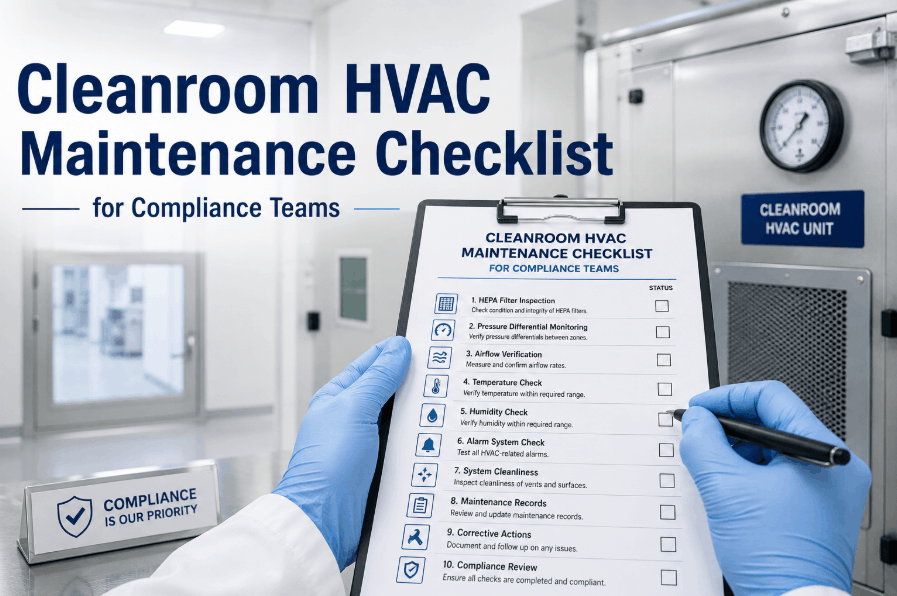
A single HVAC failure in a pharmaceutical cleanroom does not generate a maintenance work order — it generates an FDA Form 483, a batch rejection, and a contamination investigation that can halt production for weeks. Cleanroom HVAC systems are not building infrastructure. They are validated manufacturing equipment, regulated under 21 CFR Part 211, subject to qualification protocols, and required to maintain ISO classification at all times during production. The cost of one contamination event attributable to HVAC failure — product loss, regulatory response, revalidation, and investigation — routinely exceeds $2–$8 million. Pharmaceutical facilities consistently meeting GMP HVAC requirements share one structural advantage: a maintenance programme built on validated procedures, calibrated instruments, documented deviation management, and a CMMS that produces audit-ready evidence at any moment. Book a demo to see how Oxmaint manages GMP-compliant HVAC maintenance with full audit trail documentation.
$2–8M
Typical cost of a single contamination event attributable to HVAC failure in pharmaceutical manufacturing
21 CFR
FDA regulation requiring validated HVAC maintenance with complete documentation for all drug manufacturing environments
6–month
Average duration of FDA consent decree enforcement action triggered by repeated GMP HVAC documentation failures
ISO 5–8
Cleanroom classification range requiring distinct HVAC performance parameters maintained and verified continuously
Why Pharmaceutical HVAC Is Regulated Manufacturing Equipment
Unlike commercial or industrial HVAC, cleanroom air handling systems directly determine product quality and patient safety. Every pressure differential, every ACH rate, and every particle count is a GMP parameter — not a comfort preference.
GMP
Regulatory Classification
Under 21 CFR Part 211 and EU GMP Annex 1, HVAC systems in pharmaceutical facilities are classified as direct impact systems requiring Installation Qualification, Operational Qualification, and Performance Qualification. Maintenance procedures must be validated and executed by trained personnel with documented evidence retained for every task.
ISO
Cleanroom Classification Integrity
ISO 14644-1 classifies cleanrooms from ISO 5 (most stringent) to ISO 8 (least stringent) based on airborne particle counts per cubic metre. HVAC systems — specifically HEPA filtration, air change rates, and pressure cascades — are the primary mechanical controls maintaining each classification. Any HVAC deviation is a potential classification exceedance.
HEPA
Filter Integrity as Product Protection
HEPA filters in pharmaceutical environments are not changed on fixed schedules — they are tested for integrity using DOP or PAO aerosol challenge at defined intervals. A single bypass path in a filter housing introduces unfiltered air carrying viable and non-viable particles directly into the classified zone, constituting an immediately reportable GMP deviation.
CAPA
Deviation and CAPA Management
When HVAC parameters exceed alert or action limits — pressure differentials, particle counts, temperature, humidity — a formal deviation must be opened, investigated, and closed with a Corrective and Preventive Action. Every deviation and CAPA must be documented in the maintenance system and available for FDA or EMA inspector review without advance notice.
Cleanroom Classifications and HVAC Requirements
Each ISO classification carries distinct HVAC performance requirements. Maintenance programmes must be built around these parameters — not generic building PM schedules. See how Oxmaint maps your cleanroom zones to validated PM schedules and compliance documentation.
| ISO Class |
Equivalent |
Min ACH |
Max Particles (0.5µm/m³) |
Typical Use |
| ISO 5 |
EU GMP Grade A / FDA Class 100 |
240–480 |
3,520 |
Aseptic fill/finish, open sterile product, laminar flow zones |
| ISO 6 |
EU GMP Grade B (dynamic) |
150–240 |
35,200 |
Background environment for ISO 5 aseptic operations |
| ISO 7 |
EU GMP Grade C / FDA Class 10,000 |
60–90 |
352,000 |
Preparation of solutions for sterile filtration, component prep |
| ISO 8 |
EU GMP Grade D / FDA Class 100,000 |
20–40 |
3,520,000 |
Packaging of sterile products, general API manufacturing |
GMP HVAC Maintenance: Required Tasks and Validated Intervals
Every maintenance task in a pharmaceutical cleanroom must be performed using a validated Standard Operating Procedure, completed by trained and qualified personnel, and documented with date, technician identity, instrument calibration references, and outcome.
| Maintenance Task |
Regulatory Basis |
Validated Interval |
Documentation Required |
| HEPA Filter Integrity Test |
ISO 14644-3, EU GMP Annex 1, 21 CFR 211 |
Every 6–12 months, post-installation, post-maintenance |
DOP/PAO test certificate, instrument calibration record, pass/fail result, technician signature |
| Airborne Particle Count |
ISO 14644-1, EU GMP Annex 1 |
Every 6 months (ISO 5–7), annually (ISO 8), post-event |
Particle counter calibration certificate, sample location map, results vs. specification, deviation if exceeded |
| Differential Pressure Monitoring |
21 CFR 211.46, EU GMP Chapter 3 |
Continuous monitoring, calibration annually |
Continuous data log, alarm history, calibration certificate, out-of-limit deviation records |
| Air Change Rate Verification |
ISO 14644-3, ASHRAE 170 |
Every 6–12 months, post-AHU maintenance |
Anemometer calibration record, measurement locations, results vs. design specification |
| Temperature and Humidity Calibration |
21 CFR 211.68, EU GMP Chapter 3 |
Sensor calibration annually, continuous monitoring |
NIST-traceable calibration certificate, as-found/as-left data, sensor location map |
| AHU and Pre-filter Maintenance |
21 CFR 211.67, GMP facility maintenance requirements |
Pre-filters monthly, intermediate filters quarterly, AHU inspection semi-annual |
Completed SOP record, filter part numbers and lot numbers, replacement date, technician qualification reference |
One Documentation Gap Can Trigger an FDA 483. Oxmaint Closes Every Gap Before Inspectors Arrive.
Oxmaint generates complete GMP maintenance records per asset — validated intervals, technician qualifications, instrument calibration references, and CAPA linkages — all exportable in under 2 minutes for any FDA, EMA, or internal audit request.
Four GMP HVAC Failures That Trigger Regulatory Action
FDA 483 observations and EU GMP non-conformances consistently trace back to the same four HVAC maintenance failure patterns — each preventable with a structured, documented maintenance programme.
01
Missing or Incomplete Maintenance Records
The most frequently cited GMP HVAC finding in FDA inspections is not equipment failure — it is undocumented maintenance. Filter changes with no lot numbers recorded, HEPA tests with no instrument calibration reference, and pressure checks with no technician signature are all GMP deviations regardless of whether the equipment was functioning correctly.
02
Undetected Pressure Cascade Failures
Cleanroom pressure differentials between zones degrade gradually as filter loading increases, duct dampers drift, and AHU performance deteriorates. Without continuous monitoring tied to an alarm and response system, facilities operate with reversed or collapsed pressure cascades for extended periods — compromising zone classification and contamination control without triggering any visible alert.
03
HEPA Integrity Test Deferrals
Semi-annual HEPA integrity testing is resource-intensive and production-disruptive. When deferred due to scheduling pressure, facilities accumulate overdue qualification status — a direct GMP non-compliance. Any batch manufactured during an overdue HEPA qualification period is subject to retrospective investigation and potential rejection, regardless of particle count data.
04
Instrument Calibration Gaps
Particle counters, pressure gauges, anemometers, and temperature/humidity sensors used in cleanroom qualification must maintain current NIST-traceable calibration certificates. An expired calibration on any instrument used for a GMP measurement invalidates all results obtained after the calibration due date — requiring test repetition and deviation investigation for all affected batches.
Regulatory Frameworks Governing Pharmaceutical HVAC
Pharmaceutical HVAC maintenance must simultaneously satisfy multiple overlapping regulatory frameworks, each with distinct documentation, qualification, and interval requirements.
| Framework |
Jurisdiction |
Key HVAC Requirement |
Oxmaint Coverage |
| 21 CFR Part 211 |
USA (FDA) |
Validated HVAC maintenance procedures, documented records, trained personnel, periodic review |
SOP-linked work orders, qualification status tracking, personnel training records integration |
| EU GMP Annex 1 |
EU / EMA |
Contamination control strategy, HVAC design qualification, continuous monitoring, annual product review |
CCS documentation support, qualification record management, deviation and CAPA tracking |
| ISO 14644-1/3 |
International |
Cleanroom classification testing intervals, particle count methodology, HEPA integrity testing |
ISO-aligned PM scheduling, test result archiving, classification status dashboards |
| PIC/S Guide PE 009 |
PIC/S member states |
Harmonised GMP requirements for HVAC in sterile and non-sterile manufacturing |
PIC/S-aligned maintenance intervals, full audit trail per asset |
| PMDA Guidelines |
Japan |
Facility qualification requirements aligned to Japanese Pharmacopoeia and GMP ordinance |
Multi-framework compliance scheduling, Japanese GMP documentation exports |
Every Framework. Every Deadline. Every Document — Always Ready.
From FDA 21 CFR to EU GMP Annex 1 and ISO 14644, Oxmaint maps your cleanroom HVAC assets to the right validation intervals, auto-schedules every required task, and builds the complete audit trail that keeps your facility compliant across every regulatory jurisdiction you operate in.
5
Regulatory frameworks mapped into Oxmaint PM scheduling engine
2 Min
To export a full cleanroom HVAC compliance report for any FDA or EMA inspection
0
Documentation gaps when every work order enforces mandatory GMP fields before closure
60 Days
To active GMP-aligned PM schedules across all cleanroom HVAC assets — no implementation fees
How Oxmaint Manages GMP HVAC Compliance
GMP-compliant HVAC maintenance requires more than a calendar. It requires a system that enforces validated procedures, captures calibration references, manages qualification status, and produces inspection-ready evidence. Book a demo to see Oxmaint running on a live pharmaceutical facility asset register.
01
Validated Asset Registry by Cleanroom Zone and Classification
Every HVAC asset is registered against its cleanroom zone and ISO classification — AHUs, HEPA filter housings, pressure sensors, particle counters, and monitoring instruments. Qualification status (IQ/OQ/PQ), current calibration certificates, and SOP references are linked to each asset record, giving QA and engineering teams real-time visibility into compliance status across the entire facility.
02
SOP-Driven Work Orders With Mandatory Fields
GMP maintenance work orders are linked to approved SOPs and require completion of mandatory fields — instrument calibration certificate number, technician qualification reference, as-found and as-left measurements, and pass/fail result with electronic signature. Incomplete records cannot be closed without QA review, eliminating the documentation gaps that drive 483 observations.
03
Calibration Expiry Tracking and Alert Management
Every instrument used for GMP measurements — particle counters, anemometers, manometers, temperature and humidity loggers — is tracked with calibration due dates and alert thresholds. Notifications are sent 30, 14, and 7 days before expiry, and any measurement taken with an overdue instrument is flagged in the deviation management module automatically for QA review.
04
Deviation and CAPA Integration
When HVAC parameters exceed alert or action limits — pressure differentials, particle counts, temperature excursions — Oxmaint auto-generates a deviation record linked to the asset, time-stamps the event, and triggers a CAPA workflow. Every deviation from initial finding to closure is documented in a single audit trail — providing the complete investigation record required for batch disposition decisions and regulatory submissions.
Reactive vs. GMP-Compliant HVAC Maintenance: The Risk Gap
In pharmaceutical manufacturing, reactive HVAC management is not just a cost problem — it is a regulatory risk that puts product quality, batch releases, and facility licences at stake.
HEPA Filter Management
Reactive / Unstructured
Filters replaced when differential pressure alarms trigger or production staff report visible concerns. Integrity tests deferred. Qualification status overdue. Every batch manufactured during the overdue period subject to retrospective investigation.
With Oxmaint GMP Programme
Integrity tests scheduled at validated intervals with auto-generated work orders. Qualification status continuously tracked. No batch manufactured on an overdue HEPA qualification — documentation always current for any FDA or EMA inspection.
Pressure Differential Management
Reactive / Unstructured
Pressure checks performed manually at irregular intervals. Cascade failures develop gradually between checks without alarm. Batches released without verified pressure differential records, exposing QA review to retrospective deviation risk.
With Oxmaint GMP Programme
Continuous monitoring data linked to asset records. Out-of-limit events auto-generate deviations with time-stamp and batch correlation. Calibration status always current. Complete pressure differential history available for batch record review.
Inspection Readiness
Reactive / Unstructured
Maintenance records distributed across paper binders, spreadsheets, and email chains. Preparation for FDA inspection requires weeks of record compilation. Gaps discovered during preparation trigger internal escalation and potential production holds.
With Oxmaint GMP Programme
Complete maintenance history per cleanroom zone and asset exportable in under 2 minutes. Facility is inspection-ready at all times — not just in the weeks before a scheduled regulatory visit. No gap identification during preparation.
The ROI of GMP-Compliant HVAC Maintenance
$2–8M
Cost of a single HVAC-attributable contamination event — product loss, investigation, revalidation, and regulatory response
40%
Fewer GMP findings in pharmaceutical facilities with structured, documented HVAC preventive maintenance programmes
2 Min
Time to generate a complete cleanroom HVAC compliance report for FDA or EMA inspection with Oxmaint
60 Days
Time to active GMP-aligned PM schedules and audit-ready documentation across all cleanroom HVAC assets
Frequently Asked Questions: Pharmaceutical HVAC Maintenance
QHow often must HEPA filters be integrity-tested in pharmaceutical cleanrooms?
ISO 14644-3 and EU GMP Annex 1 require HEPA filter integrity testing at defined intervals — typically every 6 months for Grade A/B (ISO 5/6) environments and annually for Grade C/D (ISO 7/8). Testing is also required after any HEPA filter replacement, after maintenance work on the filter housing or ductwork upstream of the HEPA, and after any event that could compromise filter integrity such as a pressure spike. All tests must be performed using DOP or PAO aerosol challenge with a calibrated photometer, and full test certificates with instrument calibration references must be retained.
QWhat documentation does FDA expect for cleanroom HVAC maintenance?
21 CFR Part 211.67 and 211.68 require written SOPs for all equipment maintenance, records of maintenance activities with dates and personnel identification, and evidence of periodic review. For HVAC specifically, FDA expects qualification records (IQ/OQ/PQ), periodic requalification records with pass/fail results, instrument calibration certificates for all measurement devices, deviation and CAPA records for any out-of-specification findings, and change control records for any modification to HVAC systems or procedures. Records must be retained for at least one year after product expiration dating.
QWhat air change rate is required for pharmaceutical Grade A cleanrooms?
EU GMP Annex 1 and FDA guidance for Grade A / ISO Class 5 environments require a minimum of 240–480 air changes per hour, typically delivered via unidirectional (laminar) airflow at 0.36–0.54 m/s to provide sweep purging of the critical zone. The specific ACH required depends on zone geometry, heat load, and contamination control strategy — and must be verified during initial qualification and at each periodic requalification. Deviations from the validated ACH range must be documented and investigated even if particle counts remain within specification.
QHow does a CMMS support pharmaceutical HVAC compliance specifically?
A GMP-appropriate CMMS supports pharmaceutical HVAC compliance by enforcing SOP-linked work order completion with mandatory documentation fields, tracking calibration expiry dates for all measurement instruments, maintaining qualification status per cleanroom zone and asset, auto-generating deviations when alert or action limits are exceeded, and producing audit-ready reports per facility, building, or room on demand. The key distinction from a generic work order system is the ability to link every maintenance record to the SOP version, technician qualification, and instrument calibration status that were in effect at the time of execution — the complete context an FDA inspector requires.
QWhat happens if cleanroom HVAC qualification is overdue when FDA inspects?
Overdue HVAC qualification is one of the most common 21 CFR Part 211 observations on FDA Form 483 reports. When inspectors find overdue requalification — HEPA integrity tests, particle count surveys, or pressure differential calibration — they typically issue observations citing inadequate maintenance and testing of equipment. Depending on the scope and duration of the overdue status, the response can range from a 483 observation requiring a written response to a Warning Letter if the pattern indicates systemic quality system failure. Batches manufactured during the overdue period may also be subject to retrospective impact assessment and potential rejection.
GMP HVAC Compliance Is Not Negotiable. Neither Is Your Documentation.
Oxmaint gives pharmaceutical facilities validated PM scheduling by cleanroom zone and ISO classification, SOP-linked work orders with mandatory GMP fields, instrument calibration tracking, deviation and CAPA management, and inspection-ready documentation — all in one platform, live in 60 days, with no implementation fees.
ISO classification-based PM scheduling
HEPA and qualification status tracking
Instrument calibration expiry management
FDA and EMA audit-ready documentation