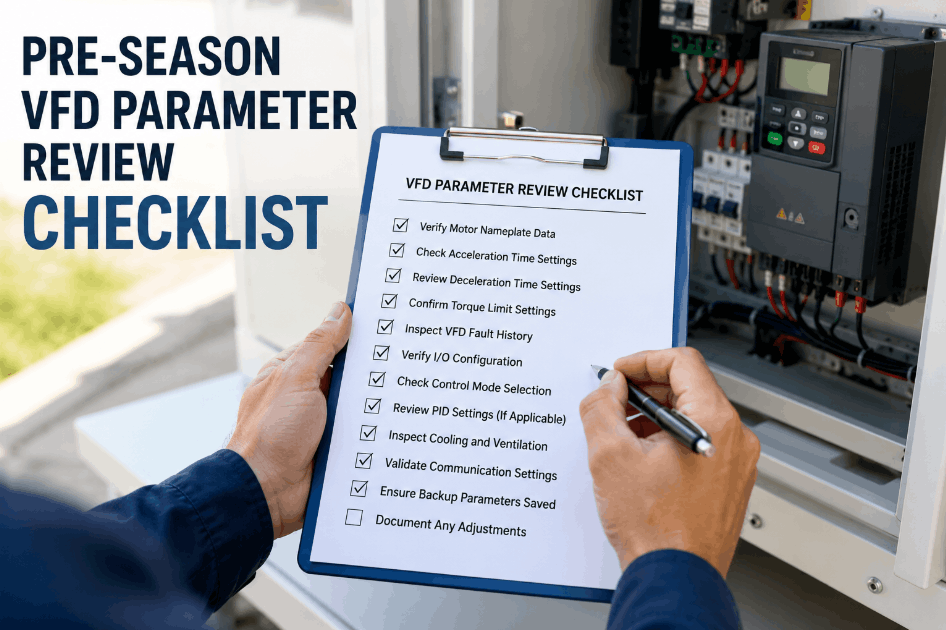
A pre-season VFD parameter review checklist gives maintenance teams a structured way to confirm acceleration ramps, torque limits, and fault history are correct before motors are pushed into peak-season load. Drives tuned for shoulder-season conditions often carry settings that no longer match actual demand, and a parameter that drifts unnoticed shows up as a nuisance trip or a burned-out bearing during the first heat wave or cold snap. Sign Up Free on Oxmaint to pull every VFD-driven asset, its last fault codes, and its current parameter set into one screen before your review window opens. Book a Demo to see how Oxmaint connects PLC and sensor data to each drive record, so acceleration curves, torque ceilings, and fault history are reviewed against real runtime data instead of a paper log nobody has touched since last year.
1. Drive Parameter & Setpoint Verification
Confirm each VFD's active acceleration, torque, and switching settings reflect current load conditions, not a default left over from commissioning or a prior season.
2. Acceleration, Deceleration & Torque Limit Tuning
Re-tune ramp times and torque headroom against the load the motor will actually carry this season, and document every change made along the way.
3. Fault History & Diagnostic Review
A full season of fault codes tells you more than the most recent trip alone — recurring low-severity faults often precede a parameter-related failure once load increases.
4. Sensor & Feedback Calibration Checks
A VFD can only be tuned as accurately as the feedback it receives. Confirm sensors feeding the control loop are reporting correctly before trusting the parameter review.
5. Documentation, Work Order & Compliance Readiness
A review is only useful if the findings are documented, assigned, and tracked to completion across every drive in scope.