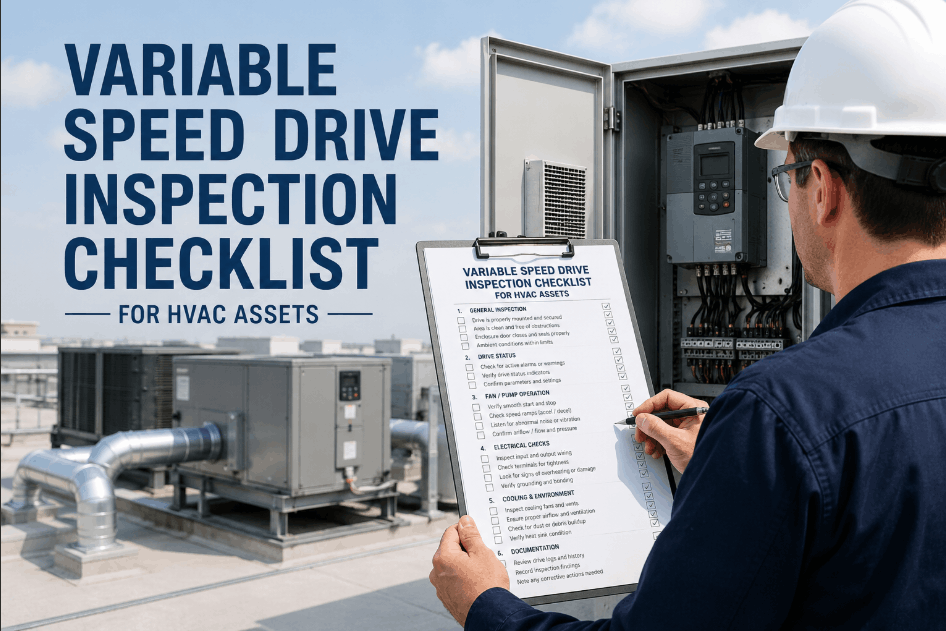
Variable speed drive failures in HVAC systems rarely happen without warning — yet the signals that precede them go undetected when inspection routines lack structure, drive alarms go unreviewed between service visits, and wiring and cooling path checks are deferred until performance has already degraded. For facility engineers and HVAC maintenance teams managing fan and pump applications, unplanned VSD failures produce immediate operational impact: lost airflow control, process temperature deviations, and emergency replacement costs that dwarf the time investment of a structured inspection routine. The gap between a drive that runs and a drive that runs reliably is almost always found in the consistency of the inspection process — whether alarm histories are reviewed, whether cooling paths are clear, whether ramp settings have drifted, and whether wiring integrity is confirmed before a fault forces a shutdown. Oxmaint's Sign Up Free platform gives HVAC maintenance teams digital inspection checklists, mobile-based asset check-ins, and real-time visibility into open findings — so variable speed drive inspections are completed on schedule and every observation is captured before it becomes a fault. From drive alarm review to thermal management verification, this checklist gives facility engineers and operations managers a structured pre-inspection confirmation framework for every VSD asset in fan and pump service. Book a Demo to see how Oxmaint connects VSD inspection records to asset histories, work orders, and maintenance schedules — ensuring every drive in your HVAC system is inspected, documented, and acted on. Use this checklist before each VSD inspection to confirm that your technicians are reviewing the right parameters, in the right sequence, against a defined asset record — not performing an informal walkthrough that misses developing faults.
1. Drive Alarm Review & Fault History Confirmation
Active and historical alarms are the most direct indicator of developing VSD issues — yet they are routinely skipped during informal inspections. Confirm that alarm history is reviewed and cleared against a documented baseline before declaring a drive in acceptable operating condition.
2. Fan & Pump Ramp Parameter Verification
Incorrect acceleration and deceleration ramp settings cause mechanical stress on connected fan and pump loads, contribute to premature bearing wear, and produce current spikes that damage drive output stages over time. Confirm that ramp parameters match the application specification before each inspection is closed.
3. Wiring Integrity & Connection Inspection
Loose or degraded wiring connections are a leading cause of intermittent VSD faults, nuisance tripping, and premature drive failure — and they are not detected without a physical inspection of terminal blocks, power cables, and control wiring under operating conditions. Confirm that wiring integrity checks are completed as a defined inspection step, not assumed from prior-service status.
4. Cooling Path & Thermal Management Verification
VSD overtemperature faults are among the most common causes of unplanned shutdowns in HVAC applications — and they are almost always preceded by a cooling path condition that could have been identified and corrected during routine inspection. Confirm that thermal management checks are included in every VSD inspection, not deferred until a temperature alarm fires.
5. Drive Performance & Control Integration Check
A VSD that passes visual and electrical checks but does not respond correctly to control signals or maintain stable output under load has not passed a complete inspection. Confirm that drive performance under operating conditions and control system integration are verified as part of every inspection close-out.