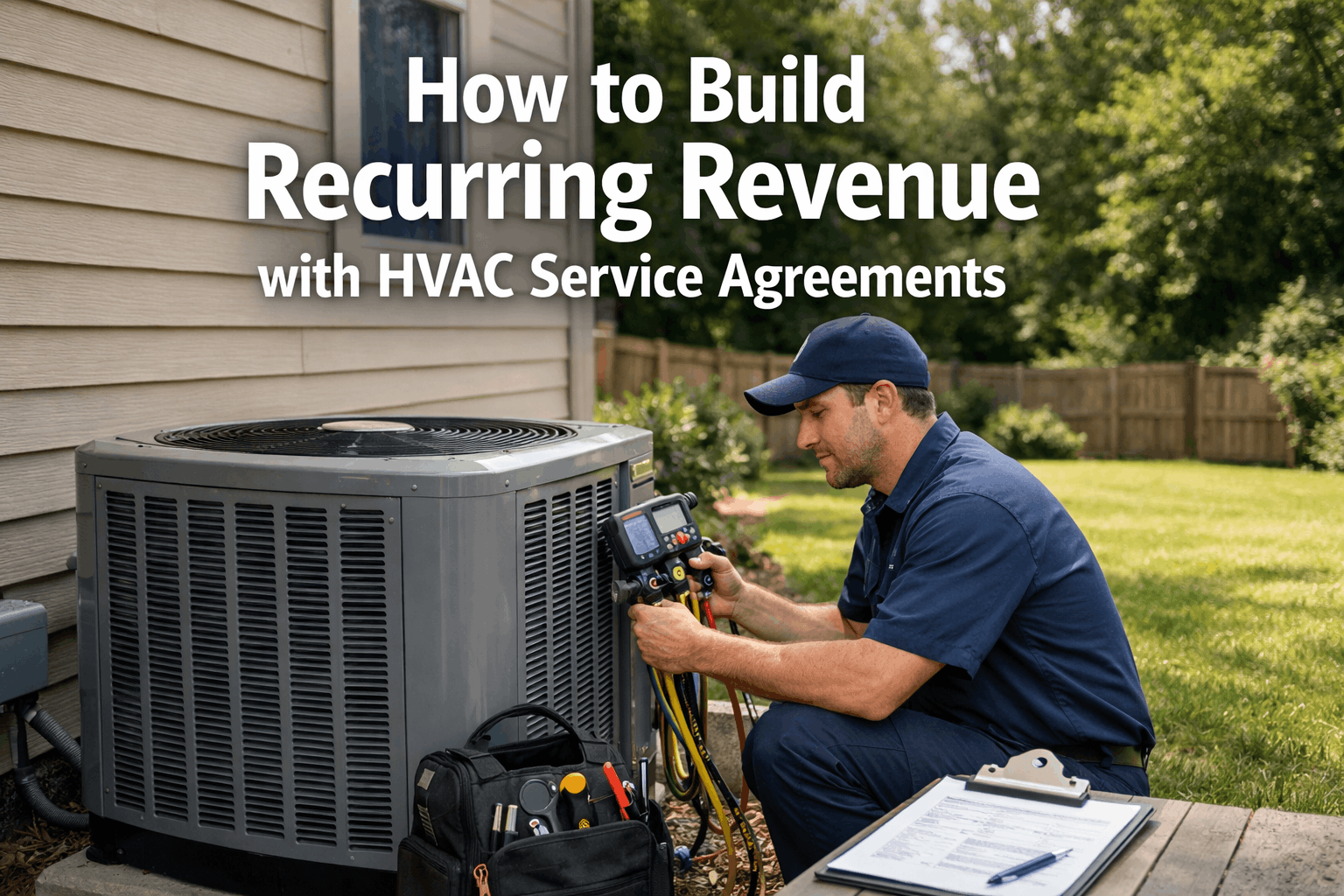
The HVAC companies that survive recessions, weather slow seasons, and build enterprise value all share one trait: a high percentage of recurring revenue. While demand-call-dependent companies ride a revenue roller coaster — feast during heat waves and cold snaps, famine during mild weather — recurring-revenue-focused companies collect predictable monthly income from service agreements, maintenance contracts, and equipment monitoring subscriptions regardless of weather or season. The difference in business valuation alone is staggering: HVAC companies with 40%+ recurring revenue sell for 6-10x EBITDA, while demand-only companies sell for 2-4x.
But building a recurring revenue engine requires more than selling agreements — it requires tracking the metrics that reveal whether your recurring book is growing, stalling, or silently eroding. Most HVAC owners know their total revenue but can't answer basic recurring revenue questions: What's our monthly churn rate? What's the lifetime value of an agreement customer? Which agreement types have the highest renewal rates? Where are we losing customers? Oxmaint's recurring revenue dashboard answers all of these in real time, giving HVAC business owners the financial intelligence to grow their most valuable revenue stream systematically.
The Recurring Revenue Metrics Every HVAC Owner Must Track
These eight metrics form the complete picture of your recurring revenue health. Oxmaint calculates each one automatically from your agreement and work order data:
Monthly Recurring Revenue (MRR)
Total predictable revenue collected from active agreements each month. The single most important number in your business. Growing MRR means growing business value. Flat MRR means you're replacing churn but not expanding. Declining MRR is a red alert.
Annual Recurring Revenue (ARR)
MRR multiplied by 12. Represents the annualized value of your current agreement book. Used for business valuation, financial planning, and year-over-year growth tracking.
Active Agreement Count
Total number of current, non-expired agreements. Track net change monthly: new agreements sold minus cancellations/non-renewals. Net positive = growing book.
Renewal Rate
Percentage of agreements that renew at expiration. The most critical retention metric. Every 5% improvement in renewal rate compounds dramatically over 3-5 years.
Monthly Churn Rate
Percentage of MRR lost to cancellations and non-renewals each month. The silent killer. Even 3% monthly churn means losing a third of your book every year.
Customer Lifetime Value (CLV)
Total revenue a PM customer generates over their entire relationship: agreement fees + PM-generated repairs + replacement sales + referrals. The number that justifies every dollar spent on retention.
Revenue Per Agreement
Total revenue generated per agreement including contract fee plus PM-discovered repairs. Shows the true economic value of each agreement beyond just the contract price.
Recurring Revenue Ratio
Recurring revenue as a percentage of total revenue. The metric that defines your business model and valuation. Every percentage point increase reduces risk and increases company value.
Churn Analysis: Finding and Fixing the Leaks
Growing recurring revenue isn't just about selling more agreements — it's about keeping the ones you have. Even small improvements in churn create massive long-term impact. Here's what the math looks like:
You Can't Grow What You Can't See. Track Every Dollar of Recurring Revenue.
Oxmaint's recurring revenue dashboard shows MRR, churn, renewal rates, CLV, and growth trends in real time — giving HVAC owners the financial visibility to build predictable, valuable businesses.
Churn Root Causes & Oxmaint's Response
Understanding why customers leave is the first step to keeping them. Oxmaint tracks cancellation reasons and provides automated interventions for each:
"I forgot I had a contract" / Passive Lapse
Customer simply didn't renew because nobody reminded them and they forgot the agreement existed. This is 100% preventable with automated renewal outreach at 60/30/15 days before expiration plus a value-recap email showing what the agreement saved them.
"I didn't see the value" / Perceived Value Gap
Customer doesn't believe the agreement was worth the price. Usually caused by missed PM visits, lack of communication about what was done, or failure to communicate findings and savings. Oxmaint sends post-visit reports showing work performed, issues found, and estimated savings.
"Too expensive" / Price Sensitivity
Customer feels the agreement cost exceeds the benefit. Address with tiered pricing (basic/standard/premium), multi-year discounts, and ROI calculations showing repair savings vs. agreement cost. Oxmaint tracks repair history to generate personalized "your agreement saved you $X" statements.
"Bad experience" / Service Quality
Customer had a negative interaction: late technician, unresolved issue, rude communication, or billing error. These require immediate service recovery. Oxmaint flags low CSAT scores on agreement customers for manager follow-up within 24 hours.
Moved / Sold Property / Other
Uncontrollable churn from life changes. Oxmaint captures new owner information when available and auto-generates a "welcome new homeowner" outreach offering to transfer or initiate a new agreement for the property.
Building a $1M+ Recurring Revenue Book: The Growth Math
Here's the realistic path to building a $1 million annual recurring revenue book from scratch or from a small starting base:
Build the Revenue Stream That Makes Your Business Worth 3x More
Oxmaint tracks every agreement, every renewal, every churn event, and every dollar of recurring revenue — turning scattered data into a clear growth roadmap for your most valuable revenue stream.
Frequently Asked Questions
What's the ideal recurring revenue percentage for an HVAC company?
Target 40-60% of total revenue from recurring sources (service agreements, PM contracts, monitoring subscriptions). At this level, your business has enough predictability to weather slow seasons, fund growth investments, and command premium valuations. Getting there takes 3-5 years of consistent effort for most companies. Start by tracking your current ratio — many HVAC owners are surprised to find they're at 10-15%, which means enormous growth opportunity. Even reaching 25-30% within 2 years dramatically changes your cash flow predictability and reduces dependence on weather-driven demand.
How does Oxmaint calculate Customer Lifetime Value?
Oxmaint calculates CLV using actual customer data, not industry averages: it sums the total revenue generated by each agreement customer from the day they signed through today (or through cancellation), including agreement fees, all service calls, repairs, replacements, and referral credits. Then it calculates the average customer lifespan (e.g., 4.2 years for residential, 6.8 years for commercial) and projects the expected remaining lifetime revenue. This gives you both historical CLV (what customers have actually generated) and projected CLV (what current customers are expected to generate). You can segment by agreement type, customer size, acquisition channel, and geography to identify which customer segments are most valuable.
What's the difference between gross churn and net churn?
Gross churn measures the total MRR lost to cancellations and non-renewals, ignoring any expansion revenue. Net churn (or net revenue retention) accounts for expansion: if you lost $2,000 MRR to cancellations but gained $3,000 MRR from existing customers upgrading to higher-tier agreements or adding systems, your net churn is actually negative (which is excellent — it means you're growing revenue from existing customers faster than you're losing it). Oxmaint tracks both metrics. Target: gross monthly churn <1.5%, net revenue retention >100% (meaning existing customer revenue grows even before counting new sales).
How do we price agreements for maximum retention AND profitability?
Oxmaint provides agreement profitability analysis by calculating the true cost to deliver each agreement type (technician time per visit, travel cost, parts used, callback rate) and comparing it to the agreement fee plus generated repair revenue. The sweet spot is pricing that covers delivery cost plus 20-40% margin on the agreement itself, while recognizing that the real profit comes from PM-generated repairs (40-60% margins). Most successful companies offer 2-3 tiers: Basic (1 visit/year, filter change, basic inspection — $149-$199), Standard (2 visits/year, comprehensive checklist, priority scheduling — $249-$349), and Premium (2 visits/year, comprehensive checklist, priority scheduling, 10-15% repair discount, no overtime charges — $399-$499). The premium tier typically has the highest retention rate because the perceived value is highest.
Can Oxmaint show the impact of recurring revenue on business valuation?
Yes. Oxmaint includes a business value estimator that calculates the valuation impact of your recurring revenue mix. The model uses industry M&A data: HVAC companies with <20% recurring revenue typically sell for 2-4x EBITDA, 20-40% recurring at 4-6x, and >40% recurring at 6-10x. By inputting your EBITDA and current recurring percentage, the tool shows how growing recurring revenue from, say, 18% to 35% could increase your company's sale value by $500K-$3M+ depending on size. This makes the investment case for agreement growth concrete: every $100K in ARR added translates to $200K-$1M in enterprise value depending on your recurring mix and growth rate.