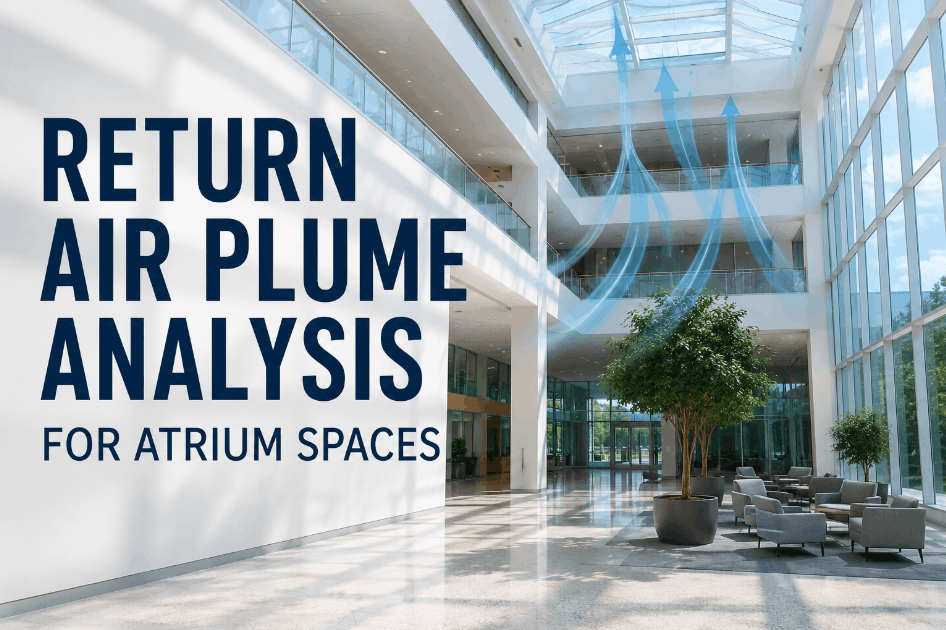
Tall atrium spaces behave nothing like a standard office floor when it comes to airflow. Warm air rises and stratifies, return grilles placed for a flat ceiling miss the plume entirely, and the result is stale air pooling at upper levels while occupants below feel a draft. Return air plume analysis traces how air actually moves through these tall open volumes instead of assuming standard return patterns apply. Sign Up Free with Oxmaint to connect atrium air distribution assets, sensor data, and inspection records so airflow issues get caught before they become comfort complaints.
Why Return Air Plume Behavior Matters in Atrium Design
A return air system designed for a normal-height room rarely performs the same way once it is scaled into a tall, open atrium. Book a Demo to see how Oxmaint's analytics tools track thermal and airflow readings across atrium levels to validate whether the original design intent still holds.
Four Factors That Shape Return Air Plume Behavior
Atrium airflow problems rarely come from a single cause, which is why isolated fixes often fail to resolve comfort complaints. Sign Up Free to build atrium airflow asset profiles in Oxmaint that connect these variables to inspection and sensor data over time.
Warm air rises faster and farther in taller volumes, so the plume's path through the atrium depends heavily on ceiling height and internal heat sources. Return grilles positioned without accounting for buoyancy effects routinely miss the rising air entirely.
Grilles sized and located for a standard ceiling height often sit well below where stale air actually accumulates in an atrium. Placement needs to follow modeled or measured plume behavior, not a fixed ceiling-height rule of thumb.
Distinct temperature layers can form at different heights, trapping warm air well above occupant level while the lower zone stays comfortable. Stratification patterns shift with occupancy, season, and solar gain through atrium glazing.
Atrium return air paths frequently share ductwork or dampers with life-safety smoke control systems. Any airflow change made for comfort reasons needs to be checked against smoke control sequence requirements before it goes into effect.
Return Air Evaluation Framework for Atrium Spaces
Evaluating atrium return air performance requires comparing measured conditions against the original design intent across multiple levels. Book a Demo to see how Oxmaint connects sensor trending with inspection workflows to support that comparison.
| Evaluation Factor | High-Risk Configuration | Low-Risk Configuration | Key Metric to Track | Monitoring Approach |
|---|---|---|---|---|
| Ceiling Height | Multi-story open atriums | Standard floor-to-ceiling spaces | Temperature differential by level | Multi-level thermal sensor logging |
| Grille Placement | Returns set below stratification layer | Returns positioned at measured plume height | Return airflow vs. design baseline | Airflow station trending |
| Solar Gain | Large glazed atrium roofs | Shaded or minimal glazing | Stratification shift across seasons | Seasonal thermal trend review |
| Smoke Control Linkage | Shared dampers with life-safety systems | Independent comfort return paths | Sequence compliance verification | BAS sequence testing |
| Occupancy Pattern | Variable, event-driven atrium use | Stable, low-density daily use | Comfort complaints per zone | Work order complaint tracking |
Common Return Air Plume Failure Patterns in Atrium Spaces
Implementing Atrium Airflow Monitoring with Oxmaint
Atrium return air problems are easy to miss because they develop gradually and rarely trigger an obvious fault. Sign Up Free and connect your atrium air distribution assets to Oxmaint's inspection and analytics workflows.
- Register supply diffusers, return grilles, and dampers as assets linked to their atrium zone
- Document original design airflow rates and commissioning thermal readings by level
- Link smoke control sequence documentation to any shared damper assets
- Log thermal sensor readings at multiple atrium levels to track stratification over time
- Set airflow variance alerts when return performance drifts from the commissioning baseline
- Attach seasonal trend data to each atrium zone record for context
- Generate digital inspection checklists for return grille and damper condition checks
- Trigger work orders automatically when stratification or airflow thresholds are exceeded
- Attach trend data to each work order so technicians understand what changed
- Monitor comfort complaints by atrium zone alongside airflow and thermal trend data
- Compare energy use against return air performance to quantify the cost of plume issues
- Report atrium airflow performance to facility leadership on a recurring basis
Return Air Performance KPIs for Atrium Spaces
Sustaining good atrium airflow performance requires tracking indicators that connect thermal behavior to occupant comfort and energy use. Book a Demo to see Oxmaint's analytics dashboards built for multi-level airflow tracking.
Tracks how much stratification is occurring across atrium levels. Widening differentials signal a return air capture problem that needs investigation.
Compares current return airflow rates to commissioning values. Significant deviation points to grille fouling, damper issues, or capacity mismatch.
Occupant comfort complaints attributable to airflow in atrium-adjacent spaces. Persistent complaints in one zone usually trace back to a specific return path issue.
Confirms that any return path change has not disrupted required life-safety smoke control sequences during testing.
Confirms thermal and CO2 sensors are positioned where the plume actually travels, not just where mounting was convenient.
Connects energy spend to measured airflow performance, helping justify investment in return air corrections.