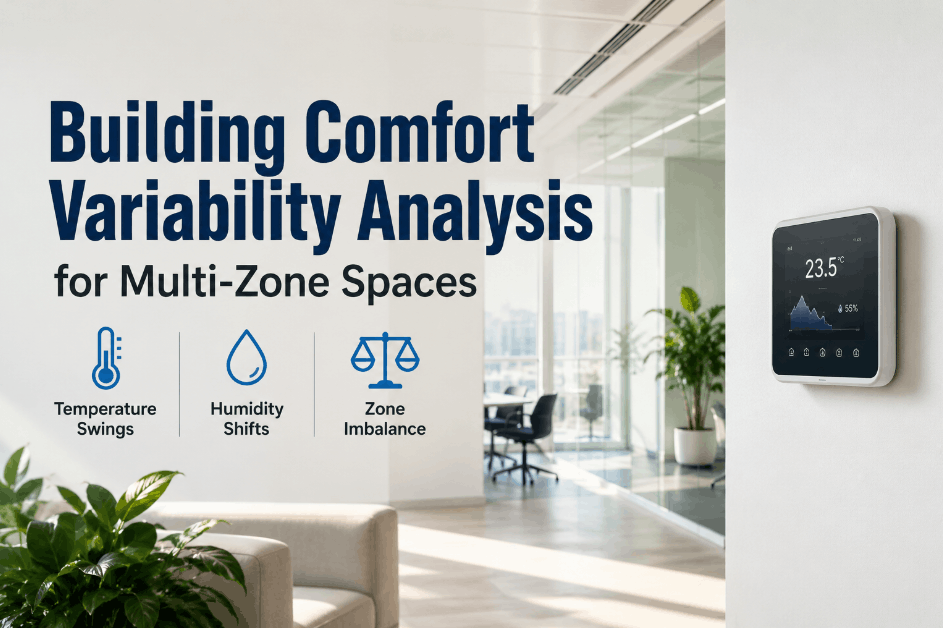
Building comfort variability analysis for multi-zone spaces identifies where temperature swings, humidity shifts, and zone imbalance are generating the most occupant disruption — and which HVAC control gaps are driving the variation rather than the outdoor environment. In multi-zone buildings, comfort variability is rarely uniform: two zones served by the same air handler can perform at opposite ends of the occupant satisfaction range when damper drift, sensor calibration loss, or airflow imbalance creates a wedge between design intent and actual delivery. Sign Up Free to configure OxMaint's zone-level inspection and environmental performance tracking before comfort complaints compound into occupant productivity and retention issues. OxMaint structures zone-by-zone inspection logging, temperature and humidity baseline comparison, and HVAC control fault documentation into a maintenance workflow that gives facilities teams a measurable picture of where comfort variability is originating across the building portfolio. Book a Demo to see how OxMaint supports multi-zone building comfort management and HVAC performance planning for facilities operations programs.
Facilities Management · HVAC Controls · 2026
Building Comfort Variability Analysis for Multi-Zone Spaces
Measure temperature swings, humidity shifts, and zone imbalance to find where comfort varies most across multi-zone buildings for structured HVAC planning.
±4°FTemperature swing threshold above which occupant comfort complaints begin to rise consistently
−24%Comfort complaint reduction in multi-zone buildings with structured zone performance logging
60%Of zone comfort variability traced to HVAC control faults, not design inadequacy
3 zoneAverage number of high-variability zones found per building in first structured inspection cycle
5 Comfort Variability Sources in Multi-Zone Buildings
Comfort variability in multi-zone spaces rarely originates from a single fault — it accumulates across components and control systems that drift independently of each other while the aggregate effect appears as inconsistent occupant experience. The five variability sources below represent the most common diagnostic gaps in multi-zone HVAC operations, and the points where OxMaint's inspection and fault documentation workflows give facilities teams a structured view of where zone imbalance is originating. Sign Up Free to configure OxMaint's zone comfort performance tracking workflow for your multi-zone building program.
01
VAV Damper Calibration Drift
Variability Type: Airflow Imbalance
High Frequency
VAV damper actuators drift from their calibrated positions over time — delivering more or less airflow than the zone setpoint requires without triggering a control alarm. Zones that receive excess airflow overcool; zones starved of airflow overheat. Logging damper position observations per zone per inspection surfaces drift before it compounds into persistent zone imbalance.
02
Zone Sensor Calibration Loss
Variability Type: Measurement Error
Control Gap
Temperature and humidity sensors that read outside their calibration tolerance cause the HVAC control system to respond to conditions that don't reflect actual zone state. A sensor reading 2°F high causes the system to over-cool; one reading 2°F low causes under-conditioning. Calibration verification logging in OxMaint tracks which sensors are operating outside specification before zone conditions deteriorate.
03
Supply Air Temperature Inconsistency
Variability Type: Distribution Source
Cascade Risk
When supply air temperature from the AHU deviates from setpoint — due to coil fouling, refrigerant issues, or control loop instability — every downstream zone is affected simultaneously. The variability appears zone-level but originates at the central plant. Logging supply air temperature per AHU per inspection separates zone-level faults from central plant degradation.
04
Humidity Control Lag and Overshoot
Variability Type: Moisture Instability
Occupant Driver
Humidity control systems in multi-zone buildings frequently exhibit lag and overshoot patterns — particularly during seasonal transitions — creating swings outside the 40–60% RH range that generate occupant discomfort, static electricity complaints, and biological growth risk. Humidity observation logging across zones identifies which spaces have the widest RH variability and which control sequences are contributing.
05
Inspection Gap — No Zone Baseline Record
Variability Type: Documentation Deficit
Prevention Input
Comfort variability compounds invisibly when zone-level inspections aren't compared to a documented baseline. Without a structured zone performance record in the CMMS, facilities teams can't distinguish normal seasonal variation from developing HVAC control degradation — or identify which zones are consistently the source of occupant complaints.
Multi-Zone Comfort Management — Without vs. With OxMaint
The structural difference between complaint-driven comfort management and CMMS-supported zone performance monitoring is visible in complaint volume, HVAC control fault resolution time, and occupant satisfaction consistency. The comparison below shows what changes when OxMaint structures zone-level inspection logging, baseline comparison, and fault escalation for multi-zone building operations. Book a Demo to assess your building's current zone comfort management approach and identify the performance gaps OxMaint can close.
Zone Comfort Management Maturity — Where Does Your Building Score?
Zone comfort management capability in multi-zone buildings ranges from reactive complaint response to fully structured CMMS-supported zone performance monitoring with baseline comparison, calibration verification, and automated fault escalation. The maturity framework below identifies where each facilities program currently operates and the specific gap driving the most comfort variability today. Book a Demo to assess your building's zone comfort management maturity with an OxMaint solutions engineer.
Multi-Zone Comfort Management Maturity
Score 5 = structured CMMS zone performance program · Score 1 = complaint response only
5
Full Zone Baseline Tracking · Calibration Verified · Variability Trended
Temperature, humidity, damper position, and sensor calibration status logged per zone per inspection. Variability trends visible per zone per season. Root cause documented on every comfort fault.
Profile: Comfort variability detected before complaint volume rises. Every zone inspection generates a performance record that improves the next HVAC control cycle.
4
Structured Inspections · Partial Baseline Comparison
Zone inspections logged with findings. Baseline comparison partial — major deviations noted but minor drift not systematically flagged. Root cause captured on significant complaint events only.
Action: Enforce baseline comparison on every zone visit. Minor drift documentation is where comfort variability prevention is built.
3
Building-Level Maintenance · No Zone Performance View
Maintenance tasks logged at building or system level. Zone-level performance not tracked separately. Comfort variability attribution requires manual investigation per complaint event.
Gap: Building-level records don't reveal zone-level variability patterns. Zone-level inspection logging is the highest-impact next step.
2
Informal Rounds · Complaint-Driven Zone Response
Zone comfort managed by responding to occupant complaints. Informal rounds without structured checklists. Zone temperature and humidity readings not logged between service events.
Risk: Comfort variability accumulates invisibly between complaint cycles. High-variability zones not identified until complaint volume forces escalation.
1
No Zone Performance Structure
Multi-zone HVAC managed at system level only. No zone-level performance record. Comfort variability unmeasured and unmapped between major service cycles.
Risk: Every zone is a source of untracked comfort variability. High-variability zones remain unidentified until complaint escalation or occupant turnover signals the problem.
Find Zone Comfort Variability Before It Surfaces in Occupant Complaints.
OxMaint structures zone inspection workflows, baseline comparison, and HVAC control fault documentation for multi-zone building operations — in one CMMS platform.
How OxMaint Structures Zone Comfort Performance Management
OxMaint connects zone-level inspection logging, condition-triggered maintenance tasks, sensor calibration verification, and root cause documentation into a single workflow for multi-zone building facilities teams. Every zone inspection becomes a baseline comparison record — with temperature, humidity, damper position, and sensor status tracked per zone over time and deviations converted into structured follow-up tasks. Sign Up Free to map your building's zone comfort baseline in OxMaint and start detecting variability before it drives occupant complaints. Book a Demo to see how OxMaint adapts to your inspection schedule, maintenance team structure, and building operations reporting requirements.
Zone Inspection Checklists
Every Zone Visit
Structured forms with baseline comparison fields
OxMaint inspection checklists include temperature, humidity, damper position, and sensor calibration status fields — logged per zone and compared to documented baseline values on every visit.
Condition-Triggered Tasks
Right Time, Not Just Date
Maintenance tasks generated from zone findings
When zone observations exceed threshold — temperature deviation, humidity outside range, damper position drift — OxMaint generates a structured follow-up task automatically, replacing the informal note that gets missed under operational load.
Zone Variability Trending
Per Zone, Per Season
Comfort variability trends per space over time
OxMaint aggregates inspection data per zone — giving facilities managers a view of which spaces are consistently high-variability and which zones carry the most comfort-related maintenance activity relative to occupant satisfaction.
Root Cause Closure
Every Work Order
Variability source captured at maintenance close
CMMS work order closure requires root cause entry on all zone comfort faults. Completion triggers PM schedule review — ensuring the same variability source doesn't recur through the next season without control adjustment.
"
We managed a 12-zone office building that generated comfort complaints every summer from three specific zones on the south side. We'd investigated each complaint and closed the tickets but never connected them. After configuring OxMaint's zone inspection workflow with temperature and damper position baseline fields, our first structured inspection cycle revealed that those three zones had VAV dampers running 15–20% below design position — delivering insufficient airflow during peak cooling load. The sensors were also reading 1.5°F below actual zone temperature, so the control system never flagged it. We corrected both on the same visit, documented root cause, and the three zones generated zero complaints the rest of that summer. The issue had existed for at least two seasons undetected.
Senior Facilities Manager — Commercial Real Estate Portfolio, 6 buildings, 85 HVAC zones, California, USA
Frequently Asked Questions
What causes building comfort variability in multi-zone HVAC systems?
VAV damper calibration drift, zone sensor calibration loss, supply air temperature inconsistency from the AHU, and humidity control overshoot are the most common causes of zone-to-zone comfort variability in multi-zone buildings.
How does OxMaint help identify high-variability zones?
OxMaint structures zone-level inspection checklists that log temperature, humidity, and damper position per zone against documented baselines — surfacing variability patterns across inspection history that complaint-driven management misses entirely.
What temperature swing range triggers occupant comfort complaints?
Temperature variations beyond ±4°F from zone setpoint during occupied hours consistently correlate with rising occupant complaint rates. Humidity deviations outside the 40–60% RH range generate parallel comfort and IAQ impacts.
Can OxMaint replace a BAS for multi-zone comfort monitoring?
OxMaint complements rather than replaces BAS systems. It structures the inspection and maintenance workflow that translates BAS data and technician observations into documented zone performance records, root cause entries, and PM schedule adjustments.
Does OxMaint support zone comfort management across multiple buildings?
Yes. OxMaint structures zone assets, inspection schedules, and work orders across multiple buildings — giving facilities managers and operations leaders a consolidated view of zone comfort variability and maintenance activity across the full building portfolio.
Turn Every Zone Inspection Into a Comfort Performance Baseline — Not a Routine Walkthrough.
OxMaint structures zone inspection checklists, condition-triggered tasks, and root cause documentation for multi-zone building operations teams — converting zone visits into measurable comfort performance data.