Response time is the single most important metric in commercial HVAC service. When a building loses cooling on a 38°C afternoon, the property manager doesn't care about your certifications or fleet size — they care about how fast a competent technician arrives with the right parts and fixes the problem. Industry data shows every hour of HVAC downtime in a commercial building costs the tenant $500-$5,000 in lost productivity, inventory risk, or customer discomfort. Yet the average service call still takes 2-6 hours from first contact to resolution, and 30-40% of first visits fail because the technician arrived without the right diagnosis or parts.
Robotics, IoT monitoring, and intelligent automation are collapsing these timelines in 2026. Remote diagnostics identify the failing component before dispatch. Predictive algorithms generate service calls before the customer notices a problem. Automated parts identification ensures the truck is loaded correctly. Drone pre-inspection gives technicians a complete picture before they climb to the roof. When these technologies feed into Oxmaint's HVAC service management platform, the entire response cycle accelerates: faster diagnosis, smarter dispatching, higher first-time fix rates, and dramatically shorter resolution times. This guide breaks down how each technology contributes and what the combined impact looks like for service companies deploying them today.
From Hours to Minutes. From Guesswork to Precision. From Callbacks to First-Time Fix.
Where Time Is Lost in a Traditional Service Call
Before exploring solutions, understanding exactly where time disappears in the traditional service cycle reveals why technology makes such a dramatic difference. Each phase below is an opportunity for automation to compress the timeline:
Customer Reports Problem
Customer calls, emails, or submits a web form. Dispatcher takes details but often gets an incomplete or inaccurate symptom description. "It's not cooling" could mean 20 different root causes. Time drains away in callback loops, phone tag, and incomplete information gathering.
Dispatch and Travel
Dispatcher identifies an available technician, assigns the call, the technician finishes their current job, then drives to the site. Average travel time runs 25-45 minutes in urban and suburban areas. Dispatchers often lack the information needed to match technician skills to the specific problem type.
On-Site Diagnosis
Technician arrives, locates the unit (often on a roof), and performs a diagnostic procedure starting from scratch. On first visits, they have no knowledge of equipment history, age, previous repairs, or current sensor readings — so diagnosis means systematic elimination of possibilities one by one.
Parts Run or Return Visit
If the right parts are on the truck, repair takes 30-90 minutes. If not, it means a return trip to the supply house (45-90 minutes each way) or rescheduling for the next day. This happens on 30-40% of first visits, adding 2-24 hours to total resolution time. It is the single biggest driver of customer dissatisfaction.
Faster Detection. Smarter Dispatch. Higher First-Time Fix. One Platform.
Oxmaint connects IoT sensors, predictive analytics, drone findings, and smart dispatching into a single service management platform that compresses every phase of the response cycle.
5 Technologies That Compress Response Time
Each of these technologies delivers standalone value, but the combination creates a multiplier effect where total time savings exceed the sum of individual improvements:
IoT Sensor Monitoring
Wireless sensors on compressor current, supply/return temperature, refrigerant pressure, and condensate levels continuously watch equipment health. When parameters cross thresholds, Oxmaint auto-generates a service call with specific fault indication, sensor data history, equipment ID, and location — often before the customer knows anything is wrong.
Predictive Failure Algorithms
Machine learning models analyse sensor trends to predict failures 2-6 weeks before they occur. Compressor bearing degradation, capacitor weakening, refrigerant slow-leaks, and condenser fouling all produce detectable signatures weeks ahead. Scheduled maintenance replaces emergency dispatch at 3-5x lower cost to the customer and the service company.
AI-Powered Smart Dispatching
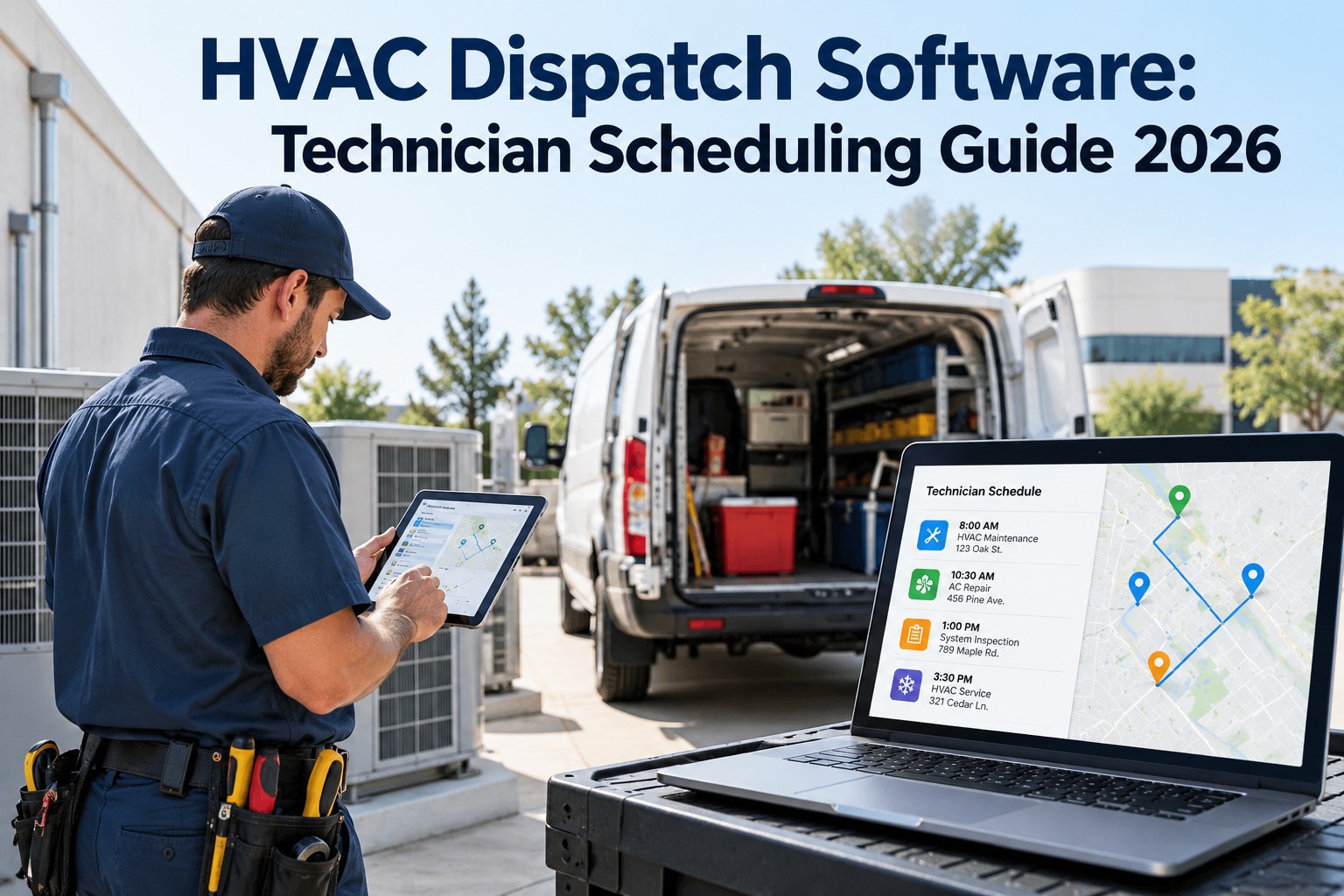
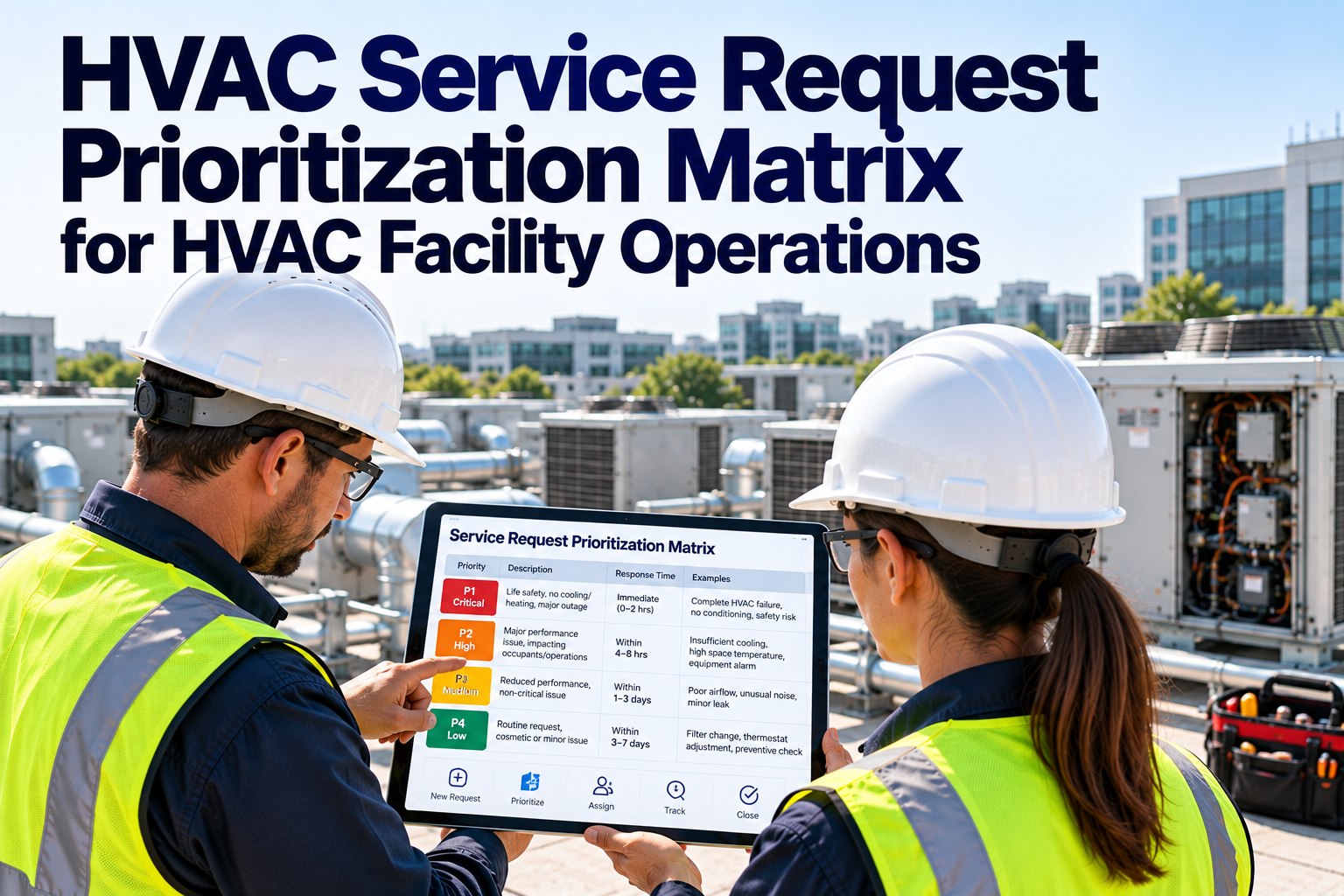
AI dispatch considers technician GPS location, current job estimated completion, skill certification match, truck parts inventory versus diagnosed need, traffic conditions, and customer priority level. It optimises across the entire fleet simultaneously — replacing dispatcher judgement calls that can only optimise one or two variables at a time.
Drone Pre-Inspection
For rooftop units, a quick drone flyover (5-10 minutes) before or concurrent with technician travel captures thermal images of condensers, verifies fan operation, identifies physical damage, and reads unit nameplates for model and serial numbers. The technician arrives with a complete diagnosis already in hand rather than starting from zero on the rooftop.
Robotic Coil Cleaning
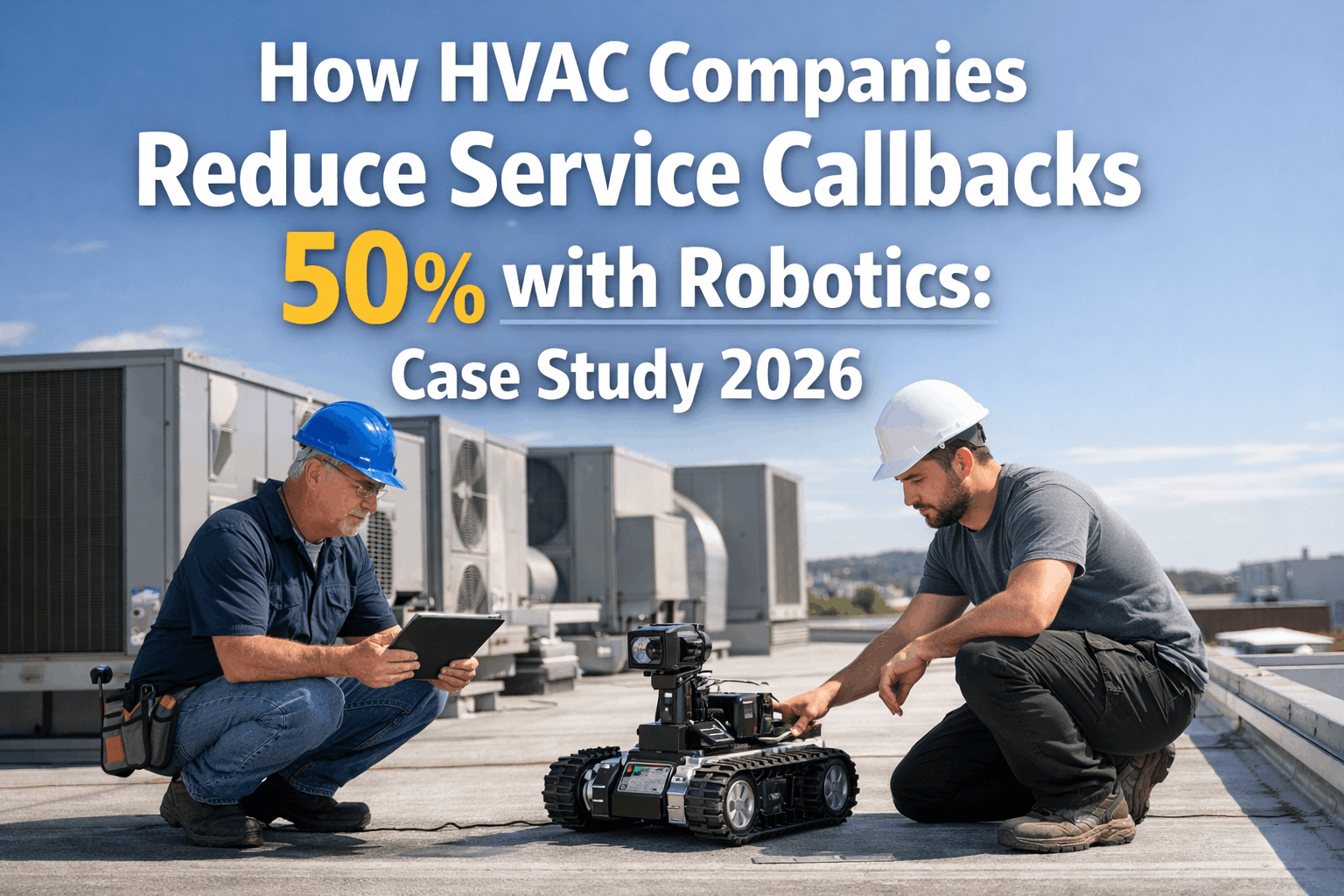
Automated robotic coil cleaning during scheduled PM restores 85-98% of airflow capacity versus 60-75% from manual cleaning. Clean coils prevent the most common summer emergency: "not cooling adequately." Systems integrated with preventive maintenance scheduling ensure coils stay clean year-round, eliminating the gradual degradation that triggers emergency callbacks during peak season.
Combined Impact: The Full Timeline Transformation
When all five technologies work together through Oxmaint, the service call timeline compresses dramatically at every phase:
First-Time Fix Rate: The Hidden Revenue Driver
Every callback costs $150-$400 in truck rolls, labour, and lost opportunity. Technology dramatically improves the metric that connects response time to profitability:
Traditional First-Time Fix Rate
Technician arrives without pre-diagnosis, discovers the problem on-site, and frequently lacks the specific part. Requires a return visit 35-45% of the time — frustrating the customer, wasting a truck roll, and blocking a revenue-generating call slot.
Technology-Enabled First-Time Fix
Remote diagnosis identifies the fault and likely parts before dispatch. AI matches the right technician with the right truck inventory. Drone confirms unit condition. The technician arrives fully prepared to complete the repair in a single visit.
ROI: The Business Case for Speed
Every Minute Faster Is Revenue Earned and Reputation Built.
Oxmaint integrates IoT monitoring, predictive alerts, smart dispatching, and drone findings into one platform that makes every service call faster, smarter, and more profitable.
Frequently Asked Questions
How many units need IoT sensors for meaningful impact?
Start with your top 20-30 commercial accounts. Even 50-100 monitored units create measurable results: 2-4 emergency calls prevented per month, 60-80% of issues auto-detected before complaint, and enough data to begin training predictive models within one cooling season. Sensor cost ($80-300/unit installed) pays for itself with a single prevented emergency call. Scale to 200-500+ units as you prove ROI and offer monitoring as a premium service agreement add-on at $25-$75/unit/month.
Does AI dispatching really beat experienced human dispatchers?
Yes. AI dispatch outperforms human dispatchers by 15-25% on time-to-arrival and 20-30% on first-time fix rate. Not because dispatchers are bad — often they're excellent — but because AI simultaneously optimises across 8-12 variables (location, skills, truck inventory, traffic, complexity, priority, current job completion, fatigue) while humans optimise 2-3 at a time. The best implementations keep dispatchers as supervisors who override AI for situations needing human judgement: VIP customers, safety concerns, or personal circumstances.
What's the realistic deployment timeline?
Month 1-2: Deploy Oxmaint CMMS with mobile app for all technicians. Immediate improvement in work order tracking, dispatch, and customer communication. Month 2-4: Install IoT sensors on top 30-50 units. Auto-alerting begins generating proactive calls. Month 4-6: Add drone to one tech's workflow for pre-inspection. Month 6-12: Enable AI-assisted dispatching, expand sensors to 100-200 units, begin predictive alerting. Most companies see measurable response improvement within 60 days of CMMS deployment alone.
How do customers react to proactive service calls?
Overwhelmingly positive. The call: "Our monitoring detected your Unit 7 compressor current trending 18% above normal — we've scheduled a tech for Thursday before it fails." This positions your company as a technology-forward asset protector. Results: 90-95% renewal rates (vs 70-80% reactive), 20-40% higher repair acceptance, and significantly stronger referrals. Always frame it as customer benefit: "we caught this before it failed and saved you an emergency."
Can a small 5-technician company benefit?
Absolutely — proportionally more, because each tech's time is more valuable when capacity is limited. Start lean: Oxmaint CMMS ($50-150/tech/month), sensors on top 20 accounts ($2-6K total), one budget drone ($4-6K). Total: $8-15K. First-year impact: 1-2 extra calls per tech per day (+$125-300K revenue), 30-40% fewer callbacks ($30-60K saved), 2-4 emergencies prevented monthly ($25-50K saved). That's $180-410K return on $8-15K. Even without drones or sensors, a good CMMS with mobile dispatch typically adds 0.5-1 calls per tech per day.
Minutes Matter. Every Technology That Saves Time Earns Money.
Oxmaint connects detection, diagnosis, dispatch, and documentation into one platform — giving your service company the fastest response times in your market.