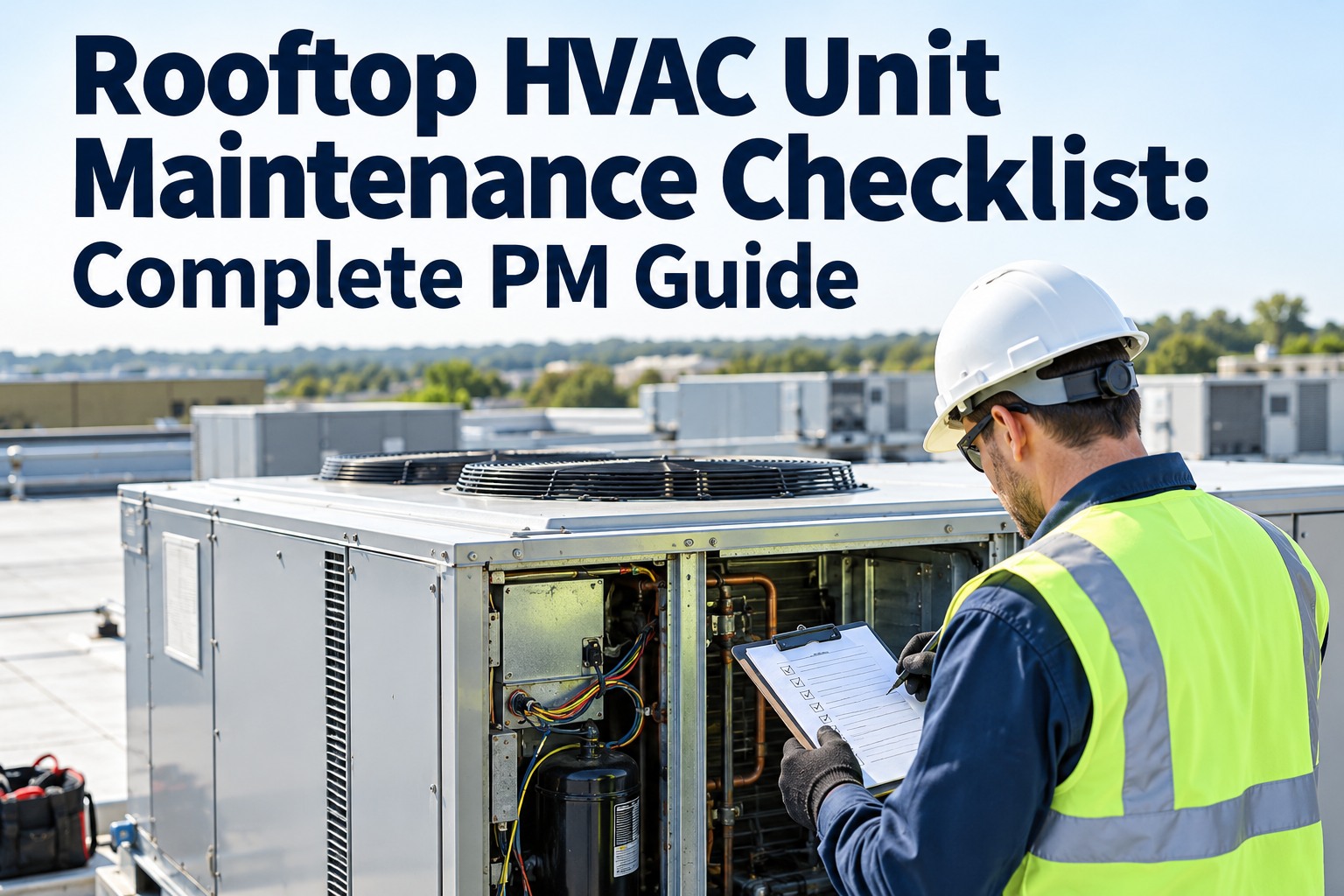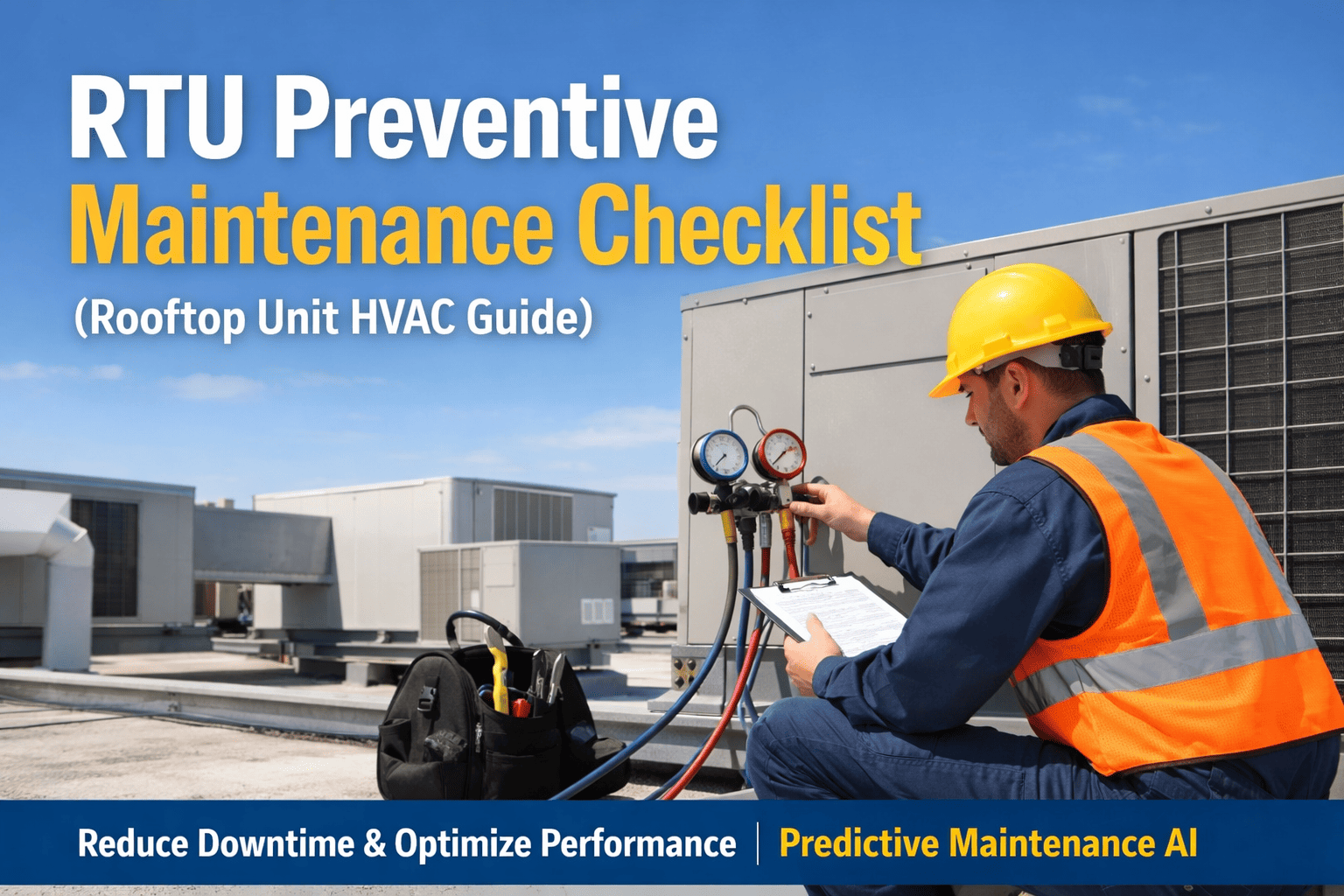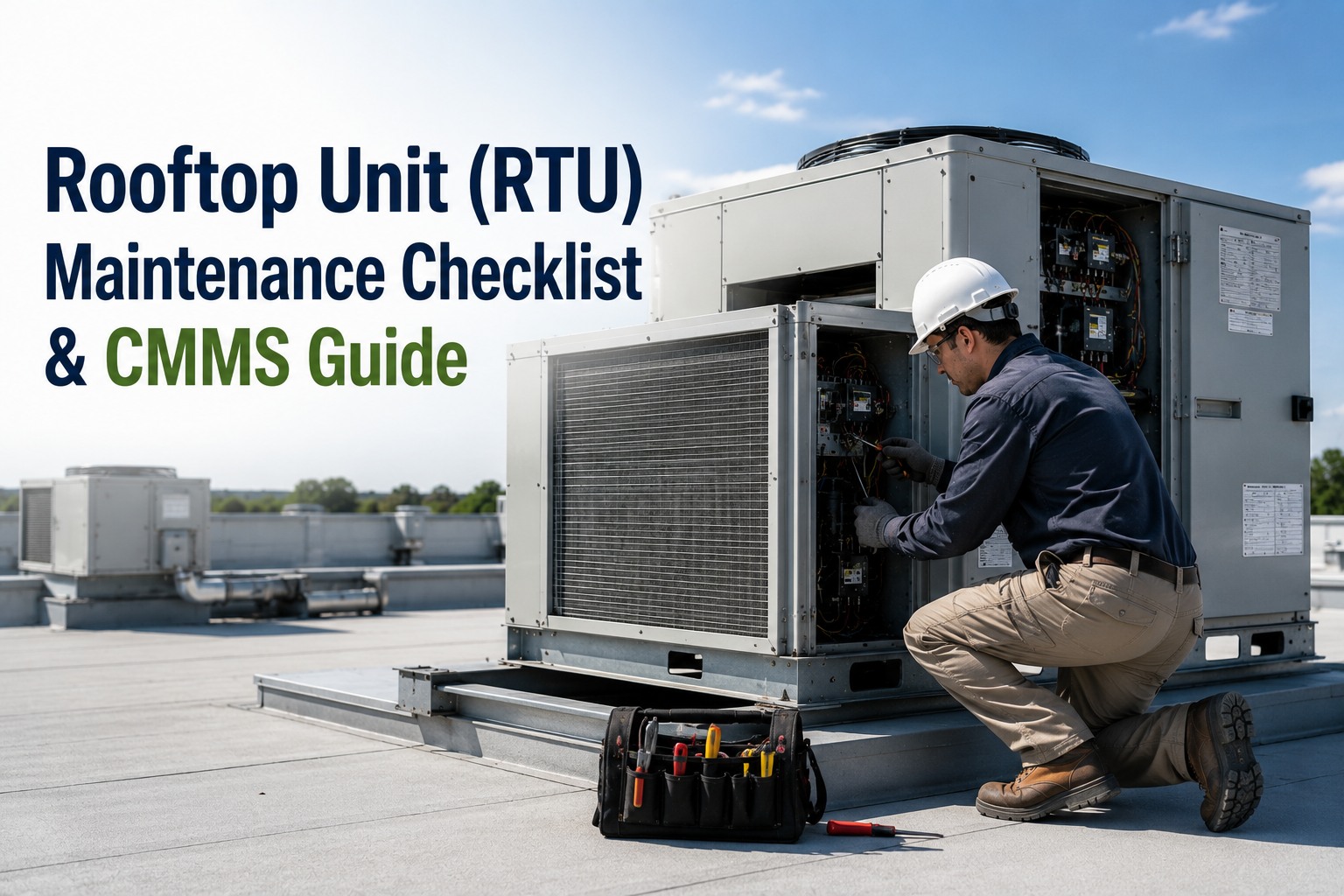
Rooftop units quietly carry 40–60% of a commercial building's cooling load, yet most receive attention only after a complaint ticket arrives. A disciplined RTU preventive maintenance program — condenser coil cleaning, belt tension, refrigerant charge verification, economizer testing — typically cuts annual HVAC energy use by 15–30% and extends equipment life by 5–8 years. This guide pairs a field-tested checklist with a CMMS workflow so facility teams can move from reactive breakdowns to scheduled, documented, audit-ready service. Ready to operationalize it? Start Free Trial and deploy the full RTU PM template in a single afternoon.
Is your rooftop unit costing you 25% more energy than it should?
A single dirty condenser coil raises compressor head pressure 15–30%, shortens compressor life, and inflates summer demand charges. Most teams lose the savings simply because PM tasks live in spreadsheets nobody opens. Convert the checklist below into automated CMMS work orders and recover the gap in one cooling season.
The real cost of skipping RTU PM
Industry benchmark: every $1 spent on preventive maintenance returns $3–5 in avoided energy, repair, and downtime costs across a typical 10–20 ton commercial RTU fleet.
A 180-asset retail portfolio spending $42K/yr on reactive RTU repairs deployed a CMMS-driven quarterly PM cycle (filters, belts, coils, economizers). Within 12 months emergency calls dropped 62%, energy bills fell 19%, and the program paid for itself in 7.4 months — a 161% first-year ROI.
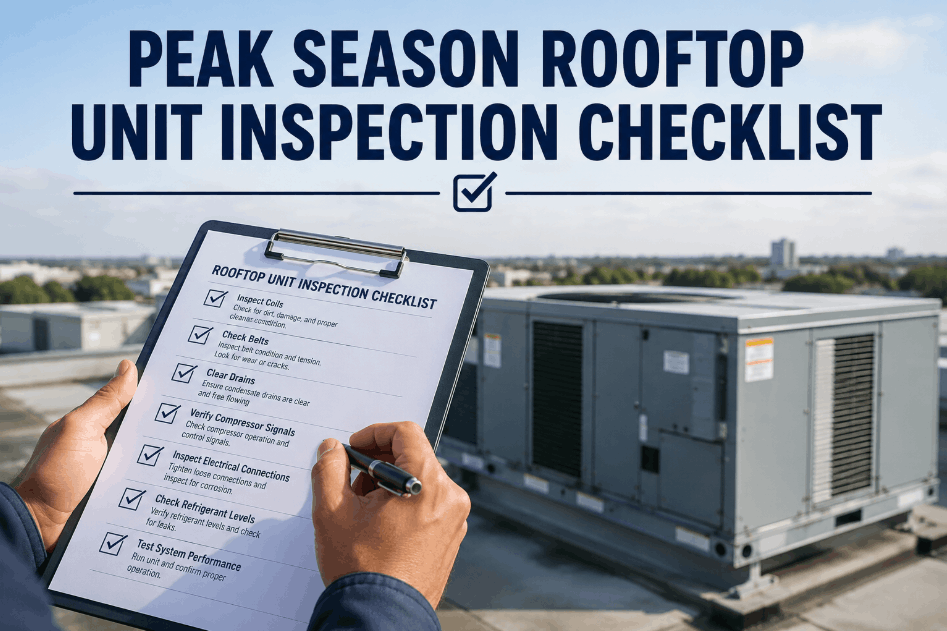
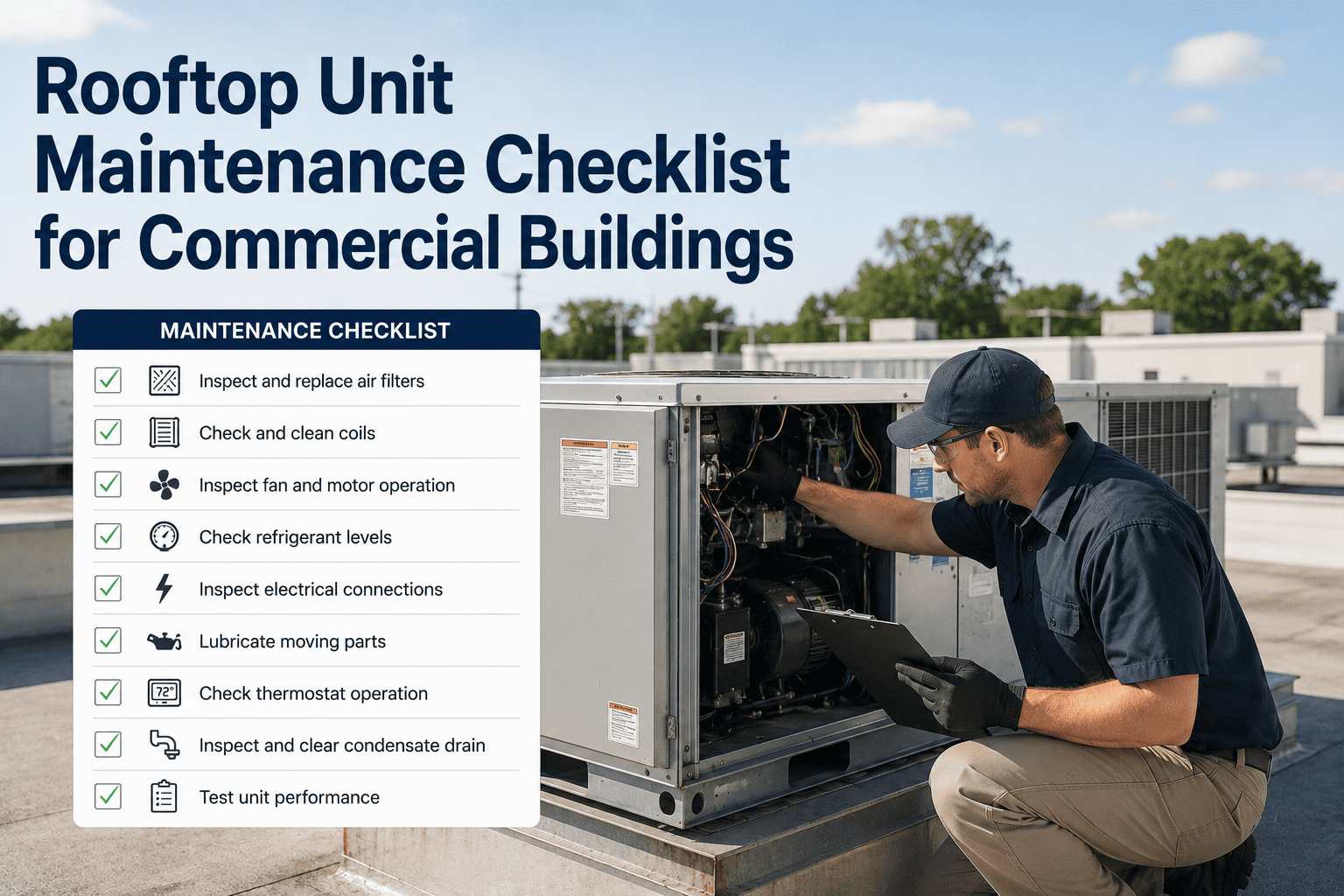
Quarterly RTU inspection checklist by system
Each tier below maps to a CMMS work-order template. Run Tier 1 monthly, Tier 2 quarterly, Tier 3 at cooling-season start and shoulder-season economizer switchover.
- Inspect and replace filters (MERV 8–13) when pressure drop exceeds 0.5 in. w.c.
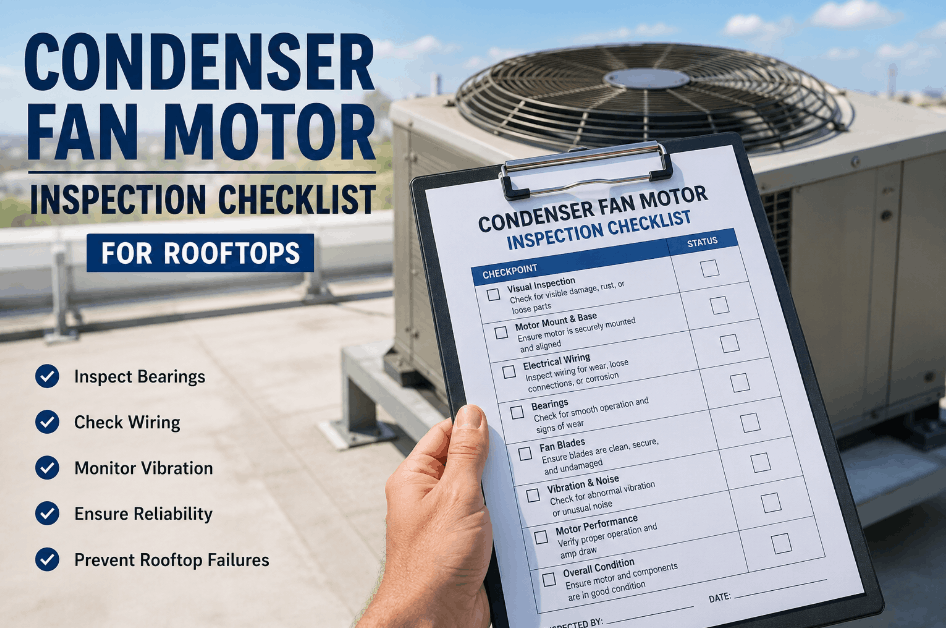
- Visually confirm condenser fan rotation and note unusual noise or vibration
- Drain pan and condensate line — verify clear flow, no standing water
- Log supply and return temperatures; flag a split outside 16–22°F
- Photograph unit nameplate, recent service tags, and any corrosion
- Inspect blower belt for cracks, glazing, tension (deflect 1/2 in. at 10 lb)
- Clean condenser coil — fin comb, low-pressure wash, verify straight fins
- Lubricate motor bearings (if not sealed); check amperage vs. nameplate FLA
- Verify refrigerant subcooling and superheat within manufacturer range
- Test economizer — dry-bulb or enthalpy switch, minimum-position, damper actuator
- Tighten electrical connections; inspect contactor pitting and capacitor bulging
- Full refrigerant charge verification — approach temperature, subcool, superheat
- Economizer functional test with calibrated sensors — free-cooling switchover
- Combustion analysis on gas heat section — CO, stack temp, efficiency curve
- Cabinet integrity — gaskets, hail guards, curb flashing, bird screen
- Calibrate space sensors and BAS points; reconcile against runtime logs
- Update asset record in CMMS — photo, readings, parts, labor hours, next due date
Service cadence at a glance
Frequencies below align with ASHRAE Guideline 32 and typical manufacturer PM charts. Adjust interval length in CMMS based on runtime hours and environmental loading.
| Task | Frequency | Trigger / Threshold | Avg. labor | CMMS work-order type |
|---|---|---|---|---|
| Filter inspection & replacement | Monthly | Pressure drop > 0.5 in. w.c. or visual saturation | 10 min | Recurring PM |
| Condensate drain clear | Monthly | Standing water in pan or algae growth | 10 min | Recurring PM |
| Belt tension & sheave alignment | Quarterly | Deflection outside 1/4–1/2 in. at 10 lb | 20 min | Recurring PM |
| Condenser coil cleaning | Quarterly | Visible debris or approach temp > 30°F | 30 min | Recurring PM |
| Refrigerant charge verification | Seasonal | Subcool/superheat outside mfr. spec | 40 min | Condition-based PM |
| Economizer functional test | Seasonal | Switchover within 5°F of setpoint; free cooling active | 35 min | Condition-based PM |
| Combustion analysis (gas heat) | Annual | CO < 100 ppm; efficiency > 80% | 45 min | Scheduled PM |
From paper checklist to automated work orders
A CMMS converts the static list above into triggered, tracked, and auditable service events. The five-step flow below is how top-quartile facility teams operate.
Asset register & hierarchy
Import every RTU with location, tonnage, serial, install date, and warranty end. Group by building, zone, or criticality to drive dispatch routing.
PM template library
Load Tier 1–3 checklists as reusable templates with parts kits, labor estimates, safety permits, and required readings pre-attached to each task line.
Automated triggers
Schedule by calendar interval, runtime hours, or condition thresholds (BAS feed). Technicians receive mobile work orders with photos, history, and checklists.
Field execution & capture
Technicians complete tasks offline on the roof; readings, parts consumed, photos, and signatures sync automatically when connectivity returns.
Analytics & audit trail
Dashboards flag overdue PMs, repeat failures, and energy drift. Export a defensible service log for ISO 55000, lease, or insurance audits in one click.
Quantifying the payback of a disciplined RTU program
Use the formula below to estimate annual savings per unit. Most facilities land between $600 and $1,400 per RTU when coil cleaning, economizer repair, and charge correction are combined.
$4,200 energy × 0.19 + $1,100 reactive × 0.55 + $1,800 amortization × 0.20 = $938 → rounded $940. Across a 40-unit portfolio: $37,600/yr.
| Intervention | Typical annual savings | One-time cost | Payback | Confidence |
|---|---|---|---|---|
| Condenser coil cleaning (quarterly) | $180–340 / unit | $60–95 | 2–4 months | High |
| Economizer repair & calibration | $220–480 / unit | $150–400 | 6–14 months | High |
| Refrigerant charge correction | $140–310 / unit | $120–280 | 8–16 months | Medium |
| Belt + filter PM (monthly) | $90–180 / unit | $40–80 | 3–6 months | High |
| Controls / BAS sensor recalibration | $160–420 / unit | $200–600 | 10–20 months | Medium |
Turn the checklist into automated, audit-ready work orders
Deploy the full RTU PM template library in OxMaint — drag in your asset list, schedule triggers, and watch overdue PMs disappear from your dashboard.
Rooftop unit maintenance, answered
How often should commercial RTUs be serviced?
Filters and condensate lines need monthly attention; belts, coils, and electrical connections quarterly; refrigerant charge, economizer function, and combustion analysis at seasonal switchover. High-runtime or harsh-environment sites (coastal, dusty, 24/7 operation) should compress intervals by 30–50%. A CMMS auto-triggers each cadence so nothing drifts.
What are the warning signs an RTU needs immediate service?
Watch for a supply-return temperature split outside 16–22°F, ice on the suction line, tripped breakers, unusual compressor noise, rising head pressure, or a runaway gas bill. Any one warrants a Tier 2 visit within 48 hours. Log the symptom in your Start Free Trial workspace and OxMaint auto-creates a prioritized work order with the unit's full service history attached.
How much can RTU preventive maintenance save on energy?
Field studies and DOE data show 15–30% energy savings when coil cleaning, proper refrigerant charge, and functioning economizers are combined. For a 20-ton unit burning $4,200/yr in electricity, that is $630–$1,260 recovered annually — typically paying back the PM cost in under 4 months.
Why use a CMMS for rooftop unit maintenance instead of spreadsheets?
Spreadsheets cannot trigger work orders, capture field readings, attach photos, or surface overdue PMs across dozens of rooftops. A CMMS centralizes asset records, automates scheduling by runtime or calendar, and produces an audit trail aligned with ISO 55000 and lease compliance requirements. It also turns reactive callouts into data — repeat failures trend visibly within weeks.
Can a CMMS help with economizer testing and compliance?
Yes. OxMaint stores the economizer test procedure as a templated checklist with required sensor readings, dry-bulb/enthalpy switchover points, and damper-actuator verification steps. Completed tests attach photos and readings to the asset record, making seasonal commissioning and any code-compliance audit defensible. To see the template in action, Book a Demo with the team.
Stop reacting to rooftop failures — start preventing them
Import your RTU fleet, attach the PM templates from this guide, and dispatch your first scheduled work order the same day. Your compressor warranty — and your summer demand charges — will thank you.
Free 14-day trial · No credit card