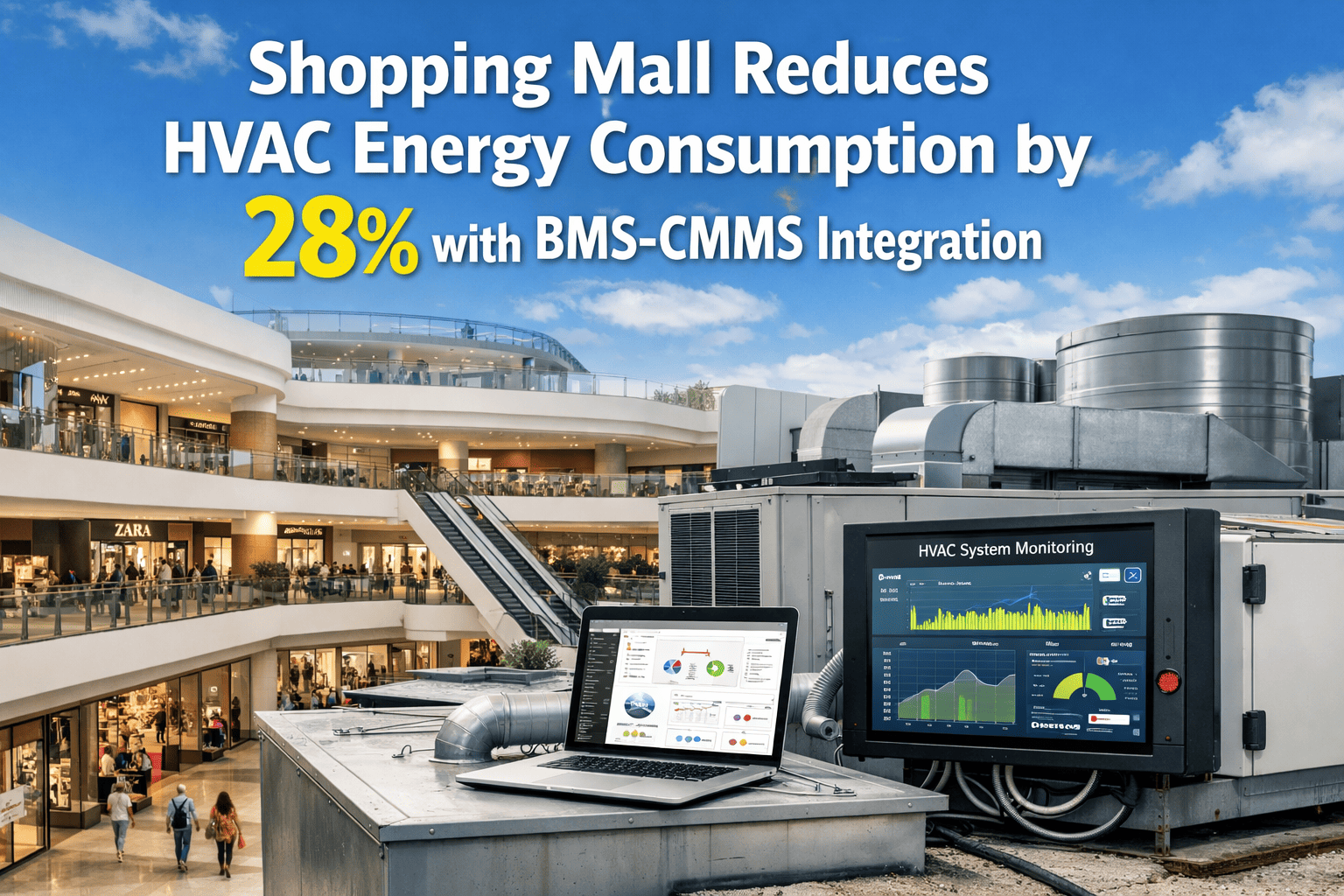
When a 1.2 million sq ft regional shopping mall across three anchor departments and 210 retail tenants began investigating why its energy bills kept rising despite no expansion in trading hours, the answer was not the equipment — it was the gap between what the Building Management System could see and what the maintenance team was actually doing about it. HVAC represented 58% of total electricity consumption. Coil fouling, setpoint drift, and unacknowledged BMS fault alerts were compounding silently across 47 air handling units. After integrating Oxmaint's CMMS with the existing BMS via OPC-UA, the mall eliminated that gap entirely — and cut HVAC energy consumption by 28% in under 12 months. Book a demo to see how BMS-CMMS integration works for your facility.
Facility Profile
Facility Type
Regional Shopping Mall — 3 anchor tenants, 210 retail units, 4 food courts
GLA
1.2 million sq ft across 3 levels
HVAC Infrastructure
47 AHUs, 6 chiller sets, 220 VAV boxes, central BMS (BACnet)
Pre-Integration Annual Energy Cost
$2.84M (HVAC); $4.9M total utility
Previous Maintenance Model
Reactive + fixed-schedule PM; BMS alarms triaged manually
Oxmaint Deployment
BMS-CMMS integration via OPC-UA; IoT sensor overlay on 47 AHUs
28%
HVAC energy reduction in 12 months
$794K
Annual energy savings recovered
47
AHUs on condition-based maintenance
91 sec
Avg BMS fault to work order — down from 3.4 days
The Problem
Why a Fully Monitored BMS Was Still Wasting $794,000 a Year
01
BMS Data With No Action Path
The BMS generated 1,200+ fault events per month across 47 AHUs and 6 chiller sets. A single building operator triaged all alarms manually via radio to technicians. Average time from BMS fault detection to maintenance action: 3.4 days. By the time fouling alerts were actioned, compressors had already been operating against degraded coils for weeks.
02
Calendar-Based Coil Cleaning Ignoring Actual Fouling
All 47 AHUs were serviced on identical 90-day coil cleaning cycles regardless of actual fouling levels. High-traffic zones (food courts, main entrance atrium) fouled 3× faster than anchor tenant back-of-house areas. Result: over-servicing in low-fouling zones, chronic under-servicing in high-fouling zones — and continuous compressor overwork in the areas that mattered most.
03
Setpoint Drift Across 210 Tenant Zones
Tenant coordinators had independently adjusted zone setpoints over three years of operation. Audit at integration revealed 34 tenant zones cooling 3–5°C below design intent — continuous chiller overcooling representing an estimated 9% of total HVAC consumption. No systematic review had ever compared BMS setpoint data against energy metering data.
The Solution
How BMS-CMMS Integration Closed Every Gap
01
BMS Connected to Oxmaint via OPC-UA
All 47 AHUs, 6 chiller sets, and 220 VAV boxes mapped into Oxmaint as individual asset records. BMS fault codes linked to pre-configured work order templates — high-priority faults generate emergency work orders in under 90 seconds, automatically assigned to the on-call trade.
02
IoT Sensor Overlay — Coil Delta-T Monitoring
Temperature differential sensors installed across all 47 AHU coils. Oxmaint tracks delta-T degradation curves per AHU in real time. Coil cleaning work orders trigger on actual fouling threshold — not calendar date. High-traffic zones now trigger at 3–4 week intervals; back-of-house zones at 12+ weeks.
03
Setpoint Drift Detection and Automated Alerts
Oxmaint correlates BMS zone setpoints against energy sub-meter data every 15 minutes. Any zone drifting more than 1.5°C from design intent generates a Facilities Manager alert with the deviation magnitude and estimated daily energy cost attached.
04
Energy KPI Dashboard — Live and Historical
Facility Director, Tenant Relations Manager, and Operations team all access the same Oxmaint energy dashboard showing kWh per zone, fault frequency per AHU, coil cleaning cycle performance, and chiller COP trends. Weekly automated energy report sent to mall management.
See How Oxmaint BMS Integration Works for Your Facility
Connect your Building Management System to Oxmaint in under 48 hours via OPC-UA or BACnet. Every BMS fault becomes an auto-assigned work order. Every coil becomes condition-monitored. Every energy anomaly becomes a documented corrective action.
Results in Detail
What Changed — Before and After Integration
The Five Waste Streams Found
What the BMS-CMMS Integration Detected — and When
Week 2
Chiller Set 3 — Condenser Fouling Running 8 Weeks Undetected
Oxmaint cross-correlated condenser approach temperature against ambient wet bulb. COP had degraded from 4.2 to 3.4 over 8 weeks — a 19% efficiency loss that BMS alarms had not flagged because no threshold had been configured for gradual degradation. Corrective cleaning recovered full COP within 4 days.
Energy recovered: ~$38,000/yr
Week 5
34 Tenant Zones — Setpoint Drift Mapped and Corrected
Systematic setpoint audit triggered by Oxmaint energy variance alerts. Facilities team conducted zone-by-zone BMS correction across affected tenants. Energy sub-meters confirmed 9.2% reduction in chiller runtime within 3 weeks of corrections.
Energy recovered: ~$262,000/yr
Week 9
AHU-12 Food Court — VFD Running at Fixed Speed Despite Demand Drop
BMS-CMMS integration identified AHU-12 VFD operating at 85% fixed speed during off-peak trading hours when food court occupancy dropped below 20%. Oxmaint generated a configuration work order. VFD reprogrammed to demand-based scheduling — average 3.1 hrs/day at reduced speed.
Energy recovered: ~$29,000/yr
Week 14
Overnight HVAC Runtime — 11 Zones Running 4+ Hours Past Close
Oxmaint energy dashboard flagged 11 zones with BMS schedules that had not been updated when trading hours changed. HVAC was running 4–6 hours per night in empty tenancies. Oxmaint work order issued to BMS operator; schedules corrected in a single day.
Energy recovered: ~$71,000/yr
Expert Review
What Facilities Directors Say About BMS-CMMS Integration
"The BMS had been telling us there were problems for years. We just had no structured pathway from the alarm to the work order to the technician to the documentation. The first month of Oxmaint integration surfaced more actionable energy findings than three years of quarterly energy audits. The setpoint drift finding alone paid for the system in the first quarter."
General Manager, Facilities & Operations
1.2M sq ft Regional Mall — Southeast Asia
"Condition-based coil cleaning sounds simple but the operational reality is transformative. Our food court AHUs used to fail mid-trading because 90-day cycles were simply not frequent enough for the environment. Now they are cleaned when delta-T tells us they need it. We have not had a food court HVAC failure during trading hours since deployment. That alone justifies the integration cost many times over."
Chief Engineer
Retail Mall Operator — 4 Properties, Asia Pacific
Frequently Asked Questions
BMS-CMMS Integration for Retail & Mall HVAC — Common Questions
How long does BMS-CMMS integration take to deploy in a shopping mall environment?
For a facility with an existing BACnet or OPC-UA compatible BMS, Oxmaint integration is typically operational within 48–72 hours. Fault code mapping to work order templates takes an additional 3–5 days depending on the number of equipment classes. Full condition-based PM trigger configuration across all AHUs and chillers is typically complete within 2 weeks.
Book a demo to walk through the integration path for your specific BMS platform.
What BMS platforms is Oxmaint compatible with for HVAC data integration?
Oxmaint connects to BMS platforms via OPC-UA, BACnet/IP, BACnet MSTP, and Modbus TCP/RTU protocols — covering the majority of commercial BMS installations including Siemens Desigo, Johnson Controls Metasys, Schneider EcoStruxure, Honeywell Niagara, and Trend. For proprietary systems, Oxmaint's integration team configures a custom data connector.
Start a free trial to verify compatibility with your current BMS infrastructure.
How does condition-based coil cleaning differ from fixed-schedule PM — and why does it save energy?
Fixed-schedule PM cleans coils every 60 or 90 days regardless of actual fouling. In practice, high-traffic zones foul 3–4× faster than low-traffic areas. Condition-based cleaning uses temperature differential (delta-T) sensor data to trigger coil cleaning precisely when fouling reaches a threshold that measurably degrades compressor efficiency — neither too early nor too late. The result is lower compressor energy consumption, fewer unnecessary labor deployments, and elimination of the failure events that occur when fixed cycles miss actual fouling.
Book a demo to see how Oxmaint configures delta-T thresholds for your AHU fleet.
What is the typical ROI timeline for BMS-CMMS integration in a large retail facility?
Based on this case study and comparable deployments, facilities with pre-existing BMS infrastructure typically recover integration costs within 3–6 months through energy savings alone. Labor savings from optimized PM scheduling and reduced emergency response add further ROI within the first year. In this mall's case, the setpoint drift correction and overnight runtime finding combined recovered over $330,000 in energy cost within the first 4 months.
Start a free trial to model ROI projections for your facility's HVAC energy profile.
Your BMS Is Already Detecting Problems. Oxmaint Makes Sure Someone Acts on Them.
Connect your existing BMS to Oxmaint and turn every fault alert into an auto-assigned work order — with condition-based PM triggers, energy KPI dashboards, and a full audit trail. No manual hand-offs. No unacknowledged alerts. No wasted energy.