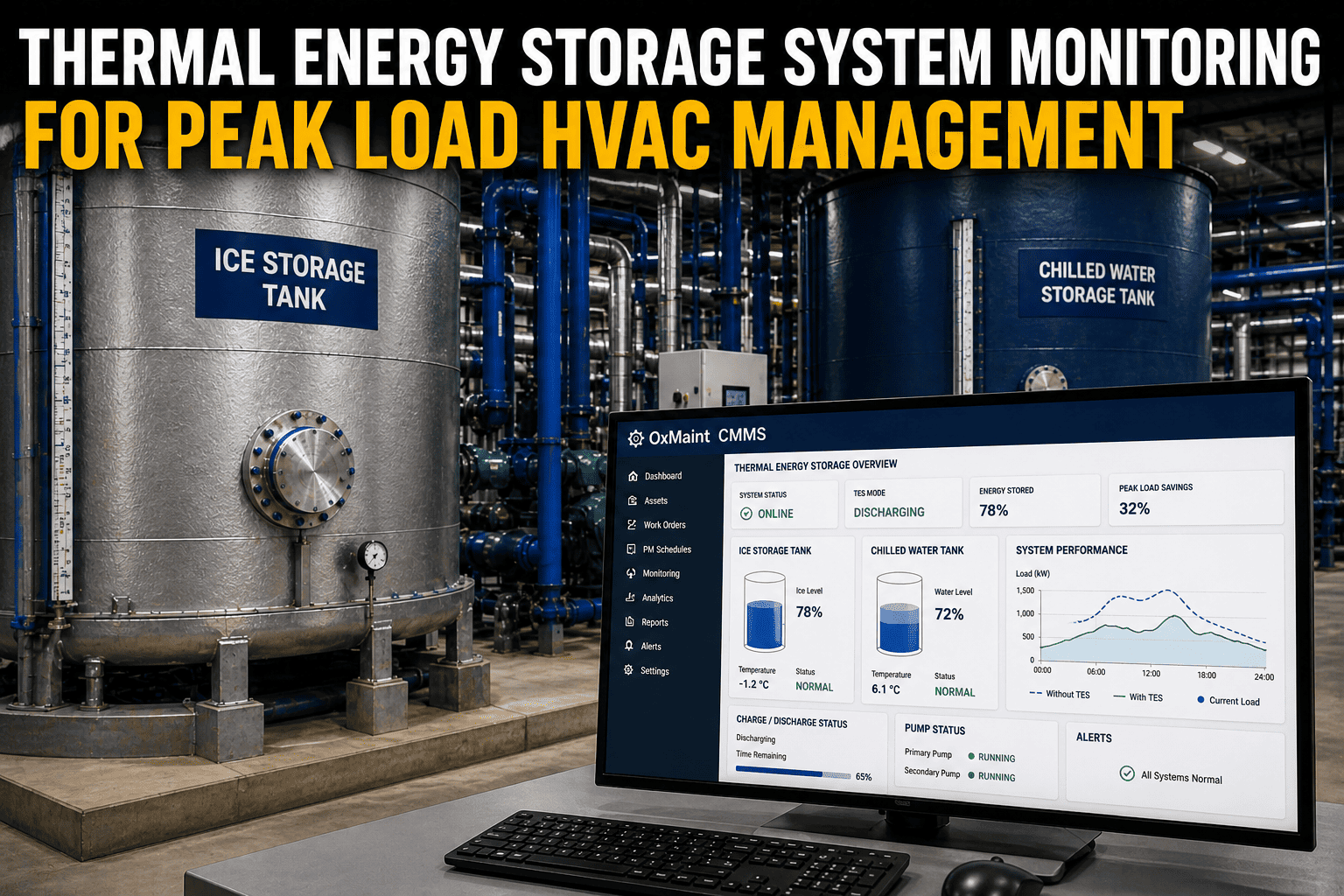
Thermal storage tank inspection is usually scheduled around equipment downtime rather than the demand cycle the tank actually exists to serve — which means insulation gaps, valve sequencing drift, and sensor calibration errors often go unnoticed until the first heat wave of the season exposes a capacity shortfall the facility was counting on. A thermal storage tank that charges correctly in March can behave very differently once ambient conditions, chiller loading, and discharge frequency all shift at once heading into peak demand. The pattern is consistent: insulation checked on a generic annual cycle instead of before the season that matters, valve sequencing logic left unverified against current utility rate schedules, and stratification behavior assumed rather than tested. Sign Up Free on Oxmaint to give facility and energy teams a single record of tank condition, valve sequencing, sensor calibration history, and water treatment data tied to each thermal storage asset — so pre-peak readiness is confirmed with documentation instead of assumption. Book a Demo to see how Oxmaint links inspection findings to automated work orders and seasonal PM scheduling, so the tank that is supposed to absorb peak cooling load is verified ready before the utility's demand charges start applying. Use this checklist in the weeks before your facility's historical peak demand window begins.
1. Tank Insulation & Envelope Integrity
Insulation performance directly determines how much stored capacity survives between charge and discharge cycles. Confirm the tank envelope is inspected for moisture and structural issues before the season when standby losses matter most.
2. Valve Position & Charge/Discharge Sequencing Verification
A thermal storage tank only delivers its intended utility savings if charge and discharge sequencing matches current rate schedules and chiller staging logic. Confirm valve operation and control sequencing before relying on the tank for peak shaving.
3. Sensor Calibration & Stratification Monitoring
Thermal storage performance depends on clean stratification between charged and return water. Confirm temperature sensors at each tank elevation are calibrated and that stratification behavior is verified through an actual test cycle, not assumed from design specifications.
4. Structural & Water Quality Inspection
Water condition inside the tank affects heat transfer efficiency, diffuser performance, and long-term internal corrosion risk. Confirm water quality and internal hardware condition are verified alongside the structural inspection, not treated as a separate program.
5. Pre-Peak Readiness Review & Documentation Cadence
A thermal storage tank inspection only protects peak demand performance if it happens on a schedule tied to the demand cycle itself and the results are reviewed before that window opens. Confirm readiness review has an owner, a deadline, and a documented outcome.