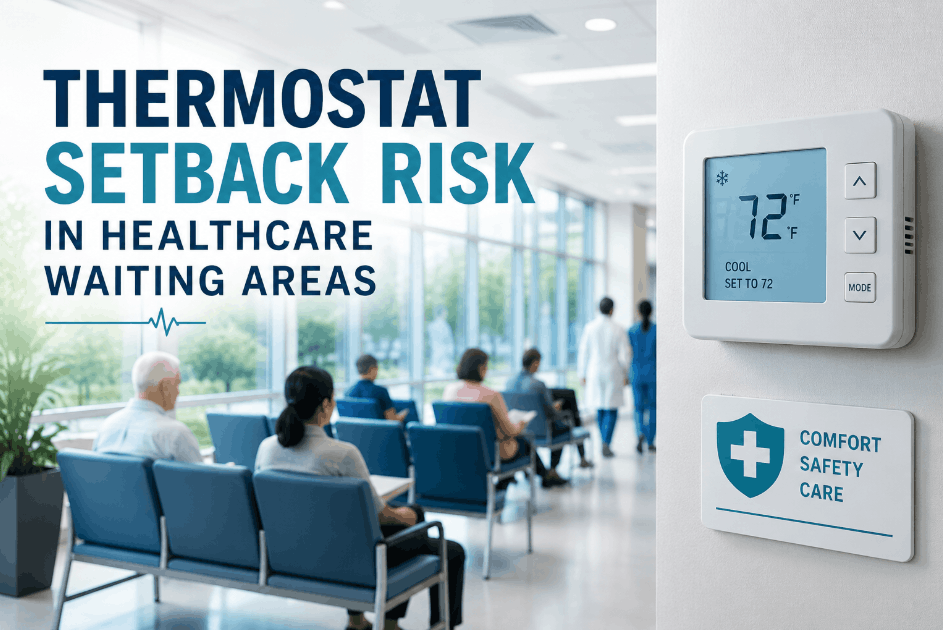
Thermostat setback strategies that work well in office buildings can create serious comfort and safety risks when applied to healthcare waiting areas. Unlike a commercial office where an unoccupied setback of several degrees has minimal consequence, a hospital or clinic waiting area may serve patients with chronic illness, elderly visitors, or individuals whose medication affects thermal regulation — making temperature swings a genuine patient experience and safety concern. Facilities that Sign Up Free on Oxmaint can manage HVAC setpoint policy work orders, document control sequence changes, and maintain the maintenance records needed to demonstrate that temperature management in patient-facing spaces meets operational standards. For healthcare facility managers building a defensible HVAC setback policy for waiting areas, Book a Demo to see how Oxmaint supports controlled setpoint management and maintenance compliance tracking.
Oxmaint helps healthcare facility teams document setpoint policies, schedule HVAC compliance reviews, and maintain the audit trail that patient-facing space temperature management requires.
6 Thermostat Setback Risks in Healthcare Waiting Areas That Require Policy Limits and Maintenance Controls
Healthcare waiting areas are not equivalent to general commercial spaces for HVAC setback purposes. Each risk below represents a patient, visitor, or regulatory consequence that unmanaged setback strategies can generate. Facilities that Sign Up Free on Oxmaint can link HVAC setpoint policy reviews to maintenance schedules — creating a documented management approach for every patient-facing zone.
Patients with cardiovascular conditions, diabetes, or autoimmune disorders are disproportionately sensitive to temperature fluctuation. Deep setbacks that cause 5–8°F swings during recovery create physiological stress that standard setback policies do not account for.
Many medications prescribed for conditions common in waiting room patients — antipsychotics, beta-blockers, diuretics — impair the body's ability to regulate temperature in response to environmental changes, amplifying the impact of setback-driven swings.
Healthcare facilities often receive patients at first appointment times immediately after night setback periods. If HVAC systems cannot recover to comfort temperature before occupancy, patients arrive into a space that remains at or near setback conditions.
Children and elderly individuals visiting healthcare facilities alongside patients have lower thermal tolerance ranges and less physiological reserve — making even moderate temperature deviations from comfort setpoints more impactful than in general commercial occupancy.
Healthcare facility accreditation standards and local health codes specify temperature ranges for patient-occupied spaces. Setback programmes that push temperatures outside these ranges — even briefly — create compliance exposure that standard commercial HVAC management does not consider.
HVAC comfort complaints in healthcare waiting areas affect patient experience scores — a measured outcome in many accreditation and funding frameworks. Temperature-related complaints in waiting areas are consistently among the most reported in patient satisfaction surveys.
Healthcare Waiting Area Thermostat Setback Limits: Zone Type, Recommended Policy, and Maintenance Controls
Each waiting area zone type in a healthcare facility carries different setback tolerance based on patient population, space function, and regulatory context. Use this reference to evaluate whether your current setback policies are appropriate for patient-facing spaces. Teams seeking a maintenance management platform to document and enforce HVAC policy controls are encouraged to Book a Demo to see Oxmaint in action.
| Waiting Area Zone | Occupant Risk Profile | Recommended Setback Limit | Recovery Time Requirement | Compliance Priority |
|---|---|---|---|---|
| General Outpatient Waiting | Mixed — includes elderly and chronic illness | No more than 2–3°F below occupied setpoint | Full recovery 45 min pre-occupancy | High |
| Emergency Department Waiting | High — acute illness, all ages | No setback — maintain occupied setpoint 24/7 | Continuous — no setback applicable | Critical |
| Paediatric Clinic Waiting | High — infants and young children | Setback not recommended — narrow temp band | Pre-occupancy temp maintained at all times | Critical |
| Oncology Waiting | Very high — immunocompromised patients | No setback — strict setpoint maintenance required | Continuous monitoring required | Critical |
| Specialist Outpatient Waiting | Moderate — mixed adult population | 3°F maximum setback — weekend only | 60 min pre-occupancy recovery required | Medium |
| Administrative / Non-Patient Waiting | Low — staff and general public only | Standard commercial setback acceptable | Standard pre-occupancy recovery | Standard |
How Oxmaint Helps Healthcare Facilities Manage HVAC Setpoint Policy Compliance in Patient-Facing Zones
Healthcare HVAC management is not only about energy efficiency — it is about patient safety, regulatory compliance, and documented control. Oxmaint gives healthcare facility teams a CMMS platform to record setpoint policies, schedule compliance reviews, and maintain the maintenance documentation that demonstrates responsible temperature management across patient-occupied spaces. Facilities can Sign Up Free and configure HVAC compliance review work orders for every patient-facing zone in their asset register.
- Patient-facing zone HVAC assets registered with setpoint policy parameters in Oxmaint
- Quarterly HVAC setpoint compliance review work orders auto-scheduled per zone
- Technician checklists verify BAS setpoint settings against approved policy limits
- Deviation findings generate immediate corrective action work orders with clinical notification
- Setpoint change history documented in the zone asset record for regulatory review
- Portfolio dashboard shows compliance review status across all patient-facing zones
Operational Value of Managed Thermostat Setback Policies in Healthcare Waiting Areas
Healthcare facility teams register patient-facing zone assets and configure setpoint compliance review PM schedules in Oxmaint — most facilities complete initial configuration within one to two weeks.
Documented setpoint limits and scheduled compliance reviews prevent the undetected setback exceedances that generate patient satisfaction complaints — protecting scores that affect accreditation and funding outcomes.
Timestamped setpoint review records, deviation findings, and corrective action documentation in Oxmaint provide ready-made evidence packages for accreditation body inspections of patient environment controls.
Healthcare temperature code compliance requires proof of monitoring and corrective response. Oxmaint's asset-linked work order history creates the regulatory audit trail that manual logbooks cannot consistently maintain.
Defined and documented setback limits — even modest ones — still deliver measurable HVAC energy savings in administrative and low-risk zones while protecting patient-facing areas from inappropriate setback application.
Healthcare networks operating across multiple facilities gain portfolio-wide setpoint policy consistency through Oxmaint — ensuring every site applies the same patient-protective temperature management standards.
Oxmaint gives healthcare facility teams the compliance scheduling, asset documentation, and audit trail tools to manage thermostat setback policy across every patient-facing zone.
Thermostat Setback Risk in Healthcare Waiting Areas — Questions Facility Teams Ask
Healthcare waiting areas serve patients with chronic illness, medication-related thermoregulation impairment, and age-related thermal sensitivity — making temperature swings that would be acceptable in commercial settings a genuine patient comfort and safety concern.
A maximum setback of 2–3°F below occupied setpoint, with full temperature recovery at least 45 minutes before first appointment times, is a conservative and defensible approach for general outpatient waiting zones.
Emergency department waiting areas, paediatric clinic waiting rooms, and oncology patient areas should maintain occupied setpoints continuously — these zones serve patient populations where any thermal instability carries disproportionate risk.
Oxmaint stores approved setpoint limits per zone in the asset record and schedules regular compliance review work orders — creating a timestamped documentation trail of what was checked, what was found, and what corrective actions were taken.
Yes. Oxmaint manages zone assets, setpoint policies, and compliance PM schedules across multiple healthcare facilities from a single platform — giving network facility managers consistent policy enforcement and portfolio-wide compliance visibility.
Oxmaint gives healthcare facility teams the zone asset documentation, compliance scheduling, and audit trail tools to manage thermostat setback policies safely across every patient-facing space in your network.